
BlackBerry Stock Up 125%: Why BB and BBX Are Not the Same

 Prefer us on Google
BlackBerry stock closed near $8.89 on 16 August 2026, after trading between $8.79 and $9.09 that session. That's roughly a 125% gain year-to-date as of 4 August 2026, against 9.5% for the S&P 500 over the same stretch — one of the better large-cap software recoveries of the year, from a company most people still associate with a keyboard phone that stopped mattering in 2013.
The rally is real and it has an identifiable cause. But before you act on it, there is a naming problem worth two minutes of your attention: the ticker "BB" refers to two completely different assets depending on which venue you are looking at, and confusing them is an expensive mistake that no quote page will warn you about.
BlackBerry stock price today and the 2026 move in numbers
Here is where BlackBerry sits as of mid-August 2026.
| Metric | Value | As of |
|---|---|---|
| Share price (NYSE: BB) | ~$8.89 | 16 Aug 2026 close |
| Session range | $8.79 – $9.09 | 16 Aug 2026 |
| 52-week range | $3.12 – $13.59 | Aug 2026 |
| Market capitalisation | ~$5.2B | Aug 2026 |
| Shares outstanding | ~586.1M | Aug 2026 |
| Year-to-date return | +124.8% | 4 Aug 2026 (Zacks) |
| Analyst consensus | Hold | 8 analysts, S&P Global |
| Average 12-month target | $9.71 (range $5.20 – $13.00) | Aug 2026, S&P Global |
| Next earnings | 24 September 2026 | Q2 FY2027 |
Two numbers in that table deserve more weight than the rest. The 52-week range of $3.12 to $13.59 means the stock has traded across a 4.4x band in twelve months — this is a small-cap-volatility profile attached to a mid-cap balance sheet. And the current $8.89 sits about 35% below the 52-week high, meaning the crowd that bought the top is already underwater. That is the honest framing the forecast sites skip.
The analyst spread tells the same story from another direction. An average target of $9.71 against a low of $5.20 and a high of $13.00 is not a consensus; it is a disagreement. The sell side does not know what this business is worth either.
Why BlackBerry stock is up: QNX royalty backlog, not nostalgia
The move is not a meme. It traces to one line item.
BlackBerry reported Q1 fiscal 2027 results on 25 June 2026, covering the quarter ended 31 May 2026:
| Line item | Q1 FY2027 | Change YoY |
|---|---|---|
| Total revenue | $152.9M | +26% |
| QNX (embedded/automotive) | $72.3M | +26% |
| Secure Communications | $73.6M | +24% |
| Adjusted EBITDA | $36M (24% margin) | +144% |
| GAAP operating income | ~$15M | Up YoY |
| Operating cash flow | +$5M | First positive Q1 in nine years |
| EPS | $0.04 | Beat $0.03 estimate |
Management then raised full-year FY2027 guidance to $594M–$621M in revenue and $119M–$139M in adjusted EBITDA, with QNX alone guided to $295M–$312M.
The number that makes that guide credible is one BlackBerry disclosed at the FY2026 close: a record $950 million QNX royalty backlog — more than double the rate at which the segment currently recognises royalty revenue. Backlog is not revenue, and design wins can slip when automakers delay programmes. But it is contracted future work sitting in vehicles that have already been designed around QNX, which is a very different quality of visibility than a software company guiding off pipeline.
The better reading of BlackBerry in 2026: it is an embedded-OS royalty business with a secure-messaging business bolted on, and the market spent the first half of the year re-rating it from "declining legacy" to "slow-compounding infrastructure." Whether that re-rating went too far is the open question — at ~$5.2B market cap against FY2027 guidance midpoint of roughly $607M, the stock trades near 8.6x forward sales, which is a growth multiple on a business guiding to high-single-digit to low-teens revenue growth.
"BB" is two tickers: BlackBerry stock vs BounceBit crypto
This is the part no quote page tells you.
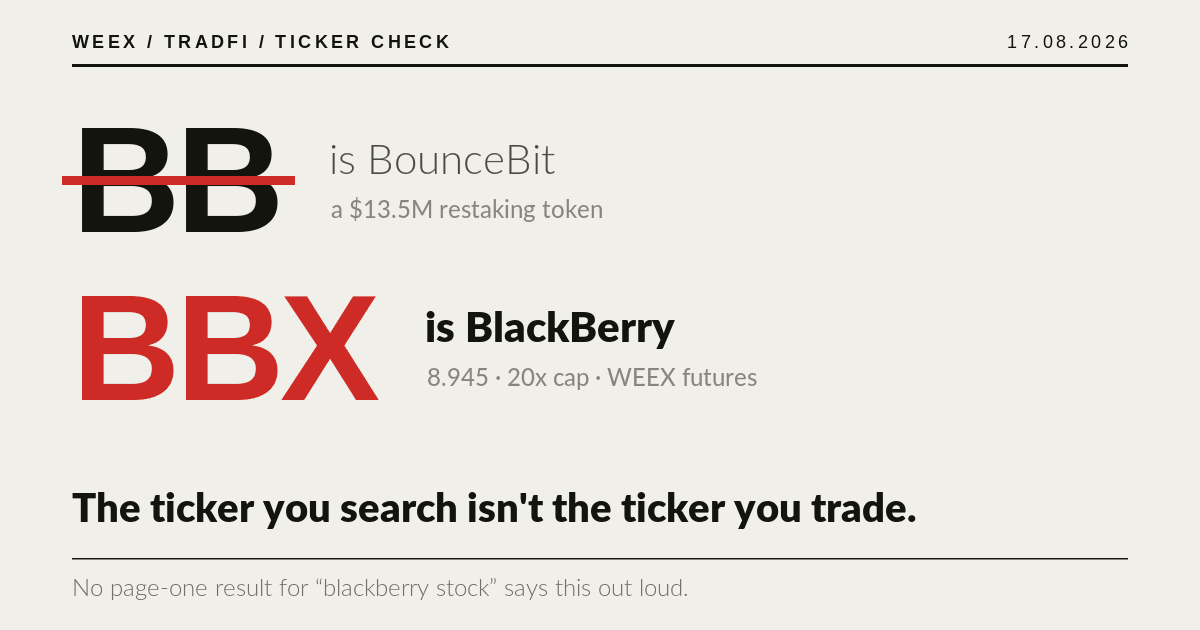
Search "BB" on a crypto exchange and you will not get BlackBerry. You will get BounceBit, a BTC restaking chain whose token launched on 13 May 2024. On WEEX, BounceBit's BB token was priced at $0.010880 with $6.61M of 24-hour volume and a $13.53M market cap, ranked 768, as of 17 August 2026 03:35 UTC.
BlackBerry's stock exposure on WEEX trades under a different symbol entirely: BBX.
| BlackBerry (NYSE: BB) | BBX perpetual (WEEX) | BounceBit (BB token) | |
|---|---|---|---|
| What it is | Equity in a software company | USDT-margined perpetual tracking BB | Crypto token, BTC restaking chain |
| Price | ~$8.89 (16 Aug 2026 close) | 8.945 (17 Aug 2026) | $0.010880 (17 Aug 2026) |
| Market cap | ~$5.2B | n/a (derivative) | $13.53M |
| Max leverage | Broker margin rules | 20× | 75× |
| Ownership rights | Yes | No | Token utility only |
| Trading hours | NYSE session hours | 24/7 | 24/7 |
| Funding cost | None | Yes, periodic funding | Yes, periodic funding |
The gap between "$5.2 billion Canadian software company" and "$13.5 million restaking token" is about 380x. They share two letters and nothing else. If you are searching for BlackBerry exposure and the venue shows you BB/USDT, you are on the wrong pair — the one you want is BBX.
That collision is not an accident on WEEX's part. BounceBit's BB listed in May 2024; the ticker was taken. Tokenised and synthetic stock products routinely append a suffix for exactly this reason — WEEX lists Apple spot exposure as AAPLX and Alphabet as GOOGLX on the same logic.
-- Price
How to trade BlackBerry stock with USDT on WEEX
BlackBerry sits inside WEEX's TradFi product line, which lets you take positions in stocks, gold, silver and oil using USDT margin from your existing account — no brokerage application, no bank wire, no waiting for the New York open.
The relevant instrument is the BBX/USDT perpetual, which quoted 8.945 on 17 August 2026 against BlackBerry's $8.89 NYSE close the prior session — a premium of roughly 0.6%. That small gap is the thing to watch. A stock perpetual is not the stock; it is a contract that tracks the stock, and outside cash-market hours the perp price is set by crypto traders' positioning rather than by equity flow. Over a weekend, that basis can widen meaningfully.
Note the leverage tier carefully, because it is not uniform across the WEEX TradFi lineup:
| Instrument | Max leverage | Note |
|---|---|---|
| BBX (BlackBerry) perpetual | 20× | Lower cap — thinner book |
| NVDA, TSLA perpetuals | 100× | Marquee large-cap names |
| Tokenised stocks (spot) | up to 100× | Per WEEX TradFi FAQ |
| XAUT / XAG (gold, silver) | up to 400× | Deepest TradFi books |
| BB (BounceBit) perpetual | 75× | Crypto token — different asset |
BBX is capped at 20× while NVDA and TSLA get 100×. Read that as a liquidity signal, not a limitation. Venues set lower caps on thinner books because a levered position in a thin market is harder to liquidate cleanly. BlackBerry is a $5.2B name with a 4.4x annual trading range; 20× on that is already aggressive.
WEEX is currently running a Global market rewards promotion for TradFi traders — trade gold and stocks to share a $100,000 prize pool, with rewards stacking across tasks and distributed first-come, first-served. Zero-fee TradFi volume does not count toward the event, market makers and institutional accounts are excluded, and eligibility for the "new user" tier means you have not previously traded TradFi pairs. Check the promotion page for live terms before sizing anything around it — chasing volume targets is one of the more reliable ways retail traders turn a working thesis into a losing month.
Getting to a BBX position, practically: fund USDT into your WEEX account, transfer to the futures wallet, search the pair as BBX (not BB), set leverage deliberately rather than accepting the default, and place a stop before you place the entry. Only USDT is accepted as TradFi margin.
Is BlackBerry stock a good buy in 2026?
The evidence supports a specific, narrow claim: BlackBerry has stopped shrinking and started generating cash. First positive Q1 operating cash flow in nine years, adjusted EBITDA up 144%, raised guidance, and a $950M royalty backlog are not cosmetic improvements.
The evidence does not support the claim that the stock is cheap. At roughly 8.6x forward sales after a 125% run, you are paying a software multiple for a business whose own guidance implies mid-teens revenue growth at best. The sell side reflects that tension — a Hold consensus with targets from $5.20 to $13.00 is analysts saying the outcome distribution is wide.
The practical read: the bull case now depends on QNX royalty conversion, not on the turnaround narrative. That narrative is priced. The 24 September 2026 Q2 report is the next real test, and the specific number to watch is whether QNX lands inside the $70M–$75M guide and whether the backlog grows again. If backlog stalls, the multiple has nothing to stand on.
Where BlackBerry traders get hurt
Three failure modes recur with this name, and they are worth naming concretely.
The ticker mistake. Buying BB/USDT when you meant BlackBerry. You end up long a $13.5M-cap restaking token instead of a $5.2B software company. This costs people real money every listing cycle, and it is entirely avoidable — confirm the instrument description on the pair page before you fund a position.
Weekend basis on a stock perpetual. BBX trades 24/7; NYSE does not. When cash markets are closed, the perp price is discovered by a much smaller pool of participants. A position sized for equity-market volatility can hit a liquidation on weekend drift that would never have printed in the cash market. If you carry BBX over a weekend, size for the perp's volatility, not the stock's.
Leverage on an earnings gap. BlackBerry's 52-week range is $3.12 to $13.59. A single-digit stock that can move 20% on a QNX guidance revision, held at 20x, needs roughly a 5% adverse move to wipe the margin. The September earnings date is public — there is no excuse for being maximally levered into it by accident.
The bottom line on BlackBerry stock
BlackBerry stock in 2026 is a genuine operational turnaround that the market has already paid for. The QNX royalty backlog gives the FY2027 guide real support; the ~8.6x forward sales multiple gives the downside real teeth. Watch the 24 September report and the backlog line specifically.
If you want exposure without a brokerage account, the instrument is BBX on WEEX TradFi — USDT-margined, 24/7, up to 20x, and quoting a small premium to the cash close as of 17 August 2026. Just make sure you are on BBX and not BB, because those two tickers lead to entirely different places. The Global market rewards $100K prize pool is live for TradFi traders now.
FAQ
1. What is BlackBerry stock trading at right now?
BlackBerry (NYSE: BB) closed near $8.89 on 16 August 2026, with a session range of $8.79–$9.09. Its 52-week range is $3.12–$13.59. Prices change constantly — check a live quote before trading.
2. Why is BlackBerry stock up so much in 2026?
Q1 fiscal 2027 revenue rose 26% year-over-year to $152.9M, adjusted EBITDA jumped 144% to $36M, and the company posted its first positive Q1 operating cash flow in nine years. Management raised FY2027 guidance to $594M–$621M. The underlying driver is QNX, which ended FY2026 with a record $950M automotive royalty backlog.
3. Is "BB" on crypto exchanges the same as BlackBerry stock?
No. On WEEX and most crypto venues, BB is BounceBit — a BTC restaking token priced at $0.010880 with a $13.53M market cap as of 17 August 2026. BlackBerry stock exposure trades under the ticker BBX. The two assets are unrelated.
4. How do I trade BlackBerry stock with USDT?
Use the BBX/USDT perpetual on WEEX TradFi. Fund USDT, transfer to your futures wallet, search BBX, and set leverage manually. Only USDT is accepted as TradFi margin, and no separate TradFi account is required.
5. What leverage is available on BBX?
Up to 20× on the BBX perpetual as of 17 August 2026 — lower than the 100× available on NVDA and TSLA perpetuals. The lower cap reflects a thinner order book, which is a reason to size down rather than a reason to max out.
6. Is BlackBerry stock a good investment in 2026?
Analyst consensus is Hold, with an average 12-month target of $9.71 and a range from $5.20 to $13.00 across eight analysts polled by S&P Global. The operational improvement is documented; the roughly 8.6x forward sales multiple after a 125% run is the contested part. This is information, not advice.
7. When does BlackBerry report next?
Q2 fiscal 2027 results are scheduled for 24 September 2026. The figures that matter most are QNX revenue against the $70M–$75M guide and whether the royalty backlog grew from $950M.
8. What is the WEEX Global market rewards promotion?
A WEEX TradFi campaign offering a $100,000 prize pool for trading gold and stocks. Zero-fee TradFi volume does not count toward the event, market makers and institutional users are excluded, and rewards are distributed first-come, first-served within seven working days of the event ending. Terms are on the promotion page.
Risk Warning
Trading stock perpetual futures carries substantial risk and can result in partial or total loss of your margin. BBX is a USDT-margined derivative that tracks BlackBerry's share price — it does not confer share ownership, dividends, or voting rights, and its price can diverge from the underlying cash market, particularly when NYSE is closed and the perpetual continues trading. BlackBerry stock itself has traded across a 4.4x range in twelve months and sits about 35% below its 52-week high; a single earnings revision on 24 September 2026 could move it sharply in either direction. Leverage of up to 20x means a roughly 5% adverse move can exhaust a maximally levered position. Additional risks include funding-rate costs on carried positions, thinner weekend and holiday liquidity in TradFi markets, slippage during volatile hours, counterparty and custody risk on any centralised venue, and regulatory changes affecting synthetic or tokenised equity products in your jurisdiction. Confirm you are trading BBX and not the unrelated BB (BounceBit) token before funding a position. Never trade with money you cannot afford to lose, and treat all figures in this article as accurate only as of their stated dates.
This content is provided for general informational purposes only and doesn't constitute financial, investment, legal, or tax advice. Any events, rewards, online promotions, or related information mentioned herein should not be considered a recommendation, solicitation, or invitation to purchase, sell, trade, or otherwise deal in any crypto assets. Crypto assets are highly volatile and may result in loss. The availability of WEEX services, products, and related events may vary by region. You are responsible for ensuring that your participation is in accordance with applicable local laws and regulations.
You may also like
SMS 2FA vs Authenticator App: Which Is Actually Safer?
What Is 2FA? A Beginner's Guide
SNDK Stock Price Surges Past $1,700: What the Five-Day Winning Streak After Investor Day Actually Signals
OpenAI Stock Price: What Investors Who Want Exposure to ChatGPT Can Actually Buy Today

What Is OpenAI Stock? Why You Cannot Buy It Yet and What the IPO Timeline Actually Looks Like
XSolut, Stealth, or a Copycat? The XST Ticker Confusion Explained 2026
NVDA Stock Price Before August 26 Earnings: What Bank of America's $94-95 Billion Revenue Estimate Actually Requires
Nike Stock Price Prediction 2026-2027: Can NKE Recover After Hitting an 11 Year Low
How to Invest in XST Coin: What Due Diligence Actually Requires Before Buying XSolut
XST Coin on Coinbase: Why the Tokens You Find There Are Not the Real XSolut

XST Coin Has Fallen More Than 50% From Its All-Time High: What the Correction After the Peak Actually Means
SNDK Stock: Inside the 56% Crash and 76% Rebound of 2026
Kioxia Stock Before the Oct 1 Split: The 24/7 Perp Problem
Dow Jones Today: The 5.31% Yield Matters More Than the Dip
MRVL Stock Before August 27: The Number That Decides the Print
MU Stock Is Down 24% While Micron's Profits Hit Records
Why Is ZEC Price Up Today? Zcash Jumps 5% as Trading Volume Surges
Pakistan Stock Market Gains 23% in One Year: What Is Driving the PSX Rally?
PSX Today: KSE-100 Closes Above 180,500 as Trading Activity Surges
ZKsync (ZK) Price Today: How the Latest ZKsync Token Unlock Could Affect Trading Liquidity
ZKsync (ZK) Token Release Explained: Circulating Supply, Unlock Schedule and Market Impact
What Is Driving MANTA/USDT Volatility? Manta Network Tokenomics and Market Catalysts
MANTA Price Today: What Traders Are Watching Around the Latest Token Release
Ether.fi (ETHFI) Token Unlock on August 18, 2026: Release Size, Schedule and Market Impact
Is MU Stock Cheap at 20x Earnings Despite 346% Revenue Growth? What the Valuation Gap Actually Means
SPYB Price Holds Near Record After US Retail Sales Miss
New Street Upgrades MU Stock to Buy: What Reaching Multi-Trillion Market Cap Requires
XST Coin Has $12,000 of Real Depth Behind a $31 Million Price
Netflix Stock Is Down 38%: What the Tape Is Pricing
Nasdaq Futures vs Stocks: NQ at 30,141 and 3 Ways to Trade
SMS 2FA vs Authenticator App: Which Is Actually Safer?
What Is 2FA? A Beginner's Guide
SNDK Stock Price Surges Past $1,700: What the Five-Day Winning Streak After Investor Day Actually Signals
OpenAI Stock Price: What Investors Who Want Exposure to ChatGPT Can Actually Buy Today
What Is OpenAI Stock? Why You Cannot Buy It Yet and What the IPO Timeline Actually Looks Like
XSolut, Stealth, or a Copycat? The XST Ticker Confusion Explained 2026
Contents
Popular coins
Latest articles


