DTCC Brings Tokenized Securities to Solana: Will SOL Demand Rise in 2027?

 Prefer us on Google

Introduction
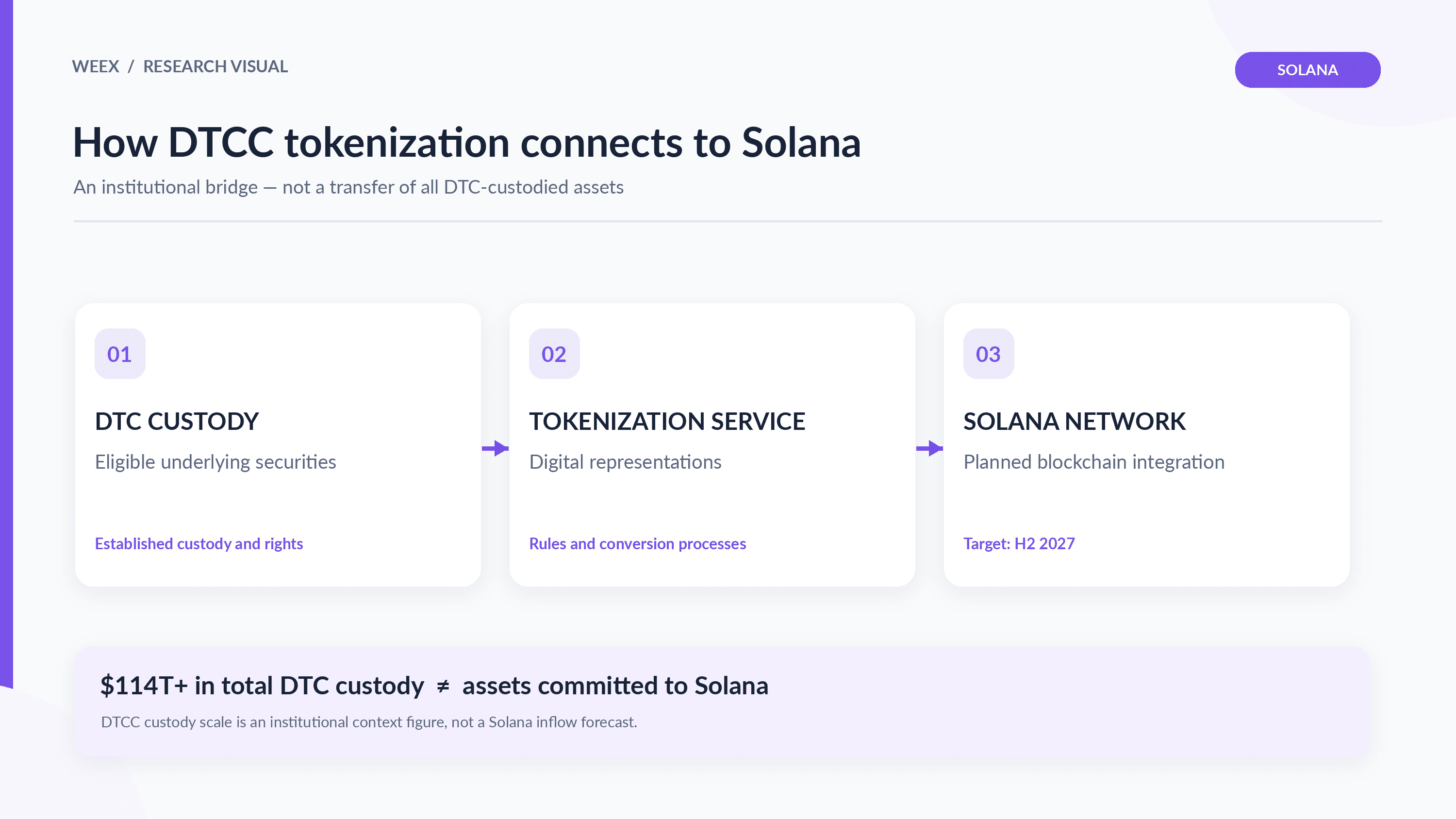
DTCC Solana tokenization has entered the spotlight after the Depository Trust & Clearing Corporation announced on November 12, 2026, that it plans to connect its Tokenization Service to the Solana blockchain. The proposed integration would allow eligible securities held through the Depository Trust Company (DTC) to be represented and managed on Solana, with availability expected in the second half of 2027. The announcement comes just two weeks after DTCC officially launched its tokenization infrastructure, establishing another connection between traditional financial markets and public blockchain networks.
The significance of DTCC Solana tokenization extends beyond a conventional blockchain partnership. DTCC reported that DTC holds more than $114 trillion in securities under custody and that 20 institutional participants had already signed agreements to access its Tokenization Service when it launched on October 28. These figures illustrate the scale of the existing financial infrastructure behind the initiative, although they do not represent assets committed to Solana. The integration could eventually enable eligible institutional participants to manage tokenized securities across traditional and blockchain-based environments while preserving the applicable rights and protections associated with the underlying assets.
For investors evaluating DTCC Solana tokenization, the central question is whether institutional securities activity will translate into measurable demand for SOL, Solana's native cryptocurrency. Although additional blockchain transactions could generate network fees and encourage ecosystem development, the value of tokenized securities is not equivalent to the amount of SOL required to process them. Understanding this distinction is essential when evaluating whether the announcement represents a meaningful economic catalyst for Solana or primarily a longer-term infrastructure development.
What Did DTCC Announce About Solana on November 12?
DTCC confirmed that it intends to integrate the Solana Layer 1 network with its Tokenization Service, extending the infrastructure through which eligible DTC-custodied securities can be converted into tokenized representations. According to the company's official November 12 announcement, the initiative forms part of its broader strategy to support interoperability between established financial-market systems and multiple blockchain networks. Rather than committing its entire securities infrastructure to Solana, DTCC is adding another network through which qualifying participants may eventually access tokenized assets.
The timing is particularly important. DTCC's Tokenization Service went live on October 28, 2026, initially supporting Canton Network and DTCC's private Besu infrastructure. The planned Solana integration is expected in the second half of 2027, meaning the announcement describes a future expansion rather than a completed deployment. As of November 12, DTCC had not publicly disclosed a specific quantity of securities already transferred to Solana through the proposed integration or a corresponding level of SOL transaction demand.
DTCC Solana Tokenization: Key Facts and Timeline
| Category | Confirmed Information | Source |
|---|---|---|
| Announcement Date | November 12, 2026 | DTCC |
| Organization | Depository Trust & Clearing Corporation | DTCC |
| Service | DTCC Tokenization Service (DTS) | DTCC |
| Initial Service Launch | October 28, 2026 | DTCC |
| Initial Networks | Canton Network and private Besu infrastructure | DTCC / The Block |
| Planned Additional Network | Solana Layer 1 | DTCC |
| Target Solana Availability | Second half of 2027 | DTCC |
| DTC Assets Under Custody | More than $114 trillion | DTCC, October 28 |
| Signed Institutional Participants at Launch | 20 | DTCC, October 28 |
| Confirmed Assets Committed to Solana | Not disclosed | November 12 announcement |
| Confirmed SOL Purchase Commitment | Not disclosed | November 12 announcement |
Sources: DTCC Tokenization Service Launch, October 28 and DTCC Solana Integration Announcement, November 12.
The distinction between DTCC's overall custody scale and the value of assets potentially deployed on Solana is essential. The $114 trillion figure describes securities held through DTC's broader infrastructure, not the amount that will be tokenized or transferred to Solana. Similarly, the 20 participating institutions have signed agreements to access the wider Tokenization Service; their participation should not be interpreted as a confirmed commitment to use Solana specifically.
Nevertheless, the announcement is commercially relevant because it connects a major public blockchain to established securities-market infrastructure. If institutional participants eventually use Solana for meaningful asset transfers, the network could gain additional financial applications, operational activity, and institutional visibility. The scale of that impact will depend on implementation and adoption rather than the announcement alone.
How Does DTCC's Tokenization Service Actually Work?
From Traditional Securities to Blockchain Representations
Traditional securities markets rely on institutions that maintain records of asset ownership, custody arrangements, and settlement obligations. DTCC performs critical functions within this infrastructure, including securities clearing, settlement, custody, and asset servicing. Its Tokenization Service introduces the ability to create blockchain-based representations of eligible assets already held within the established DTC system.
Under the service's framework, an eligible security remains connected to the existing financial-market infrastructure while an authorized participant can use a corresponding tokenized representation. DTCC describes these assets as digital twins that retain the relevant economic entitlements, ownership rights, and investor protections associated with their traditional counterparts. Participants may also be able to convert eligible positions between traditional and tokenized forms according to the service's operating rules.
The objective is not to create a speculative cryptocurrency that simply follows the market price of a publicly traded stock. Instead, DTCC is seeking to make regulated securities more flexible to manage and transfer through supported blockchain environments. This distinction matters because a tokenized security backed by an established custody and legal framework differs materially from a synthetic trading product that offers price exposure without ownership of the underlying shares.
Traditional vs. DTC-Tokenized Securities
| Feature | Traditional DTC-Custodied Security | DTC-Tokenized Representation |
|---|---|---|
| Underlying Asset | Eligible financial security | Representation of an eligible DTC-held security |
| Custody Infrastructure | Existing DTC system | Connected to DTC custody infrastructure |
| Ownership Rights | Applicable securities ownership rights | Intended to retain corresponding rights |
| Asset Conversion | Conventional account and settlement processes | Conversion between eligible traditional and tokenized forms |
| Transfer Infrastructure | Traditional financial-market systems | Supported blockchain networks |
| Potential Operational Benefit | Established securities processing | Greater flexibility in asset movement and collateral use |
| Regulatory Framework | Applicable securities rules | Existing protections and safeguards remain relevant |
Source: DTCC Tokenization Service Official Launch.
This model addresses one of the main challenges facing institutional tokenization: transferring assets onto blockchain infrastructure without removing them from a legally recognizable ownership and custody framework. A technically transferable token is not sufficient for institutional adoption if participants cannot establish who owns the underlying security, how corporate actions are handled, or what happens when a transaction needs to be reversed or corrected under applicable rules.
DTCC's approach attempts to combine existing financial protections with more flexible technical infrastructure. However, the availability of blockchain representations does not automatically eliminate settlement obligations, compliance procedures, or operational risks. These functions remain important regardless of the technology used to record and transfer assets.
-- Price
Why Is Solana Attractive for Institutional Securities Tokenization?
Solana's technical architecture is designed to process transactions with relatively low fees and high throughput, features that can be attractive for financial applications involving frequent transfers or smaller transaction values. For institutional securities infrastructure, the potential benefits are not limited to faster trading. Blockchain-based records may also support more flexible collateral movement, automated transaction processes, and interaction between different financial applications operating on compatible networks.
Consider a financial institution that holds eligible securities and wants to use them as collateral in another approved financial arrangement. Under conventional systems, moving or verifying collateral can involve multiple intermediaries and operating schedules. A tokenization framework could potentially reduce some of that coordination burden by making qualifying assets easier to identify, transfer, and manage through approved digital workflows. The benefit would depend on the final system design, permissions, liquidity arrangements, and legal enforceability rather than network speed alone.
Solana also has an established ecosystem of digital asset applications, including exchanges, payment infrastructure, and token-based financial services. Connecting regulated securities infrastructure to a public blockchain could create opportunities for additional institutional applications, although any integration with existing decentralized finance protocols would still be subject to eligibility, regulatory, and technical restrictions.
Importantly, DTCC's decision does not establish that Solana is superior to every other blockchain for all securities applications. The company's stated strategy is multi-chain, allowing financial institutions to choose from different environments according to their needs. The more meaningful development is that Solana is being incorporated into a broader institutional infrastructure network rather than replacing that network.
What Do DTCC's $114 Trillion in Custodied Assets Mean for Solana?
The $114 trillion custody figure is potentially the most eye-catching number associated with the announcement, but it requires careful interpretation. It represents the total value of assets under DTC custody as disclosed by DTCC, not the value scheduled for tokenization on Solana. Treating that number as expected Solana inflows would substantially exaggerate what the announcement actually confirms.
Three separate measurements need to be distinguished: securities eligible for tokenization, securities actually represented on a supported blockchain, and the number of transactions generated by those representations. Each represents a different stage of adoption. A large amount of tokenized value could remain relatively inactive, while a smaller amount of frequently transferred collateral could create substantial operational activity.
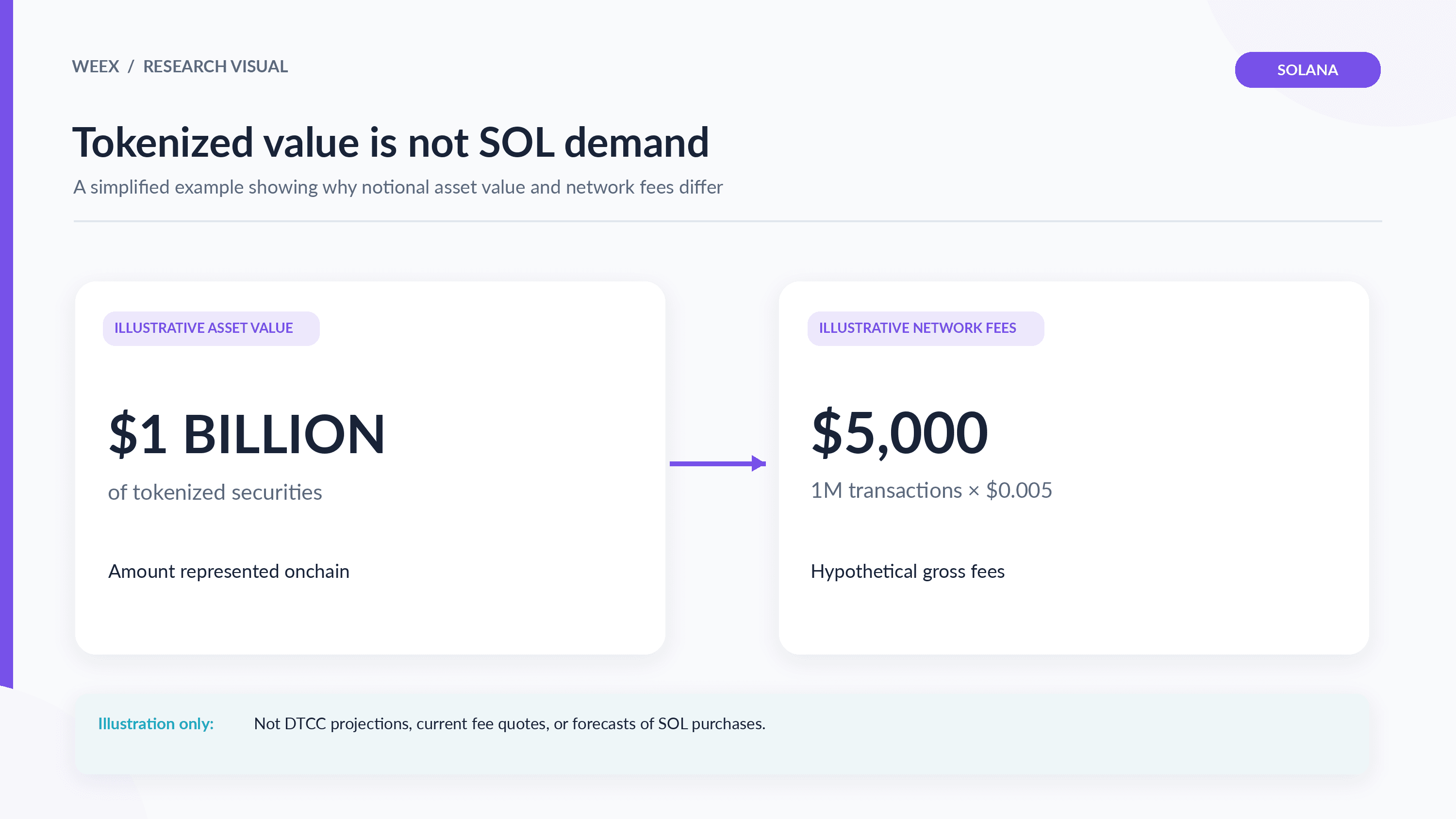
For example, imagine that an institution tokenizes $1 billion of eligible securities but transfers those positions only a handful of times each month. The recorded value would be significant, yet the corresponding network-fee activity could remain limited. By contrast, a smaller pool of assets used repeatedly for collateral operations might produce more transactions. Neither hypothetical scenario establishes that SOL purchases would match the value of securities involved.
The relevant analytical question is therefore not how much money DTCC currently holds in custody, but how much qualifying activity eventually moves onto Solana and how that activity interacts with the network's transaction-fee and token-holding requirements.
Will DTCC Tokenization Increase SOL Demand?
The Difference Between Asset Value and Native Token Demand
SOL serves several functions within the Solana ecosystem, including paying transaction fees and participating in the network's proof-of-stake system. If DTCC-supported applications eventually generate additional onchain transactions, those operations could increase the amount of transaction processing that requires SOL.
However, a transaction involving a tokenized Treasury security does not require participants to purchase an equivalent dollar amount of SOL. The native token primarily supports network operations, while the tokenized security represents a separate underlying asset. A transfer worth $10 million can therefore generate only a comparatively small amount of network-fee activity.
The ultimate demand effect also depends on transaction frequency, fee levels, operational wallet balances, staking behavior, and whether institutions hold SOL directly or acquire it only when necessary. Even meaningful growth in institutional transaction count may produce less direct SOL buying pressure than investors initially expect.
A Hypothetical Network-Fee Model
A simplified model can illustrate the distinction:
Gross network fees = Number of transactions × Average fee per transaction
The following examples assume an average total transaction cost of $0.005 solely for illustration. This assumption is not a verified DTCC fee quote or a forecast of the future Solana fee structure.
| Hypothetical Monthly Transactions | Assumed Fee per Transaction | Illustrative Monthly Gross Fees |
|---|---|---|
| 100,000 | $0.005 | $500 |
| 1,000,000 | $0.005 | $5,000 |
| 10,000,000 | $0.005 | $50,000 |
| 100,000,000 | $0.005 | $500,000 |
Source: Illustrative calculation, not reported DTCC transaction data. Figures exclude account-related costs, priority fees, rent requirements, and other network or application expenses.
The calculation highlights a fundamental characteristic of efficient blockchains: low transaction costs can make large-scale financial activity economically attractive without creating proportional demand for the native cryptocurrency. Even if tokenized securities represent billions of dollars, the amount spent on network processing may be small relative to the value of the assets being transferred.
This does not mean institutional adoption has no economic value for Solana. Greater use could encourage new applications, attract developers, increase demand for network infrastructure, and improve the ecosystem's usefulness to financial institutions. Those longer-term effects are possible but cannot be quantified from the November 12 announcement.
How Does DTCC's Multi-Chain Strategy Affect the Solana Investment Case?
DTCC initially launched its Tokenization Service using Canton Network and private Besu infrastructure, and the planned Solana integration expands the available blockchain environments. This approach indicates that traditional financial institutions may increasingly use several networks for different purposes rather than selecting one universal blockchain.
For Solana, inclusion in this infrastructure could improve institutional visibility and create opportunities to support regulated digital asset workflows. However, participating institutions may still choose other supported networks based on legal requirements, transaction characteristics, system compatibility, privacy needs, or existing commercial relationships.
The multi-chain structure also complicates attempts to estimate SOL demand. If tokenized activity is distributed across several networks, growth in the broader DTCC service will not necessarily translate into the same level of growth on Solana. Future disclosures about transaction allocation and participating applications will therefore be more informative than the total value of assets supported by the overall service.
Readers interested in the wider use of blockchain-based financial assets can explore WEEX's RWA Tokenization and Solana Overview, which explains how real-world assets can be represented using blockchain tokens. The DTCC approach differs in its direct connection to established securities custody and regulated market infrastructure.
What Risks Could Delay or Limit the Solana Integration?
The first uncertainty is implementation timing. DTCC currently expects Solana support during the second half of 2027, leaving several months for technical integration, testing, institutional onboarding, and operational preparations. A target launch window is not a guarantee that every planned capability will become available on schedule.
The second challenge concerns institutional adoption. Participants may need to adapt custody systems, transaction controls, compliance procedures, and internal technology before using the Solana connection. These changes can require significant operational work even when the underlying blockchain technology is already available.
A third limitation is the relationship between tokenized assets and secondary-market liquidity. Creating a regulated tokenized representation does not automatically establish an unrestricted, globally accessible market. Eligible users, approved trading venues, counterparty arrangements, and securities regulations may continue to determine how the assets can be transferred.
Finally, operational reliability and security remain important. Institutions managing regulated securities require confidence in transaction processing, asset recovery procedures, governance, and the ability to manage technical disruptions. DTCC's established infrastructure may help coordinate these requirements, but the final performance of its Solana integration will need to be demonstrated in practice.
What Should SOL Investors Watch Before the 2027 Launch?
The most relevant near-term indicator will be whether DTCC provides additional details about the Solana implementation, including technical milestones, institutional participants, supported asset types, and expected operational arrangements. Updates from DTCC itself will offer a stronger basis for evaluation than speculative estimates of future tokenized asset values.
After launch, attention should shift toward measurable adoption: the number and value of eligible positions represented on Solana, transfer frequency, network fees, the number of active participating institutions, and any evidence of sustained application usage. These indicators can help distinguish a technically successful integration from one that generates meaningful ongoing network activity.
Investors should also monitor the broader institutional tokenization landscape. Developments involving other blockchains, regulatory frameworks, and traditional financial infrastructure may influence whether Solana receives a significant share of future tokenized securities activity.
How to Buy and Trade Solana (SOL) on WEEX
Users interested in following Solana's market performance can access the WEEX SOL/USDT Spot Trading page. After logging in, users can review the current SOL price, order-book liquidity, and available order types before selecting an amount to trade. Market orders prioritize execution against available liquidity, while limit orders allow users to specify a preferred price, although execution is not guaranteed.
Experienced traders can also explore SOL/USDT Perpetual Futures on WEEX, subject to account eligibility and market availability. Perpetual contracts provide derivatives exposure without requiring direct ownership of SOL, and their margin, leverage, and funding mechanisms introduce additional risks. Users should review contract specifications, margin requirements, and liquidation conditions before opening a position.
The DTCC announcement is relevant to Solana's broader ecosystem but does not change the fundamental distinction between owning SOL, trading SOL perpetual futures, and holding a regulated tokenized security. These are different products with different economic rights and risks.
Conclusion
DTCC's planned Solana integration represents a meaningful step toward connecting established securities infrastructure with public blockchain networks. The company has already launched its Tokenization Service, secured agreements with institutional participants, and outlined plans to expand supported networks in 2027. Solana's inclusion creates an opportunity for additional institutional applications, although the implementation is not yet complete.
The critical investment distinction is that more tokenized securities do not automatically create equivalent demand for SOL. The actual effect will depend on transaction activity, network fees, institutional participation, and the broader ecosystem developments that follow implementation.
For now, DTCC's November 12 announcement is best understood as an infrastructure and adoption milestone rather than a verified increase in SOL buying demand. The strongest evidence of its economic significance will emerge from operational activity after the planned 2027 launch.
FAQ
1. What is DTCC Solana tokenization?
DTCC Solana tokenization refers to DTCC's plan to connect its existing Tokenization Service to the Solana blockchain. The integration is intended to allow eligible securities held through DTC to be represented and managed in tokenized form while retaining applicable investor protections and ownership rights.
2. When will DTCC launch tokenized securities on Solana?
DTCC announced on November 12, 2026, that it expects the Solana integration to become available in the second half of 2027. A specific operational launch date and confirmed volume of assets committed to Solana have not yet been disclosed.
3. Does DTCC's $114 trillion custody figure mean $114 trillion will move onto Solana?
No. The figure describes the broader value of securities held under DTC custody, not the amount scheduled for tokenization on Solana. The value of assets eventually represented on the network will depend on eligibility, institutional participation, and actual usage.
4. Will DTCC's Solana partnership increase SOL prices?
No particular price movement is guaranteed. Additional blockchain activity could generate transaction fees and support ecosystem development, but the value of tokenized assets does not translate directly into the same amount of demand for SOL. Market conditions and adoption rates will also influence outcomes.
5. Can I trade SOL on WEEX after the DTCC announcement?
Eligible users can access SOL/USDT spot and perpetual futures markets on WEEX, subject to product availability and applicable restrictions. Spot transactions involve buying or selling supported cryptocurrency, while perpetual futures provide derivatives exposure involving margin, funding, and liquidation risks.
This content is provided for general informational purposes only and doesn't constitute financial, investment, legal, or tax advice. Any events, rewards, online promotions, or related information mentioned herein should not be considered a recommendation, solicitation, or invitation to purchase, sell, trade, or otherwise deal in any crypto assets. Crypto assets are highly volatile and may result in loss. The availability of WEEX services, products, and related events may vary by region. You are responsible for ensuring that your participation is in accordance with applicable local laws and regulations.
You may also like

USOE Price Drop: Why Did United States Oil Exchange Fall Over 90% in a Week?
What Does It Mean to Stake Crypto? Staking on WEEX Explained
USOR Token Price: Why the Oil Meme Coin Is Down 99% From Its Peak
How to Stake Solana: Exchange vs Wallet, Rewards and Unstaking
How to Buy USOE? What DEX Access Involves, Which Wallet and Contract Risks Apply and What an Exchange Listing Would Require
Is USOE Legit? What the Website Claims, What Independent Sources Found and What Is Still Missing
What Is USOE (United States Oil Exchange)? Claims, Contract Checks and Liquidity Risks
What Is Project Cortex (XTX) Crypto? How to Identify the Token Behind the Trending Name

Is United States Oil Exchange (USOE) Really Oil-Backed? Reserve Claims and Token Holder Rights
Is XTruth Oil (XTO) Legit? Contract Checks, Payout Gaps and Liquidity Risks
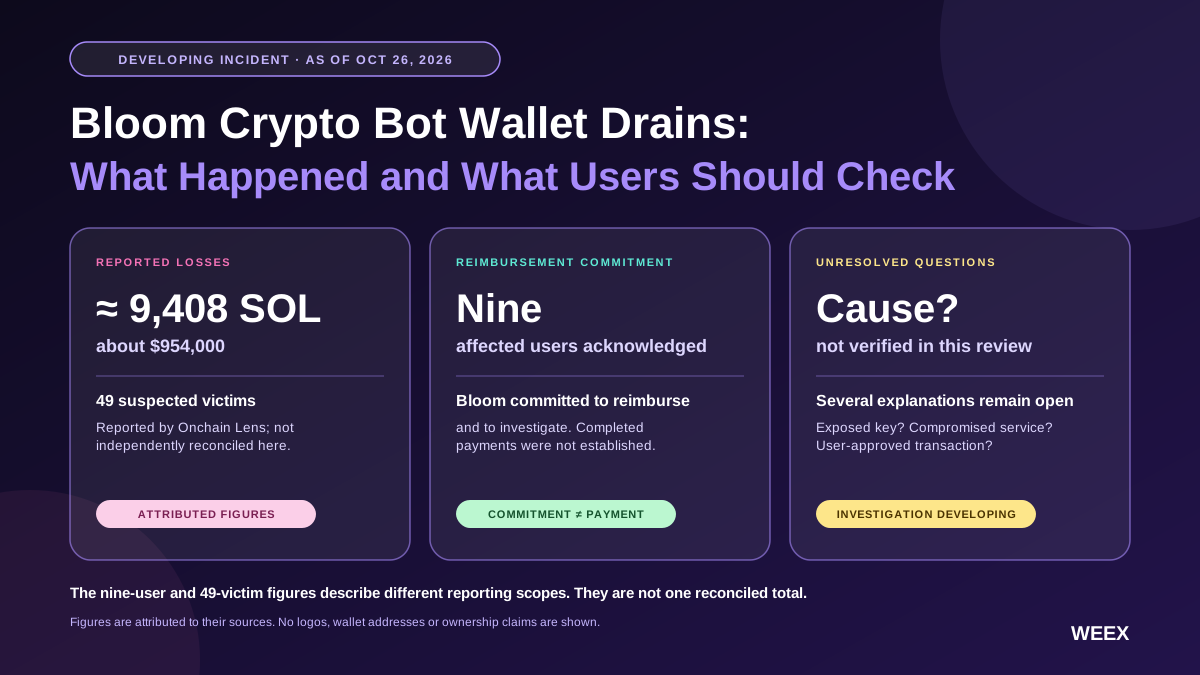
Bloom Crypto Bot Wallet Drains: What Happened and What Users Should Check

Is United States Dividend Fund (USDF) Legit? What Website Checks and Reddit Actually Show
Is National Oil Dividend Fund (NODF) Backed by Oil? Reserve and Dividend Claims Checked
What Is Kimchi Crypto Trader’s Wallet Address? Public Records and Verification Guide
xStocks Crypto Explained: What Tokenized Stocks Are, How They Work and What Holders Should Check
Solana Alpenglow Upgrade: What Changes When Finality Hits 150ms
Cyberleek Token Risks: Memecoins Tied to Leaks, Anonymous Wallets and Why Verification Matters

Staking APR vs Inflation: How Much of Your Crypto Yield Is Real?
Buy Limit Order: How to Buy Crypto Below the Market Price
Cyberleek: How the GTA 6 Leaker's Memecoin Turns Leaks Into Fees
How to Buy New Crypto Before Listing: 5 Routes and Their Traps

What Is Staking? 4 Myths to Clear Up Before You Stake Crypto
What Is Blockchain and How Does It Work? One Real Block Explained
XST Coin Explained: Two Tokens Share One Ticker, Check Which One
2Z Token Unlock on October 2: What 1.66B DoubleZero Tokens Mean

Solana Alpenglow Mainnet Date: Why Sept 28 Wasn't Launch Day

Phantom Wallet vs MetaMask: What's the Difference
How to Install and Set Up Phantom Wallet
What Is Phantom Wallet? A Complete Guide to the Solana Wallet
How to Buy Crypto in Europe with EUR on WEEX OTC
USOE Price Drop: Why Did United States Oil Exchange Fall Over 90% in a Week?
What Does It Mean to Stake Crypto? Staking on WEEX Explained
USOR Token Price: Why the Oil Meme Coin Is Down 99% From Its Peak
How to Stake Solana: Exchange vs Wallet, Rewards and Unstaking
How to Buy USOE? What DEX Access Involves, Which Wallet and Contract Risks Apply and What an Exchange Listing Would Require
Is USOE Legit? What the Website Claims, What Independent Sources Found and What Is Still Missing