
ENA Token Price Up 76% in a Month: The October 5 Unlock Test

 Prefer us on Google


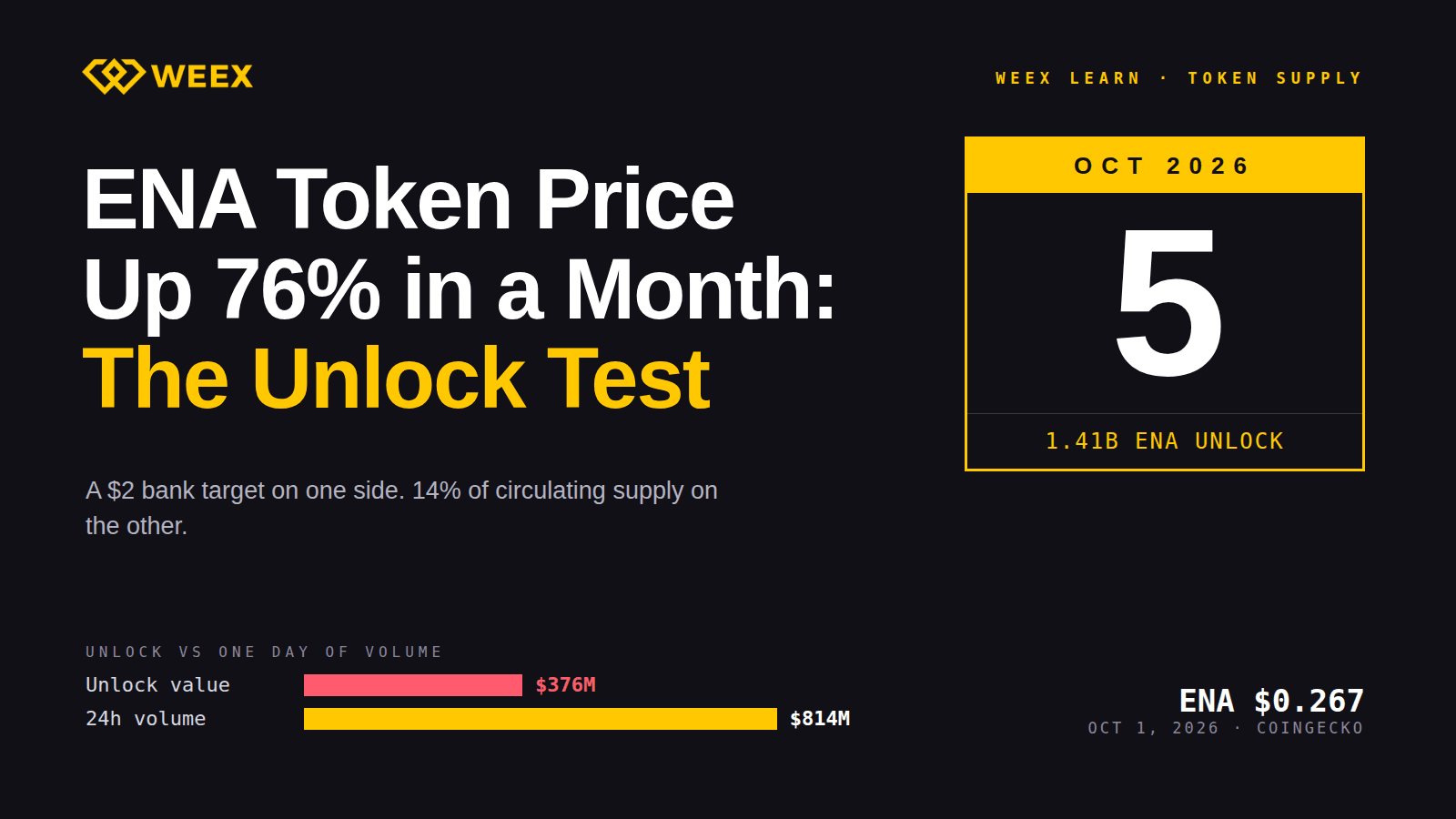
The ENA token price is about $0.267 on October 1, 2026, up 28.6% in a week and 75.8% in a month, after Standard Chartered opened coverage of Ethena with a target of $2.00 by the end of 2028. Four days from now, on October 5, about 1.41 billion ENA held by early investors becomes liquid in a single tranche. Those are the two forces on the price: a tokenomics overhaul that Wall Street has now endorsed, and the largest one-day supply release in the token's history. This article sets out today's numbers, what changed in Ethena's token design, how big the unlock is relative to the market that has to absorb it, and how much buying the much-discussed fee switch would really produce.
ENA Token Price Today: Key Figures as of October 1, 2026
Figures are from CoinGecko and the WEEX market pages.
- Price: $0.2673 on CoinGecko (October 1); $0.2623 on the WEEX ENA price page at its September 30 reading
- 24-hour range on WEEX: $0.2441 to $0.2798
- 24-hour volume: $814 million market-wide; $875.54 million shown on WEEX's tracker
- Market cap: $2.70 billion, rank #42. Fully diluted valuation: $4.01 billion.
- Supply: 10.095 billion circulating of a 15 billion maximum
- All-time high: $1.52 in April 2024. ENA is about 82% below it.
- 52-week range: roughly $0.07 to $0.64
The token has almost quadrupled from its low near $0.07 and is still down more than 80% from its peak. Both statements are true, and which one a reader anchors on tends to decide how they see the next section.
Why Ethena Price Rallied: Buyouts, a Fee Switch and a $2 Target
The recovery has a clear sequence.
August 27, 2026. The Ethena Foundation announced it had bought out locked tokens from large seed investors, specifically those with allocations above 0.25% of supply who had been selling. The amount paid and the number of tokens acquired were not disclosed. The same proposal ended monthly investor vesting and introduced a fee switch. ENA moved from about $0.14 to $0.17.
September 2. Governance approved the package with 17.8 million ENA in favor and none against.
September 21. ENA reached $0.21.
Late September. Ethena extended its USDe basis trade to equity perpetuals on Binance, using tokenized stocks as collateral, and its final airdrop season closed on September 30.
September 30. Standard Chartered's Geoff Kendrick initiated coverage with year-end targets of $0.42 for 2026, $1.10 for 2027 and $2.00 for 2028, built on USDe supply growing from about $4.9 billion to roughly $40 billion. ENA was at $0.2594 when the note was published. Ethena's team responded that $40 billion was conservative against an internal goal of $100 billion over five years.
The bank's near-term target implies about 57% upside from today's price in three months. That is the bullish frame. The unlock is the other one.
The October 5 ENA Unlock in Numbers
Under the old schedule, investor tokens were vesting monthly through March 2028. The September vote replaced that drip with one accelerated release on October 5, 2026.
- Size: about 1.41 billion ENA. The figure is derived from the vesting schedule; Ethena has not published an exact count.
- Share of supply: roughly 14% of the current circulating supply, taking it from about 10.1 billion to about 11.5 billion
- Value at $0.267: about $376 million
- Against liquidity: a little under half of one day's trading volume at current levels
That last comparison is the useful one. A $376 million release into a market trading more than $800 million a day is absorbable if recipients sell gradually, and disruptive if a meaningful share hits the book in the first hours.
Who holds these tokens matters more than how many there are. The foundation's buyout specifically removed the investors who had been selling. What remains is, by construction, the group that held through an 80% drawdown. That argues for less selling than the headline size suggests. Against it: these holders have just watched the price rise 76% in a month, and for early backers with a cost basis in cents, $0.27 is a profit at any size.
One overhang is partly fenced off. StablecoinX holds about 3.03 billion ENA, around 20% of supply, and its sales require written consent from the foundation with five business days' notice. Team allocations, about 12% of total supply, stay on their original lock-up terms and are not part of October 5.
There is a real benefit on the far side. After October 5 there are no more monthly investor unlocks. A token that has faced predictable sell pressure every month since 2025 loses that drag. Markets often sell ahead of a known supply event and recover once it passes, and a fair number of buyers in the current rally are betting on exactly that.
-- Price
How Much Buying Will the Ethena Fee Switch Create?
The fee switch is the centerpiece of the bullish case, so it is worth doing the arithmetic rather than taking the label at face value.
The mechanism is not active. It turns on only when USDe supply reaches $7.5 billion, measured on a 14-day rolling average. USDe supply is about $4.9 billion, up from roughly $4.07 billion at the end of August. It needs to grow another 53% to reach the trigger. For reference, USDe peaked at $14.8 billion in October 2025, so the threshold is well inside what the protocol has already achieved.
Once active, the levy scales with supply:
- 5% of gross protocol revenue at $7.5 billion of USDe
- 10% at $10 billion
- 15% at $15 billion
- 20% at $20 billion
Of what the foundation captures, 95% goes to buying ENA on the open market.
Now the numbers. At $7.5 billion of USDe and a 6% yield, gross revenue is about $450 million a year. Five percent of that is $22.5 million, and 95% of that is about $21 million of annual buybacks. Against a $2.70 billion market cap, that is a buyback yield under 1%. At the first tier, the fee switch is a signal, not a force.
The picture changes at scale. At Standard Chartered's $40 billion scenario, the same 6% yield gives $2.4 billion of gross revenue, a 20% levy captures $480 million, and about $456 million a year goes to buybacks. That is 17% of today's market cap annually, and the bank estimates buybacks would absorb 23% of ENA supply at that level.
The honest conclusion is that ENA is a leveraged bet on USDe growth, and the leverage only bites well above $7.5 billion. The fee switch pays for itself at $20 billion and beyond. Between here and there, the price runs on expectations. Two caveats belong next to that: the levy comes out of what sUSDe holders and partners currently earn, which could slow the very growth it depends on, and the foundation has not committed to burning the tokens it buys.
ENA Price Levels to Watch Around the Unlock
- $0.244 to $0.25: the low of the past 24 hours and the first support
- $0.21: the September 21 level, where the rally last paused
- $0.28 to $0.30: the recent high and the round number above it
- $0.42: Standard Chartered's year-end 2026 target
- $0.64: the 52-week high
A practical observation from past large unlocks across the market: the sharpest moves often come in the two days before the date, as short positions build, and in the first hours after it, when the selling that was feared either appears or does not. Entering in size the day before is the least favorable time to take the risk.
How to Buy or Trade ENA on WEEX
- Check the live figure on the WEEX ENA price page, then open the ENA/USDT spot pair.
- Use limit orders. The past day's range was about 14% from low to high.
- Consider splitting the purchase across October 5: part before, part after. That converts a timing guess into an average.
- For hedging an existing spot holding through the unlock, the ENA/USDT perpetual allows a short position. The contract lists leverage up to 500x as of October 1, 2026, which is far more than an event like this warrants. A 1x to 3x hedge with isolated margin does the job.
- Check the funding rate before opening a short. When many traders hedge the same event, shorts pay longs, and that cost accrues every funding interval.
The Bottom Line on ENA Token Price
The ENA token price has risen 76% in a month because the foundation removed its most persistent sellers, ended monthly vesting, and received a $2 long-term target from a major bank. On October 5 the market absorbs about $376 million of newly liquid tokens, held by investors who have not sold so far and now have a much better price at which to do it. Beyond that date the supply picture is the cleanest it has been. The fee switch is real but small until USDe is several times larger than today. The single number that settles the debate is USDe supply: watch whether it moves from $4.9 billion toward $7.5 billion, and how fast.
FAQ
1. What is the ENA token price today?
About $0.267 on October 1, 2026, per CoinGecko, with a market cap of roughly $2.70 billion. ENA is up 28.6% over seven days and 75.8% over thirty.
2. Why is ENA going up?
The Ethena Foundation bought out selling seed investors, governance approved a fee switch and an end to monthly investor unlocks, and Standard Chartered initiated coverage on September 30, 2026 with targets of $0.42 for end-2026 and $2.00 for end-2028.
3. How big is the ENA unlock on October 5?
About 1.41 billion ENA, roughly 14% of circulating supply and worth about $376 million at current prices. It replaces the monthly vesting that would otherwise have run through March 2028.
4. When does the Ethena fee switch start buying ENA?
When USDe circulating supply reaches $7.5 billion on a 14-day average. Supply is about $4.9 billion as of late September 2026. At the first tier, buybacks would be about $21 million a year.
5. Can ENA reach $2?
Standard Chartered's target assumes USDe grows about eightfold to $40 billion by 2028. ENA's record high is $1.52. The target is a forecast that depends on stablecoin growth that has not happened yet, not a guarantee.
This content is provided for general informational purposes only and doesn't constitute financial, investment, legal, or tax advice. Any events, rewards, online promotions, or related information mentioned herein should not be considered a recommendation, solicitation, or invitation to purchase, sell, trade, or otherwise deal in any crypto assets. Crypto assets are highly volatile and may result in loss. The availability of WEEX services, products, and related events may vary by region. You are responsible for ensuring that your participation is in accordance with applicable local laws and regulations.
You may also like

How to manage Idle USDT? Top 5 Platforms to Earn Passive Income in 2026 OCT

Taiwan's Travel Rule Starts in October: What Domestic Crypto Transfers Will Require

Germany's Crypto Tax Draft 2027: What the 50 Percent Substitute Assessment Means
Self-Custody Wallets: When a Crypto Transfer Must Be Reported to Brazil's Coaf

Italian Crypto Tax Return 2026: Filing Deadline, Forms and Gains Rate
What Is Aleo (ALEO) Crypto, and Why Did Its Price Jump Up to 88%?
What Is Blockchain Technology? Follow One Transaction to See
What Is Pi Network? A Complete Beginner's Guide
NEAR Price Jumps 80% in a Week: What Confidential Intents Changed

PENGU Airdrop on WEEX: Get 10 USDT in PENGU Before October 6

Why Did the CLARITY Act Fail in the Senate, and What Happens Next for Crypto Regulation?
Airdrops This Week (September 17-23, 2026): Official Conditions and Safety Checks
Senate CLARITY Act Cloture Vote Today: Can Trump's Ethics Compromise Get 60 Votes?
USDC on Arc: What Circle's Mainnet Launch Changes for Holders
Oracle Stock Futures After Earnings: How Leverage Got Liquidated

MU Stock Reclaims $1,000 Again: What's Actually Different This Time

XST Coin Price Fell Over 40% for Two Straight Days: What That Pattern Actually Means
Is The US Becoming The Crypto Capital? Brad Garlinghouse's Bold Predictions Explained
GPT-6 Astra and Crypto: The AI Token Bid and the Cyber Risk
Nike Is Being Removed From the S&P 100: What a 12 Year Low Actually Means for the Stock
Lululemon Stock Crashes to an 8 Year Low Right Before Its New CEO Even Starts

PONS Robinhood Chain Token: What the Buyback Rally Rests On

Dell Stock Surges 9.4% After Smashing Earnings Estimates: What Drove the AI Server Beat

SQQQ Explained: Why the 3x Inverse Nasdaq ETF Bleeds Value

How Safe Are the Crypto Exchanges Pakistani Traders Actually Use? A Security Comparison
XST Coin Price Crosses Into Deep Capitulation Territory: What a 90%+ Decline Actually Signals
Crypto Futures Liquidation in Pakistan: How It Works and How to Manage Risk
XPL/USDT After the August 25 Unlock: Will Ecosystem Incentives Create Demand or Selling Pressure?
SPCX Stock Keeps Swinging Around Its $135 IPO Price : What the Lockup Schedule Still Ahead Actually Means
Best Futures Exchange in Pakistan for 2026? What Leverage, Liquidity, and Liquidation Risk Actually Require
How to manage Idle USDT? Top 5 Platforms to Earn Passive Income in 2026 OCT
Taiwan's Travel Rule Starts in October: What Domestic Crypto Transfers Will Require
Germany's Crypto Tax Draft 2027: What the 50 Percent Substitute Assessment Means
Self-Custody Wallets: When a Crypto Transfer Must Be Reported to Brazil's Coaf
Italian Crypto Tax Return 2026: Filing Deadline, Forms and Gains Rate
What Is Aleo (ALEO) Crypto, and Why Did Its Price Jump Up to 88%?
Contents
Popular coins
Latest articles




