
How to Buy ANT Stock on Day One: What Is Confirmed

 Prefer us on Google


Anthropic’s ANT stock is expected to begin trading on the Nasdaq Global Select Market on Thursday, November 19, 2026, according to CNBC, and individual investors can buy ANT stock in two ways: by requesting shares at the IPO price through one of six selling brokers, or by placing an order in their own brokerage account once ANT stock starts trading.
Anthropic’s amended registration statement says it expects retail investors in the United States and other countries to receive up to 20% of the shares offered, depending on demand, and neither route guarantees a fill. This article explains how to buy ANT stock on day one, using only what Anthropic’s SEC filings, the SEC’s investor guidance and named news reports confirm.
What Is Confirmed About the ANT Listing?
Anthropic announced on October 26, 2026, that it had filed a Form S-1 registration statement with the U.S. Securities and Exchange Commission for a proposed initial public offering of its Class A common stock. The announcement names the ticker ANT and the Nasdaq Global Select Market as the listing venue. It also states that the registration statement had not yet become effective and that the securities may not be sold, and offers to buy may not be accepted, until it does. In practice, nobody can buy ANT shares until the registration becomes effective and the offering is priced.
The amended S-1 filed in November gives the first official terms. It estimates a price range of $70.00 to $78.00 per share, with $74.00 used as the midpoint for illustrative figures, and covers 825,000,000 Class A shares. Of those, Anthropic is selling 801,351,354 new shares and existing stockholders are selling 23,648,646. The underwriters have an option to buy up to 123,750,000 additional shares from Anthropic. Goldman Sachs and Morgan Stanley lead a syndicate of more than 20 banks.
The pricing and trading dates are not in the version of the filing reviewed, where the prospectus date is blank. The dates come from news reports: CNBC reported on November 10, citing sources, that trading could start on November 19, and crypto.news and TradingKey reported pricing on November 18 and trading on November 19. Those dates are reported, not filed, and the final prospectus, which the SEC says usually appears as a 424B4 filing on EDGAR after pricing, will confirm the final price.
Can Individual Investors Buy ANT at the IPO Price?
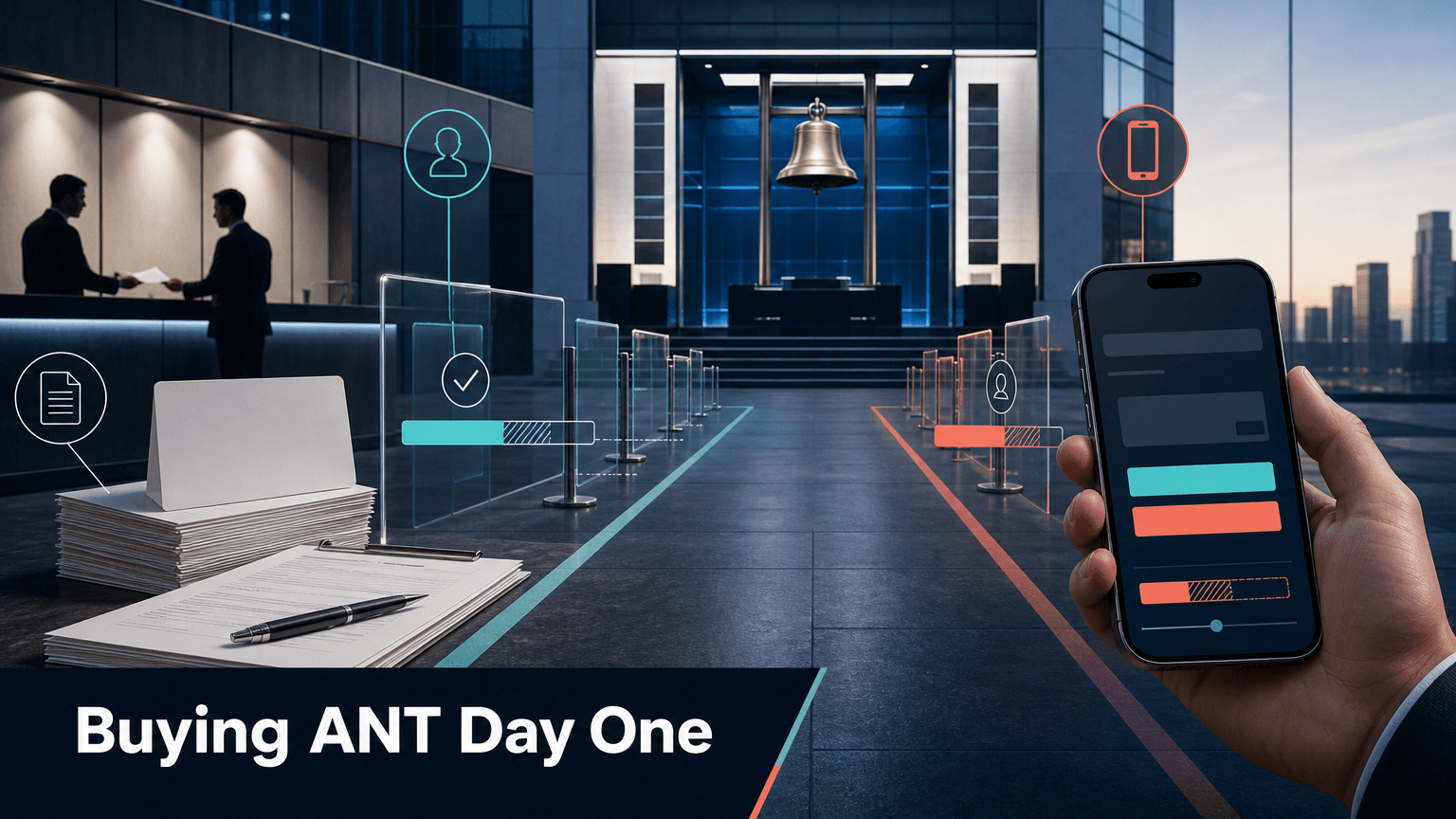
Yes, some can. The “Sales to Retail Investors” section of Anthropic’s amended S-1 says the company expects allocations to retail investors, both in the United States and in other countries, to represent up to 20% of the shares offered, with final amounts depending on actual demand. That is a ceiling and not a promise. A request for shares at the IPO price can be partly filled or not filled at all, and the filing does not set a minimum allocation for any individual.
The filing names six firms that will act as selling group members and offer shares to their customers through their online platforms at the IPO price: Charles Schwab, Fidelity (Fidelity Brokerage Services and Fidelity Capital Markets), Robinhood Financial, TradePMR, SoFi Securities and E*TRADE from Morgan Stanley. A customer of one of these firms is the only kind of individual investor the filing describes as being able to receive shares at the IPO price. Customers of other brokers would normally buy after trading begins.
The SEC’s investor guidance explains why allocations are limited. Underwriters often give most IPO shares to institutional and high-net-worth clients, so access for typical investors is limited, and underwriters typically obtain “indications of interest” from prospective investors before the registration becomes effective. FinanceFeeds reported on November 11 that Robinhood and SoFi customers can place indications of interest through each platform’s IPO Access feature before pricing, and that neither platform guarantees an allocation. Eligibility rules, minimums and account requirements are set by each broker, and the sources reviewed do not list them.
How Can You Buy ANT Stock on the First Day of Trading?
Investors who do not receive IPO shares, or who do not have an account at one of the six firms, can buy ANT stock in the open market once trading begins. This works like buying any listed stock: an investor needs a funded brokerage account that offers access to Nasdaq-listed shares, searches for the ticker ANT and places an order. The SEC notes that most individual investors buy IPO shares this way, after the shares start trading, and warns that buying in the open market right after an IPO can be risky.
The order type matters more than usual on a first day. The SEC defines a market order as an order to buy at the best available price, and warns that the execution price is not guaranteed and can differ from the last quoted price, and that a large order can fill in parts at different prices. A limit order buys at a specific price or better, which keeps an investor from paying more than a set price, but the SEC warns that execution is not guaranteed because the order fills only if the market reaches the limit. Which order types are offered, and how they are handled, depends on the brokerage firm.
The price in the open market can be far from the IPO price. The SEC states that the offering price “may bear little relationship to the trading price” and that closing prices after an IPO can be well above or below it. An investor who requests shares at the IPO price pays the price set on November 18, while a buyer on November 19 pays whatever the market sets that day. Neither price can be known before the evening of pricing, so the figures in this article should be rechecked then.
-- Price
How Is the ANT IPO Price Set, and What Is Stabilization?
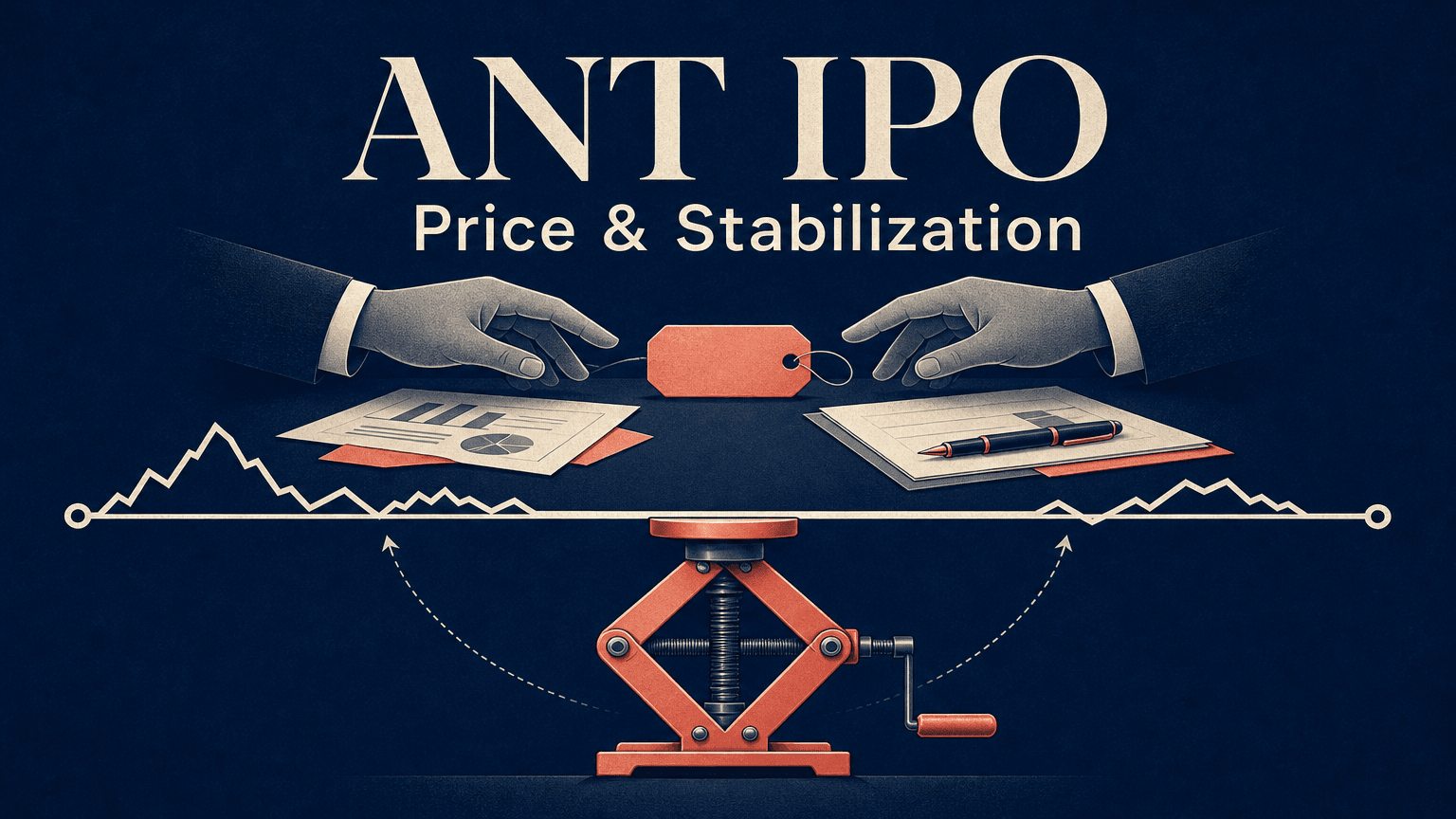
According to the underwriting section of the amended S-1, the IPO price will be determined by negotiations among Anthropic, the selling stockholders and the representatives of the underwriters. The filing lists the factors considered: prevailing market conditions, the company’s historical performance, its business and earnings prospects, an assessment of management and the market valuations of comparable companies. The SEC describes the process in similar terms, as a mix of market conditions, analysis and negotiation.
The filing also describes stabilization. Morgan Stanley is named as the stabilization agent for the underwriters and “may engage in transactions that stabilize, maintain, or otherwise affect the price” of the Class A stock. The underwriters may sell more shares than they are obliged to buy, creating a short position, and may close it by exercising their option to buy up to 123,750,000 additional shares or by buying in the open market. The filing states that they are not required to stabilize and may stop at any time.
Stabilization can make early trading look steadier than it will later. The SEC notes that underwriters may support the price in the first few days and that once that support ends, a stock “may decline significantly below the offering price.” This does not predict how ANT will trade. It explains why a first-day price may not be a reliable guide to later prices, and why an investor should not assume that the open-market price reflects demand alone.
Who Else Is Buying ANT Shares, and Who Cannot Sell Right Away?
Alongside the public offering, the filing describes a $26.0 billion private placement of Class N shares at the IPO price to seven companies: Google, NVIDIA, AMD, Broadcom, Micron, Microsoft and TSMC. At the $74.00 midpoint, the filing’s illustrative figures show Google and NVIDIA each buying about $10.0 billion, AMD about $2.5 billion, Broadcom, Micron and Microsoft about $1.0 billion each and TSMC about $500 million. These shares close immediately after the offering, are not registered in it and are “restricted securities.”
The filing also notes that certain board members and their affiliated entities have indicated interest in buying up to $303 million of Class A shares at the IPO price. It states that these indications are “not binding agreements or commitments to purchase,” and that shares bought this way are subject to lock-up restrictions. A lock-up is an agreement that limits when insiders and early investors can sell.
Lock-up terms are specific. Directors, officers and holders of substantially all capital stock, about 15.5 billion Class A-equivalent shares, generally face restrictions for up to 180 days, and co-founders and certain holders of more than 0.5% of fully diluted shares face restrictions for up to 365 days. The filing also says about 3.6 billion shares under the 180-day period may become sellable earlier, including up to 10% of lock-up securities held by some current and former employees, starting on the first trading day. The SEC warns that lock-up expirations can push prices down when many shares become available at once.
What Do Public Investors Get When They Buy ANT Stock?
Public investors buy Class A common stock. According to the filing, Class A carries one vote per share and is not convertible. It is not the only class of stock. A single Class F share carries 50.1% of the total voting power on matters put to stockholders generally, including the election of most directors, and has no economic rights. Class T stock, held by the Long-Term Benefit Trust, elects directors who together make up a majority of the board.
The filing states that Anthropic is a “controlled company” under Nasdaq rules. The Class N shares sold in the private placement carry no votes except where required by law and convert to Class A on transfer to an unaffiliated third party, and Class E shares issued to employees vote only on limited matters. These details describe the share structure. They are not a judgment on whether the structure is good or bad.
For an investor, the practical meaning is that owning ANT stock gives an economic stake and one vote per share, but not control over who sits on the board. The SEC’s investor guidance notes that dual-class structures can make it hard for public shareholders to influence corporate matters. An investor should read the “Description of Capital Stock” section of the prospectus before buying and decide whether that structure is acceptable.
What Should Buyers Check Before Placing an Order?
Buyers should start with the prospectus. The SEC calls it the offering document describing the company and the IPO terms, and advises checking that the filing being read is the most recent one, because the prospectus can change during registration. The final prospectus is usually filed on EDGAR after pricing and includes the final offering price, which the preliminary version does not.
Buyers should also check their broker. The filing names six selling brokers for IPO-price shares, but it does not say which customers qualify, whether non-U.S. customers can use them or how shares are allocated. Those rules are set by each broker, and a request for shares can be reduced or refused. Brokers also decide which order types they support, and an account that cannot trade Nasdaq-listed shares cannot buy ANT stock on day one.
The SEC says IPOs can be risky and speculative investments, that companies may have little or no reporting history and that research from underwriters may conflict with their investment banking interests. Anthropic’s own prospectus carries risk language, including a warning, reported by Fortune, that using AI to build more capable AI “could also pose a considerable safety risk.” Nothing in this article is investment advice, and it does not predict how ANT will trade.
Conclusion
Individual investors can buy ANT stock in two ways: by requesting shares at the IPO price through Charles Schwab, Fidelity, Robinhood, TradePMR, SoFi or E*TRADE from Morgan Stanley, which the filing says may receive up to 20% of the offering depending on demand, or by buying in the open market once ANT starts trading on the Nasdaq Global Select Market, which is expected on November 19, 2026. The estimated range is $70 to $78 per share, the final price will be set after the November 18 pricing and neither route guarantees a fill or a price.
The filing’s details on stabilization, lock-ups and share classes explain why early trading may not reflect later prices. Anyone planning to buy should check the final prospectus after pricing, confirm their broker’s rules and choose an order type with the SEC’s warnings on market and limit orders in mind.
FAQ
1. How do I buy ANT stock on the first day?
Open and fund a brokerage account that offers Nasdaq-listed stocks, search for the ticker ANT after trading starts and place an order. Trading is expected to begin on Thursday, November 19, 2026, according to CNBC.
2. Can retail investors buy ANT at the IPO price?
Some can. Anthropic’s amended S-1 says it expects retail allocations in the United States and other countries to represent up to 20% of the shares, depending on demand, and names six selling brokers. An allocation is not guaranteed.
3. Which brokers are selling ANT shares at the IPO price?
The filing names Charles Schwab, Fidelity, Robinhood Financial, TradePMR, SoFi Securities and E*TRADE from Morgan Stanley. Each sets its own eligibility rules.
4. What is the ANT price range?
The amended S-1 estimates $70.00 to $78.00 per share, using $74.00 as the midpoint, for 825,000,000 Class A shares. The final price will be set at pricing, expected on November 18.
5. Should I use a market order or a limit order for ANT?
The SEC says a market order buys at the best available price but the fill price is not guaranteed, while a limit order buys at a set price or better but may not fill. Which one suits an investor depends on their priorities and their broker’s rules.
This content is provided for general informational purposes only and doesn't constitute financial, investment, legal, or tax advice. Any events, rewards, online promotions, or related information mentioned herein should not be considered a recommendation, solicitation, or invitation to purchase, sell, trade, or otherwise deal in any crypto assets. Crypto assets are highly volatile and may result in loss. The availability of WEEX services, products, and related events may vary by region. You are responsible for ensuring that your participation is in accordance with applicable local laws and regulations.
You may also like
ACKET Token Surges 1,000% After Jensen Huang Resigns: What Is Confirmed
Binance Hack: $6.3B Laundering Trail and Recovery Progress
Corporate Actions for Tokenized Stocks: How Dividends, Splits and Mergers Are Handled

Cyberleek Token Risks: Memecoins Tied to Leaks, Anonymous Wallets and Why Verification Matters
How to Buy New Crypto Before Listing: 5 Routes and Their Traps
What Is Blockchain and How Does It Work? One Real Payment Traced
Anonymous Crypto Wallet: What Each One Hides and Where It Fails
WEEX Broker Models: Strategy Bots, Copy Trading and Sub-Exchanges
WEEX API Key Setup: How to Connect a Third-Party Platform Safely
Best Crypto Wallet App in 2026: How to Choose Between Hot, Cold, Custodial, and Web3 Wallets
RSI Indicator Settings: What 7, 9, 14 and 21 Did on BTC Charts
Ethereum 2030 Roadmap: Vitalik's Cryptographic World Computer
Best Decentralized Crypto Wallet for Beginners: What Self-Custody Really Asks of You

Best Crypto App for Beginners: Exchange App, Wallet App, or Both?
QNT Futures: Funding Rate and Long vs Short After a 4x Rally
Which Crypto to Buy for Beginners: A Simple 3-Tier Starter Plan
Taiwan's Travel Rule Amendment Published: What Domestic Crypto Transfers Will Require
WEEX Futures Trading: What 400x Leverage Really Costs You
Is Hyperliquid Safe? Risks You Should Know Before You Trade
What Is Hyperliquid? A Complete Guide to the Perpetuals Exchange
What Is Pi Network? A Complete Beginner's Guide
What Is a Funding Rate? How Perpetual Futures Charge Longs and Shorts
Lighter (LIT) Futures: Cross vs Isolated Margin on a 17% Range
XRP Futures: How to Long or Short XRP After the Clarity Act Vote
What Is ZCAT and Is It Worth Buying? Anonymous Cat (ZCAT) Guide for 2026

MU Stock Reclaims $1,000 Again: What's Actually Different This Time
GPT-6 Astra and Crypto: The AI Token Bid and the Cyber Risk
StonkFun Just Became Solana's Hottest Launchpad: STONK Surges 250% to Prove It

What Is Tangem Wallet? A Complete Beginner's Guide
AAPL Under Ternus: What Apple's CEO Change Means for Traders
ACKET Token Surges 1,000% After Jensen Huang Resigns: What Is Confirmed
Binance Hack: $6.3B Laundering Trail and Recovery Progress
Corporate Actions for Tokenized Stocks: How Dividends, Splits and Mergers Are Handled
Cyberleek Token Risks: Memecoins Tied to Leaks, Anonymous Wallets and Why Verification Matters
How to Buy New Crypto Before Listing: 5 Routes and Their Traps
What Is Blockchain and How Does It Work? One Real Payment Traced




