HPE Stock Hits a Record on $1.2B AI Order: Is It Still Cheap?

 Prefer us on Google


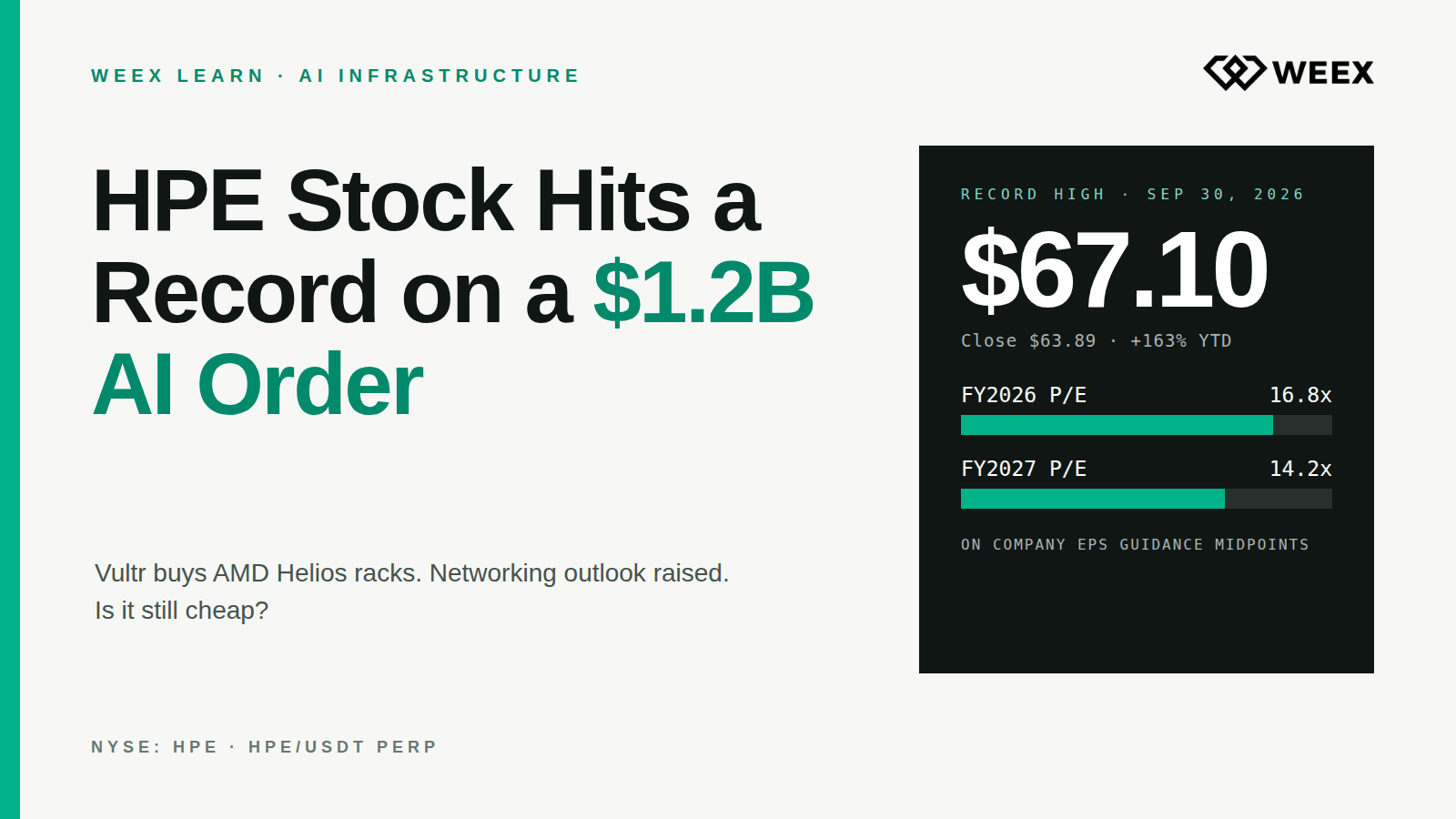
HPE stock rose 3.9% to close at $63.89 on September 30, 2026, after touching a record $67.10 intraday, on two pieces of news: a $1.2 billion order from cloud provider Vultr for AMD Helios AI rack systems, and a raised outlook for its networking business and Juniper cost savings. The shares are up about 163% this year. That is a remarkable run for a company most investors filed under "legacy servers" two years ago, and it raises a fair question about what is left. The short answer: on next year's guided earnings HPE still trades at about 14 times, far below the AI hardware names it now competes with, and the main thing standing between the company and its targets is the cost and availability of memory. This article explains both.
HPE Stock Price and Key Figures as of September 30, 2026
Market data is from TradingView at the September 30 close.
- Close: $63.89, up 3.9% on the day; about 5% below the intraday record of $67.10
- Market cap: about $84.8 billion
- 52-week range: $19.84 to $67.10
- Performance: about +163% year to date, +20.3% over one month
- Volume: 32.8 million shares
The stock gave back more than half of its intraday gain by the close. On a record-high day that is ordinary profit-taking, but it also marks $67 as the level to clear.
Why HPE Stock Is Up: The Vultr Order and New Targets
Three announcements landed together.
The Vultr order. Vultr committed $1.2 billion to deploy AMD Helios AI rack systems across its US data centers. HPE supplies the networking, liquid cooling and deployment services around AMD's processors. This is HPE's first Helios win, and the detail that matters is one from the last earnings call: management said Helios was not included in its fiscal 2027 framework and described it as a market opportunity worth tens of billions of dollars. A $1.2 billion order for a product line that was excluded from guidance is upside to the published numbers, not a contribution toward them.
The networking outlook. HPE now expects networking revenue to grow in the high-teens to low-20s percent range in fiscal 2027, up from the 14% to 17% it guided in the Q3 framework. It projects data-center networking to compound at a low-to-high 50s percent annual rate through fiscal 2029, and routing in the low-to-high 20s.
Juniper savings. The target for annual run-rate cost synergies from the Juniper Networks acquisition was raised to $800 million by the end of fiscal 2028, from at least $600 million.
The market is reacting less to the dollar value of one order than to the mix shift it implies. Networking carried a 22% operating margin last quarter. Cloud and AI, the server-heavy segment, ran at 17%. Every point of growth that moves from servers to networking is worth more in profit.
What HPE's Latest Earnings Say About the Business
The most recent reported quarter is fiscal Q3 2026, which ended July 31.
- Revenue: $12.2 billion, up 34% year over year
- Non-GAAP EPS: $1.11, a quarterly record; GAAP EPS of $1.06
- Non-GAAP gross margin: 40%, also a record
- Cloud and AI revenue: $9.0 billion, with AI systems orders of $2.4 billion and AI systems revenue of about $1.6 billion
- Networking revenue: $2.9 billion, including $700 million of orders for AI networking
- Free cash flow: $958 million
Guidance at that point called for Q4 revenue of $13.9 billion to $14.8 billion and non-GAAP EPS of $1.20 to $1.30, full-year fiscal 2026 non-GAAP EPS of $3.75 to $3.85, and a fiscal 2027 framework of 13% to 17% revenue growth with non-GAAP EPS of $4.40 to $4.60 and free cash flow of at least $5.0 billion.
One number in that list is easy to pass over: AI systems orders of $2.4 billion against revenue of $1.6 billion. Orders running 50% ahead of shipments means backlog is building, which is good for visibility and a reminder that HPE cannot yet ship everything customers want to buy.
-- Price
Is HPE Stock Still Cheap at $64?
On the company's own targets, the arithmetic is straightforward.
- Fiscal 2026: $63.89 against the $3.80 midpoint is about 16.8 times earnings.
- Fiscal 2027: against the $4.50 midpoint, about 14.2 times.
- Free cash flow: $5.0 billion on an $84.8 billion market cap is a yield of about 5.9%.
The GAAP trailing multiple is higher, about 33 times, because reported earnings still carry Juniper acquisition costs. That gap closes as integration charges roll off.
Fourteen times forward earnings for a company growing revenue in the mid-teens, with a raised networking outlook and an order that sits outside guidance, is not a stretched valuation. It is a discount to the broad market. The reason for the discount is history: server businesses have thin margins and HPE has disappointed on execution before. Evercore ISI downgraded the stock to In Line around September 14, and the shares fell 8.6% that day. They have since recovered all of it and more.
The better reading is that the stock is being rerated from a hardware assembler to a networking-led infrastructure company, and that process is perhaps half done. Whether it finishes depends on margins holding as AI systems grow, and that leads directly to memory.
The Memory Problem: HPE on the Other Side of Micron's Margins
On the Q3 call, HPE named its primary supply constraint: DDR5, DDR4 and NAND flash, along with wafer and clean-room capacity. On the same day HPE stock hit its record, Micron reported that DRAM prices rose by a high-teens percentage and NAND by about 30% in a single quarter, and posted an 87% gross margin.
Those two facts are the same fact seen from opposite ends. Micron's margin is HPE's bill of materials. A server maker buying memory at these prices has three choices: pass the cost to customers, absorb it in margin, or ship fewer units because parts are unavailable. HPE has done well with the first so far, as its record 40% gross margin shows. But Micron also said supply will be tighter in 2027 and 2028 than in 2026, and that about 75% of its 2027 output is already committed.
This is what experienced hardware investors will watch most closely. If HPE's gross margin holds near 40% through two more quarters of rising memory prices, the rerating case is intact. If it slips, the market will conclude that pricing power in the AI supply chain sits with component makers, and the multiple will stall. Traders who want to see the other side of this trade can look at the MU/USDT perpetual, which tracks Micron.
Risks That Could Reverse the HPE Stock Rally
- Follow-on orders. One $1.2 billion Vultr deal is a proof point. Delay or downsizing of subsequent phases would undercut the Helios narrative quickly.
- Customer concentration. Mid-size cloud providers such as Vultr fund AI buildouts with outside capital. Their spending is more sensitive to financing conditions than a hyperscaler's.
- Juniper integration. Raising a synergy target to $800 million raises the cost of missing it.
- Volatility. HPE has moved more than 5% in a day 35 times in the past year. A stock up 163% with that profile can drop 15% without any change in the business.
- The next report. HPE's fiscal year ends October 31, and fourth-quarter results typically arrive in early December. Guidance of 60% to 72% Cloud and AI growth for Q4 leaves little room for supply slippage.
How to Trade HPE Stock Exposure on WEEX
The HPE/USDT perpetual on WEEX offers leverage of up to 50x as of October 1, 2026.
- Open the HPE/USDT contract and confirm session rules for stock-linked pairs in the WEEX TradFi futures guide.
- Use isolated margin and keep leverage low. With 35 daily moves above 5% in a year, 10x leverage puts a position within two ordinary bad days of liquidation.
- Set the stop-loss at order entry. The prior close near $61.50 is the first level where the breakout thesis weakens, since a move below it erases the whole reaction to the news.
- Keep in mind that the contract settles in USDT and tracks the share price. It does not carry HPE's dividend or any shareholder rights.
The Bottom Line on HPE Stock
HPE stock reached a record because the company booked a $1.2 billion order in a product line that was not in its guidance and raised the outlook for its highest-margin business. At about 14 times fiscal 2027 earnings with a 5.9% free cash flow yield, the shares are not priced like an AI winner yet. The condition for getting there is specific and measurable: gross margin holding near 40% while memory suppliers keep raising prices. The December earnings report is the next place that gets tested.
FAQ
1. Why is HPE stock going up?
On September 30, 2026, HPE announced a $1.2 billion order from Vultr for AMD Helios AI rack systems, raised its fiscal 2027 networking growth outlook to the high-teens to low-20s percent range, and lifted its Juniper synergy target to $800 million. The stock hit a record $67.10 and closed at $63.89.
2. What is the HPE stock all-time high?
$67.10, set intraday on September 30, 2026. The 52-week low is $19.84.
3. Is HPE stock a buy after the rally?
That depends on your view of margins. The stock trades at about 14 times the midpoint of fiscal 2027 EPS guidance, which is modest, but the business relies on memory components whose prices are rising fast. This article is not a recommendation.
4. What is AMD Helios, and why does it matter for HPE?
Helios is AMD's rack-scale AI system design. HPE builds and deploys it with its own networking and liquid cooling. Management excluded Helios from its fiscal 2027 framework, so orders such as Vultr's are additional to guidance.
5. When does HPE report earnings next?
HPE's fiscal fourth quarter ends October 31, 2026. The company has not confirmed a date as of October 1; results have historically come in early December.
This content is provided for general informational purposes only and doesn't constitute financial, investment, legal, or tax advice. Any events, rewards, online promotions, or related information mentioned herein should not be considered a recommendation, solicitation, or invitation to purchase, sell, trade, or otherwise deal in any crypto assets. Crypto assets are highly volatile and may result in loss. The availability of WEEX services, products, and related events may vary by region. You are responsible for ensuring that your participation is in accordance with applicable local laws and regulations.
You may also like
MU Stock After a Record Q4: Why Micron Slipped on a Huge Beat
Bitcoin Futures at $83K: PnL and Position Sizing Into Jobs Week
What Is STOCKER? Stockereum, Stock-Paired Meme Tokens, and Risks
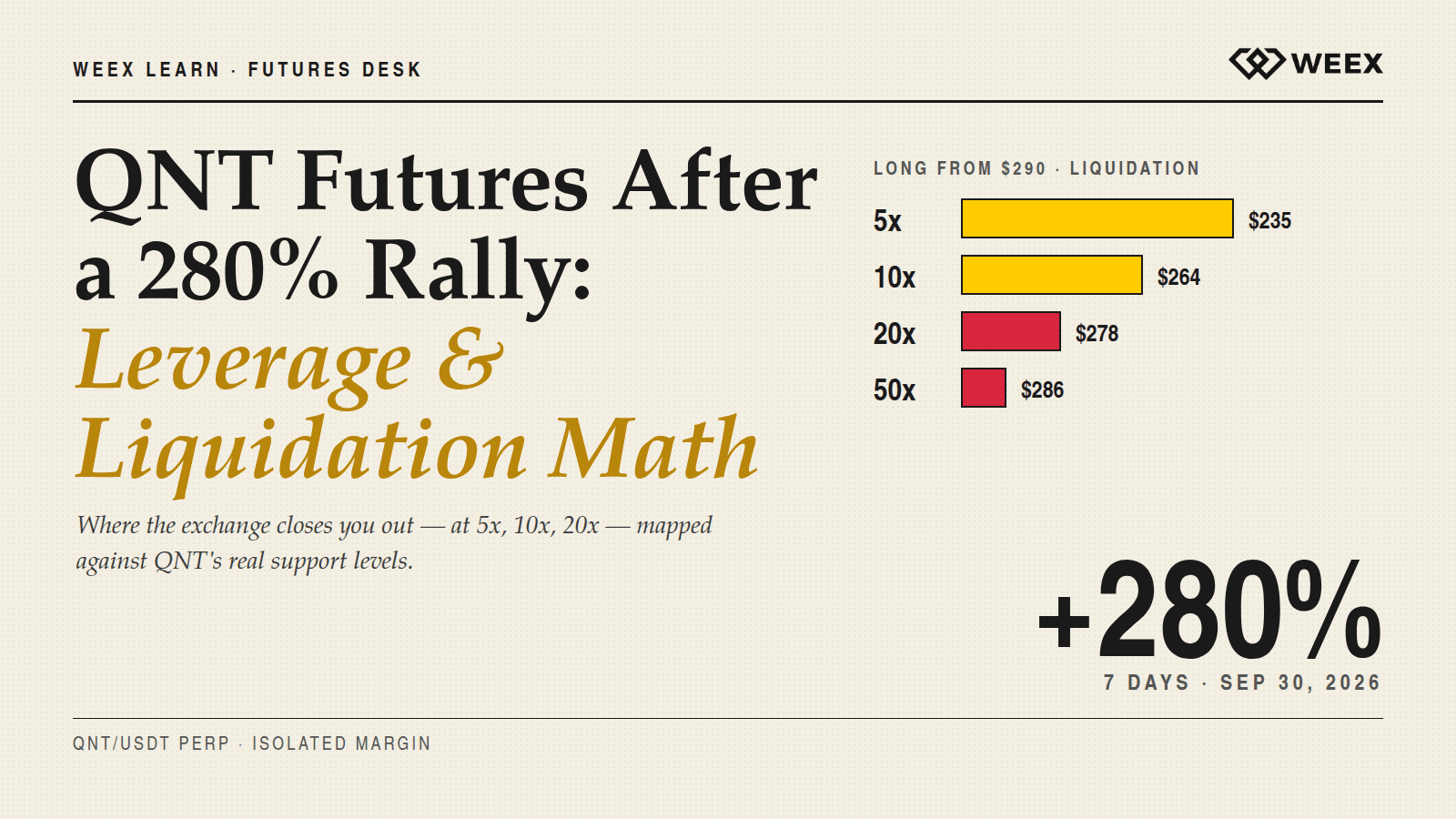
QNT Futures After a 280% Rally: Leverage and Liquidation Math
WIF and POPCAT Price Rally: Can the Solana Meme Rotation Hold?
Is QNT a Stock or Crypto? Quant (QNT) and Quantinuum Stock Are Not the Same Asset
What Is Quant (QNT) Crypto? How Overledger Works, QNT Utility, and Token Supply Explained

Taiwan's Travel Rule Starts in October: What Domestic Crypto Transfers Will Require

Italian Crypto Tax Return 2026: Filing Deadline, Forms and Gains Rate
Ethereum Futures Trading: How to Size ETH Positions and Read PnL
INJ Meridian Upgrade: What Activates Sept 24 and What to Watch

How to Connect Phantom Wallet to a Solana DApp
Funding Rate Crypto: What BTC and ETH Are Paying Right Now
Crypto Liquidation: The Exact Price That Wipes Out Your Position

How to Trade on Hyperliquid: A Step-by-Step Guide
WEEX and MiCA: What the RDWW-1194 Entry in Poland's Register Says
XPL Unlock on Sept 25: How to Long or Short Plasma Futures Safely

Circle's Arc Mainnet Is Live: Can It Actually Close the Gap With Tether's USDT?
Stonkfly Fruit-Fly Brain Bitcoin Experiment: What It Shows and Does Not Prove
SOL Perpetual Contracts: Mark Price, Index Price and Liquidation
XRP Futures: How to Long or Short XRP After the Clarity Act Vote
WEEX API Key Security: What a Leaked Key Can Still Do to You
WEEX API Key Setup: Permissions, IP Binding and Key Limits

Lost Your 2FA Device? Here's What to Do Next
Trust Wallet vs MetaMask: Which One Is Better for Beginners?

Trust Wallet Seed Phrase: How to Store It Safely and What Never to Do

AVAX Futures: Trading the Avalanche RWA Catalyst With Leverage
SpaceX Stock Futures: Where to Put Stops on a 115% Range
LSK Short Squeeze: How $33.7M of Bears Blew Up in a Day
Zcash Futures: What the $34.5M Short Squeeze Cost the Bears
MU Stock After a Record Q4: Why Micron Slipped on a Huge Beat
Bitcoin Futures at $83K: PnL and Position Sizing Into Jobs Week
What Is STOCKER? Stockereum, Stock-Paired Meme Tokens, and Risks
QNT Futures After a 280% Rally: Leverage and Liquidation Math
WIF and POPCAT Price Rally: Can the Solana Meme Rotation Hold?
Is QNT a Stock or Crypto? Quant (QNT) and Quantinuum Stock Are Not the Same Asset