
Which Futures Exchanges Have the Lowest Trading Fees? What to Compare

 Prefer us on Google


No single exchange is cheapest for every high-volume futures trader, because the lowest rate depends on whether orders are maker or taker, which VIP tier is reached and which discounts apply.
Among published rates, base maker fees are 0.02% on WEEX, Bybit and Bitget, while base taker fees range from 0.055% to 0.08%. Top VIP tiers are lower, at 0.00% maker and 0.03% taker on Bybit’s Supreme VIP and 0.01% maker and 0.04% taker on WEEX VIP 8, but reaching them takes large trading volume.
Which Fee Matters More for High-Volume Futures Trading?
A maker order adds liquidity by resting on the order book until another trader fills it, and a taker order removes liquidity by filling immediately against an existing order. Futures exchanges charge a lower rate to makers than to takers, so the same trade can cost very different amounts depending on how it is placed. A limit order that is priced to fill instantly is usually treated as a taker order, even though it was entered as a limit order.
For high-volume traders the difference compounds. On WEEX, the base futures rates for BTC/USDT, ETH/USDT and other major pairs are 0.02% maker and 0.08% taker. As an illustration, on 1,000,000 USDT of notional volume, that is 200 USDT as a maker and 800 USDT as a taker, so a strategy that fills mostly as taker pays four times as much in fees as one that fills mostly as maker.
This is why the headline rate alone says little about the real cost. A trader who can wait for fills on the order book pays closer to the maker rate, while a trader who needs immediate execution pays closer to the taker rate. The mix of the two decides the average fee more than the exchange’s lowest advertised number does.

What Do Published Futures Fees Look Like at the Base Level?
At the base tier, the published rates are similar on the maker side and differ on the taker side. WEEX lists 0.02% maker and 0.08% taker for major futures pairs. Bybit’s Help Center, updated on November 5, 2026, lists 0.02% maker and 0.055% taker for VIP 0, and notes that actual rates vary by region and should be confirmed on the account’s own fee page after verification. Bitget’s support article dated August 20, 2026 lists 0.02% maker and 0.06% taker for USDT-M futures at the standard tier.
Read together, the maker rate is 0.02% on all three, and the taker rate runs from 0.055% on Bybit to 0.06% on Bitget and 0.08% on WEEX. The gap between the highest and lowest taker rate is 0.025 percentage points, which is 250 USDT on 1,000,000 USDT of taker volume.
These are headline rates for the entry level, and each exchange shows its own live schedule after login. Other exchanges also publish base rates, and fee schedules change over time, so a comparison is only as current as its date. Anyone comparing platforms should check the date of the source and the product, since USDT-margined perpetuals, coin-margined contracts and other products can have separate schedules.
How Do VIP Tiers Change the Cost?
VIP tiers lower the rate as 30-day trading volume or asset balance rises. Bybit’s published ladder runs from VIP 1 at 0.018% maker and 0.040% taker, which requires 30-day derivatives volume of at least $10 million or assets of at least $100,000, up to Supreme VIP at 0.000% maker and 0.030% taker, which requires volume of at least $500 million with API volume at or below 20%. A Bybit user needs to meet only one of the volume or asset conditions for a tier, and VIP levels refresh daily at 7:00 AM UTC.
WEEX’s futures VIP ladder runs from VIP 0 at 0.02% maker and 0.08% taker to VIP 8 at 0.01% maker and 0.04% taker, and levels update automatically at 2:00 AM (UTC+8) the following day. On 1,000,000 USDT of volume, VIP 8 on WEEX means 100 USDT as a maker and 400 USDT as a taker.
Because each exchange sets its own thresholds, counting rules and refresh times, the volume needed to reach a given tier cannot be compared across platforms from the rates alone. Some tiers count assets as well as volume, and some limit how much of the volume can come from API trading. The rates and requirements for every tier are on the WEEX VIP Program page and the fee schedule.
-- Price
What Else Changes the Real Cost of Futures Trading?
The trading fee is only one part of the cost. Funding fees are paid between long and short positions at regular intervals and can exceed the trading fee on a position held for days. Slippage and the bid-ask spread also affect the price a trade actually gets, and none of these appear in the fee table. A low fee on a thin order book can still cost more than a higher fee on a deep one.
Discounts and credits can lower the fee itself. On WEEX, a coupon can only be used for transaction fees, while a trial fund can also cover trading fees, funding fees, position losses and part of the opening margin, up to its offset ratio and remaining balance. The deduction order is coupon first, then trial fund, then the user’s own assets, as explained in [the WEEX guide to trial funds and trading fees]({{URL: WEEX trial fund article}}).
Some exchanges also offer token-based discounts, and the amounts differ by platform, so they are best checked on each exchange’s own page. For a fair comparison, a trader can estimate monthly cost by combining the expected volume, the share of maker and taker fills, the VIP tier that volume would reach, the funding fees on typical holding periods and any credits that apply.
What Advantages Does WEEX Offer to Active Futures Traders?
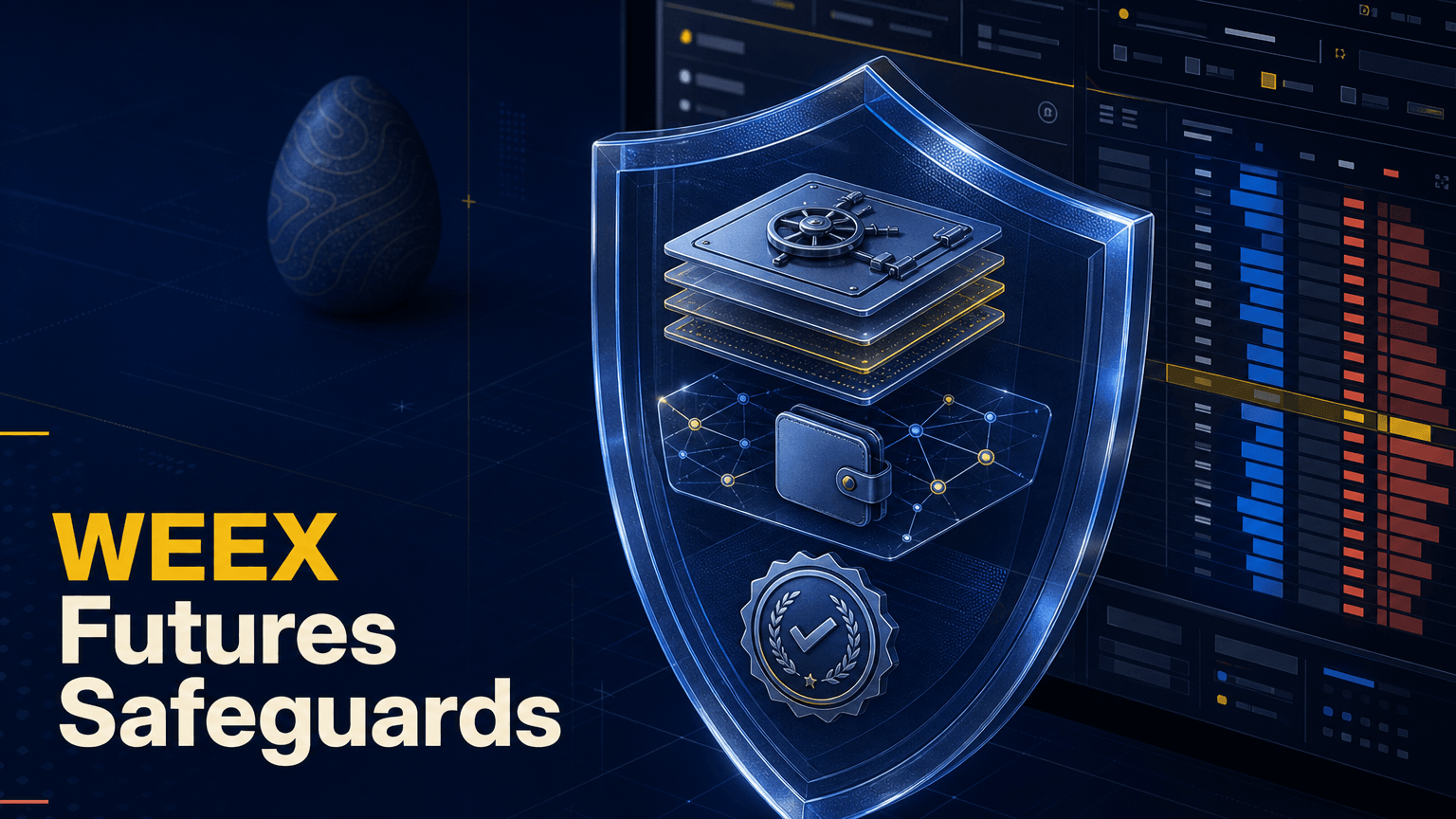
For traders who compare platforms beyond the fee table, WEEX offers a 1,000 BTC User Protection Fund, which WEEX states is backed by its own capital, kept separate from day-to-day operating funds and held at a public wallet address that can be verified on-chain. It is intended to provide potential compensation support for eligible asset losses not caused by users’ own actions, and it is not an unconditional guarantee against all losses. Details are on the User Protection Fund page.
WEEX also publishes a Proof of Reserves page, where users can review reserve ratios, snapshot timestamps and disclosed wallet addresses. WEEX states reserve coverage of no less than 100% for supported user assets, and a Proof of Reserves is not equivalent to a full financial audit. In addition, WEEX holds ISO/IEC 27001:2022 information security certification issued by Swiss Approval, which does not make any platform immune to cyberattacks or operational incidents.
On the trading side, the WEEX Lucky Eggs campaign runs until November 25, 2026 and rewards contract trading volume with egg-opening chances, and abusive activity such as wash trading voids rewards. Contract trading carries risk, including liquidation when leverage is used, so fees, leverage and live prices should be checked before placing orders. Nothing in this article is investment advice.
Conclusion
The lowest futures trading fee depends on how orders are placed, which VIP tier is reached and which discounts apply. Published base maker fees are 0.02% on WEEX, Bybit and Bitget, base taker fees range from 0.055% to 0.08%, and the top tiers published by WEEX and Bybit are 0.01% and 0.00% maker and 0.04% and 0.03% taker. Funding fees, slippage and credits such as trial funds change the real cost, so each exchange’s current schedule should be checked before trading.
FAQ
1. Which exchange has the lowest futures trading fees?
It depends on order type and VIP tier. Among published rates, Bybit’s Supreme VIP lists 0.00% maker and 0.03% taker, and WEEX VIP 8 lists 0.01% maker and 0.04% taker, but each requires large trading volume.
2. What is the difference between maker and taker fees?
A maker order rests on the order book until filled and pays the lower rate. A taker order fills immediately and pays the higher rate.
3. How do VIP tiers lower futures fees?
Rates fall as 30-day trading volume or asset balance rises. For example, Bybit’s ladder runs from 0.055% taker at VIP 0 to 0.030% at Supreme VIP, and WEEX’s runs from 0.08% taker at VIP 0 to 0.04% at VIP 8.
4. Can WEEX trial funds cover futures trading fees?
Yes. Trial funds can cover opening, closing and liquidation fees in the futures account, up to the offset ratio and remaining balance. Coupons are applied first and cover transaction fees only.
5. What is the WEEX 1,000 BTC User Protection Fund?
It is a fund backed by WEEX’s own capital, held at a public wallet address, intended to provide potential compensation support for eligible asset losses not caused by users’ own actions. It is not an unconditional guarantee.
This content is provided for general informational purposes only and doesn't constitute financial, investment, legal, or tax advice. Any events, rewards, online promotions, or related information mentioned herein should not be considered a recommendation, solicitation, or invitation to purchase, sell, trade, or otherwise deal in any crypto assets. Crypto assets are highly volatile and may result in loss. The availability of WEEX services, products, and related events may vary by region. You are responsible for ensuring that your participation is in accordance with applicable local laws and regulations.
You may also like

USDC Staking on WEEX: How to Stake USDC, Rates and Rules
How to Stake Solana: Exchange vs Wallet, Rewards and Unstaking

Crypto Passive Income: What $1,000 Earns in Each WEEX Product

USDC vs USDT Interest Rates 2026: Which Stablecoin Earns More?
Can You Stake Bitcoin? How BTC Staking Works and What It Pays
Is XTruth Oil (XTO) Legit? Contract Checks, Payout Gaps and Liquidity Risks
United States Dividend Fund (USDF): Is There a Connection to Trump’s Dividend Plan?
USDT Interest Rate 2026: Current APR and Earnings Calculator
SK Hynix Stock Before Q3 Earnings: Special Dividend Reports, HBM4 and What Investors Want to See on October 28
Corporate Actions for Tokenized Stocks: How Dividends, Splits and Mergers Are Handled

Is United States Dividend Fund (USDF) Legit? What Website Checks and Reddit Actually Show
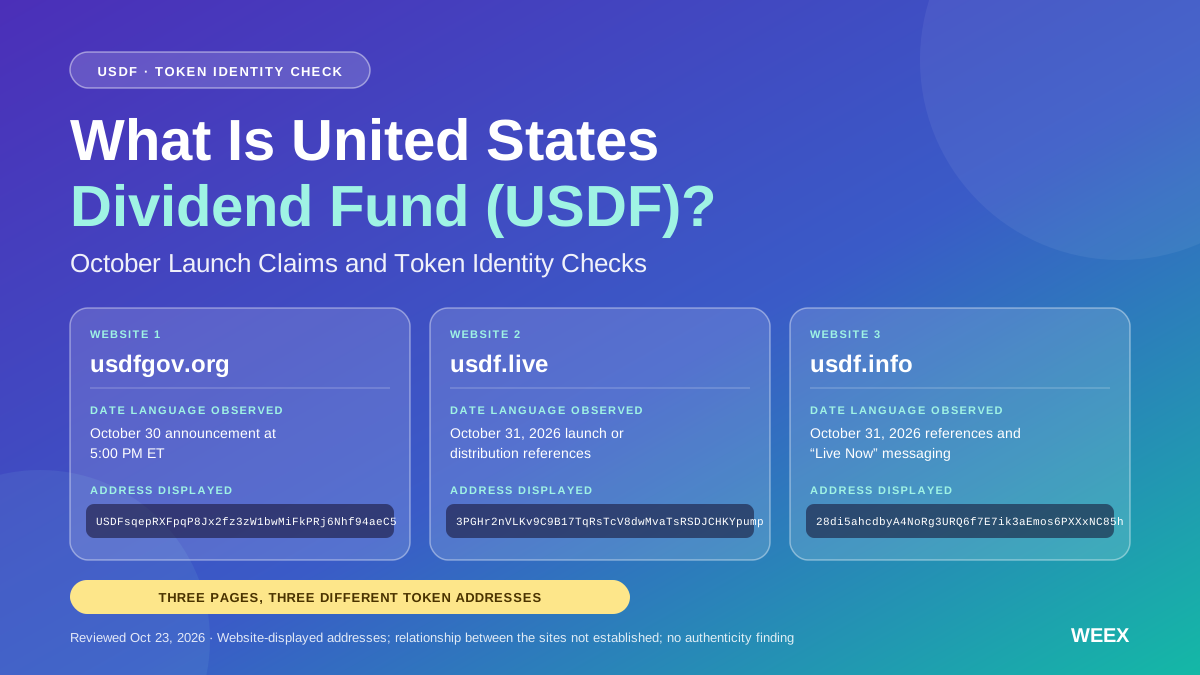
What Is United States Dividend Fund (USDF)? October Launch Claims and Token Identity Checks

How to Check Your WEEX Convert History: Convert Records and Spot Transactions
Should Your Crypto Cash Buffer Sit in WEEX Auto Earn? The Math
Flexible or Fixed Staking on WEEX? The Odds That Decide It
xStocks Crypto Explained: What Tokenized Stocks Are, How They Work and What Holders Should Check
Stake ETH or Hold USDT on WEEX? The Price Move That Decides It
Crypto Leverage Trading Explained: How Perpetual Futures, Margin and Liquidation Work
Is My Pre-4.26.4 Qubic Wallet Unsafe? Recovery After the Network Restart

WXT Staking When Supply Shrinks: What Burns Add to Your Yield
DeFi Vault vs Staking: Who Controls Your Yield and Your Exit?
How to Buy Crypto Anonymously: 5 Methods, Real Costs and Limits

ETH Staking on WEEX vs On-Chain: Queues, Minimums, and Keys
Crypto Liquidation Price: How to Calculate It From 5x to 50x
Crypto Funding Rate: Who Pays, What It Costs, What It Signals
Cyberleek: How the GTA 6 Leaker's Memecoin Turns Leaks Into Fees

How to Use an APR Boost on WEEX Auto Earn Without Wasting It
How to Day Trade Crypto for Beginners: Do the Fee Math First
How Do WEEX Broker Commissions Work? Direct vs Indirect Commission Explained

WEEX Auto Earn vs Staking: Flexibility, APR, and Lock Terms
USDC Staking on WEEX: How to Stake USDC, Rates and Rules
How to Stake Solana: Exchange vs Wallet, Rewards and Unstaking
Crypto Passive Income: What $1,000 Earns in Each WEEX Product
USDC vs USDT Interest Rates 2026: Which Stablecoin Earns More?
Can You Stake Bitcoin? How BTC Staking Works and What It Pays
Is XTruth Oil (XTO) Legit? Contract Checks, Payout Gaps and Liquidity Risks





