
2025 Crypto Violence Retrospective: 65 Physical Assaults, 4 Fatal Incidents

 Prefer us on Google

Original Article Title: In Defense of Exponentials
Original Article Author: Haseeb Qureshi, Dragonfly General Partner
Original Article Translation: Azuma, Odaily Planet Daily
Editor's Note: Do you remember the recent news about the Russian cryptocurrency billionaire Roman Novak and his wife Anna being found dismembered and buried on a beach in Dubai? In 2025, another dark side of the cryptocurrency industry is the increasing frequency of violent attacks against holders, especially the wealthy.
As a highly recognizable figure in the industry, Haseeb Qureshi, the bald-headed General Partner of Dragonfly, has today conducted a data analysis of violent incidents in the cryptocurrency field in recent years and explained that the reason for writing this article is because he is "increasingly scared." The data shows that in 2025, there were a total of 65 violent incidents in the industry, including 4 major fatal cases. Not only is the number of attack incidents rapidly increasing, but the attacks themselves are becoming more violent. Therefore, at the end of the article, Haseeb thoughtfully includes some personal safety recommendations.
Below is Haseeb's full article, translated by Odaily Planet Daily.
Are violent attacks against cryptocurrency holders on the rise?
Jameson Lopp has been quietly maintaining a database known as "wrench attacks," which are violent attacks against cryptocurrency holders aimed at coercing them to hand over their crypto assets. This is currently our closest source of "real-world benchmark data" to assess whether holding crypto assets is becoming more dangerous over time.
I have recently become increasingly afraid of such attacks, so I took Lopp's dataset and used a somewhat Vibe Coding method to visualize some of it to see what's really going on. Here are my findings.
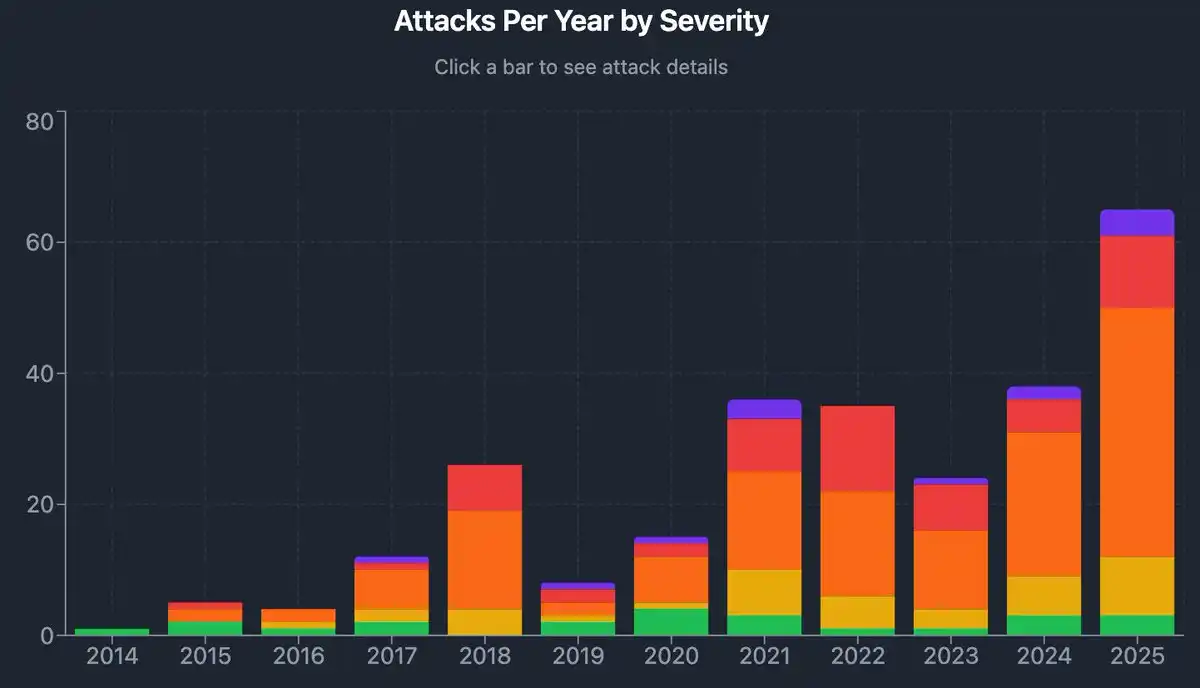
You are not mistaken—the number of attack incidents is indeed increasing over time (with 65 incidents in 2025). Furthermore, the attacks themselves are becoming more violent.
I had Claude categorize each attack into 5 levels, with the specific classification scheme as follows:
· Minor (3 incidents in 2025): Theft without physical confrontation, attempted theft, ATM/device theft.
· Moderate (9 incidents in 2025): Robbery with some level of violence or assault, drugging, extortion;
· Severe (38 incidents in 2025): Armed robbery, kidnapping, home invasion with firearms or weapons;
· Extremely Severe (11 incidents in 2025): Kidnapping involving torture, dismemberment, severe beating, gunshot wounds;
· Fatal (4 incidents in 2025): Victim fatality.
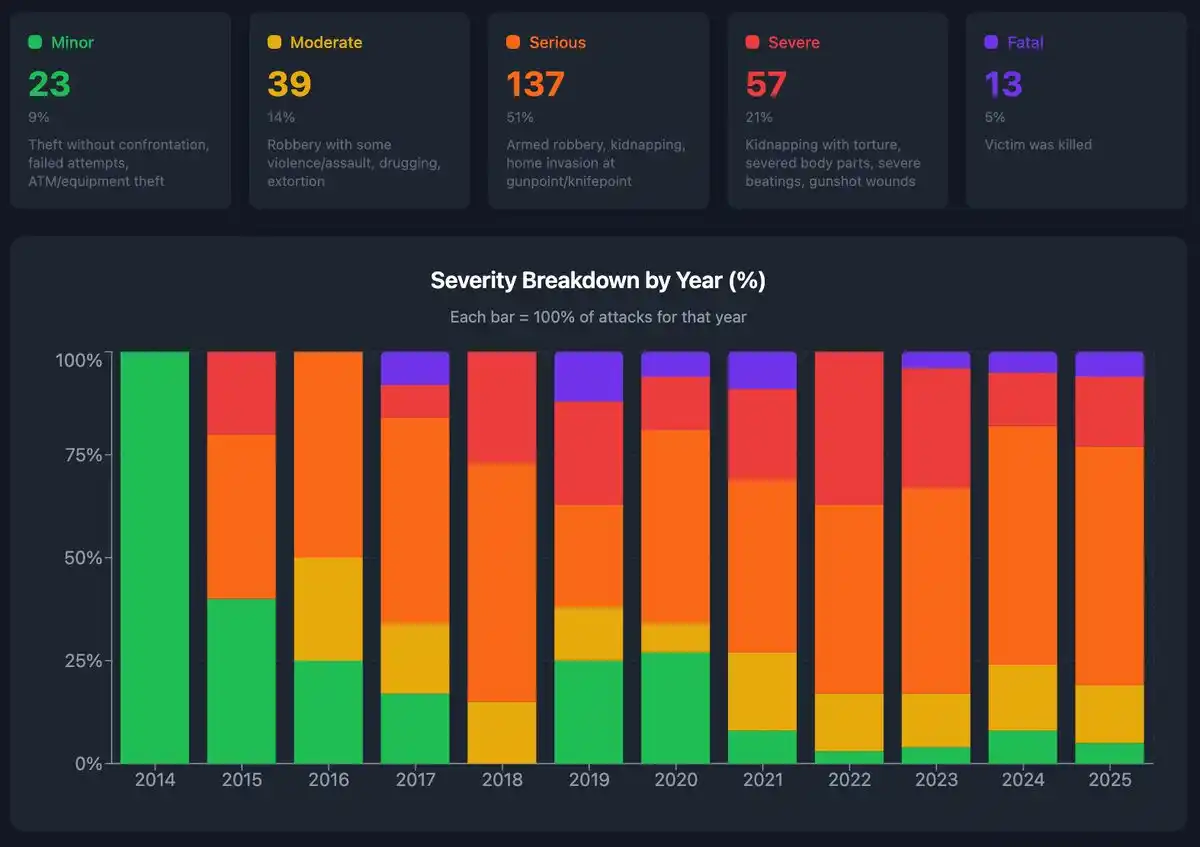
From the results, it can be seen that on average, the level of violence per single attack is continuously increasing.
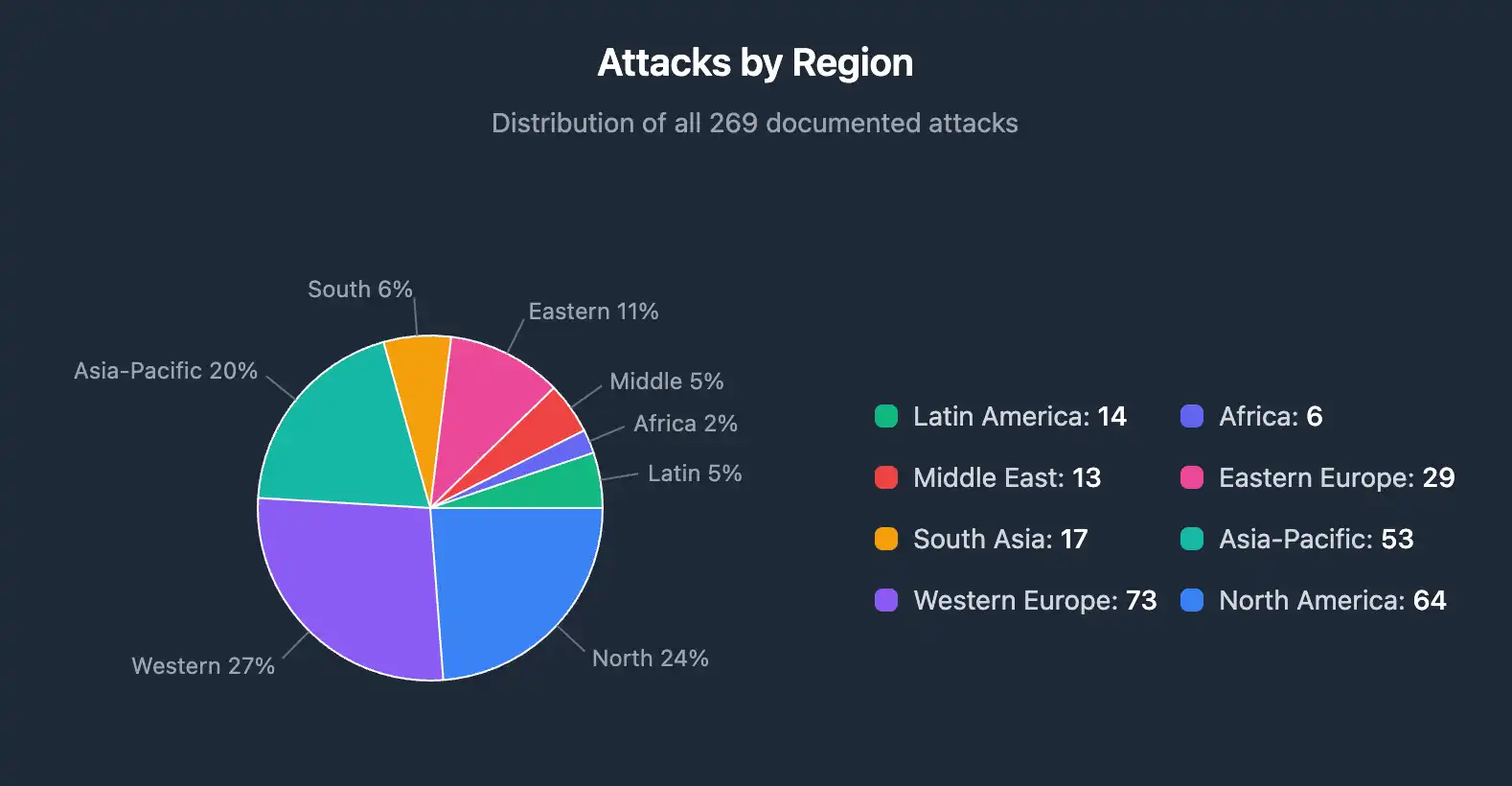
Geographically, Western Europe and the Asia-Pacific region saw the highest increase in violent incidents. North America is currently still relatively the safest region, but even in North America, there has been an upward trend in absolute numbers.
So, what is causing the rise in violent incidents?
One of the most straightforward explanations is to link the frequency of violent incidents to the total market capitalization of the cryptocurrency market. In simple terms—higher prices, more crime.
Take a look at the chart results: the white line represents the total market cap of cryptocurrency; the colored area represents the number of violent incidents.
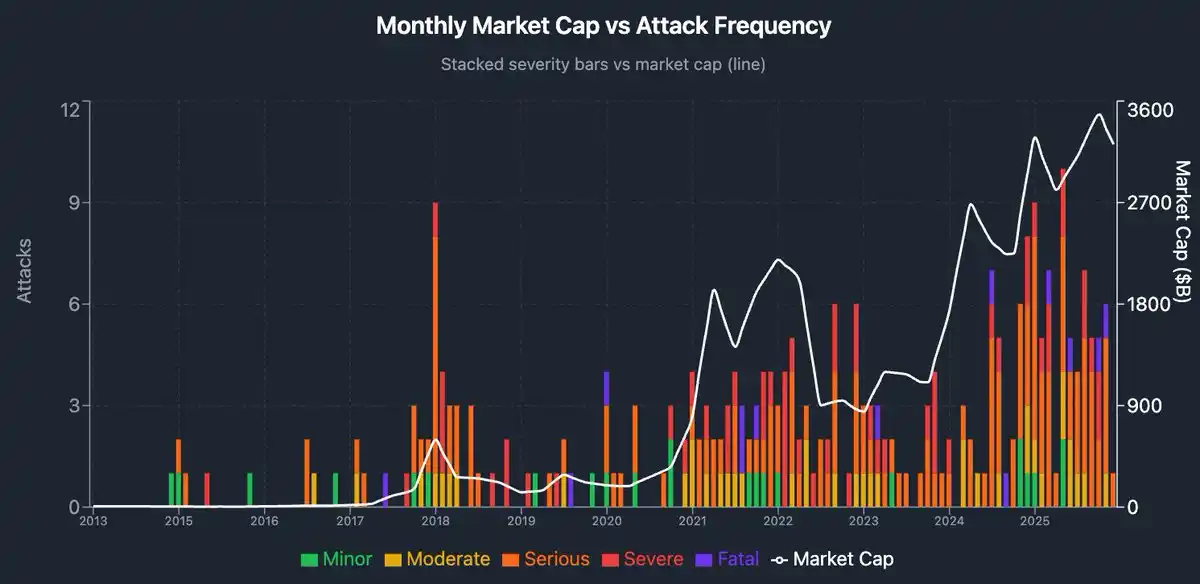
Conducting a simple regression analysis, the provided R² result is 0.45, meaning that 45% of the variation in violent incidents can be explained solely by the price itself. In other words, as we mentioned earlier, when prices rise, violent incidents increase—I have also run regression analyses on other variables, but none are as convincing as total market cap.
So, is it that simple? Does this already prove that holding cryptocurrency will pose an increasing personal danger?
We can perform another "stress test" to see if there are other hypotheses that could explain why the number of violent incidents is on the rise?
One possible explanation is that the increase in cryptocurrency prices inherently means more people hold cryptocurrency assets. In other words, the increase in criminal events may simply be because the "population base" has increased, and the actual risk of violence faced by each individual may not have truly risen.
Let's conduct a rationality check on this. Since accurately measuring the total number of cryptocurrency users is difficult, I chose two alternative indicators:
· The first is Coinbase's monthly active users, not cumulative registered users, as we want to exclude those who have already churned and no longer hold coins;
· The second method is more rudimentary, analyzing the number of violent incidents per unit market cap to derive an approximate measure of the "likelihood of theft per dollar."
Once you standardize the above data, you will see completely different conclusions: the blue line represents the number of violent incidents per Coinbase user; the green line represents the number of violent incidents per dollar of wealth
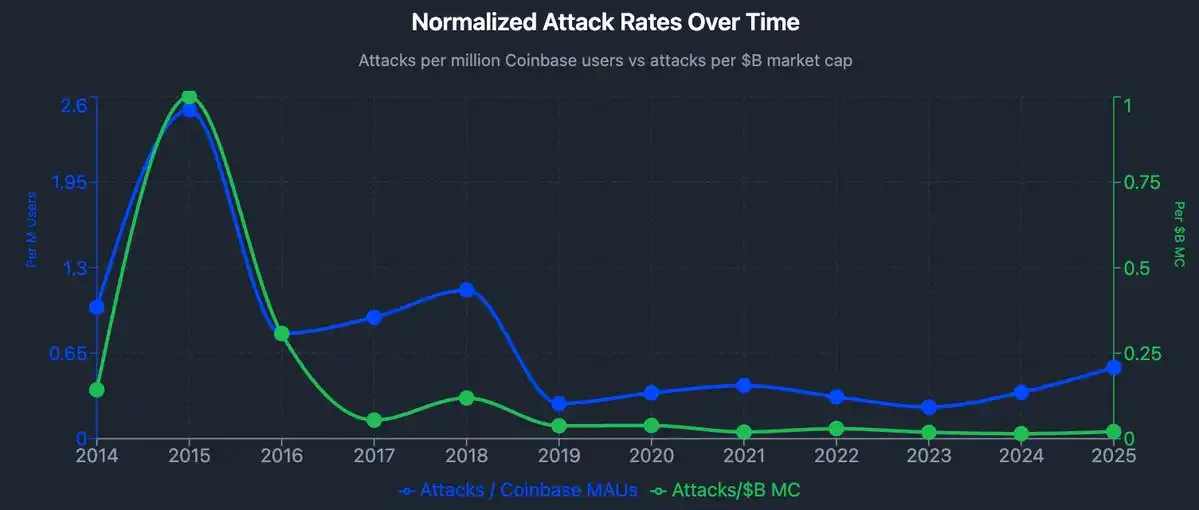
This data set suggests that 2015 and 2018 were actually the most dangerous periods to hold crypto. Yes, even though the number of attack incidents was much lower at that time, the number of cryptocurrency holders was also much, much lower.
From 2015 to 2025, Coinbase's monthly active users grew from 2 million to 120 million, a whopping 60x increase, but violent incidents did not increase proportionally.
Certainly, in recent years, the number of violent incidents per user has indeed increased, but the increase has been relatively modest, roughly equivalent to the 2021 violence levels and significantly lower than pre-2019 levels. Meanwhile, the rate of violent incidents per dollar of wealth has remained nearly unchanged.
We must also consider the alternative hypothesis of "news reporting bias"—whether incidents are just more likely to be reported—but this is beyond the scope of this analysis.
Overall, the number of violent incidents is indeed increasing, and the attack methods are becoming more violent. However, this can be partially attributed to the "population effect," meaning there are now more cryptocurrency holders, so the individual risk is not increasing as dramatically as it may seem.
But ultimately, this is not just an academic discussion. This is a truly serious, real-world issue.
If you are part of a high-risk group, there are actually many ways to improve your personal security. Here are some standard offline security suggestions:
· Try to live in a secure city, preferably in a residence with 24/7 security;
· Avoid wearing cryptocurrency-related clothing or implying that you hold cryptocurrency in public;
· Use a service like DeleteMe to remove your personal information from data brokers;
· Get a PO Box and have all commercial mail sent there to prevent your address from being widely circulated;
· Set up a hot wallet with a "giveaway" amount of money that is entirely separate from your actual cold storage assets;
· Diversify your funds: use multiple services, platforms, and devices to store your assets so that you don't lose everything at once in the worst-case scenario;
· Unless necessary, avoid publicly broadcasting your specific location in real-time, especially during cryptocurrency conferences;
· If you are truly part of a high-risk group or are about to visit a high-risk area, consider hiring private security – in some areas, this can be much more useful than you think.
2026 has arrived, and the year-end is approaching, with a long holiday ahead. Please be sure to stay safe.
-- Price
This content is provided for general informational purposes only and doesn't constitute financial, investment, legal, or tax advice. Any events, rewards, online promotions, or related information mentioned herein should not be considered a recommendation, solicitation, or invitation to purchase, sell, trade, or otherwise deal in any crypto assets. Crypto assets are highly volatile and may result in loss. The availability of WEEX services, products, and related events may vary by region. You are responsible for ensuring that your participation is in accordance with applicable local laws and regulations.
You may also like

Futu has had all its illegal gains confiscated, reminding cryptocurrency exchanges

Kraken's parent company Payward has received preliminary approval from Dubai VARA to conduct cryptocurrency business
Chinese and American police jointly crack down on a Dubai-based fraud gang for the first time, suspected of luring victims with high-return cryptocurrency projects

The US FBI, in collaboration with multiple countries, has dismantled several "pig butchering" cryptocurrency scam networks, involving amounts totaling millions of dollars

Gate's Q1 2026 report is online, compliance layout strengthens global competitiveness

70x in a Month: When $RAVE Put Istanbul’s Dancefloor on the Chain
A Web3 project with zero VCs and no whitepaper started with a midnight party for 200 people. Eighteen months later, its token $RAVE is up 70x, and its contract liquidations briefly eclipsed Ethereum’s. Is this just pure speculation, or are we looking at a new breed of cultural asset?

Soaring 50 times, with an FDV exceeding 10 billion USD, why RaveDAO?

Binance provides temporary transfers for employees in the UAE to address disruptions in operations in the region due to the Middle East conflict

Dubai releases regulatory framework for derivatives trading on cryptocurrency exchanges

UAE Accelerates Digital Dirham Pilot with Its First Successful Transaction
Key Takeaways The UAE’s pilot program for its central bank digital currency (CBDC), the digital dirham, has achieved…

SAFEX has officially rebranded to YUBIT, ushering in a new era of globalization and innovation.
WLFI collaborates with RaveDAO to host its first offline event, bringing the world's first USD1 offline payment scenario to life.

Reuters: A huge explosion was heard in Dubai

The world belongs to Chinese people who speak English
Drone attacks on oil tanks near Dubai airport, Emirates flights suspended

USDC's market value is approaching its historical high of 80 billion USD, with analysts attributing this to capital outflow from the UAE
The Dubai TOKEN2049 summit is proposed to be postponed to April 2027 due to geopolitical influences

Stablecoins are breaking away from cryptocurrency, becoming the next generation of infrastructure for global payments

Due to the impact of the geopolitical situation, the demand for stablecoins in Dubai has surged, with over 2.3 billion USDC minted in the past week
Hong Kong Crypto Ecosystem 2.0: Stablecoins, RWA, and the New Battleground for Financial Institutions

Political Prediction Market 67% Win Rate Star Account Wagers $27,100 on "US-Iran Ceasefire in March"

Token2049 Dubai Organizer: Despite Escalating Middle East Conflict, Conference Will Proceed as Planned

The Shadow Business Empire of Iran's New Supreme Leader: Oil, Real Estate, and Financial Intrigue
Dubai gold is experiencing rare discounted trading, possibly due to logistics disruptions caused by the Middle East conflict
36 years, 4 wars, 1 script: How does capital price the world in conflict?
MegaETH Co-founder: 48 Hours After Leaving Dubai, I Reassessed the Entire Crypto Space
Near Dubai's renowned wealthy enclave "Palm Jumeirah," a loud explosion, thick smoke, and fire were reported.
Elliptic Highlights Russian Crypto Platforms Evading Sanctions
Key Takeaways: A network of Russian crypto exchanges is reportedly aiding users in circumventing Western sanctions. Five major…

WEEX AI Trading Hackathon Dubai Opening Ceremony Ends, Live Viewers Exceed 150,000
Bybit to Introduce Dollar Accounts With Partner Banks – Can Crypto Go Mainstream?
Key Takeaways Bybit plans to introduce “MyBank” dollar accounts in partnership with licensed financial institutions, enhancing seamless conversion…
Futu has had all its illegal gains confiscated, reminding cryptocurrency exchanges
Kraken's parent company Payward has received preliminary approval from Dubai VARA to conduct cryptocurrency business
Chinese and American police jointly crack down on a Dubai-based fraud gang for the first time, suspected of luring victims with high-return cryptocurrency projects
The US FBI, in collaboration with multiple countries, has dismantled several "pig butchering" cryptocurrency scam networks, involving amounts totaling millions of dollars
Gate's Q1 2026 report is online, compliance layout strengthens global competitiveness
70x in a Month: When $RAVE Put Istanbul’s Dancefloor on the Chain
A Web3 project with zero VCs and no whitepaper started with a midnight party for 200 people. Eighteen months later, its token $RAVE is up 70x, and its contract liquidations briefly eclipsed Ethereum’s. Is this just pure speculation, or are we looking at a new breed of cultural asset?

Contents
Latest articles

Latest coin listings on WEEX


