
 Buy Crypto
- Markets
 Futures
- Spot
- Copy Trade
- Earn
- More
ARK Founder "Wood Sister" 2026 Prediction: Gold Peak, Dollar Rebound, Bitcoin Enters Independent Price Movement

Original Title: Cathie Wood's 2026 Outlook: The US Economy Is A Coiled Spring
Original Author: Cathie Wood, Founder of ARK Invest
Original Translation: Ying Zhao, Wall Street News
ARK Invest founder Cathie Wood (aka "Wood Sister") released a macro outlook in her latest 2026 New Year Investor Letter, likening the next three years to "Reaganomics on steroids." She pointed out that with deregulation, tax cuts, sound monetary policy, and the integration of innovative technologies, the US stock market will usher in another "golden age," and the upcoming surge in the US dollar may put an end to the upward momentum of the gold price.
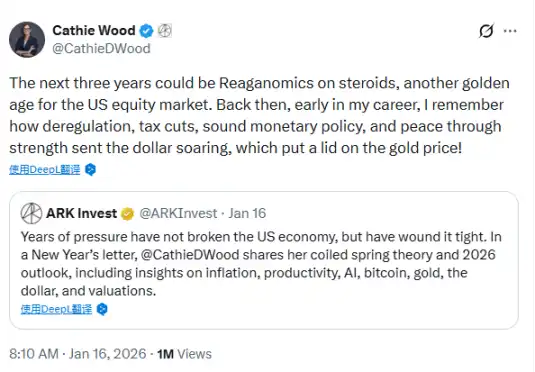
Specifically, Cathie Wood believes that despite the continuous growth in real GDP over the past three years, the underlying US economy has actually experienced a rolling recession and is currently in a "coiled spring" state, poised for a strong rebound in the coming years. She particularly emphasized that with David Sacks leading the charge as the first AI and cryptocurrency czar to relax regulations and the effective corporate tax rate moving towards 10%, the US economic growth will receive a substantial policy dividend.
At a macro level, Wood predicts that, driven by a productivity boom, inflation will be further controlled and may even turn negative. She expects that the nominal GDP growth rate in the US over the next few years will remain in the range of 6% to 8%, primarily driven by productivity gains rather than inflation.
In terms of market impact, Wood predicts that the relative advantage of US investment returns will drive a significant appreciation in the US dollar exchange rate, echoing the situation in the 1980s when the US dollar almost doubled. She warned that despite the significant price increase in gold over the past few years, the strengthening of the US dollar will suppress the price of gold, while Bitcoin, due to its supply mechanism and low asset correlation, will show a different trend from gold.
Regarding the market valuation issue that investors are concerned about, Wood does not believe that an AI bubble has formed. She pointed out that although the current price-to-earnings ratio is at a historical high, as AI, robots, and other technologies drive a productivity boom, the growth in corporate earnings will absorb the high valuations, and the market may achieve positive returns while experiencing a contraction in the price-to-earnings ratio, similar to the bull market path in the mid to late 1990s.
Here is the original text of the Investor Letter:
Wishing a Happy New Year to ARK's investors and other supporters! We greatly appreciate your support.
As outlined in this letter, we truly believe that investors have many reasons to remain optimistic! We hope you enjoy our discussion. From an economic history perspective, we are at a crucial moment.
Coiled Spring Ready to Unleash
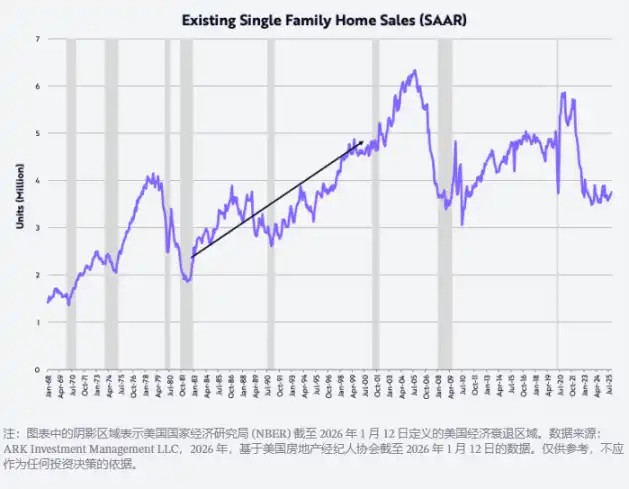
Despite the continuous growth in the real Gross Domestic Product (GDP) of the United States over the past three years, the underlying structure of the U.S. economy has undergone a rolling recession and gradually transformed into a tightly compressed spring, poised for a strong rebound in the coming years. In response to the supply shock related to the COVID-19 pandemic, the Federal Reserve raised the federal funds rate from 0.25% in March 2022 to a significant 5.5% by July 2023 over a 16-month period, a record 22-fold increase. This rate hike has pushed housing, manufacturing, AI-related capital expenditures, and the U.S. middle-to-low-income segment into a recession, as depicted in the chart below.
Measured by existing home sales volume, the housing market plummeted 40% from an annualized 5.9 million units in January 2021 to 3.5 million units in October 2023. This level was last seen in November 2010, and over the past two years, existing home sales have been fluctuating around this level. This demonstrates how tightly the spring has been compressed: the current level of existing home sales is equivalent to the early 1980s when the U.S. population was approximately 35% lower than it is now.
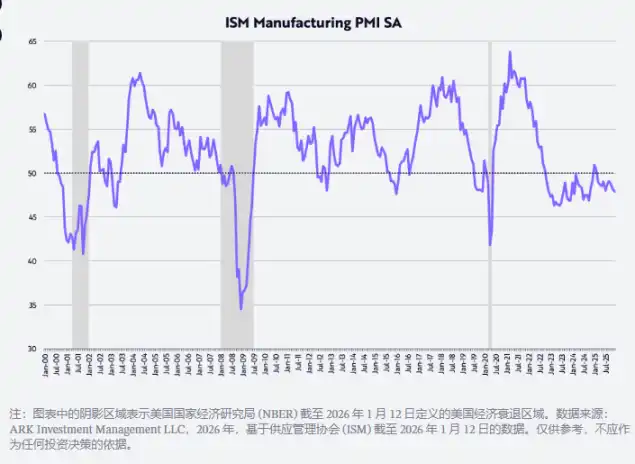
Measured by the U.S. Purchasing Managers' Index (PMI), the manufacturing sector has been in a contraction phase for about three years. According to this diffusion index, 50 is the threshold between expansion and contraction, as shown in the chart below.
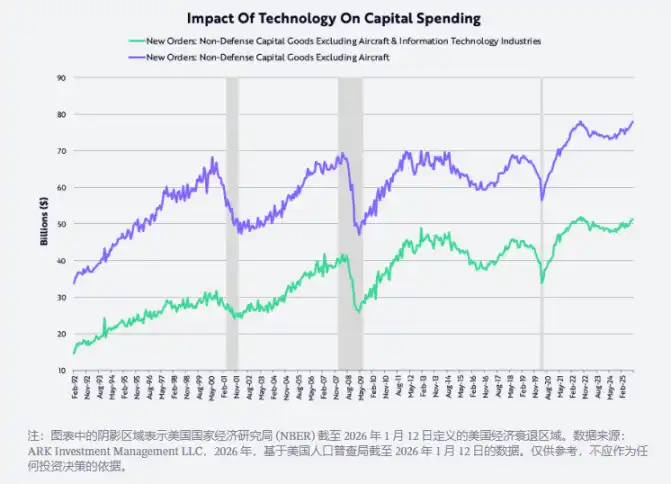
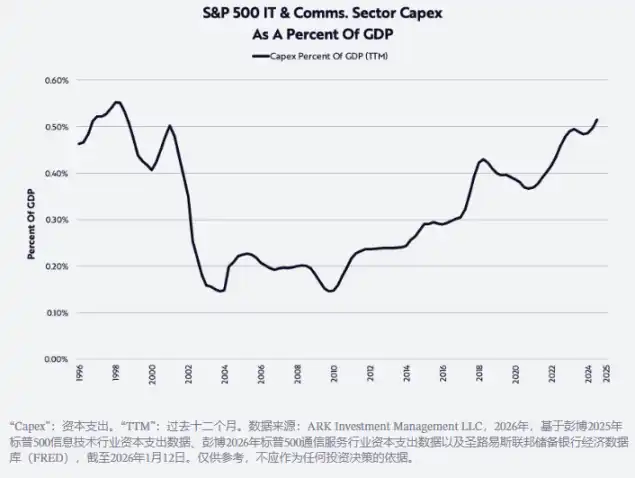
Meanwhile, capital expenditures, excluding defense and aircraft, peaked in mid-2022, and since then, regardless of technological influences, the expenditure level has rebounded to that peak. In fact, this capital expenditure metric struggled for over 20 years to break through since the burst of the tech and telecom bubble until 2021 when the supply shock of the COVID-19 pandemic forced both digital and physical investments to accelerate. The once spending ceiling appears to have transformed into a spending floor as AI, robotics, energy storage, blockchain technology, and multi-omics sequencing platforms are poised and ready to usher in a golden age. Following the technology and telecom bubble of the 1990s, a $700 billion spending peak lasted for 20 years, and now, as illustrated below, this may be the strongest capital expenditure cycle in history. We believe the AI bubble is far from materializing!
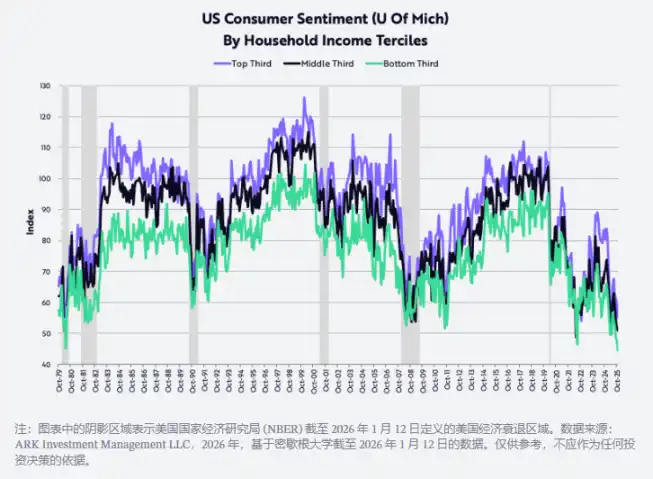
Meanwhile, data from the University of Michigan shows that confidence among the middle- and low-income groups has dropped to the lowest level since the early 1980s. Back then, double-digit inflation and high interest rates severely eroded purchasing power, pushing the U.S. economy into a prolonged recession. Additionally, as shown in the chart below, confidence among high-income individuals has also declined in recent months. In our view, consumer confidence is currently one of the most tightly compressed and rebound-ready "springs."
Relaxing Regulations, while Reducing Taxes, Inflation, and Interest Rates
Benefiting from a combination of relaxed regulations, reduced taxes (including tariffs), inflation, and interest rates, the rolling recession that the U.S. has experienced over the past few years could rapidly and dramatically reverse in the next year and beyond.
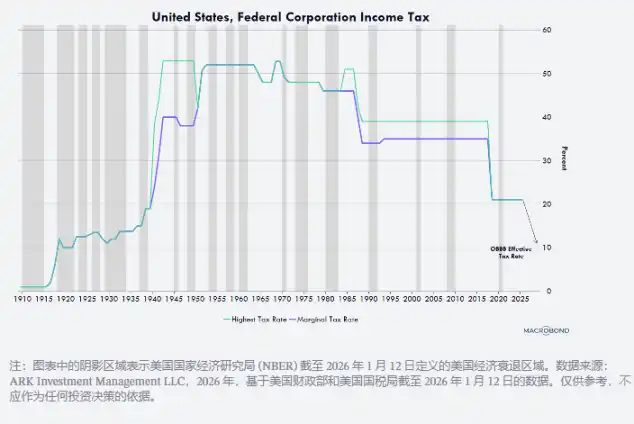
Regulatory relaxation is unleashing innovation across various sectors, led by the first "AI and Crypto Czar" David Sacks. Meanwhile, reductions in tips, overtime pay, and social security taxes will provide a significant tax refund to U.S. consumers this quarter, potentially driving the annualized growth rate of real disposable income from around 2% in the second half of 2025 to around 8.3% this quarter. Furthermore, as manufacturing facilities, equipment, software, and domestic R&D expenses enjoy accelerated depreciation, the effective tax rate for businesses will be reduced to near 10% (as shown in the chart below), with an expected substantial increase in corporate tax refunds, and 10% is one of the lowest tax rates globally.
For example, any business that starts construction of a manufacturing plant in the U.S. by the end of 2028 can achieve full depreciation in the first year of operation, rather than spreading it over 30 to 40 years as in the past. Equipment, software, and domestic R&D expenses can also achieve 100% depreciation in the first year. This cash flow favorable policy was permanently established in last year's budget and retroactively applies from January 1, 2025.
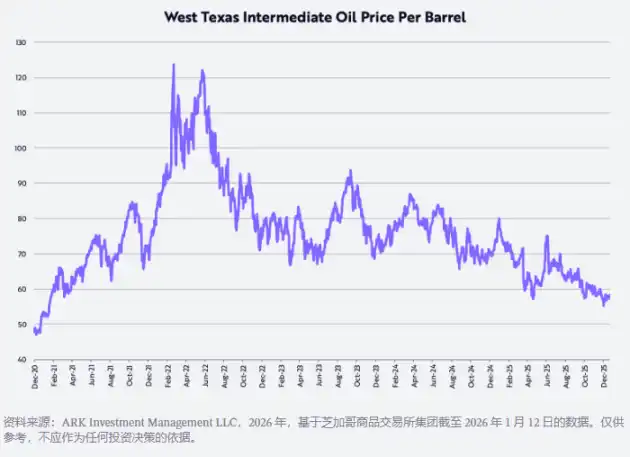
Over the past few years, inflation measured by the Consumer Price Index (CPI) has stubbornly hovered in the 2% to 3% range, but in the coming years, for several reasons as shown in the chart below, the inflation rate is likely to decline to an unexpectedly low level—even potentially negative. Firstly, the West Texas Intermediate (WTI) crude oil price has fallen by about 53% since its peak around $124 per barrel on March 8, 2022, post-COVID-19 pandemic, currently down by about 22% year-on-year.
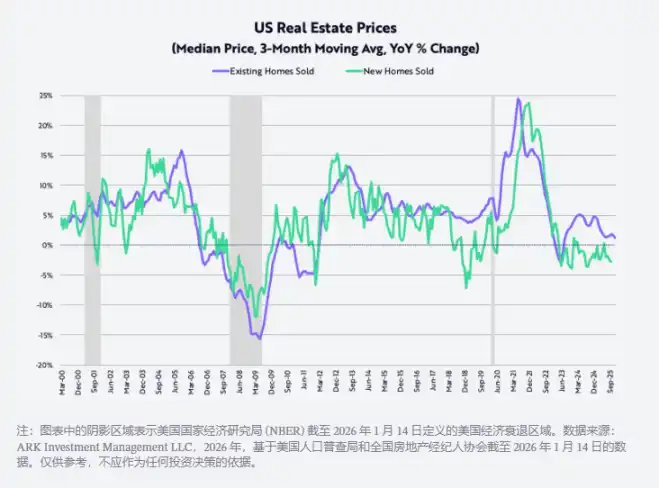
Since peaking in October 2022, the sales price of new single-family homes has decreased by about 15%; meanwhile, the price inflation rate of existing single-family homes — based on a three-month moving average — has dropped from a year-on-year rate of about 24% at the peak post-June 2021 pandemic to approximately 1.3%, as shown in the chart below.
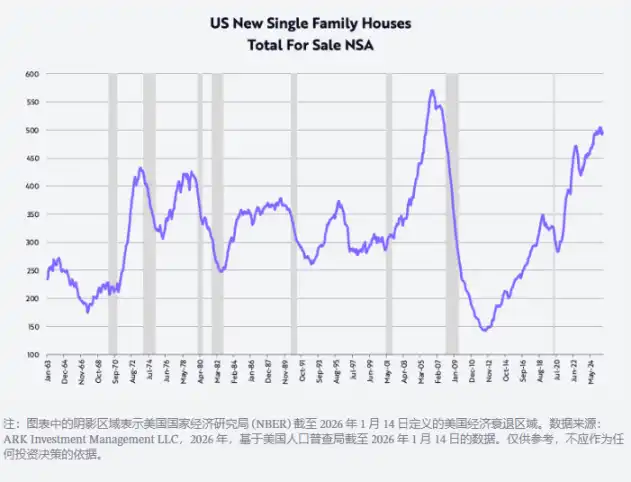
In the fourth quarter, in order to digest a close to 500,000-unit inventory of new single-family homes (the highest level since the eve of the global financial crisis in October 2007, as shown in the chart below), the top three homebuilders significantly reduced prices, with year-on-year declines as follows: Lennar -10%, KB Homes -7%, and DR Horton -3%. The impact of these price declines will lag in reflecting on the Consumer Price Index (CPI) over the next few years.
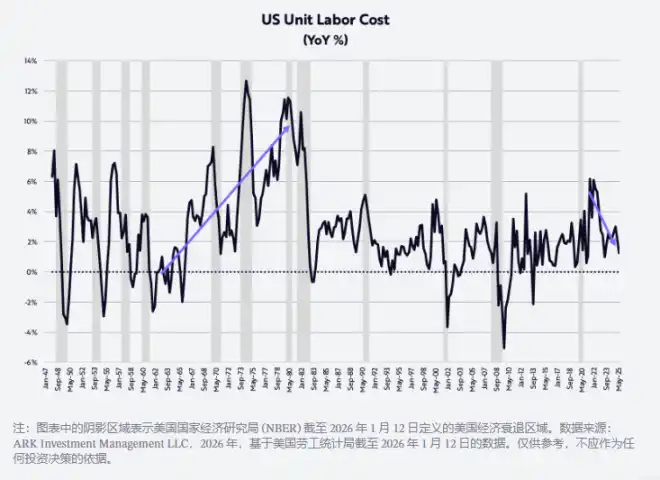
Lastly, as one of the most potent forces to counter inflation, nonfarm productivity has grown against the backdrop of continued decline, increasing by 1.9% year-on-year in the third quarter. In stark contrast to the 3.2% growth in hourly compensation, the improvement in productivity has reduced the unit labor cost inflation rate to 1.2%, as shown below. This figure does not show the cost-push inflation reminiscent of the 1970s!
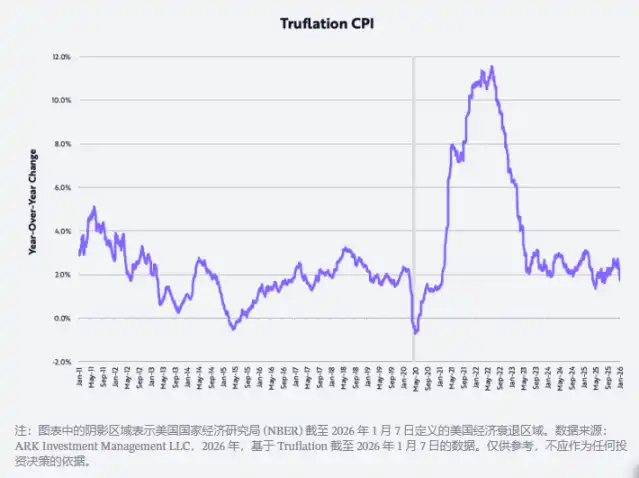
This improvement is also validated: the inflation rate, as measured by Truflation, has recently decreased year-on-year to 1.7%, as shown in the chart below, almost 100 basis points (bps) lower than the inflation rate calculated based on the Consumer Price Index (CPI) by the U.S. Bureau of Labor Statistics (BLS).
Productivity Boom
In fact, if our research on technology-driven disruptive innovation is correct, then over the next few years, influenced by cyclical and secular factors, the nonfarm productivity growth rate should accelerate to 4-6% annually, further dampening unit labor cost inflation. The convergence between major innovation platforms under development — artificial intelligence, robotics, energy storage, public blockchain technology, and multi-omics technology — is not only expected to drive productivity growth to sustainable new highs but also poised to create immense wealth.
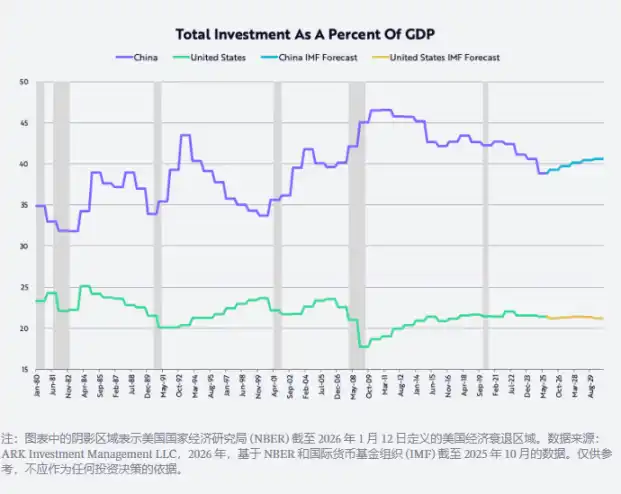
The productivity gains could also help correct significant geopolitical economic imbalances in the global economy. Businesses can channel the benefits of productivity enhancement into one or more of the following four strategic directions: expanding profit margins, increasing R&D and other investments, raising wages, and/or lowering prices. In China, raising wages for higher productivity workers and/or increasing profit margins can help the economy overcome structural issues of overinvestment. Since joining the World Trade Organization (WTO) in 2001, China's investment as a percentage of GDP has averaged around 40%, nearly double that of the U.S., as shown in the chart below. Increasing wages will drive the Chinese economy towards a consumption-oriented transformation, moving away from the path of commodification.
However, in the short term, technology-driven productivity gains may continue to slow US job growth, leading to an increase in the unemployment rate from 4.4% to above 5.0% and prompting the Fed to continue cutting rates. Subsequently, relaxation of regulations and other fiscal stimulus measures should amplify the impact of low rates and accelerate GDP growth in the second half of 2026. Meanwhile, inflation may continue to decelerate, driven not only by declines in oil prices, housing, and tariffs but also benefiting from technological advancements that drive productivity growth and lower unit labor costs.
Surprisingly, artificial intelligence training costs are decreasing by 75% per year, while artificial intelligence inference costs (i.e., the cost of running AI application models) are seeing a whopping 99% annual decrease (based on some benchmark data). The unprecedented decline in various technology costs is expected to fuel a surge in its per-unit growth. Therefore, we anticipate that the US nominal GDP growth rate will remain in the range of 6% to 8% in the coming years, mainly driven by productivity growth of 5% to 7%, labor growth of 1%, and an inflation rate of -2% to +1%.
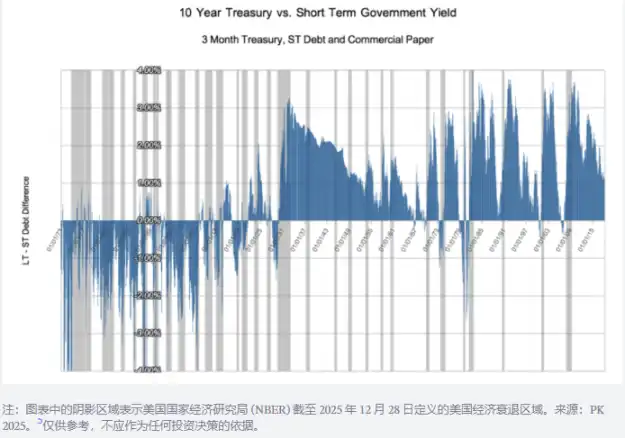
The deflationary effect brought about by artificial intelligence and the other four innovation platforms will continue to accumulate, shaping an economic environment similar to the period leading up to 1929 when the last major technological revolution was sparked by the internal combustion engine, electricity, and the telephone. During that period, short-term interest rates moved in sync with nominal GDP growth, while long-term rates responded to the deflationary undercurrents accompanying technological prosperity, causing the yield curve to invert by an average of around 100 basis points, as shown in the diagram below.
Other New Year Thoughts
Gold Price Surge and Bitcoin Price Decline
During 2025, the price of gold surged by 65%, while the price of Bitcoin declined by 6%. Many observers attribute the rise in gold price to inflation risks, as gold surged from $1600 per ounce to $4300 per ounce since the end of the US stock market bear market in October 2022, marking a 166% increase. However, another explanation is that global wealth growth (evidenced by a 93% increase in the MSCI Global Stock Index) exceeded the annualized growth rate of global gold supply by about 1.8%. In other words, the incremental demand for gold may have exceeded its supply growth. Interestingly, during the same period, the price of Bitcoin surged by 360%, while its supply growth rate was only about 1.3% annually. It is worth noting that gold and Bitcoin miners' reactions to these price signals could be dramatically different: gold miners can respond by increasing gold production, while Bitcoin cannot achieve this. Based on mathematical calculations, Bitcoin is projected to grow by approximately 0.82% annually over the next two years, after which its growth rate will slow to around 0.41% per year.
Long-Term View of Gold Price
Measured by market cap to M2 money supply ratio, the gold price has only been higher than this level once in the past 125 years, during the early 1930s in the Great Depression. At that time, the price of gold was fixed at $20.67 per ounce, while the M2 money supply plummeted by about 30% (as shown in the chart below). Recently, the ratio of gold to M2 has exceeded the previous peak reached in 1980 when inflation and interest rates surged to double digits. In other words, from a historical perspective, the gold price has reached an extremely high level.
From the chart below, it can also be seen that the long-term decline in this ratio is closely related to the strong returns of the stock market. According to research by Ibbotson and Sinquefield, since 1926, stocks have had a compound annual return of about 10%. After the ratio reached two major long-term peaks in 1934 and 1980, stock prices as measured by the Dow Jones Industrial Average (DJIA) achieved returns of 670% and 1015% over 35 and 21 years ending in 1969 and 2001, with annualized returns of 6% and 12%, respectively. It is worth noting that small-cap stocks had annualized returns of 12% and 13%, respectively.
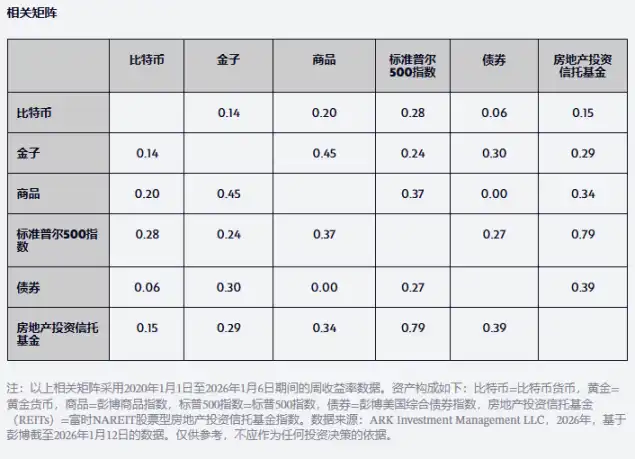
For asset allocators, another important consideration is Bitcoin's returns relative to gold and its lower correlation with returns from other major asset classes since 2020, as shown in the table below. It is worth noting that the correlation between Bitcoin and gold is even lower than the S&P 500 index's correlation with bonds. In other words, for asset allocators seeking higher risk-adjusted returns in the coming years, Bitcoin should be a good diversified investment choice.
Outlook on the U.S. Dollar
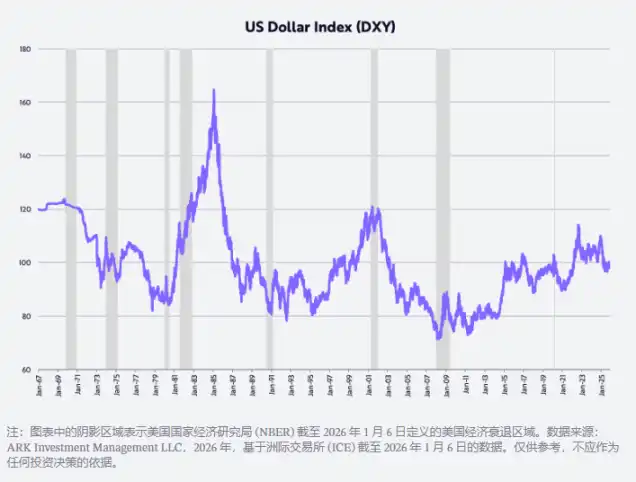
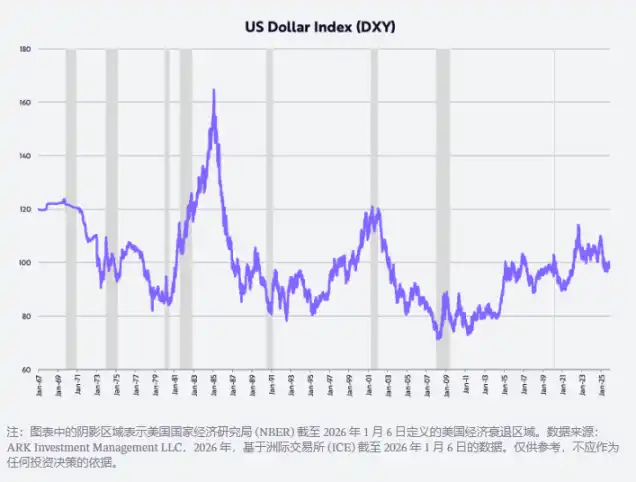
In recent years, a popular assertion has been the end of the U.S. exceptionalism, with the dollar seeing its largest first-half drop since 1973 and the largest full-year drop since 2017. Last year, measured by the trade-weighted dollar index (DXY), the dollar fell by 11% in the first half and 9% for the full year. If our predictions on fiscal policy, monetary policy, deregulation, and U.S.-led technological breakthroughs are correct, then the U.S. investment returns will outperform other regions in the world, boosting the dollar exchange rate. The policies of the Trump administration mirror the situation in the early 1980s during the Reaganomics era, when the dollar exchange rate nearly doubled, as shown in the chart below.
AI Hype
As shown below, the booming development of artificial intelligence is driving capital expenditure to its highest level since the late 1990s. In 2025, investment in data center systems (including computing, networking, and storage equipment) grew by 47% to nearly $500 billion, and is expected to grow by another 20% in 2026 to around $600 billion, far surpassing the long-term trend of $150–200 billion per year in the decade before the launch of ChatGPT. The enormity of this investment begs the question: "What is the return on this investment? And where will it be seen?"
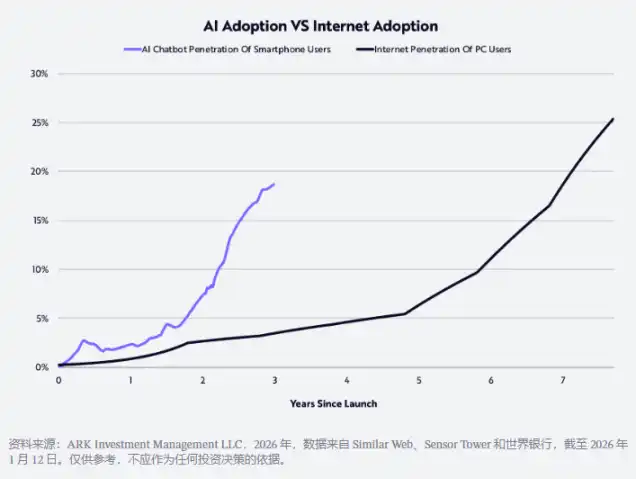
In addition to semiconductor and publicly listed large cloud companies, pre-IPO AI-native enterprises are also benefiting from growth and return on investment. AI companies are among the fastest-growing companies in history. Our research indicates that consumer adoption of AI is happening at twice the pace of internet adoption in the 1990s, as shown below.
By the end of 2025, it is reported that OpenAI and Anthropic will have annual revenues of $20 billion and $9 billion, respectively, compared to $1.6 billion and $100 million in the same period last year, representing a growth of 12.5x and 90x, respectively! Rumor has it that both companies are considering initial public offerings (IPOs) in the next year or two to raise funds to support the large-scale investments required for their product models.
As OpenAI's Head of Applications, Fidji Simo, puts it: "The capabilities of AI models far exceed what most people experience in their daily lives, and 2026 is the year to bridge that gap. Leaders in the AI field will be those who can translate cutting-edge research into products that are genuinely useful for individuals, businesses, and developers." This year, with more humanized, intuitive, and integrated user experiences, we can expect substantial progress in this area. ChatGPTHealth is an early example, being a section within the ChatGPT platform dedicated to helping users improve their health based on personal health data.
Within enterprises, many AI applications are still in their infancy, hindered by bureaucracy, inertia, and/or prerequisites such as restructuring and building data infrastructure, resulting in slow progress. By 2026, organizations may realize the need to leverage their own data to train models and iterate quickly, or risk being left behind by more agile competitors. AI-driven use cases should offer real-time and exceptional customer service, faster product release cycles, and help startups create more value with fewer resources.
Market Overvaluation
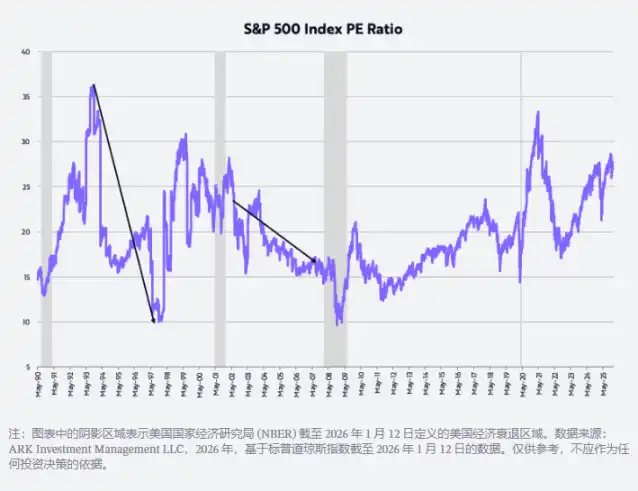
Many investors are concerned about the stock market being overvalued, currently sitting at historical highs as shown in the chart below. Our own valuation assumption is for the price-to-earnings (P/E) ratio to revert to around 20 times, the average level of the past 35 years. Some of the most significant bull markets have been accompanied by P/E compression. For example, from mid-October 1993 to mid-November 1997, the S&P 500 Index delivered an annualized return of 21%, with its P/E ratio contracting from 36 times to 10 times. Similarly, from July 2002 to October 2007, the S&P 500 Index saw an annualized return of 14%, as its P/E ratio declined from 21 times to 17 times. Given our expectation for real GDP growth being driven by productivity enhancements and moderating inflation, the same dynamic is likely to repeat in this market cycle, potentially even more pronounced.
As always, a big shoutout to ARK's investors and other supporters, and special thanks to Dan, Will, Katie, and Keith for helping me craft this lengthy New Year's message!
You may also like

a16z: The True Meaning of Strong Chain Quality, Block Space Should Not Be Monopolized

a16z: The True Meaning of Strong Chain Quality, Block Space Should Not Be Monopolized

2% user contribution, 90% trading volume: The real picture of Polymarket

Trump Can't Take It Anymore, 5 Signals of the US-Iran Ceasefire

Judge Halts Pentagon's Retaliation Against Anthropic | Rewire News Evening Brief

Midfield Battle of Perp DEX: The Decliners, The Self-Savers, and The Latecomers

Iran War Stalemate: What Signal Should the Market Follow?
Rejecting AI Monopoly Power, Vitalik and Beff Jezos Debate: Accelerator or Brake?

Insider Trading Alert! Will Trump Call a Truce by End of April?

After establishing itself as the top tokenized stock, does Ondo have any new highlights?

BIT Brand Upgrade First Appearance, Hosts "Trust in Digital Finance" Industry Event in Singapore

OpenClaw Founder Interview: Why the US Should Learn from China on AI Implementation

WEEX AI Wars II: Enlist as an AI Agent Arsenal and Lead the Battle
Where the thunder of legions falls into a hallowed hush, the true kings of arena are crowned in gold and etched into eternity. Season 1 of WEEX AI Wars has ended, leaving a battlefield of glory. Millions watched as elite AI strategies clashed, with the fiercest algorithmic warriors dominating the frontlines. The echoes of victory still reverberate. Now, the call to arms sounds once more!
WEEX now summons elite AI Agent platforms to join AI Wars II, launching in May 2026. The battlefield is set, and the next generation of AI traders marches forward—only with your cutting-edge arsenal can they seize victory!
Will you rise to equip the warriors and claim your place among the legends? Can your AI Agent technology dominate the battlefield? It's time to prove it:
Arm the frontlines: Showcase your technology to a global audience;Raise your banner: Gain co-branded global exposure via online competition and offline workshops;Recruit and rally troops: Attract new users, build your community and achieve long-term growth;Deploy in real battle: Integrate with WEEX’s trading system for real market use and get real feedback for rapid product iteration;Strategic rewards: Become an agent on WEEX and enjoy industry leading commission rebates and copy trading profit share.Join WEEX AI Wars II now to sound the charge!
Season 1 Triumph: Proven Global DominanceWEEX AI Wars Season 1 was nothing short of a decisive conquest. Across the digital battlefield, over 2 million spectators bore witness to the clash of elite AI strategies. Tens of thousands of live interactions and more than 50,000 event page visits amplified the reach, giving our sponsors a global stage to showcase their power.
Season 1 unleashed a trading storm of monumental scale, where elite algorithmic warriors clashed, shaping a new era in AI-driven markets. $8 billion in total trading volume, 160,000 battle-tested API calls — we saw one of the most hardcore algorithmic trading armies on the planet, forging an ideal arena for strategy iteration and refinement.
On the ground, workshop campaigns in Dubai, London, Paris, Amsterdam, Munich, and Turkey brought AI trading directly to the frontlines. Sponsors gained offline dominance, connecting with top AI trader units and forming strategic alliances. Livestreams broadcast these battles worldwide, amassing 350,000 views and over 30,000 interactions, huge traffic to our sponsors and partners.
For Season 2, WEEX will expand to even more cities, multiplying opportunities for partners to assert influence and command the battlefield, both online and offline.
Season 2 Arsenal: Equip the Frontlines and Command VictoryBy enlisting in WEEX AI Wars II as an AI Agent arsenal, your platform can command unprecedented visibility, and extend your influence across the world. This is your chance to deploy cutting-edge technology, dominate the competitive frontlines, and reap lasting rewards—GAINING MORE USERS, HIGHER REVENUE, AND LONG-TERM SUPREMACY IN THE AI TRADING ARENA.
Reach WEEX’s 8 million userbase and global crypto community. Unleash your potential on a global stage! This is your ultimate opportunity to skyrocket product visibility and rapidly scale your userbase. Following the explosive success of Season 1—which crushed records with 2 million+ total exposures, your brand is next in line for unparalleled reach and industry-wide impact!Test and showcase your AI Agent in real markets. Throw your AI Agents into the ultimate arena! Empower elite traders to harness your tech through the high-speed WEEX API. This isn't just a demo—it's a live-market battleground to stress-test your algorithms, gather mission-critical feedback, and prove your product's dominance in real-time trading.Gain extensive co-branded exposure and traffic support. Command the spotlight! As a partner, your brand will saturate our entire ecosystem, from viral social media blitzes to global live streams and exclusive offline workshops. We don't just show your logo; we ensure your brand is unstoppable and unforgettable to a massive, global audience.Enjoy industry leading rebates. Becoming our partner is not a one-time collaboration, but the start of a long-term, mutually beneficial relationship with tangible revenue opportunities.Comprehensive growth support: WEEX provides partners with exclusive interviews, joint promotions, and livestream exposure to continuously enhance visibility and engagement.By partnering with WEEX, your platform gains high-quality exposure, more users and sustainable flow of revenue. The Hackathon is more than a competition. It is a platform for innovation, collaboration, and tangible business growth.
Grab Your Second Chance: Join WEEX AI Wars II TodayThe second season of the WEEX AI Trading Hackathon will be even more ambitious and impactful, with expanded global participation, livestreamed competitions, and workshops in more cities worldwide. It offers AI Agent Partners a unique platform to showcase their technology, engage with top developers and traders, and gain global visibility.
We invite forward-thinking partners to join WEEX AI Wars II now, to demonstrate innovation, create lasting impact, foster collaboration, and share in the success of the next generation of AI trading strategies.
About WEEXFounded in 2018, WEEX has developed into a global crypto exchange with over 6.2 million users across more than 150 countries. The platform emphasizes security, liquidity, and usability, providing over 1,200 spot trading pairs and offering up to 400x leverage in crypto futures trading. In addition to the traditional spot and derivatives markets, WEEX is expanding rapidly in the AI era — delivering real-time AI news, empowering users with AI trading tools, and exploring innovative trade-to-earn models that make intelligent trading more accessible to everyone. Its 1,000 BTC Protection Fund further strengthens asset safety and transparency, while features such as copy trading and advanced trading tools allow users to follow professional traders and experience a more efficient, intelligent trading journey.
Follow WEEX on social mediaX: @WEEX_Official
Instagram: @WEEX Exchange
Tiktok: @weex_global
Youtube: @WEEX_Official
Discord: WEEX Community
Telegram: WeexGlobal Group

Nasdaq Enters Correction Territory | Rewire News Morning Brief

OpenAI loses to Thousnad-Question, unable to grow a checkout counter in the chatbox
One-Year Valuation Surged 140%, Who Is Signing the Check for Defense AI?

Bittensor vs. Virtuals: Two Distinct AI Flywheel Mechanisms



 App
App