
Base Builder Talk: How a China-based Developer Endorsed by Base is Going All-In on the On-Chain Economy




The Base protocol has rapidly emerged as a leader in the Ethereum L2 ecosystem during the cryptocurrency boom, thanks to its astonishing growth rate and innovative capabilities. Its success is not accidental but rather the result of the collective efforts of numerous developers, builders, and community members. Being the crypto media outlet in the Asia-Pacific region most focused on the Base ecosystem, BlockBeats has specially curated the "Base Builder Talk" column to gain better insights into the development path and future opportunities behind the Base ecosystem. The column invites Asia-based teams, developers, and community contributors deeply involved in and actively building the Base ecosystem to share their journeys and unique insights. Through this series of interviews, we hope to enable more people to understand the community resilience and boundless potential of Base.
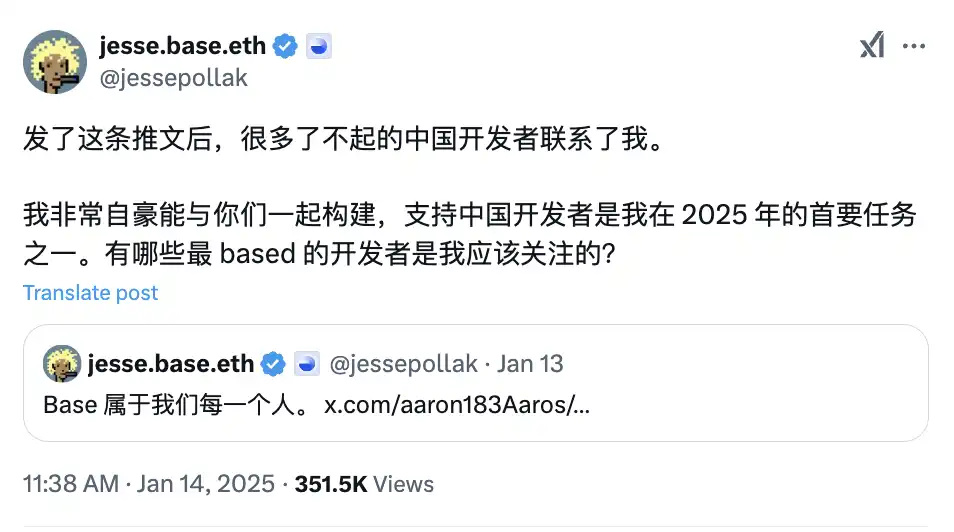
Base Protocol Lead Jesse States Supporting Chinese Developers is the Top Priority for 2025
In the first edition, BlockBeats invited 183Aaros.base.eth, a researcher at Onchain who was recently retweeted by Jesse. From traditional economics to on-chain economics, he showcased a new paradigm of "production-consumption-reconsumption-reproduction" in the Onchain world with unique dialectical thinking and practical experience. In the conversation, Aaros mentioned his understanding of the "cyber reality," interdisciplinary thinking on on-chain economics, and enthusiasm for building the Base ecosystem. Through his narration, we may catch a glimpse of the significant role Base plays in shaping the on-chain economic structure and fostering new application forms.
Below is the full interview content, reorganized for readability:
BlockBeats: Please provide a brief background about yourself and why you embarked on the crypto journey.
Aaros: I studied Economics for my undergraduate degree in the UK, and my Master's was in investment banking. In 2018, I joined a hedge fund recommended by a law school assistant professor, where I was mainly responsible for screening crypto projects for them. It was also during that time that I truly entered the "rabbit hole" of cryptocurrency.
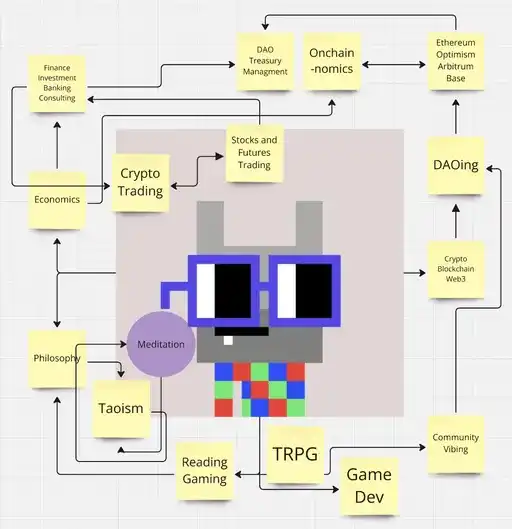
Image Source: Aaros Personal Website
While the traditional financial industry was relatively conservative towards the crypto industry at the time, I personally had high hopes for the future of cryptocurrency. Based on my reflections on currency and logical consistency, I bought a significant amount of Cardano tokens at the time. Later, after returning to my home country, I worked in traditional finance for a period, mainly in industry research and the IPO market. At the same time, I had been continuously investing in cryptocurrency, and after gaining my first bucket of gold in the 2021 crypto bull market, I resigned to go all in on Web3.
BlockBeats: So, let's talk about your crypto journey over the years. Why did you choose the Base ecosystem?
Aaros: My main project is Onchainomics. From 2018 to 2021, it was a phase where I conducted industry research, made investments, traded, and laid the foundation for an economic framework. Then, in 2022, after several partners joined me, incorporating philosophy, the economics of desire along with my previous traditional economic viewpoint and trading indicators, we established a consistent yet highly complex core predictive system.
Onchainomics is a subset under this framework, with many concepts and forecasts yet to be elaborated. I chose Base because I resonated with Jesse's slogan "build a global onchain economy." This statement aligns well with my vision and mission over the years; it's exactly what I've been looking for.
During Onchain Summer, Jesse also mentioned in the Buildathon that a builder could be not only a coder but also a creator and a community builder, all are welcome to participate. This broad perspective deeply attracted me. Although I can code a bit, my strength lies in economics and industry research. Developing a comprehensive project independently in Web 3 is quite challenging. After hearing Jesse talk about this narrative, I felt like I could also participate. I really liked its narrative. I want to engage more in this ecosystem and contribute my efforts. It's a very pure thought — I want to play with everyone, and if you allow me to join, I'm in.
BlockBeats: Over the past year, Aaros has had many award-winning papers. Could you first talk to us about the sources of inspiration for your usual writing and your work style?
Aaros: My sources of inspiration mainly come from the aforementioned core predictive system, integrating hot topics and theory dissemination. There is a contradiction in my work style: the core predictive system may not be directly understandable to most people as it spans various disciplines. However, what each reader can understand actually stems from these core predictive systems.
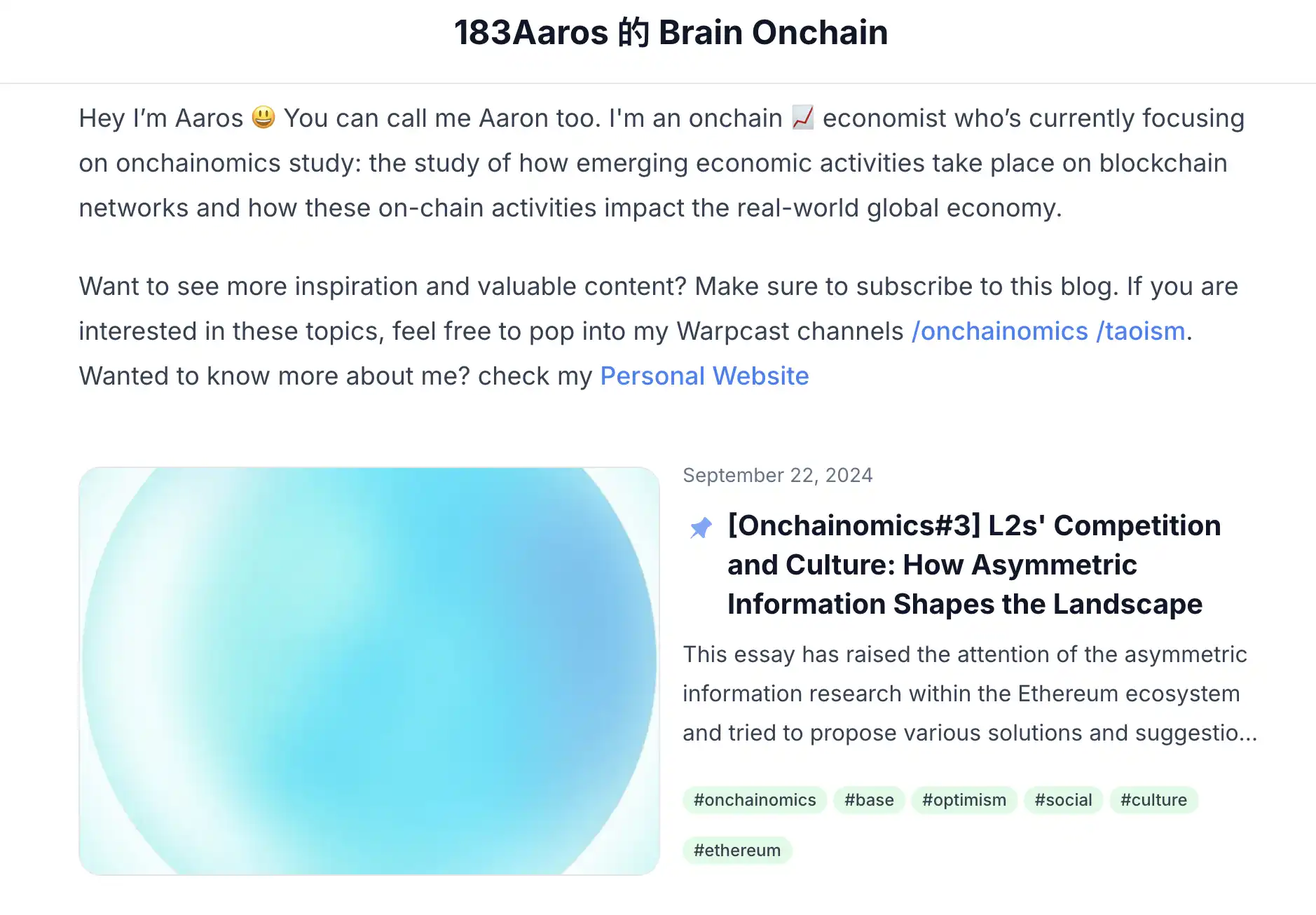
Aaros's Paragraph Homepage
What Is Onchain? Deconstructing On-chain Economics
BlockBeats: How do you understand Onchain? Does it bring the real world onto the chain?
Aaros: We have a rather special understanding, using dialectics to deconstruct and reconstruct the proposition of reality and virtuality. Traditionally, reality and virtuality are seen as opposites, but where is the breakthrough point? For example, take Meituan. Is it virtual or real? Here, it seems that this proposition is somewhat deconstructed, and no matter which way you think about it, it seems both right and wrong. This is where dialectics come into play.
We have coined a term called "cyber reality" — not the binary opposition of virtual or real, but a new kind of reality, a new paradigm. Narratives like encryption, Onchain, and Agents, in terms of their impact on consumption and production, are not binary oppositions.
If we are stuck in the narrative of the past, we cannot see the possibilities brought by the new narrative, so we need to use the definition of cyber reality to move it towards the so-called reality. In this proposition, there is no pure virtual because the virtual is also real. Therefore, Onchain is also a realization of cyber reality.
BlockBeats: After discussing Onchain, let's talk about On-chain Economics. On your website, you define it as an integration of blockchain economics, tokenomics, and traditional economics, making it an interdisciplinary field. Could you break down this concept?
Aaros: The concept is encompassed within cryptoeconomics. The starting point was this because at that time, we had not yet seen clearly the relationship between Onchain and Offchain, virtual, and real. So I tackled it in a somewhat classificatory or categorical way to define it, but in reality, I did not provide an ontological status; we just saw a gap between some disciplines, and we described this gap.
Traditional macroeconomics does not pay much attention to on-chain economic activities, and its follow-up is relatively slow. The MIT Cryptoeconomics Lab has contributed to some discourse, but it has not been fully promoted. On the other hand, on-chain, because Ethereum developers are more focused on cryptography, the entire industry has a trend of studying game theory as the main line of cryptoeconomics.
Pure game theory research, Tokenomics research, I personally think is relatively narrow. After the emergence of many on-chain activities such as the Base ecosystem, the entire market is generating more new economic activities, many of which have not been studied by scholars. Our initial starting point was just to discover this gap. Later, we found a quasi-ontological status for this gap, that it is truly something new, not just virtual, not just real, it is the "cyber reality."
BlockBeats: As an individual participating in the crypto economy, what are some common sense knowledge that we need to know?
Aaros: Do not persist in using modern industrialism and productionism like looking for a needle in a haystack. It is not the more you produce, the better. Productivity is one aspect, and production structure, production relations, consumption structure, income structure are another. Global production oversupply actually requires creating demand. Creating real demand or fake demand, as long as you can digest this contradiction, it will be a boost, and the economy will give you a certain status and return. I think it is more similar to Base's culture, focusing on the consumption end rather than the production end. Traditional economics focuses more on how to improve production efficiency, but the cycle we are currently in may be: without consumption demand, everything is impossible.
BlockBeats: What do you think consumption is? Participating in the on-chain economy, mint NFTs, or something else?
Aaros: Yes, participate, engage, and then ordinary individuals can consume more of these things.
BlockBeats: Just consuming, in simple terms, how can individuals make money on-chain?
Aaros: Money is currency. In the production-consumption paradigm, currency is an intermediary link. In fact, consumption is not just spending money. For example, Capital is not just money, it is also skills, it is also your cognition. So you have to construct it yourself, but to construct, you need handy tools. This building is not production; it is a structure that constructs a new narrative, new scenes, and a new life.
For example, let's take another example. Using an AI Agent is a form of consumption behavior. Of course, you can also see it as the other end, utilizing an AI Agent to produce an article is a form of production behavior. However, when you first learn to use it, you are a consumer participating in the cycle. Your first step is consumption (usage) to join this wave, and then you realize what you can produce on top of AI.
Onchain's "Production-Consumption" New Paradigm
BlockBeats: Jessie recently posted an update, saying that two AI agents helped him buy a pizza. Aaros, could you discuss how in this new paradigm, AI and humans collectively participate in the on-chain economic production-consumption process?
Aaros: I think Jessie has perfectly exemplified that paradigm. Through his consumption behavior, he explains why consumption is important, why the consumption scenario is important, and why creating consumption is important.
Our original paradigm refers to the production function, which is production, followed by consumption. In the past, we always thought of production and consumption as two ends, and the new approach is from p to c' and then to p' and back to p. In other words, after the traditional way, there will be a c', which I previously wrote in the Notes as "to create." Jesse's act of having two AI agents collaborate to order pizza is the essence of that c'. It is not just a consumption behavior but a kind of creation that builds a whole new paradigm, hence called "to create."
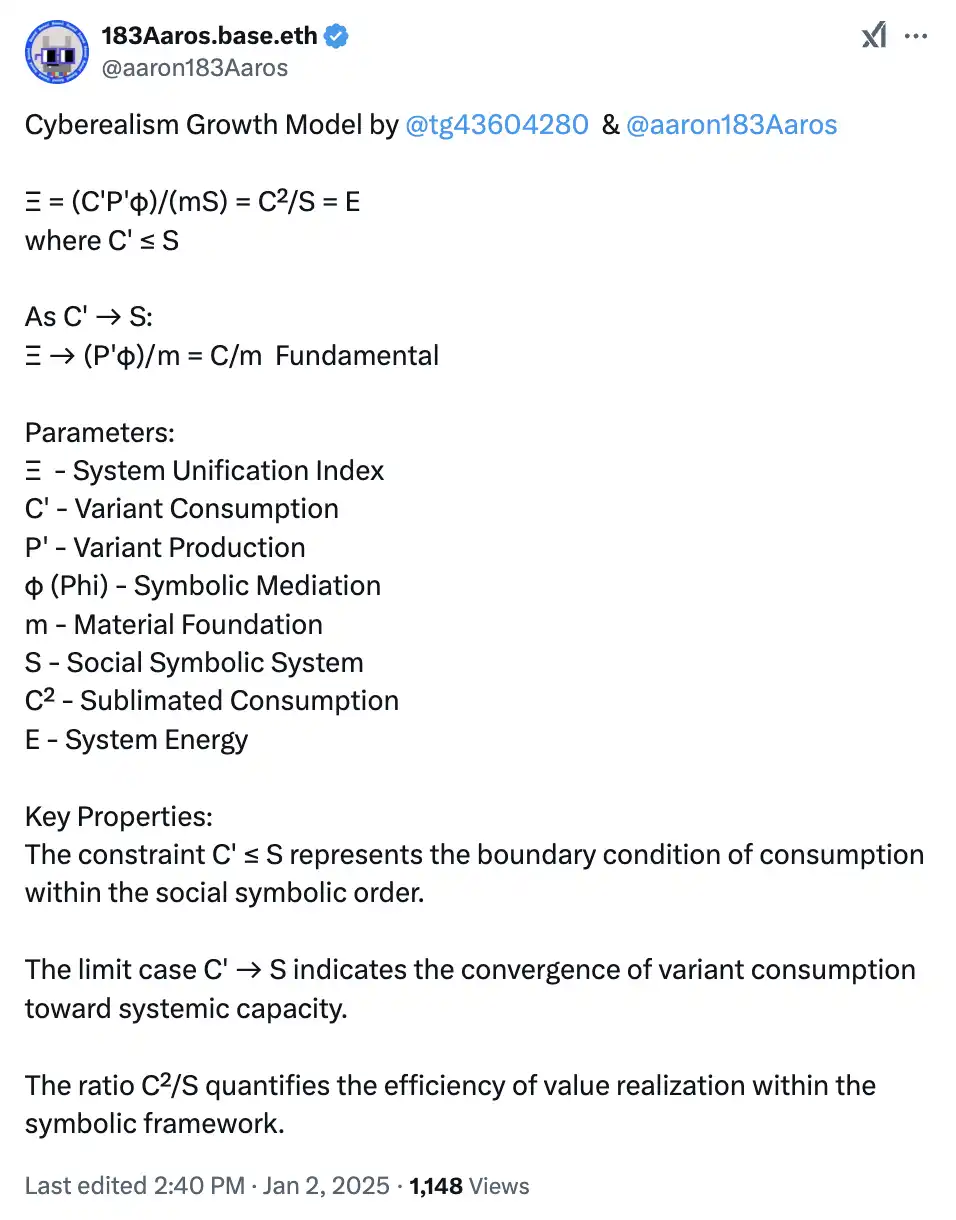
It may seem a bit complex to understand. p' is equivalent to after you create c', you would think about how to optimize various aspects of this c'. The first step is to get things done, meaning to buy the pizza. However, many small details are not perfect; it's just a demo. Still, by creating this consumption scenario, the subsequent p' is about completing and perfecting various aspects of this consumption scenario. However, this is not actually production; it is an improvement in production efficiency. It is not about solving the "buying pizza" problem in the P domain but addressing the "two AI agents" issue in the P' domain.
This is somewhat like building a mother machine. A mother machine is the machine in the mechanical industry that produces bearings, and the meaning of this 'p' is a machine's machine. If you want to create the next generation of a cyberspace economy or a crypto economy, you must first build the mother machine. For example, Base's OnchainKit is a kind of mother machine-building behavior, including Ethereum constantly emphasizing infrastructure, which is also a way of a mother machine—first, someone imagined or demonstrated a new narrative and a new consumption scenario, and then proceeded to mass-produce mother machines that can support consumption.
BlockBeats: Speaking of building a machine's machine, is the Base Builder House plan you sent me also considered a kind of action to build this machine?
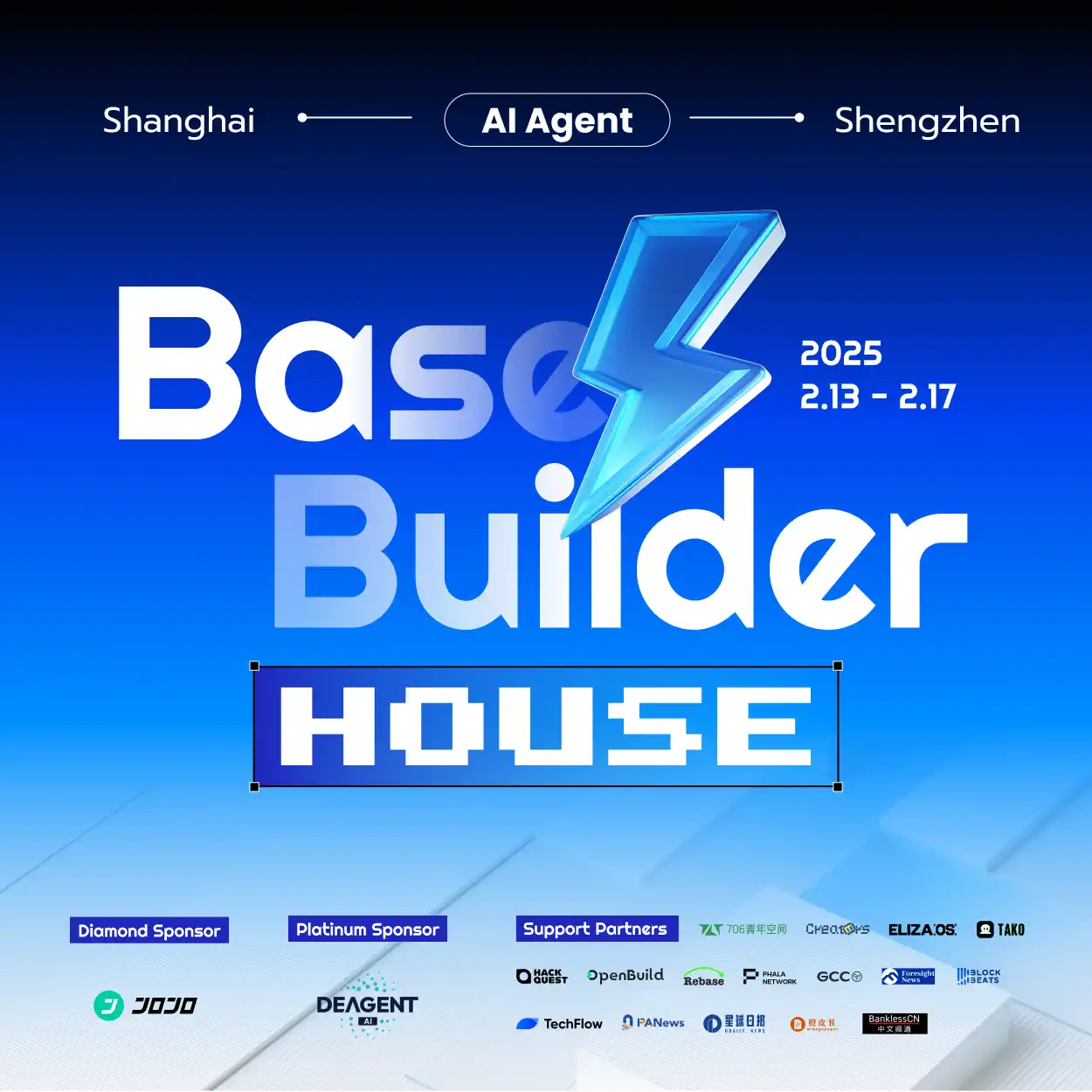
Aaros: Yeah, 706Creators initiator Shirlene came to me. She had previously done a hacker house at Solana and Sui, and this time came to me wanting to do a builder house in Shanghai and Shenzhen, collectively exerting efforts to develop the Base ecosystem in the Chinese community. So, we are planning to hold a building creating and living event in February.
BlockBeats: What will be the final output form then?
Aaros: The ultimate output direction is that 10 projects can go Onchain, some Demo onboarding Onchain. Through this build house, the Chinese community partners in Base will have a closer connection and be able to help each other, just like the English-speaking Base builder community.
Base Builder House Sign-up Link
BlockBeats: There is a viewpoint that believes American entrepreneurs have no idea how to develop applications, and Onchain is simply reinventing the wheel. What's the point of moving Dianping or Didi to the chain? How do you see this?
Aaros: We can link back to the paradigm I just mentioned, this is not a repeat of the mass production. For example, Jesse's behavior, he is in c', his focus is not on how well p is done, not the question of how to get the pizza faster, but on creating a new c', another thing is what Musk advocates to do is also from c' to p', "to create", "to produce".
BlockBeats: It means not to consider from a biased practical perspective, but to focus on innovation.
Aaros: Yes, narrative or cognitive innovation, and then the next step is that we start again as if there was no Meituan before, and we recreate a Meituan, such a process. I think the so-called "everything on the chain" narrative in 2017 was at the first p, but now the Onchain is at the position of c'/p', which is a different place, more about the different monetary mindset, where money as an important intermediary in the equation causes demand to change.
BlockBeats: So how are these demands generated? Or are the current demands sufficient to generate those applications?
Aaros: c' can be intuitively felt in one sentence, which is "We choose to go to the Moon", the person who made that choice is doing c'. It's not about how well the spaceship to the moon was built, but about "We choose to go to the Moon", this decision, this belief.
Ethereum Needs to Focus on the "Greater Ecosystem"
BlockBeats: These days the Ethereum Foundation has been caught in a public opinion storm, we can talk about the entire Ethereum ecosystem. As someone deeply involved in both the OP and Base ecosystems, what are the differences between these two ecosystems at the moment? And what stage is the L2 War currently in? Is there any sign of a winner-takes-all situation, or is it in a stage where the outcome is still uncertain?
Aaros: I have been following this recent issue. I agree with Vitalik's attitude of focusing on the core Top Developer, and on the other hand, the community demands more transparency, openness, marketing, and so on, which I think is also reasonable.
The relationship between OP and Base has always been very close, as Base is one of the initiators of the OP Superchain, and now many Base experts also serve as advisors to various OP committees. Base is currently the most expensive L2 in terms of on-chain settlement fees, and in this regard, I don't think there should be a winner-takes-all concept. Base is also quite open to Solana and other excellent ecosystems, not in a closed-door state, and very much welcomes collaboration among ecosystems.
On the other hand, the relationship between OP+Base and Ethereum may need to be closer. Ethereum's support for L2s has seen changes this year, such as interoperability between L2s. The Ethereum Foundation (EF) has also initiated some activities to support this, and there are some EIPs supporting improvements in this area.
BlockBeats: Vitalik has just released an article, and the most widely spread viewpoint in it is that he has begun to talk about consolidating Ethereum as the main asset of a larger Ethereum economic system, encouraging L2s to support Ethereum, and then returning a portion of the fees to L1, such as through burning permanent staking or donating rewards. Can we understand this as Vitalik feeling a bit urgent, facing internal and external challenges?
Aaros: Over the past few years, we have seen the entire Ethereum ecosystem place a strong emphasis on topics such as Tokenomics and MEV minimization after the 2.0 upgrade. However, at a larger ecosystem level and between different L2s, there are few discussions on cross-ecosystem macro and microeconomic issues. For example, the topic of information asymmetry, which is obvious in microeconomics, could have been foreseen in the era of ETH 2.0 but had to wait until conflicts erupted before being addressed. This is an area where improvements can be made.
BlockBeats: Can we blame the Ethereum Foundation for inaction?
Aaros: I think this is a blind spot that is easy to fall into in a decentralized environment, where everyone focuses on what they are good at, and areas where they are not proficient are overlooked and left unattended. However, this is normal. Of course, I am not optimistic that researchers will shift from a microeconomic and technologically deterministic view to a more holistic or reconstructive perspective to focus on macro issues.
BlockBeats: Why is that?
Aaros: The so-called mass adoption requires bridging to the traditional economy, onboarding, but so far I have only seen some slogans or marketing stuff, without any related research or organization focusing on this advancement. To be honest, there are quite a few people in the ecosystem who don't think my work is research. They might think that you haven't researched topics like MEV minimal extraction, haven't focused on technical details or those seemingly very technical issues, that's what they consider research, not this narrative or model perspective that I take.
BlockBeats: Do you think you need to clear your name?
Aaros: We are a kind of essentialist research, just seeing that I said it, whether there is an audience, whether readers can understand, there is actually no specific connection to our theory for now.
BlockBeats: In 2024, the trend rotates quickly. In 2023, I think it's okay. Friendtech can get hype for half a year. Starting from Blast, every trend lasting two months is already considered long. In this rhythm, how do you maintain your own pace, find your principles, and build your framework?
Aaros: This might be the talent of an INTP hahaha, a kind of thinking mode with primary introverted logic, insisting on a complete logical system. The suggestion may be to try to focus on some laws that remain effective after a paradigm shift.
BlockBeats: Recommend three researchers you admire the most.
Aaros: Professor Paul Dylan-Ennis from University College Dublin Business School. Then there are Teacher Luo (0xLuo) and Teacher Pingfeng. They have a keen sense of smell, act purely, and can give me some very good dehydrated perceptions.
BlockBeats: How do you define yourself then?
Aaros: My own perception is an Engine Starter.
BlockBeats: What kind of engine?
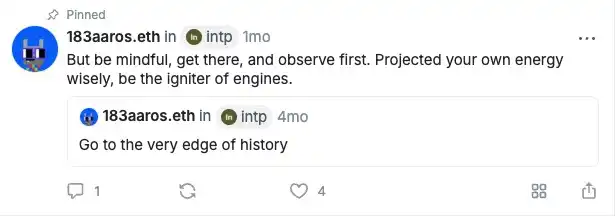
Aaros: The Engine of History. I have a pinned post on Farcaster where I talk about going to the very edge of history, and that's basically what this is—self-positioning.
You may also like

Why Is BlackRock Investing $5 Billion in the SpaceX IPO?

Cryptocurrency market makers collectively seek change as it becomes increasingly difficult to make money

a16z Crypto Partner: Cash flow is the moat

Citibank releases "2030 Asset Tokenization Market Outlook": 6 major trends may create a $8.2 trillion market

The trillion-dollar valuation test: Are the three major super IPOs a celebration for tech stocks or a nightmare for the crypto market?

Morning Report | Digital Asset completes $355 million financing led by a16z Crypto; Meta completes operational separation from Manus
Morning News | CME Group launches Nasdaq Cryptocurrency Index futures; Asset management giant Janus Henderson strategically invests in Ethena

Bitcoin Layer 2 Network Botanix: Why Did We Choose to Dissolve?

Why did Oracle deliver the strongest financial report in history, yet its stock price fell?
When the P2P illicit funds from ten years ago turned into 60,000 bitcoins

Dialogue with OmenX Founder: Why does the prediction market need an evolution from "spot" to "derivatives"?
Galaxy in-depth report: Is Solana still worth paying attention to?

Young people in South Korea make a "final effort" in the epic bull market
The pricing controversy of Trade.xyz exposes the fatal weakness of Pre-IPO perpetual contracts
How much longer can Ethereum's last big buyer hold on?

World Cup 2026 Coming – WEEX Celebrates with $1M Prize Pool & Michael Owen Live

Morning Report | OpenAI has submitted an S-1 registration statement draft to the U.S. SEC; Morpho completes $175 million financing

Galaxy Deep Research Report: How Hyperliquid's HIP-4 Upgrade Changes the Landscape of Prediction Markets?
Why Is BlackRock Investing $5 Billion in the SpaceX IPO?
Cryptocurrency market makers collectively seek change as it becomes increasingly difficult to make money
a16z Crypto Partner: Cash flow is the moat
Citibank releases "2030 Asset Tokenization Market Outlook": 6 major trends may create a $8.2 trillion market
The trillion-dollar valuation test: Are the three major super IPOs a celebration for tech stocks or a nightmare for the crypto market?
Morning Report | Digital Asset completes $355 million financing led by a16z Crypto; Meta completes operational separation from Manus


