
Based Rollups will help Ethereum integration——Puffer Finance


By Roland Roventa, Head of Investments at Mechanism Capital
Trump’s victory has sparked a DeFi renaissance, and Ethereum (which accounts for 63% of the global DeFi total locked) is poised to capitalize on this momentum and breakout. Since the results of the US presidential election, the Ethereum ecosystem has continued to outperform expectations.
However, Ethereum’s rollup-based scaling path, while critical to scaling, faces a significant challenge: fragmentation. The current rollup ecosystem is in a winner-take-all situation, resulting in liquidity, user attention, and user base being dispersed across isolated L2 chains. To fully tap the potential of DeFi’s resurgence, Ethereum must resolve these divisive dynamics, and Ethereum needs to resolve the current fragmentation and build a more unified and open network.
Bridging the Gap: Solving Ethereum’s Fragmentation and Liquidity Challenges
Puffer Finance’s innovative solution – UniFi, directly addresses Ethereum’s fragmentation challenge. We believe that once the market recognizes that Puffer is not just another Liquid Heavy Staking Token (LRT), but an innovative infrastructure solution, it will outperform expectations.
Puffer’s Past: Puffer started as a leading LRT protocol focused on providing decentralized staking solutions.
Puffer’s Present: Puffer has evolved into a unified solution centered on Ethereum. Puffer has evolved from the first native liquid re-staking protocol to a comprehensive Ethereum integrated and extended ecosystem, consisting of the following three core components:
· Decentralized Liquid Re-staking Protocol (LRT)
Puffer's flagship product, with anti-slashing features, high yield and security, supporting decentralized re-staking in the Ethereum ecosystem.
· UniFi Based Rollup Stack
A L2 based serialization solution that enables seamless interaction between L2<>L2 and L2<>L1, supporting atomic composability for efficient cross-chain operations.
· UniFi Pre-confirmed AVS
The industry's first pre-confirmed AVS provides near-instant transaction finality for L1 and L2 transactions, significantly improving the speed and reliability of the Ethereum network.
Through the UniFi rollup-based stack, Puffer Finance transforms Ethereum's fragmentation into a positive-sum ecosystem.
Part I Puffer UniFi Based Roll-up Stack - What is it? How does it work?
What are based roll-ups?
Based rollups is an advanced scaling method that integrates directly with Ethereum's shared sorter, without relying on centralized sorters commonly used by other L2s (such as optomistic or zero-knowledge proof L2s). The core idea was first proposed by Justin Drake in a research article in March 2023:
"Based rollup, that is, L1-ordered rollup, means that its order is driven by the underlying L1. Specifically, based rollup means that the next L1 proposer can cooperate with L1 searchers and builders to include the next rollup block in the next L1 block without permission." - Justin Drake
For people with a non-technical background, the above description may seem complicated. In short, the main chain-based rollup verifies transactions directly on L1, giving full play to the efficiency of Ethereum's existing mechanisms. In contrast, other common rollup schemes (such as optimistic & ZK) usually verify transactions on L2 before submitting them to L1.
By using based sorting (using Ethereum L1 validators for sorting), the following advantages can be obtained:
· Inheriting the liveness and decentralization characteristics of the Ethereum network: reliability is ensured and it is not affected by single points of failure.
· Simplified infrastructure: no need to run a separate sorter.
· Faster execution speed: faster transaction finality through pre-confirmation (more on this later).
· Aligned with the economic interests of L1: new revenue opportunities are created for existing validators through non-invading MEV (maximum extractable value).
· Reduced operating costs: because transaction sorting is the responsibility of L1.
Based Rollups > Optimistic Rollups
tl’dr:
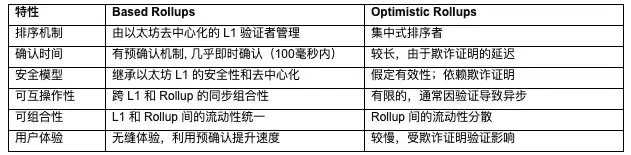
By optimizing the underlying transaction ordering process, costs can be reduced and speeds can be increased while retaining the inherent security and decentralization of the Ethereum network.
Puffer is Based
Puffer UniFi is an Ethereum-based based rollup that enables the creation of application chains through its technology stack.
It solves the problem of Ethereum liquidity fragmentation by achieving synchronous composability. Transactions on UniFi can interact directly with other based rollups without bridging, creating a unified liquidity and application layer. Developers can easily launch their own application chains, capture transaction fees and leverage shared liquidity.
UniFi's goal is to bring atomic composability to the Ethereum chain - redefining the possibilities of on-chain interactions. Through atomic composability, UniFi will allow Layer 1 and Layer 2 to interact smoothly and integrated within a single Ethereum block. For example, a user or protocol can deposit assets from L1 to UniFi, perform complex operations such as swaps or liquidity mining, and then withdraw assets back to L1 within the same 12-second Ethereum block. This is not only fast, but also a breakthrough in blockchain interoperability.
Puffer is not competing with L1, but collaborating with L1 to expand its capabilities in an integrated way.
How it works?
Inspired by research in collaboration with Justin Drake, Puffer UniFi uses Trusted Execution Environments (TEEs) in its processing stack. To achieve real-time proofs, Puffer plans to use TEEs as a temporary auxiliary tool. The implementation of real-time proofs can significantly improve interoperability. Once zero-knowledge proof (ZK proof) technology reaches sufficient speed, provers will be able to move from relying on trusted hardware to a completely zero-knowledge-based solution.
Puffer UniFi's Architecture Analysis
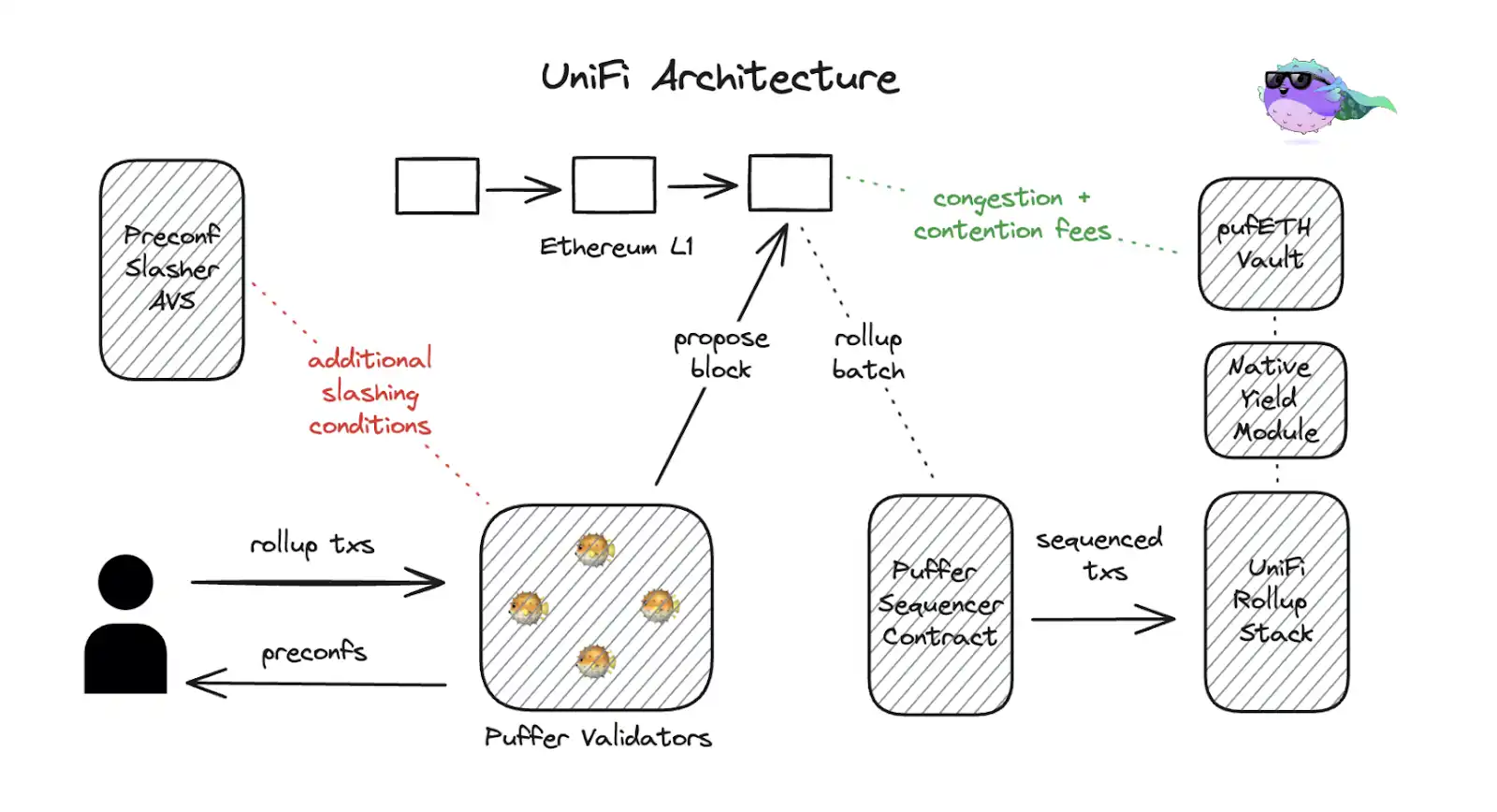
Architecture Overview - Puffer's UniFi Pre-Confirmation AVS provides users with L2 execution confirmation services. Users can experience sub-second transaction speeds when interacting through UniFi. In UniFi Universal Rollup, native revenue tokens can be used as fuel (Gas) tokens.
The consensus layer, data availability layer, and settlement layer are all handled by the base layer (Layer 1, i.e. Ethereum). Rollups focus on the functions of the execution layer.
This is what makes the Puffer app-chain unique.
Why is this important?
Puffer is building its own app-chain using based rollups, which enables seamless integration of the EVM protocol. This provides everyone in the ecosystem with the opportunity to participate and benefit, whether individual validators or large dApps, can benefit from a faster, more efficient, and more decentralized Ethereum. Ethereum's fragmentation problem has existed for too long, and now is the time to change this status quo.
Ecosystem Overview
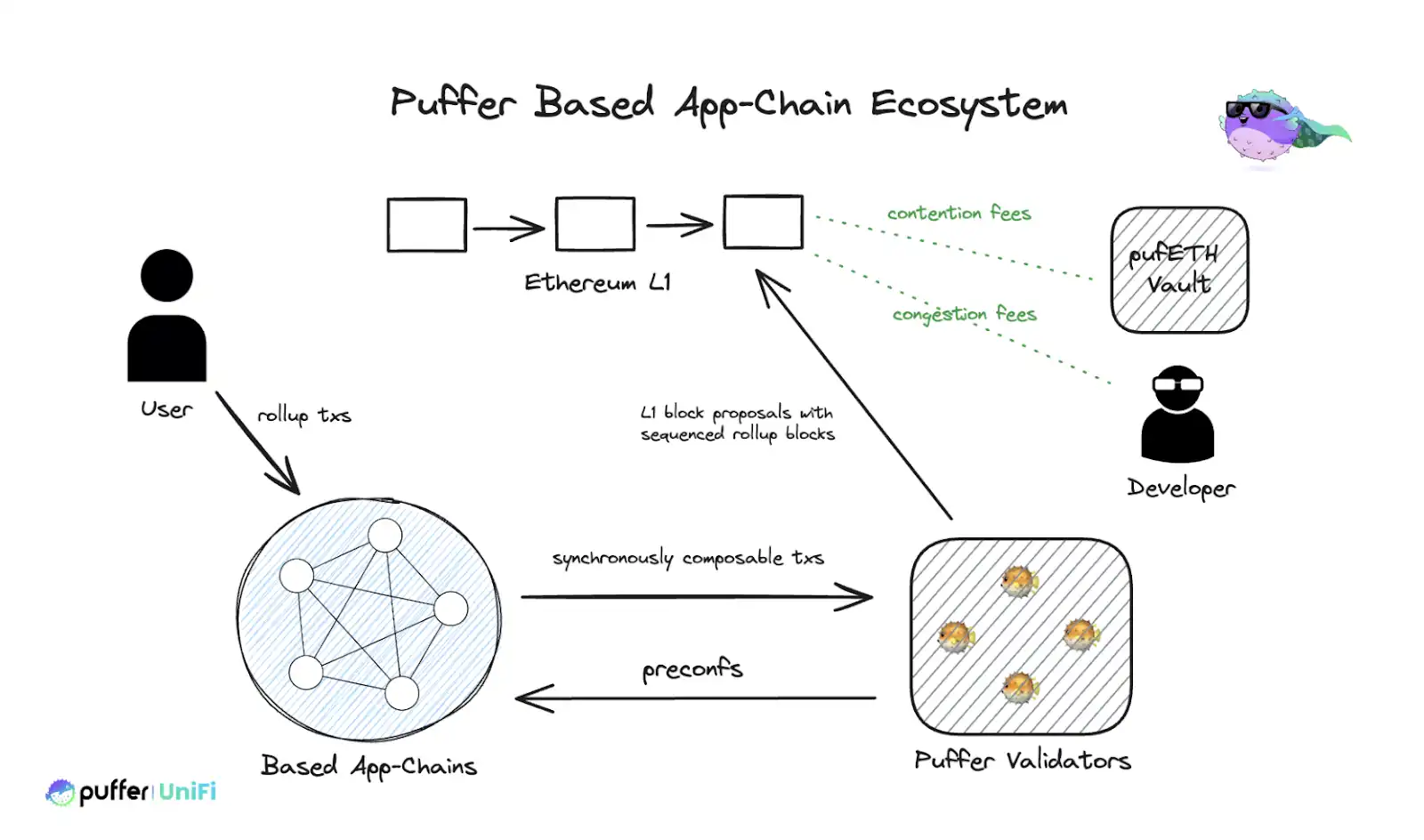
Growth will occur in phases:
Phase 1: Puffer will introduce based rollups to users and developers. For protocols that are not yet ready to run their own application chain, they can be deployed directly to UniFi.
Phase 2: UniFi will launch an SDK that enables any dApp developer to quickly build and deploy their own application chain in a simplified way.
Part 2: UniFi Pre-confirmation AVS
UniFi provides near-instant execution confirmation through pre-confirmation technology. This is not just a speed improvement, but a new Ethereum scalability solution. Pre-confirmation technology solves Ethereum's fragmentation problem while providing extremely fast transaction confirmation.
How is it implemented? As Ethereum's 12-second block time limits the finality of fast transactions, preconfirmations become critical to improving the user experience. To address this issue, Puffer has developed a proprietary preconfirmation AVS technology that provides near-instant (about 100 milliseconds) transaction confirmation guarantees, ensuring that the transaction will be included in the next block. This innovation greatly improves the speed and reliability of the based rollup ecosystem.
How does it work?
Preconfirmations are divided into two types: execution preconfirmations and inclusion preconfirmations. Both can be used to provide users with faster transaction confirmations on L1 or L2: The advantage of execution preconfirmations is that they provide users with a final and guaranteed commitment, including confirmation of the status after the transaction is executed. For example, it can confirm the price of the transaction execution, thereby significantly improving the user experience.
It is challenging to implement L1 execution preconfirmation; however, L2 execution preconfirmation effectively solves this problem. Puffer UniFi AVS uses this capability to provide a more optimized user experience.
Preconfirmation Guarantee Mechanism: Preconfirmation represents a promise made by the proposer (validator or delegated proposer) to the user. If this promise cannot be fulfilled, there should be a penalty, such as slashing. Restaking protocols like EigenLayer play an important role in providing slashing guarantees for preconfirmation. It is worth noting that Puffer UniFi Preconfirmation AVS is the first service of its kind to run on EigenLayer.
Puffer UniFi: The Catalyst for the Next Chapter of Ethereum - Unification
UniFi's synchronous composability is a disruptive innovation. Interactions across Rollups are like operating on a unified chain, without the need for L2 bridges (which no one likes), reducing costs and mitigating security risks associated with asset transfers. UniFi's approach unifies liquidity, enabling developers and users to interact seamlessly across chains, improving Ethereum's liquidity and user experience like never before.
What it means to developers: UniFi provides developers with a unique opportunity to scale applications in a unified and low-friction environment. By eliminating centralized sorters, UniFi significantly reduces operating costs, allowing developers to focus on the product itself without having to worry about the complexity of applying isolated L2s. In addition, UniFi's architecture makes the deployment of based rollups almost as simple as deploying smart contracts, greatly lowering the barrier to entry for developers and encouraging innovation.
Revenue Gain: How Puffer’s Based Rollups and Pre-confirmations Drive Value in the Ethereum Ecosystem
All revenue streams translate into revenue for the Reserve, governed by the $PUFFER token.
Puffer’s upgraded revenue model (note, not just an LRT) leverages based rollups and pre-confirmations to create sustainable value within the Ethereum ecosystem. Through based rollups, Puffer generates ordering fees, which is enabled by the mechanism that allows Ethereum validators to manage transaction ordering. UniFi enables seamless interoperability between not only Ethereum L1 and L2, but also L2, unifying liquidity and composability. By integrating ordering fees into the Ethereum validator network, Puffer captures transaction-based revenue while reinforcing the value of Ethereum’s native economy.
Users can also pay preconfirmation tips to have their transactions processed first. This provides Puffer with an additional revenue stream, forming a diversified revenue stream alongside transaction inclusion fees. These fees and tips will be pumped back into the Puffer ecosystem, further enriching the value of its native tokens pufETH and unifiETH, while providing additional revenue to token holders.
As Puffer core contributor Amir explains:
“If every user pays a premium for these preconfirmations to ensure faster and more reliable transactions on Ethereum, then AVS becomes closely tied to every transaction a user makes on Ethereum. This builds a very powerful, efficient revenue-generating AVS that can steadily output organic revenue.”
About vePuffer
One of the key factors that enables a protocol to achieve sustainable long-term price growth is tokenomics. A good protocol must have a well-designed token model that focuses on creating value for long-term holders. At Mechanism Capital, we focus on token economics design and support teams that can innovate and maximize token value capture.
Puffer Finance is launching vePuffer as an update to token economics. Its goal is to pass value to token holders and align incentives across the ecosystem. To do this, they are introducing the following innovations:
Decentralized Governance:
vePUFFER enables the community to participate in voting on the allocation of PUFFER points, in line with Puffer's goal of decentralization.
Tradable Points:
The second season of ERC20 PUFFER points supports trading, and users can obtain early returns or make additional purchases through trading, which increases flexibility and arbitrage potential.
Flexible Strategies:
Tradable points allow users to decide to hold, sell, or buy based on personal strategies and market sentiment, enhancing risk management capabilities.
Bribe Market:
The protocol can provide incentives to vePUFFER holders to increase the number of votes in their pools, thereby improving APR and liquidity.
Competing Protocols:
Bribery allows protocols to attract votes to increase APR, driving user participation and creating aligned incentives.
Community-Driven Rewards:
The vePUFFER model supports governance, speculation, and diverse strategies, empowering users to shape the incentives of the ecosystem.
Why Puffer’s UniFi is Unique: Reshaping Ethereum’s Rollup Landscape
By launching UniFi, Puffer has created an opportunity for Ethereum to transition from a fragmented Rollup environment to a unified, positive-sum ecosystem that brings together developers, users, and liquidity in unprecedented ways. The end result? A stronger, more resilient Ethereum that can meet the needs of billions of users.
Disclaimer: The content of this article does not constitute any investment advice.
You may also like

Morning Report | BitMine increased its holdings by 126,971 ETH last week; trader Eugene announced his exit from the crypto market

Wang Chuan: How can one not feel anxious after the neighbor Old Wang made thirty times profit by investing in storage stocks? (Seven) - A quarter-century cycle

Cryptocurrency CEXs are flocking to sell US stocks, and traditional brokerages are facing an "uninvited guest."

$75 billion in foreign capital has fled, and South Korean retail investors have absorbed it all using leverage

Japan’s Three Megabanks Plan Joint Stablecoin Issuance in Fiscal 2026
MUFG, SMBC, and Mizuho reportedly plan to jointly issue fiat-pegged stablecoins in fiscal 2026, signaling Japan’s growing push into bank-led digital payment infrastructure.

Humanity Discloses H Token Dual-Chain Attack Details, With Losses on Ethereum and BSC Exceeding $36 Million
Humanity said the H token attack across Ethereum and BSC caused more than $36 million in losses after leaked ProxyAdmin keys enabled malicious contract upgrades and token minting.
White House Discusses CLARITY Act With Law Enforcement Ahead of Senate Vote
The White House discussed the CLARITY Act with law enforcement ahead of a Senate vote, focusing on illicit finance risks and developer protections.

Bitcoin Trading Guide 2026: Strategies for Experienced Traders

What Is XAUT and PAXG? Why Tokenized Gold Is Booming in 2026

Will the SpaceX IPO Hurt Bitcoin? Here's What Traders Are Watching

Foreign selling in the South Korean stock market accelerates, with cumulative net sales reportedly reaching $75 billion this year
On June 9, The Kobeissi Letter, citing Goldman Sachs data, reported that global investors are selling South Korean stocks at an unusually rapid pace. In the latest trading session, foreign investors sold about $801 million worth of Kospi constituent stocks again; total foreign outflows last week reached about $10 billion, and the market has been in net foreign selling on nearly every trading day over the past month. According to the data cited in the report, foreign investors have sold about $75 billion worth of South Korean stocks so far this year. Meanwhile, South Korean retail and institutional investors together recorded roughly $69 billion in net buying over the same period, suggesting that the market’s main buying support has come from domestic capital rather than returning overseas funds. The information currently disclosed still mainly comes from The Kobeissi Letter’s retelling and Goldman Sachs data summaries, while public details on the statistical period and the specific definition of “selling” remain relatively limited.

Fortune Warns of Strategy’s Financing Structure Risks as Bitcoin Premium Narrows
Fortune warned that Strategy’s Bitcoin treasury model faces growing financing risks as MSTR’s net asset premium narrows and preferred stock dividend pressure increases.

Ferrari Challenge Le Mans: Carl Moon to Dominate in WEEX Livery

Sahara AI Responds to SAHARA’s Sharp Drop: No Contract or Product Security Issues Found, Internal Investigation Underway
Sahara AI responded to SAHARA’s 60% price drop, saying no token contract or product security issues have been found and an internal investigation is underway.

WEEX Deposit/Withdrawal Dynamic Island: Your Asset Status, Always in Sight
Scaling Crypto Derivatives: The Digital Asset Infrastructure Behind High-Volume Trading
In the fast-moving digital asset ecosystem, derivatives platforms face an extreme architectural test. High-leverage futures markets demand more than just standard security—they require absolute operational precision, zero-latency matching engines, and ironclad structural scalability, all while navigating intense market volatility.
As global platforms scale to meet these demands, the industry is shifting away from rigid, monolithic setups toward a more agile, "decoupled" infrastructure philosophy.
The Blueprint for High-Volume Copy TradingFor elite global exchanges like WEEX (founded in 2018), this architectural choice becomes critical when scaling high-volume retail features like social copy trading. When thousands of users automatically mirror the real-time strategies of elite traders simultaneously, it triggers sudden, monumental spikes in concurrent transactional volume.
To prevent execution latency or settlement bottlenecks during these peak volatility events, a platform's primary engine must remain entirely dedicated to risk management, copy-trade synchronization, and order matching.
The Architectural Rule: New-generation platforms must separate front-end user execution engines from heavy backend infrastructural overhead to eliminate operational friction.
By separating these layers, platforms can maintain complete sovereignty over their trading environments and user experiences while strategically aligning with institutional-grade infrastructure ecosystems. This strategic framework allows modern exchanges to leverage advanced Digital Asset Custody infrastructure such as Cobo’s behind the scenes, ensuring that backend wallet management scales elastically alongside trading spikes.
Capitalizing on Market Momentum and 400× LeverageIn a derivatives arena where platforms offer up to 400× leverage on perpetual contracts, capital efficiency and market agility are core business metrics. To capture market momentum, an exchange needs the ability to rapidly expand its asset offerings, supporting everything from legacy crypto assets to sudden, trending altcoins across a massive library of trading pairs.
Adopting a flexible, scalable Wallet-as-a-Service (WaaS) solution such as Cobo’s could completely rewrite the development timeline for high-growth exchanges. Instead of spending months of engineering capital building out custom backend wallet architectures for every new blockchain network, platforms can deploy localized infrastructure in days.
This agility allows platforms to instantly scale their listings to over a thousand trading pairs without compromising security or delaying time-to-market. It mirrors the exact operational advantages seen during high-velocity market events, similar to how advanced wallet infrastructure empowers platforms during sudden asset surges; allowing exchanges to pass that speed and liquidity directly to their global user base.
A Mature Foundation for GrowthThe synergy between trusted infrastructure ecosystems and global trading platforms represents the natural evolution of a maturing crypto market. As WEEX continues to scale its global spot and derivatives offerings for over 6 million users, adopting robust backend paradigms proves that platforms no longer have to compromise between cutting-edge trading velocity and uncompromised structural security.

Get Paid to Onboard? Try WEEX’s New Homepage with Rewards for Registration, Deposit & Trade
WEEX Custom Layout: Build Your Perfect Trading Workspace in Seconds
Morning Report | BitMine increased its holdings by 126,971 ETH last week; trader Eugene announced his exit from the crypto market
Wang Chuan: How can one not feel anxious after the neighbor Old Wang made thirty times profit by investing in storage stocks? (Seven) - A quarter-century cycle
Cryptocurrency CEXs are flocking to sell US stocks, and traditional brokerages are facing an "uninvited guest."
$75 billion in foreign capital has fled, and South Korean retail investors have absorbed it all using leverage
Japan’s Three Megabanks Plan Joint Stablecoin Issuance in Fiscal 2026
MUFG, SMBC, and Mizuho reportedly plan to jointly issue fiat-pegged stablecoins in fiscal 2026, signaling Japan’s growing push into bank-led digital payment infrastructure.
Humanity Discloses H Token Dual-Chain Attack Details, With Losses on Ethereum and BSC Exceeding $36 Million
Humanity said the H token attack across Ethereum and BSC caused more than $36 million in losses after leaked ProxyAdmin keys enabled malicious contract upgrades and token minting.


