
Bitcoin Bounces Back to $91,000: Can It Break Out of the Continued Rally?



Original Title: "Crypto Market Takes a Breather, Bitcoin Rebounds above $91,000 - Can It Continue?"
Original Author: Shaw, Golden Finance
In the early morning of November 27, after weeks of sluggishness, the crypto market saw a turning point. Bitcoin experienced a rapid rebound, quickly surpassing $91,500, momentarily touching $91,950, with a more than 4% increase in 24 hours; Ethereum returned above the $3,000 mark, briefly reaching $3,071.37, with a more than 3.5% increase in 24 hours. Data shows that within the past 24 hours, there were liquidations worth $323 million across the network, with long liquidations totaling $77.083 million and short liquidations totaling $246 million.
Recently, there has been a shift in the market direction. Under the combined influence of macroeconomic factors and the expectation of a Fed rate cut, the crypto market has temporarily halted its decline. Can this recent rise indicate that the market has bottomed out for a rebound and can it continue?
1. Crypto Market Halts Decline and Rebounds, Panic Eases Slightly
Early today, the crypto market saw a turning point after weeks of sluggishness, with Bitcoin experiencing a rapid rebound, quickly surpassing $91,500, momentarily touching $91,950, with a more than 4% increase in 24 hours; Ethereum returned above the $3,000 mark, briefly reaching $3,071.37, with a more than 3.5% increase in 24 hours.
Coinglass data shows that within the past 24 hours, there were liquidations worth $323 million across the network, with long liquidations totaling $77.083 million and short liquidations totaling $246 million. BTC liquidations amounted to $133 million, ETH liquidations to $52.3725 million, SOL liquidations to $16.2007 million. In the past 24 hours, a total of 112,363 people were liquidated, with the largest single liquidation occurring on Hyperliquid-BTC-USD, valued at $14.5787 million.
The recent persistent decline in cryptocurrencies, coupled with this significant rebound, has given the market a brief respite, easing the deepening panic to some extent. Positive macroeconomic trends, growing expectations of a Fed rate cut, ETF funds, and other factors may be the main drivers of this cryptocurrency rebound.
2. Improved Macro Economic Data Stimulates Major Asset Markets
The latest data shows that the U.S. initial jobless claims last week recorded 216,000, estimated at 225,000, with a previous value of 220,000, hitting the lowest level since mid-April, significantly boosting investor confidence. Although the PPI report showed a slight increase in wholesale prices due to rising energy and food costs, the core PPI increase (2.6%) was the smallest since July 2024.
In the U.S., recent macroeconomic data has been positive, and retail stocks related to Thanksgiving holiday consumption have received a boost. Optimism has supported the continued strength of tech stocks and small-cap stocks. The S&P and Nasdaq hit two-week highs. Dell closed up nearly 6%. NVIDIA rebounded in the chip sector, rising over 1%, while Coreweave rose over 4%; Google fell by 1%.
The improvement in macroeconomic data has stimulated investors' confidence in the market, and the rise of major assets such as U.S. stocks has also impacted the rebound in the cryptocurrency market.
III. Fed Signals a Shift, Rate Cut Expectations Rise Again
The latest Fed Beige Book shows that in recent weeks economic activity in the U.S. has remained largely unchanged, with overall consumer spending further declining except among high-end consumers. The Beige Book noted that the U.S. labor market has softened slightly, and price levels have seen moderate increases. The Fed stated in the report: "The overall economic outlook remains stable, with some surveyed businesses warning of risks of economic slowdown in the coming months, while the manufacturing sector demonstrates cautious optimism." Due to the recent longest-ever U.S. government shutdown lasting until November 12, key economic data collection was disrupted, and field surveys reflecting the actual conditions of businesses and consumers in recent months have been closely watched. Fed officials will be unable to access complete labor market and inflation data for October and November before the December policy meeting.
Following the report, JPMorgan economists revised their forecast, believing that the Fed will start cutting rates in December, reversing the bank's judgment a week ago that policymakers would delay the rate cut until January next year. JPMorgan's research team stated that several heavyweight Fed officials (especially New York Fed President Williams) have expressed support for a near-term rate cut, prompting them to reassess the situation. Currently, JPMorgan expects the Fed to cut rates by 25 basis points in December and another 25 basis points in January next year.
CME's "FedWatch" data shows that the probability of a 25-basis-point rate cut by the Fed in December is 84.9%, with a probability of maintaining the rate at 15.1%. The cumulative probability of a 25-basis-point rate cut by January next year is 66.4%, with a probability of keeping the rate unchanged at 11.1%, and a cumulative probability of a 50-basis-point cut at 22.6%. In addition, Polymarket data shows that the "probability of the Fed cutting rates by 25 basis points in December has risen to 83%," with a decrease to 16% in the probability of maintaining the rate unchanged, and the trading volume for this prediction event has reached $173 million.
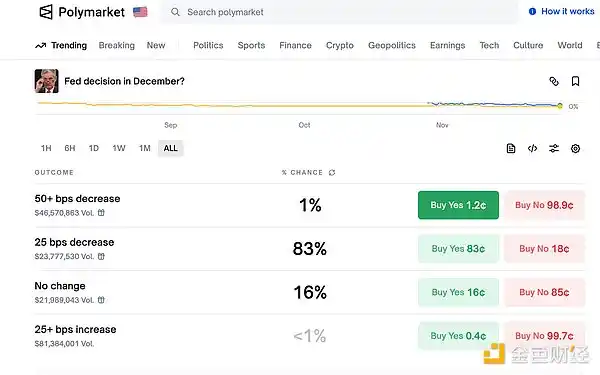
Recent Federal Reserve reports and statements from several officials have continuously raised market expectations of a rate cut in December, with investors regaining confidence in risk assets as liquidity re-enters the market.
IV. ETF Fund Flows Rebound Slightly; New Coin ETFs Launched
Trader T monitoring data shows that the U.S. Bitcoin Spot ETF has seen net inflows for two consecutive days, totaling $149 million; the U.S. Ethereum Spot ETF has also seen net inflows for two consecutive days, totaling $139 million. In addition, several institutions have successively launched ETFs for other mainstream coins. Grayscale has now launched XRP and Dogecoin ETFs. Bitwise has officially launched the Bitwise Dogecoin ETF on the New York Stock Exchange, with the code BWOW. Franklin Templeton, VanEck, and others have also applied to launch new ETF products.
The temporary recovery in ETF fund inflows, along with the introduction of related cryptocurrency asset ETFs by other institutions, indicates that institutional investor funds have not completely exited and will re-enter after the readjustment.
V. Market Analysis and Interpretation
Can this recent cryptocurrency rebound signal that the market has bottomed out, that the deep correction has come to an end, and that the upward trend can continue? Let's take a look at some recent market analysis and interpretations.
1. 4E Lab observations indicate that the return of ancient whales, the relaxation of ETF derivatives, a trend towards structured regulation, and continuous institutional buying together constitute a moderately bullish signal. Bitcoin's "expectation gap" has shifted from extreme optimism to rational optimism, while Ethereum is regaining attention from on-chain whales. Improvement in funding and regulatory environments has led the market into a phase of resonance with the three factors of "warm policy, stable funding, and rising sentiment."
2. Matrixport's chart release states, "Based on federal funds futures implied pricing, the market expects an 84% probability of a Fed rate cut on December 10th, with a 65% probability of holding rates steady in January next year. Under such interest rate path expectations, even if a rate cut is implemented in December, the overall monetary policy easing will still be limited. Compared to Bitcoin, gold has a higher correlation with the U.S. fiscal deficit and debt issuance pace, and is more directly related to hedging fiscal expansion and rate cut expectations. Bitcoin relies more on actual incremental fund inflows, and given the current limited incremental liquidity, divergence in the short term between gold and Bitcoin trends is likely to continue."
3. Galaxy Digital Founder Mike Novogratz stated that he still believes Bitcoin can return to $100,000 by the end of the year, but there will be significant selling pressure by then. The "1011" flash crash had a mid-term psychological impact on the market. Additionally, Novogratz mentioned that with clearer crypto policies and the involvement of traditional financial giants, the market will see deep fragmentation in the future, favoring tokens that can provide value.
4. Bitwise Advisor Jeff Park believes that the previous four-year Bitcoin halving cycle has ended and has now been replaced by a two-year cycle, driven by the economic behavior of institutional fund managers and ETF fund flows.
5. CryptoQuant analyst Abramchart pointed out that the market has just experienced a deep "leverage washout," with the total open interest dropping from $45 billion to $28 billion, marking the largest decline in this cycle. This is not a bearish signal but more like a market bloodletting, clearing out overleveraged speculative positions and setting the stage for a healthier upward momentum.
6. BitMine Chairman Tom Lee believes that Bitcoin could potentially revisit its October all-time high of $125,100 before the end of the year. In an interview on Wednesday, Lee stated, "I think it's very likely that Bitcoin could surpass $100,000 by the end of the year, and maybe even set a new high."
7. Wintermute Trading Strategist Jasper De Maere pointed out that the options market indicates traders generally expect Bitcoin to fluctuate in the $85,000-$90,000 range, betting that the market will maintain the status quo rather than experience a breakthrough trend. Whether this rebound can truly translate into a sustainable uptrend will ultimately depend on whether macro policies and funding can provide lasting and robust support.
8. Delphi Digital analysts published an analysis of the bullish and bearish structures currently forming in BTC. The bullish scenario interprets the current trend as an ABC correction, which needs to be completed and break above $103,500 to confirm. The bearish scenario involves the current rebound forming a lower high below $103,500 at any point, which would trigger the next leg down to complete a full 5-wave impulse decline before seeing a larger-scale sustained rebound.
9. LiquidCapital (formerly LDCapital) Founder Elaine Yi posted stating: ETH Returns to 3000, extreme panic sentiment has passed, and she continues to be optimistic about the follow-up market trend.
You may also like

Morning Report | OpenAI has submitted an S-1 registration statement draft to the U.S. SEC; Morpho completes $175 million financing

Galaxy Deep Research Report: How Hyperliquid's HIP-4 Upgrade Changes the Landscape of Prediction Markets?

Latest research from 13 top universities including Cornell University: The current state, challenges, and misconceptions of the fusion of Crypto and AI

Deconstructing Anthropic: The Best AI Company, Possibly Also a Type of Organizational Invention

Every exchange is a "Universal Exchange."

The counterattack of traditional finance: Alliance chains are quietly reviving
Pantera Capital Partner: How Tokenization is Restructuring the Private Equity and Early Investment Ecosystem?

Mastercard Launches Agent Pay for AI, Plans to Record AI Agent Payment Authorizations on Polygon
Mastercard launched Agent Pay for AI, a new payment protocol designed to help AI agents make small payments such as pay-per-use access to data and APIs. The system plans to record human-granted AI agent permissions on Polygon, focusing on verifiable authorization, identity, and payment controls.

Curve Deploys Llamalend v2 on Optimism With 250,000 OP Incentives
Curve launched Llamalend v2 on Optimism with 250,000 OP incentives from the Optimism Foundation. The upgrade expands Llamalend beyond its earlier crvUSD-focused model, adding broader collateral support, LlamaRisk market reviews, and the ability to use Curve LP tokens as collateral.

Raydium Old Liquidity Pool Reportedly Exploited, With $1.34 Million Moved to Ethereum and Tornado Cash
An old Raydium liquidity pool was reportedly exploited for around $1.34 million in USDC, RAY, and wSOL, with the stolen funds bridged to Ethereum and deposited into Tornado Cash. The incident highlights the tail risks of legacy DeFi pools, old contracts, and cross-chain fund laundering paths.
Kalshi Executive Challenges “SBF Backed AI Unicorns” Narrative, Says Leopold Aschenbrenner Was Key Figure
Kalshi executive John Wang questioned the “SBF backed AI unicorns” narrative, saying Leopold Aschenbrenner was the key figure behind major AI investment decisions.

New York Proposes Stricter Stablecoin Issuer Rules Aligned With Federal GENIUS Act
NYDFS proposed stricter stablecoin issuer rules aligned with the GENIUS Act, covering reserves, custody, redemption timelines, audits, and capital buffers.

CryptoQuant Says Bitcoin Profitable Supply Is Near 45% Pressure Zone as On-Chain Data Points to Market Repricing
CryptoQuant said Bitcoin’s profitable supply is nearing the 45% pressure zone, signaling rising market stress, unrealized losses, and a possible on-chain repricing phase.

Bitcoin Falls Below 200-Week Moving Average as On-Chain Data Shows Over Half of Supply in Loss
Bitcoin dropped below its 200-week moving average as on-chain data showed over 50% of circulating supply is now in loss, signaling rising market stress.

CFTC Reportedly Plans New Prediction Market Rules Focused on Manipulation Risk and Public Interest Review
The CFTC is reportedly preparing new prediction market rules focused on manipulation risk, public interest review, and retail trader protections.

Meet the new WEEX trial fund—your gateway to greater profits

WEEX Labs Lands at Dutch Blockchain Week: A Disruptive Crypto × AI Conversation Sets Sail in Amsterdam
SK Hynix Reportedly Plans U.S. ADR Listing as Early as August, With SEC Approval Possible in Late June
SK Hynix may pursue a U.S. ADR listing as early as August, with SEC approval reportedly possible in late June amid strong AI chip supply chain demand.
Morning Report | OpenAI has submitted an S-1 registration statement draft to the U.S. SEC; Morpho completes $175 million financing
Galaxy Deep Research Report: How Hyperliquid's HIP-4 Upgrade Changes the Landscape of Prediction Markets?
Latest research from 13 top universities including Cornell University: The current state, challenges, and misconceptions of the fusion of Crypto and AI
Deconstructing Anthropic: The Best AI Company, Possibly Also a Type of Organizational Invention
Every exchange is a "Universal Exchange."
The counterattack of traditional finance: Alliance chains are quietly reviving


