
Bitcoin End-of-Year Volatility - What Were the Reasons?


On the last day of 2024, Bitcoin experienced a brief plunge to $92,000, resulting in a total of $277 million in liquidations across the network in the past 24 hours. Of this amount, long positions were liquidated at $185 million, while short positions were liquidated at $92.16 million. Meanwhile, as the U.S. stock market opened, both crypto-related stocks and the "Big Seven" of the U.S. stock market saw a widespread decline, with the Dow Jones falling by 1.04%, the S&P 500 Index dropping by 1.13%, and the Nasdaq declining by 1.33%.
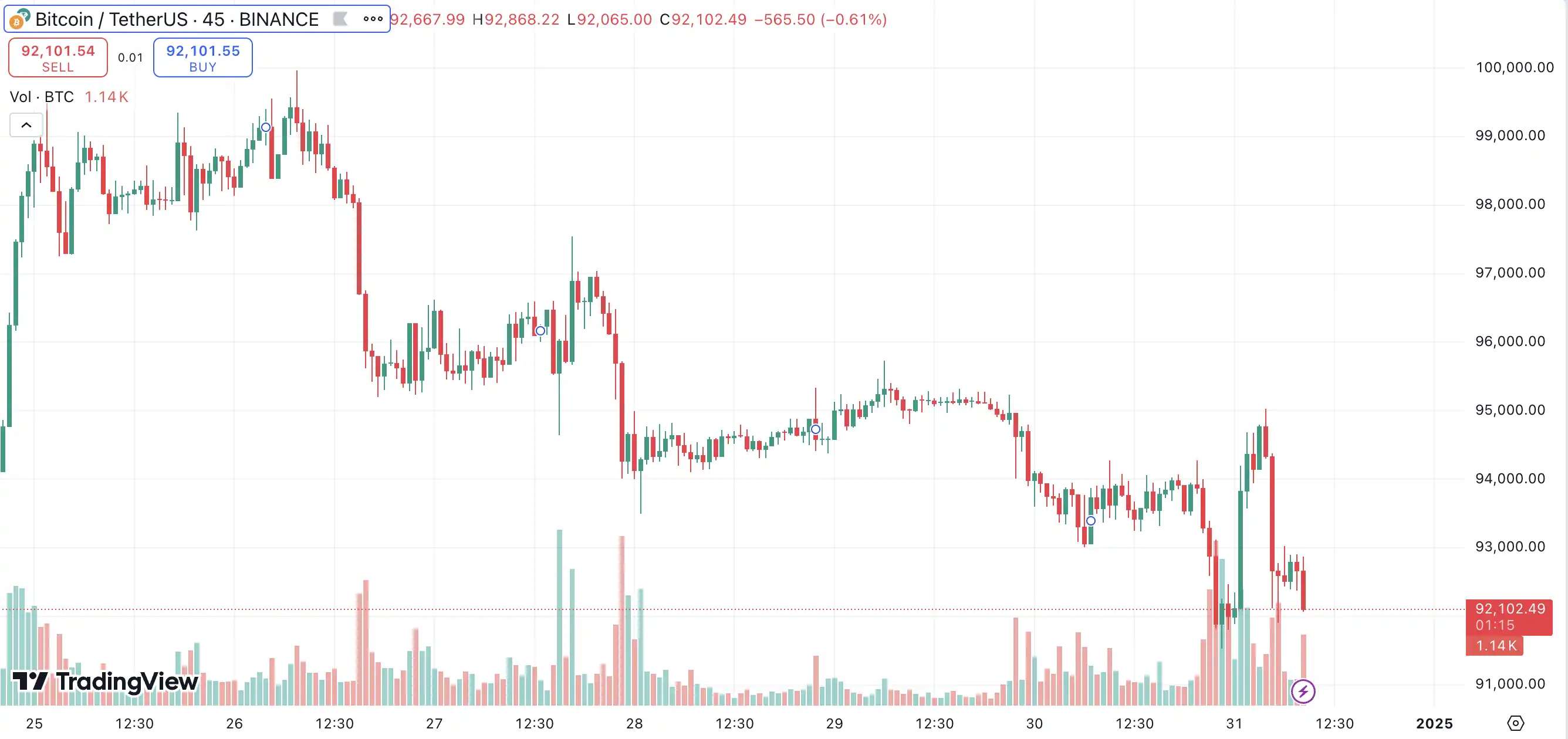
Since entering the Christmas market trend in late December, Bitcoin has experienced multiple sudden plunges. Below are the market reasons for Bitcoin's recent downturn compiled by BlockBeats for reference.
Strength of the U.S. Dollar and Unpopularity of U.S. Stocks and the Crypto Market
According to data from Bank of America, the U.S. stock market saw approximately $35 billion in outflows in the past week, marking the highest weekly outflow since December 2022. In addition, Goldman Sachs' trading desk estimates that U.S. pensions will sell $21 billion worth of U.S. stocks by the end of December this year due to the trends in stocks and bonds, and will purchase an equivalent amount of bonds.
On the past Friday, the yield on the 10-year U.S. Treasury note rose by nearly 1% to 4.629%, nearing a seven-month high. The U.S. stock market may face the risk of massive fund sell-offs. Wall Street analysts believe that in the current absence of major news, data, and light trading, the 10-year U.S. bond yield, as an anchor for asset pricing, will have an impact on the stock market. The higher the yield, the greater the pressure on the stock market.
As the strength of the U.S. dollar has pushed down global currencies and assets, including Bitcoin, dollar-denominated assets become more attractive compared to cryptocurrency in a strengthening dollar environment. Investors prefer traditional investments such as U.S. Treasuries or stocks, which produce returns in a strong dollar environment. Additionally, with declining liquidity and year-end profit-taking by investors, the possibility of further gains in cryptocurrency has been weakened.
Outflows in Bitcoin Spot ETFs
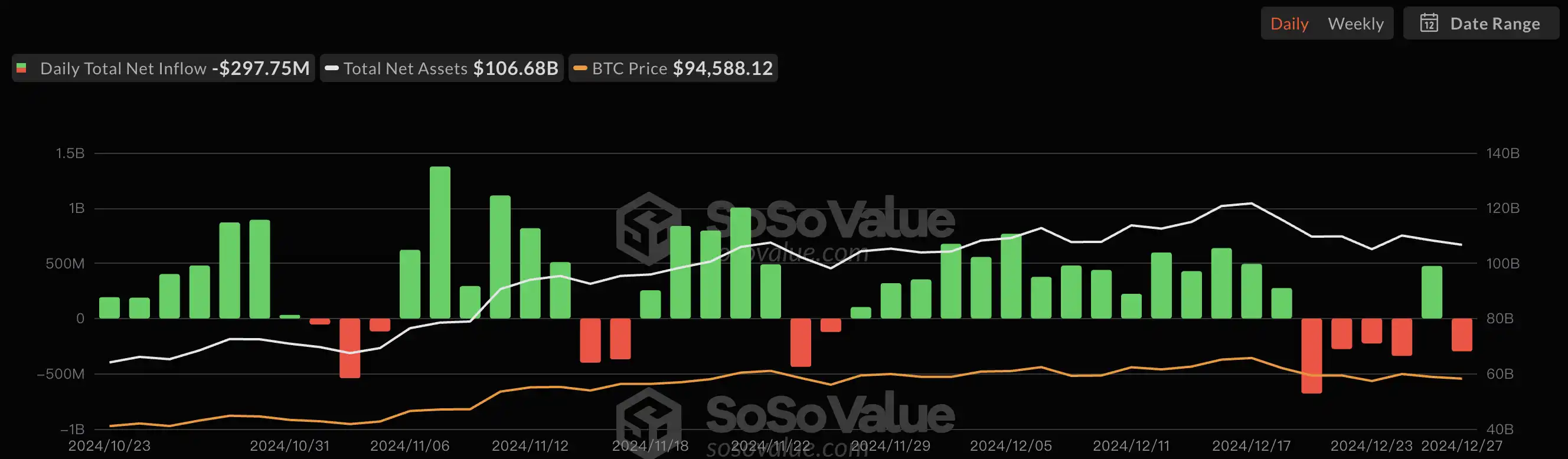
Data from Bitcoin spot ETFs have transitioned from a net inflow status seen during the "Trump Rally" to a net outflow status, with a total net outflow of $377.6 million last week, and a daily net outflow yesterday. On December 27, Fidelity's FBTC saw a net outflow of $208 million, setting a new all-time high for single-day net outflows.
Options Expiration and End-of-Quarter Volatility Sell-off
On December 17, QCP indicated that the options market had sent some cautious signals. Even as the spot price continued to hit new highs, the options market exhibited a persistent skew towards put options relative to call options—perhaps reflecting investors' preference for risk hedging rather than aggressively chasing the uptrend.
On December 28, BTC and ETH options with a notional value of nearly $20 billion were set to expire, almost half of Deribit's total OI. Meanwhile, the Bitcoin price dropped from $97,000 to $94,000 on the same day. QCP believes this was a typical end-of-quarter volatility sell-off, especially considering the continued spot volatility and option sellers continuing to close positions.
Greeks.live analyst Adam also posted on social media, stating that the skew differences between option expiries have widened. Since the bull market at the end of this year, the skew between expiries has been very close, fluctuating around 5%, with most differences not exceeding 1%. However, as recent adjustments have taken place, the differences have started to widen, with the short-term skew experiencing a greater decline. These data indicate a significant decrease in market enthusiasm, with option market participants showing reduced optimism for January.
Stablecoin Minting Volume Declines, USDT FUD Affects Market Confidence
Since December, the minting volume of stablecoins has seen a significant drop. Only on the 13th, Tether minted an additional 1 billion USDT on Ethereum, and USDC's minting volume in December was only 200 million. However, since November 6, Tether has minted 21 billion USDT on Ethereum and Tron blockchains.
Today, the EU's MiCA regulation officially came into effect, but Tether's USDT has not yet received regulatory approval, raising concerns about its future in the EU market. MiCA imposes strict requirements on stablecoin issuers, such as Tether, regarding capital reserves and liquidity, which could lead to their exit from the EU market. Some EU exchanges have already begun taking measures to comply with the new rules, with Coinbase Europe delisting stablecoins like USDT.
Nevertheless, Tether's significant market capitalization and global adoption make it unlikely to suffer an immediate financial shock. Tether's CEO Paolo Ardoino posted on social media, stating, "Don't believe FUD. Competitors are just eager to make you believe in things that don't exist. USDT is safe."
It is worth noting that Tether itself has not faced any financial issues or engaged in any illegal activities. Tether will focus on supporting new stablecoin projects, such as launching stablecoins EURQ and USDQ that comply with MiCA standards. However, given the stablecoin industry's previous history of collapses, short-term USDT FUD can still affect market confidence.
You may also like

Mastercard Launches Agent Pay for AI, Plans to Record AI Agent Payment Authorizations on Polygon
Mastercard launched Agent Pay for AI, a new payment protocol designed to help AI agents make small payments such as pay-per-use access to data and APIs. The system plans to record human-granted AI agent permissions on Polygon, focusing on verifiable authorization, identity, and payment controls.

Curve Deploys Llamalend v2 on Optimism With 250,000 OP Incentives
Curve launched Llamalend v2 on Optimism with 250,000 OP incentives from the Optimism Foundation. The upgrade expands Llamalend beyond its earlier crvUSD-focused model, adding broader collateral support, LlamaRisk market reviews, and the ability to use Curve LP tokens as collateral.

Raydium Old Liquidity Pool Reportedly Exploited, With $1.34 Million Moved to Ethereum and Tornado Cash
An old Raydium liquidity pool was reportedly exploited for around $1.34 million in USDC, RAY, and wSOL, with the stolen funds bridged to Ethereum and deposited into Tornado Cash. The incident highlights the tail risks of legacy DeFi pools, old contracts, and cross-chain fund laundering paths.

Kalshi Executive Challenges “SBF Backed AI Unicorns” Narrative, Says Leopold Aschenbrenner Was Key Figure
Kalshi executive John Wang questioned the “SBF backed AI unicorns” narrative, saying Leopold Aschenbrenner was the key figure behind major AI investment decisions.

Pantera Capital Partner: How Tokenization is Restructuring the Private Equity and Early Investment Ecosystem?

New York Proposes Stricter Stablecoin Issuer Rules Aligned With Federal GENIUS Act
NYDFS proposed stricter stablecoin issuer rules aligned with the GENIUS Act, covering reserves, custody, redemption timelines, audits, and capital buffers.
Every exchange is a "Universal Exchange."

The counterattack of traditional finance: Alliance chains are quietly reviving

CryptoQuant Says Bitcoin Profitable Supply Is Near 45% Pressure Zone as On-Chain Data Points to Market Repricing
CryptoQuant said Bitcoin’s profitable supply is nearing the 45% pressure zone, signaling rising market stress, unrealized losses, and a possible on-chain repricing phase.

Bitcoin Falls Below 200-Week Moving Average as On-Chain Data Shows Over Half of Supply in Loss
Bitcoin dropped below its 200-week moving average as on-chain data showed over 50% of circulating supply is now in loss, signaling rising market stress.

CFTC Reportedly Plans New Prediction Market Rules Focused on Manipulation Risk and Public Interest Review
The CFTC is reportedly preparing new prediction market rules focused on manipulation risk, public interest review, and retail trader protections.

Meet the new WEEX trial fund—your gateway to greater profits

WEEX Labs Lands at Dutch Blockchain Week: A Disruptive Crypto × AI Conversation Sets Sail in Amsterdam
SK Hynix Reportedly Plans U.S. ADR Listing as Early as August, With SEC Approval Possible in Late June
SK Hynix may pursue a U.S. ADR listing as early as August, with SEC approval reportedly possible in late June amid strong AI chip supply chain demand.

SpaceX vs Tesla vs xAI: Which Elon Musk Trade Has the Biggest Upside in 2026?
OpenAI Reveals It Has Confidentially Submitted an S-1 to the SEC, Keeping the Door Open for a Future IPO
On June 9, according to an OpenAI announcement, the company recently confidentially submitted a draft S-1 registration statement to the U.S. Securities and Exchange Commission (SEC), beginning the preliminary compliance process for a potential initial public offering. OpenAI said it chose to disclose this proactively because it expected the news might leak; however, the company has not yet set a specific listing timeline, and related arrangements may still take some time.
Latest research from 13 top universities including Cornell University: The current state, challenges, and misconceptions of the fusion of Crypto and AI
Deconstructing Anthropic: The Best AI Company, Possibly Also a Type of Organizational Invention
Mastercard Launches Agent Pay for AI, Plans to Record AI Agent Payment Authorizations on Polygon
Mastercard launched Agent Pay for AI, a new payment protocol designed to help AI agents make small payments such as pay-per-use access to data and APIs. The system plans to record human-granted AI agent permissions on Polygon, focusing on verifiable authorization, identity, and payment controls.
Curve Deploys Llamalend v2 on Optimism With 250,000 OP Incentives
Curve launched Llamalend v2 on Optimism with 250,000 OP incentives from the Optimism Foundation. The upgrade expands Llamalend beyond its earlier crvUSD-focused model, adding broader collateral support, LlamaRisk market reviews, and the ability to use Curve LP tokens as collateral.
Raydium Old Liquidity Pool Reportedly Exploited, With $1.34 Million Moved to Ethereum and Tornado Cash
An old Raydium liquidity pool was reportedly exploited for around $1.34 million in USDC, RAY, and wSOL, with the stolen funds bridged to Ethereum and deposited into Tornado Cash. The incident highlights the tail risks of legacy DeFi pools, old contracts, and cross-chain fund laundering paths.
Kalshi Executive Challenges “SBF Backed AI Unicorns” Narrative, Says Leopold Aschenbrenner Was Key Figure
Kalshi executive John Wang questioned the “SBF backed AI unicorns” narrative, saying Leopold Aschenbrenner was the key figure behind major AI investment decisions.
Pantera Capital Partner: How Tokenization is Restructuring the Private Equity and Early Investment Ecosystem?
New York Proposes Stricter Stablecoin Issuer Rules Aligned With Federal GENIUS Act
NYDFS proposed stricter stablecoin issuer rules aligned with the GENIUS Act, covering reserves, custody, redemption timelines, audits, and capital buffers.


