
- Buy Crypto
- Markets
 Futures
- Spot
- Copy Trade
- Earn
- More
Bloomberg has reported twice, Hyperliquid once again in Wall Street's radar

At 1:12 AM EST on February 28, during the exchange downtime, the trading volume of the prediction contract on Polymarket regarding the US striking Iran surged.
Source: @yenwod_
At 1:13 AM, the first open-source intelligence tweet about the airstrike appeared on Twitter.

One minute later, the price and trading volume of the crude oil perpetual contract on Hyperliquid's Trade.xyz followed an anomaly.
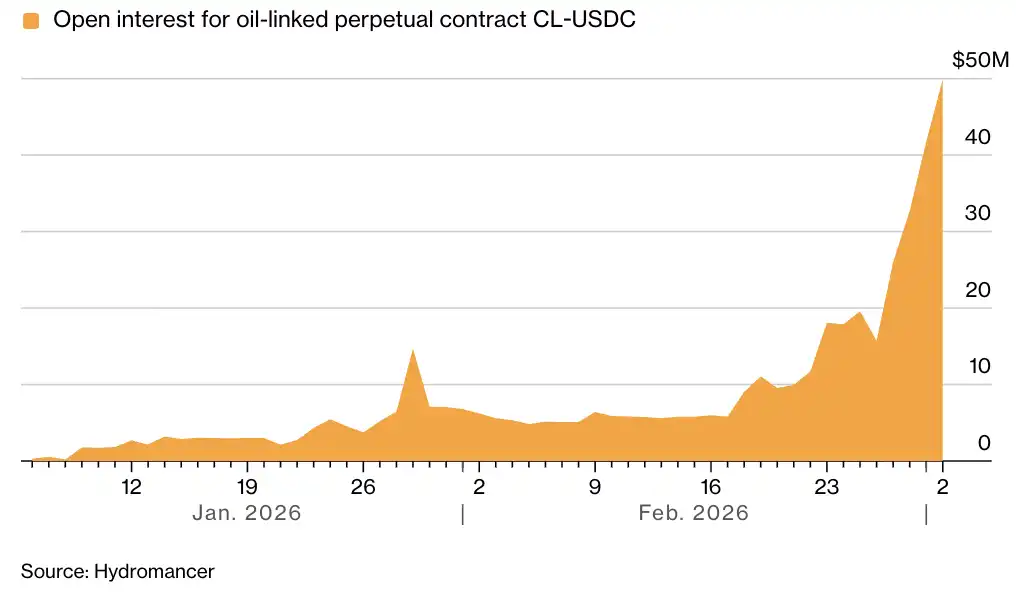
After the headline news broke, the crude oil perpetual contract on the Hyperliquid platform rose by 5%, with OI reaching $50 million. HYPE's price increased by 13%, leading the top 25 tokens by market cap.
24/7 Trading
Out of the past year's ten high-volatility macroeconomic events, eight occurred over the weekend. Hyperliquid's round-the-clock price discovery mechanism is drawing attention from the traditional financial markets.
In two recent articles about Hyperliquid, Bloomberg pointed out that as the intersection between the crypto market and traditional finance deepens, Wall Street is starting to closely watch platforms like Hyperliquid. During weekends when traditional markets are closed, on-chain derivatives offer continuous risk pricing capabilities. Bloomberg cited market participants stating that this round-the-clock pricing mechanism is a structural upgrade to enhance market efficiency. Weekend market movements validate a trend where round-the-clock on-chain trading of all asset classes is an inevitable direction for financial market development.
Decoupling
With the growth of HIP-3 supporting traditional market trading, HYPE's price performance has already begun to decouple from the default benchmark of the crypto market, Bitcoin. When news of the strike broke, the price of Bitcoin briefly fell and entered a period of volatility. In contrast, HYPE, which caters to trading demands for precious metals, stocks, and more, showed an independent trend.
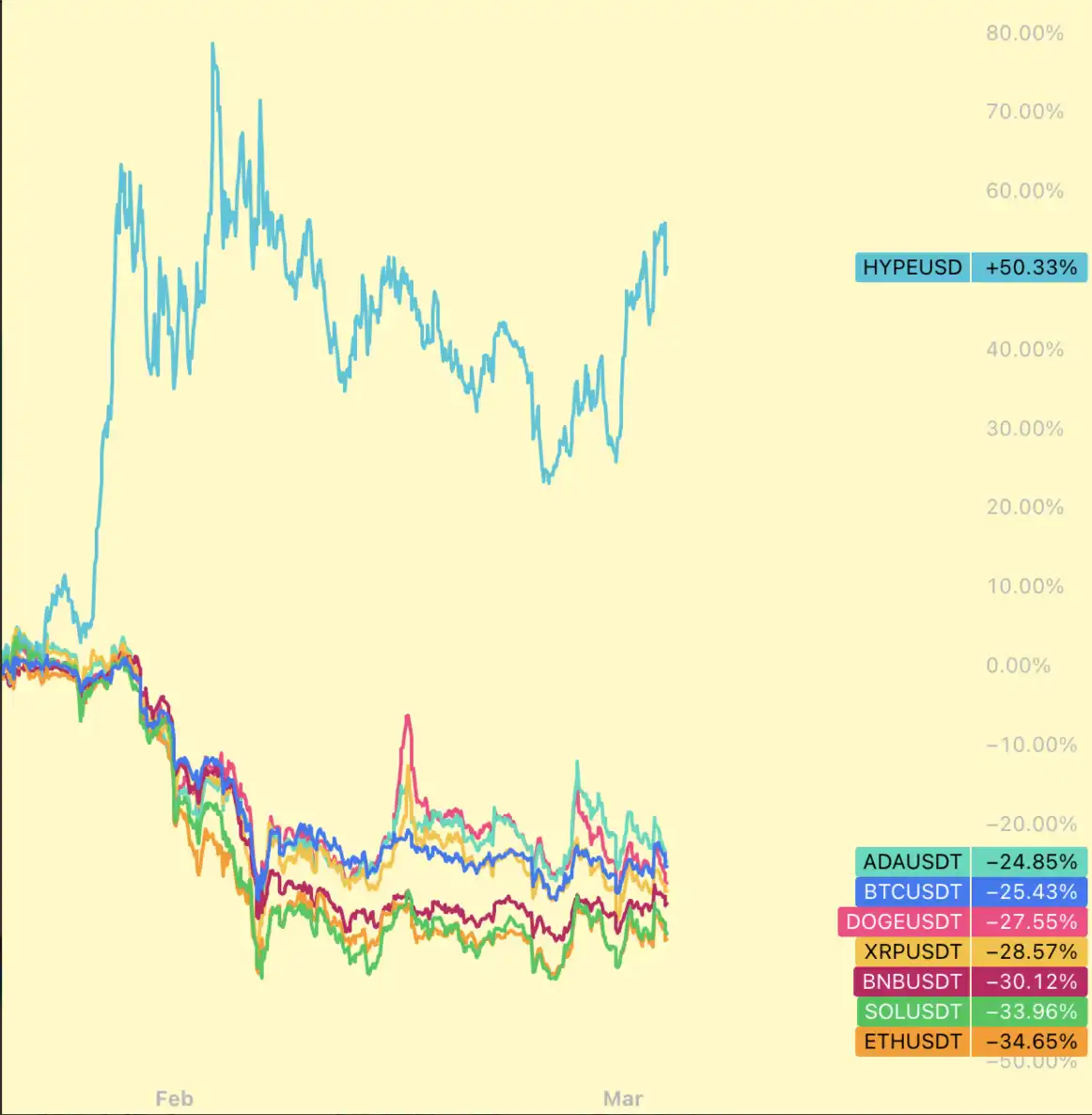
In late January, when silver broke $100 and gold broke $5500, the trading volume of silver-only contracts on the HIP-3 exchange tradexyz reached $1.2 billion, driving HYPE's 55% increase in three days, while Bitcoin only rose by 3% during that period.
Surge in Gold, Silver, and Copper Contract Trading Volume onTrade.xyz Since January
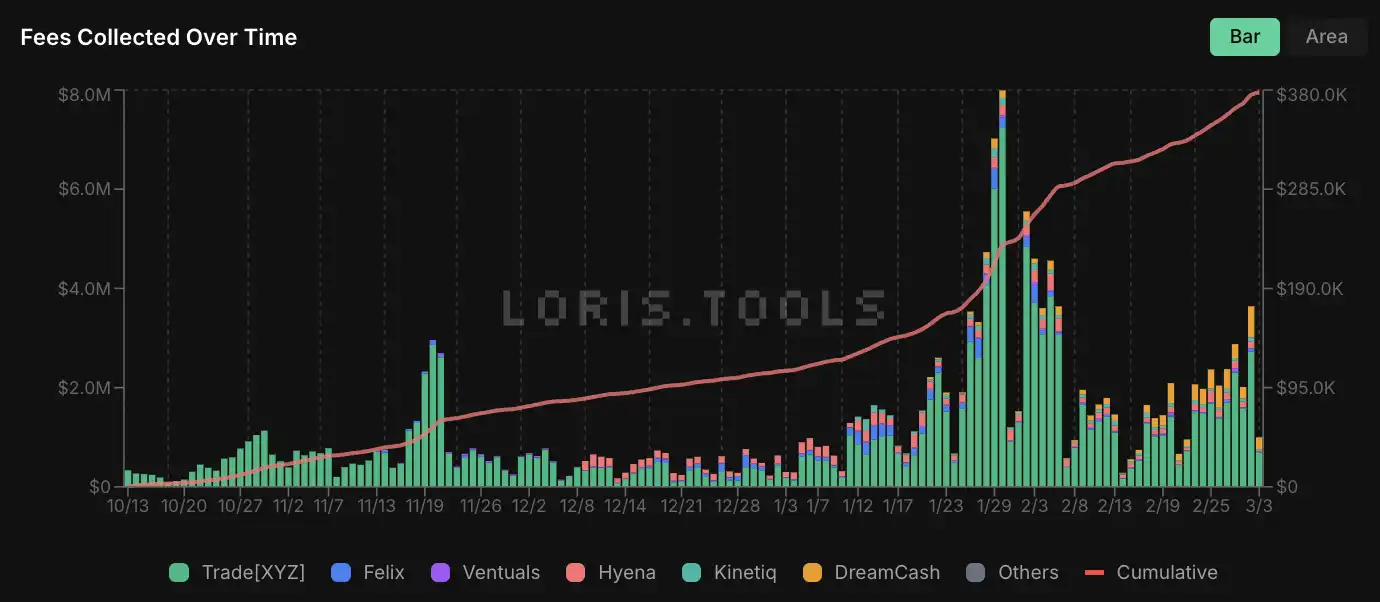
The Tokenomics explained the reason behind the HYPE surge. Hyperliquid's HIP-3 protocol dictates that 50% of all fee revenue generated by HIP-3 exchanges flows into the Hyperliquid Official Aid Fund for HYPE buybacks. Macro volatility drives up trading volume, increasing the buyback size, creating strong buying pressure for the HYPE token.
Fee Revenue Generated by HIP-3 Exchanges on
HYPE holders are not only betting on Hyperliquid's growth as an offshore Perp DEX but also on longing geopolitical uncertainty.
Hyperliquid is just the clearest expression of this narrative so far, and the market is finally starting to reflect that.
Discrepancy
Nevertheless, on-chain derivatives still have a ways to go to meet traditional institutional standards.
Hyperliquid's current edge lies in small to medium-sized retail orders. According to Blockworks Research, during normal trading hours, its Silver contract's spread is comparable to the COMEX micro contract. However, the depth discrepancy is significant. COMEX has a $13 million order book depth within ±5 bps, whereas Hyperliquid has only around $230k.
COMEX vs. Hyperliquid Order Book Depth Comparison
Source: Blockworks Research
In extreme market sell-offs, on-chain liquidity suffers from greater tail risks. 1% of Hyperliquid's Silver trades experience a slippage of over 50 bps, while COMEX still offers better execution costs in such scenarios.
COMEX vs. Hyperliquid Execution Slippage Comparison
Source: Blockworks Research
Currently, Hyperliquid's liquidity and funding rate model cannot yet meet the needs of large funds. To compete at an institutional level, on-chain platforms need to address KYC issues and may even need to establish technical and collaborative frameworks that match traditional clearing institutions. Many industry participants still believe that if the Chicago Mercantile Exchange (CME) were to launch 24/7 trading, it would have a natural hedging advantage and trust foundation.
However, the traditional financial market's reliance on a risk control model based on physical closure times has indeed shown its limitations. The ability to continuously price risk without waiting for Monday's opening is a core value proposition of offshore exchanges like Hyperliquid.
The transfer of market pricing power to the blockchain will be a long process. But we must dare to dream — just in case it comes true.
You may also like

Quick Overview of Alliance ALL16 Demo Day: 18 New Projects Featuring Emerging Trends in Prediction Markets and AI Applications

The Ethereum Foundation launches "Hardness," a dedicated team to safeguard the decentralized baseline
Morning News | Boya Interactive plans to invest no more than $70 million to purchase cryptocurrency; WeChat launches official lobster plugin; Bitcoin mining difficulty decreased by 7.76% to 133.79 T

The competition for stablecoin yields, how has it stalled U.S. cryptocurrency regulatory legislation?
This Week's News Preview | The joint cryptocurrency regulatory guidance document from the U.S. SEC and CFTC officially takes effect; Polymarket announces major news

What characteristics do the projects delisted by mainstream exchanges have?

Before the $75,000 Gamma level, both bulls and bears are waiting for a signal

Business Opportunities of Tokenized Stocks
In-depth research report on the Resolv protocol hacking incident, who is the final payer?

Crypto Market Sees Large Liquidations: $272 Million in Long Positions Affected
Key Takeaways In the last 24 hours, $272 million worth of contracts were liquidated across the entire crypto…

Whale Increases BTC Shorts and Bets on Crude Oil: A Strategic Crypto Move
Key Takeaways A prominent whale, known as “UnRektCapital,” has strategically escalated its short position in Bitcoin while simultaneously…
Hackers in Brazil Use Fake Google Play Store to Steal Cryptocurrency
Key Takeaways Hackers in Brazil are exploiting fake Google Play Store pages to spread Android malware. Infected devices…

Exchanging 200,000 for nearly 100 million, DeFi stablecoins face another attack

The underlying business agreement of the trillion-dollar Agent economy: Understanding ERC-8183, it's not just about payments, but the future

When Wall Street's ETH begins to "yield": Looking at the asset properties of Ethereum from BlackRock's ETHB
The Power of Agency: The Agentic Wallet and the Next Decade of Wallets

Understanding x402 and MPP in One Article: Two Routes for Agent Payments



 App
App