
Can the Uniswap Foundation's massive investment plan solve the token value capture dilemma?



Original Title: Uniswap Foundation votes on a massive $165.5m USD funding.
Original Author: Ignas
Original Translation: Tim, PANews
The Uniswap Foundation has voted on a $165.5 million USD investment plan, but why?
Because the performance of Uniswap v4 and Unichain post-release has fallen far short of market expectations.
In over a month:
· Uni v4's Total Value Locked (TVL) is only $85 million
· Unichain's TVL is only $8.2 million
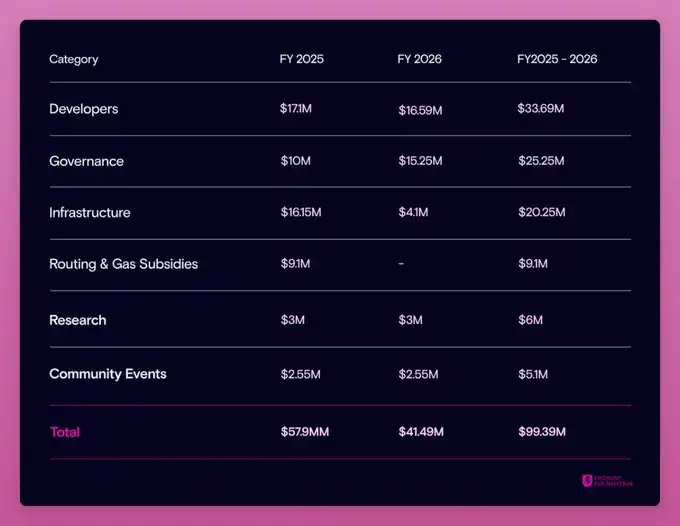
To drive growth, the Uniswap Foundation has proposed allocating $165.5 million in funding towards the following:
· $95.4 million for Grants (developer initiatives, core contributors, validators);
· $25.1 million for Operations (team expansion, governance tooling);
· $45 million for Liquidity Incentives.
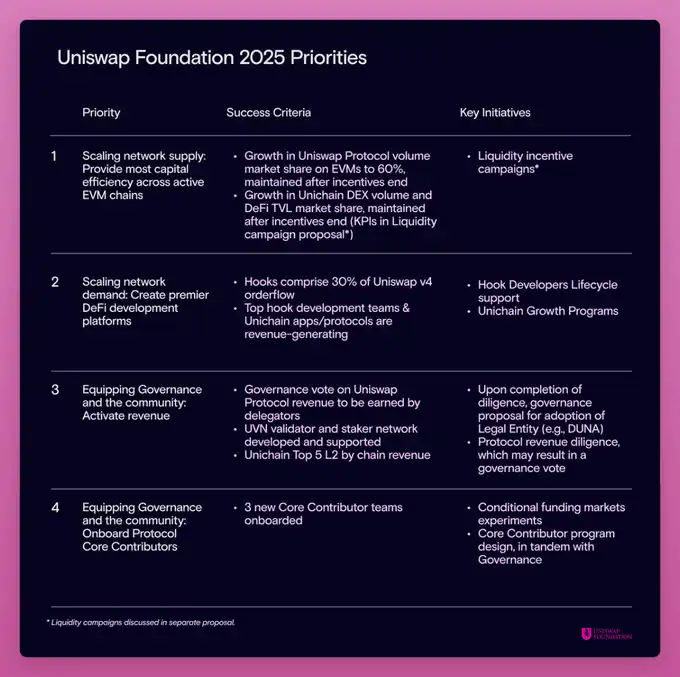
As you can see, Uni v4 is not just a DEX but also a liquidity platform, and Hooks are applications built on top of it.
Hooks are meant to drive the ecosystem growth of Uni v4, hence the need to accelerate this process through a funding initiative.
A breakdown of the funding budget:
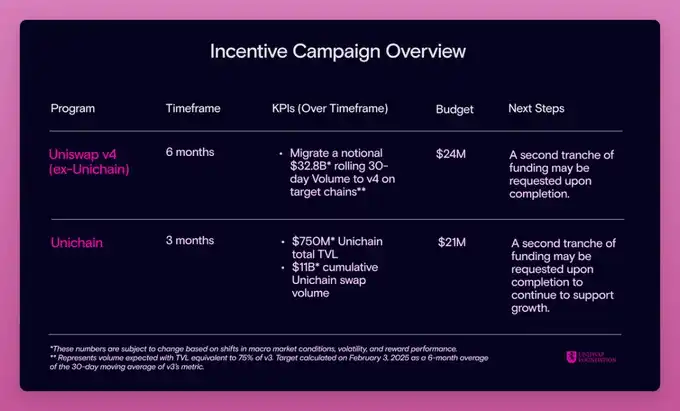
The $45 million Liquidity Provider (LP) Incentives will be used as follows:
· $24 million (distributed over 6 months): To incentivize liquidity migration from other platforms to Uni v4;
· $21 million (distributed over 3 months): To drive Unichain's Total Value Locked (TVL) from the current $8.2 million to $750 million.
On the other hand, Aerodrome mints approximately $40-50 million worth of AERO tokens per month for Liquidity Provider (LP) incentives.
The proposal has passed the temperature check phase but still faces some criticism:
Amidst industry shifts, Aave proposes a weekly buyback of $1 million worth of AAVE tokens, Maker plans a monthly buyback of $30 million, and UNI holders are likened to a "cash cow" that has never had its token value captured.
UNI tokens do not enable a fee-sharing mechanism, yet Uniswap Labs has earned $171 million over two years through frontend fees.
The key to the whole system lies in Uniswap's organizational design:
· Uniswap Labs: Focuses on protocol tech development;
· Uniswap Foundation: Drives ecosystem growth, governance, and funding initiatives (such as grants, liquidity incentives).
Quite a savvy legal team.
Aave and Maker have established a closer alignment of interests with token holders, and I don't understand why Uniswap's frontend fees cannot be shared with UNI holders.
In conclusion, other criticisms mainly revolve around the core team's high salaries, Gauntlet's responsibility for liquidity incentive execution, and the establishment of a new centralized DAO legal structure (DUNA).
As a small governance representative for Uniswap, I have voted in favor of this proposal, but I still have significant concerns about the future of UNI holders: the incentive mechanism has failed to align with holders' interests.
However, I am a loyal fan of Uniswap and highly appreciate its driving role in the DeFi space. The current stagnation of Uni v4 and Unichain is very concerning, and they need to introduce incentive measures to foster development.
The next Uni DAO vote should focus on the UNI token's value-capture mechanism.
You may also like

The stablecoin positioning battle escalates: When compliance is just a ticket to entry, will USD1 become the biggest winner?

Can the CLARITY Act Become Law by July 4? Everything You Need to Know About the Final Battle

How to exit after asset tokenization?

The foundation of SpaceX's trillion-dollar valuation: Who is dividing Musk's annual capital expenditure of tens of billions?

France vs Senegal World Cup 2026: Mbappe’s New Era Begins Against a Historic Rival

SharpLink CEO: How to understand that Ethereum developers have just surpassed 1 million?

Morning Report | MiCA grace period expires on July 1; Kalshi's trading volume in the first week of the World Cup breaks $5.1 billion, setting a record

What is the connection between Huang Zheng of Pinduoduo and blockchain?

Morning Report | Prediction market platforms like Kalshi and Polymarket jointly sue Kentucky over 14.25% trading tax; Bridgewater founder discusses decision-making in the AI era: principled thinking should run parallel to AI, human insight remains irre...

If the AI bubble has already burst, who will truly remain?
Paul Graham: How to Make a Billion Dollars

After 18 years, blockchain has finally started to head towards the main channel
Claude enforces "facial recognition for household registration," starting in July, no ID card means no access?

On the day of SpaceX's IPO, the first real test of the three perpetual mechanisms

Value Distribution of Stablecoins
Galaxy Deep Dive: Is the Bitcoin Four-Year Cycle Still Valid?

SpaceX IPO, Nvidia, and Bitcoin: Why Traders Are Watching More Than Just Crypto in 2026

The other side of Musk's trillion-dollar fortune: 85% cannot be sold
The stablecoin positioning battle escalates: When compliance is just a ticket to entry, will USD1 become the biggest winner?
Can the CLARITY Act Become Law by July 4? Everything You Need to Know About the Final Battle
How to exit after asset tokenization?
The foundation of SpaceX's trillion-dollar valuation: Who is dividing Musk's annual capital expenditure of tens of billions?
France vs Senegal World Cup 2026: Mbappe’s New Era Begins Against a Historic Rival
SharpLink CEO: How to understand that Ethereum developers have just surpassed 1 million?


