
CLARITY Act Stalls: Why Has the Interest-Bearing Stablecoin Become a Bank's "Thorn in the Side"?

 Prefer us on Google


Original Article Title: "Why Do Banks Have to Ban Stablecoin Yield?"
Original Article Author: Azuma, Odaily Planet Daily
With Coinbase's temporary "rebound" and the delay in the Senate Banking Committee's deliberations, the cryptocurrency market infrastructure bill (CLARITY) has once again entered a phase of stalemate.
Amidst the current market debate, the biggest point of contention surrounding CLARITY has centered around "interest-bearing stablecoins". Specifically, the GENIUS Act passed last year explicitly banned interest-bearing stablecoins in order to seek support from the banking industry. This act forbade stablecoin issuers from paying holders "any form of interest or return," but did not restrict third parties from providing returns or rewards. The banking industry was very unhappy with this "workaround" and attempted to overturn it in CLARITY, seeking to ban all types of interest-bearing mechanisms. This move drew strong opposition from some cryptocurrency groups represented by Coinbase.
Why are banks so resistant to interest-bearing stablecoins and determined to block various yield avenues? The purpose of this article is to answer this question in detail by dissecting the profit model of large U.S. commercial banks.
Bank Deposit Outflow? Utter Nonsense
In the arguments against interest-bearing stablecoins, the most common reason cited by the banking industry representatives is "concern that stablecoins will cause bank deposit outflows." Bank of America CEO Brian Moynihan said in a conference call last Wednesday: "Up to $6 trillion in deposits (about 30% to 35% of all U.S. commercial bank deposits) may migrate to stablecoins, thereby limiting banks' ability to lend to the overall U.S. economy... and interest-bearing stablecoins could accelerate deposit outflows."
However, with a basic understanding of the stablecoin operation logic, it is evident that this statement is highly misleading and deceptive. When $1 flows into the USDC or other stablecoin systems, this $1 does not simply disappear but is held in the reserve treasury of stablecoin issuers like Circle, ultimately flowing back into the banking system in the form of cash deposits or other short-term liquid assets (such as government bonds).
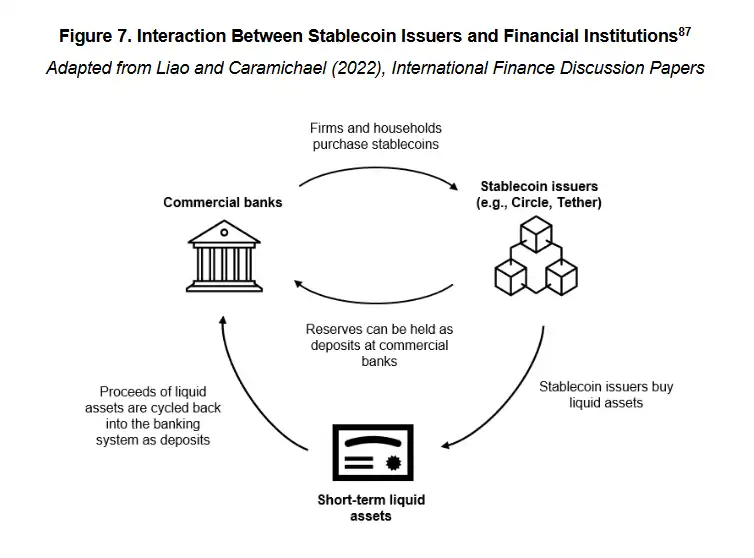
Other mechanisms of stablecoins involving crypto collateral, futures hedging, algorithms, etc., are not considered here.
One reason is that such stablecoins account for a smaller proportion.
Second, this is because these stablecoins do not fall within the scope of this article's discussion of compliant stablecoins in the U.S. regulatory system—last year's GENIUS Act clearly defined the reserve requirements for compliant stablecoins, with reserve assets limited to cash, short-term government securities, or central bank deposits, and must be segregated from operating funds.
So the fact is very clear that stablecoins will not lead to bank deposit outflows because funds will ultimately always flow back to banks and can be used for credit intermediation. This depends on the stablecoin's business model and has little to do with whether it is interest-bearing.
The real key issue lies in the change in deposit structure after the funds flow back.
The Money Tree of American Banks
Before analyzing this change, we need to briefly introduce the interest-earning business of U.S. major banks.
Van Buren Capital General Partner Scott Johnsson cited a paper from the University of California, Los Angeles, stating that since the 2008 financial crisis damaged the banking industry's reputation, U.S. commercial banks in the deposit-gathering business have differentiated into two completely different forms—high-rate banks and low-rate banks.
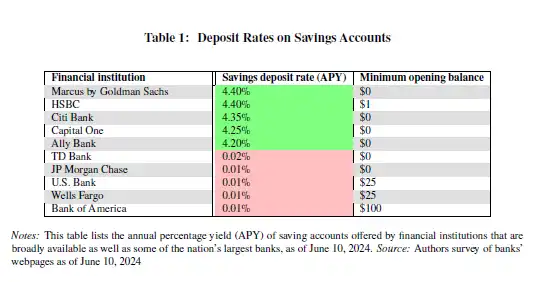
High-rate banks and low-rate banks are not a formal regulatory classification but rather commonly used terms in the market context—manifesting on the surface, the interest rate spread between high-rate banks and low-rate banks has reached over 350 basis points (3.5%).
Why, for the same deposit, is there such a significant interest rate spread? The reason is that high-rate banks are mostly digital banks or banks with a business structure that focuses on wealth management or capital markets business (such as Capital One). They rely on high-interest rates to attract deposits to support their lending or investment business; in contrast, low-rate banks are mainly national large commercial banks like Bank of America, JPMorgan Chase, and Wells Fargo, that hold the actual discourse power of the banking industry. They have a large retail customer base and payment network and can maintain extremely low deposit costs through customer stickiness, brand effects, and branch convenience, without needing to attract deposits through high-interest rates.
From a deposit structure perspective, high-rate banks generally focus on non-transactional deposits, mainly used for savings or interest returns—such funds are more sensitive to interest rates, resulting in higher costs for banks; low-rate banks mainly focus on transactional deposits, mainly used for payments, transfers, and settlement—these funds are characterized by higher stickiness, frequent liquidity, extremely low interest rates, and are the most valuable liabilities for banks.
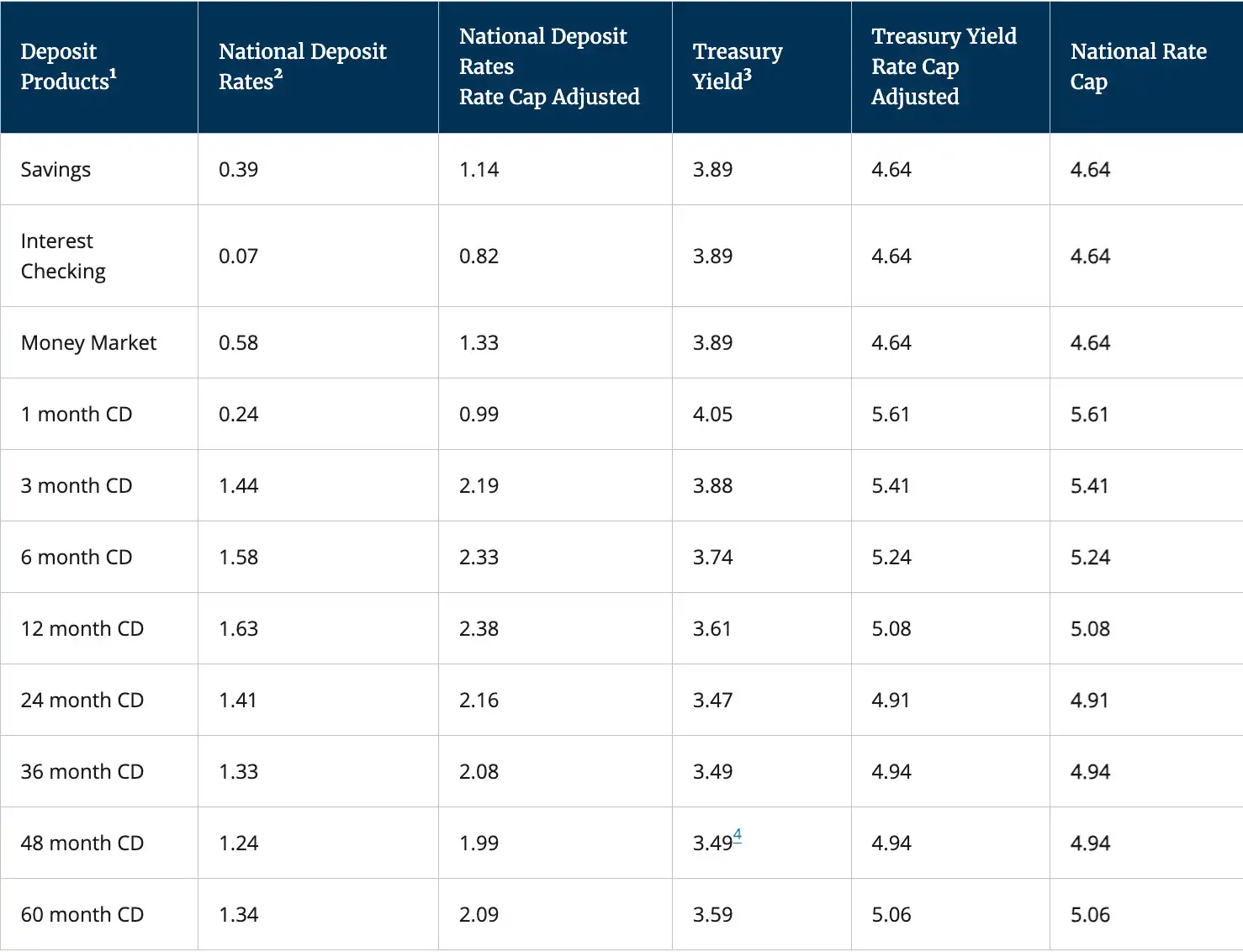
The latest data from the Federal Deposit Insurance Corporation (FDIC) shows that as of mid-December 2025, the average annual interest rate on U.S. savings accounts is only 0.39%.
It is worth noting that this data has already factored in the impact of high-yield banks. Due to the low-rate model of mainstream U.S. banks, the actual interest paid to depositors is much lower than this level. Galaxy Founder and CEO Mike Novogratz bluntly stated in an interview with CNBC that large banks pay almost zero interest to depositors (about 1-11 basis points), while the concurrent Fed benchmark interest rate is between 3.50% to 3.75%. This interest differential brings banks huge profits.
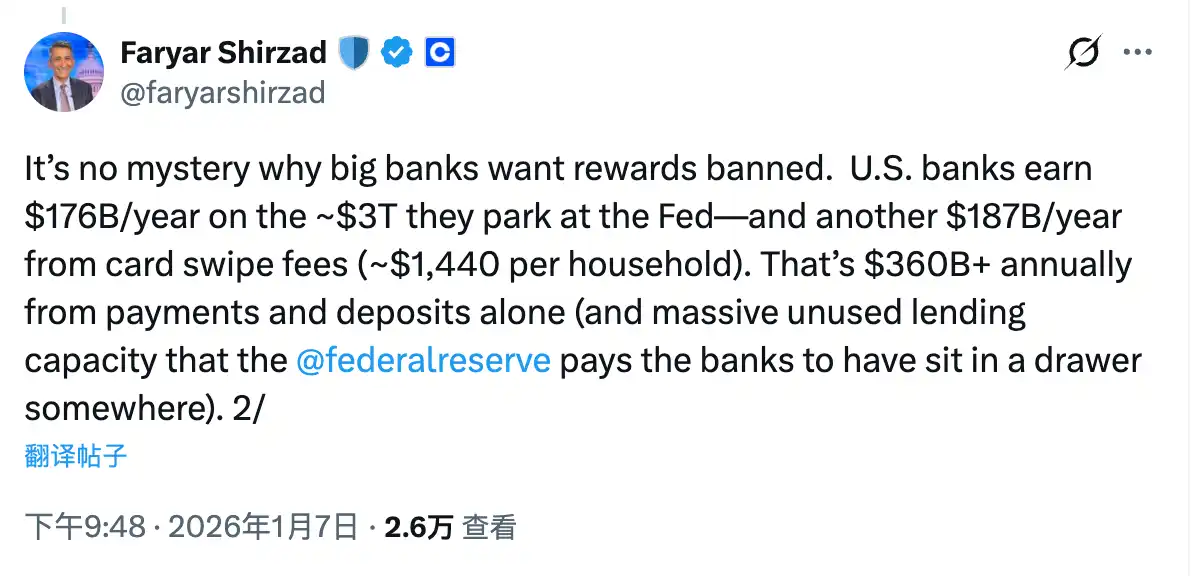
Coinbase's Chief Compliance Officer Faryar Shirzad did a clearer calculation on this—major U.S. banks can earn $176 billion annually from the approximately $3 trillion funds deposited in the Federal Reserve, and they can also earn $187 billion annually from transaction fees charged to depositors. Just from the deposit interest differential and transaction fee revenue, it brings in over $360 billion in annual income.
The Real Change: Deposit Structure and Interest Distribution
Back to the point, what changes will the stablecoin system bring to the bank deposit structure? How will an interest-bearing stablecoin drive this trend? The logic is actually very simple. What are the use cases of stablecoins? The answer is nothing but payments, transfers, settlements, and so on—sounds familiar, right?
As mentioned earlier, the above functions are precisely the core utility of transactional deposits, which are not only the main type of deposits for large banks but also the most valuable liability for banks. Therefore, the real concern of the banking industry about stablecoins is that—as a new type of transaction medium, stablecoins can directly compete with transactional deposits in terms of use cases.
If stablecoins do not have an interest-bearing function, that's one thing. Considering the existence of entry barriers and the meager interest advantage of bank deposits (no matter how small, it's still something), the likelihood of stablecoins posing an actual threat to this core area of large banks is not high. But once stablecoins are endowed with interest-bearing capability, driven by the interest differential, more and more funds may shift from transactional deposits to stablecoins. Although these funds will eventually flow back into the banking system, the stablecoin issuer, for profit reasons, will inevitably invest most of the reserve funds into non-transactional deposits, holding only a certain percentage of cash reserves to meet daily redemptions. This is the so-called change in deposit structure—while the funds remain within the banking system, bank costs will significantly increase (interest rate spread will be compressed), and income derived from transaction fees will also be substantially reduced.
At this point, the essence of the problem is very clear. The reason why the banking industry is so vehemently opposed to interest-bearing stablecoins has never been about whether "the total amount of deposits in the banking system will decrease," but about the potential changes in deposit structure and the resulting profit redistribution issues.
In the era without stablecoins, especially interest-bearing stablecoins, large U.S. commercial banks firmly controlled transactional deposits, a "zero-cost or even negative-cost" source of funds. They could earn risk-free returns through the spread between deposit interest rates and the benchmark rate, as well as continue to charge fees for basic financial services such as payment, settlement, and clearing, thereby building an extremely solid closed loop that required little to no profit-sharing with depositors.
The emergence of stablecoins is essentially dismantling this closed loop. On the one hand, stablecoins, at a functional level, are highly comparable to transactional deposits, covering core scenarios such as payment, transfers, and settlements; on the other hand, interest-bearing stablecoins further introduce the variable of yield, allowing transactional funds, which were originally not sensitive to interest rates, to potentially be repriced.
In this process, funds will not leave the banking system, but banks may lose profit control over these funds — liabilities that were almost zero-cost are forced to convert into liabilities that require market-based returns; payment fees that were once monopolized by banks are also beginning to flow to stablecoin issuers, wallets, and protocol layers.
This is the real change that the banking industry cannot accept. Understanding this point, it is not difficult to understand why interest-bearing stablecoins have become the most intense and difficult-to-compromise point of contention in the CLARITY milestone process.
-- Price
This content is provided for general informational purposes only and doesn't constitute financial, investment, legal, or tax advice. Any events, rewards, online promotions, or related information mentioned herein should not be considered a recommendation, solicitation, or invitation to purchase, sell, trade, or otherwise deal in any crypto assets. Crypto assets are highly volatile and may result in loss. The availability of WEEX services, products, and related events may vary by region. You are responsible for ensuring that your participation is in accordance with applicable local laws and regulations.
You may also like

Strategy Q1 net loss of $12.54 billion and for the first time hinted at selling BTC to pay dividends, Coinbase lays off about 700 people and restructures its framework to focus on AI

The first large-scale adoption of a "yield-bearing stablecoin" was in China

The Bounce is a Illusion? The Bond Market Has Answered

White House Advances ‘Clarity Act’ on Stablecoins: Key Developments
Key Takeaways: The Clarity Act is set to establish a federal regulatory floor for stablecoins, poised to transform…

OSL USDGO reached $130 million, Deutsche Börse invested in Kraken, Capital B increased its BTC holdings
NIGHT Ready for Unveiling on Bitget PoolX—Seize 9 Million NIGHT Tokens
Key Takeaways: Bitget PoolX is launching the NIGHT project with a massive 9 million token airdrop. The event…
Last week, Strategy invested $1 billion to increase its holdings of 13,927 bitcoins

Tether Exec Leads Crypto-Backed PAC in US Midterm Strategy
Key Takeaways: Jesse Spiro from Tether will chair a new crypto-backed Super PAC, Fellowship PAC, to influence the…

Cryptocurrency exchanges are launching a battle for VIP clients
StandX Introduces SIP1 and SIP2: Holding Subsidy Mechanism Launched, Reshaping On-Chain Trading and Reward Structure

UK investors face double taxation when purchasing STRC, and 21Shares ETP may be a better alternative

BeatSwap is evolving towards a full-stack Web3 infrastructure, covering the entire lifecycle of IP rights.

Key Market Insights for December 18th, How Much Did You Miss Out On?

On-chain Yield: ZEROBASE Stablecoin APY Reaches 12%, Syrup USDC Pool APY Reaches 7.19%

Key Market Information Discrepancy on October 27th, a Must-See! | Alpha Morning Report

Linea has announced the launch of the Ignition Liquidity Incentive Program, distributing 1 billion LINEA tokens as rewards.
Euler Labs: Aware of the USR attack incident and urgently disabled the RLP collateral feature

Daily Observation of Cryptocurrency Concept Stocks: Nasdaq Bets on Stocks on the Blockchain, Strategy Buys Another 17,994 BTC, ETH Treasury Stocks Enter Production Period
Strategy 2025 Q4 Net Loss of $12.4 Billion, Annual Fundraising of $25.3 Billion
Ripple Joins Elite Crypto and Banking Players at High-Stakes White House Summit
Key Takeaways Ripple secured a critical position at a White House summit focusing on stablecoin regulation. The meeting…
Senate Crypto Bill Markup Rescheduled to January 27 Amid Legislative Momentum
Key Takeaways The Senate Agriculture Committee has rescheduled the release of the legislative text for crypto market structure…
Former Brazil Central Bank Official Introduces Real-Pegged Stablecoin Offering Yield Sharing
Key Takeaways BRD, a newly unveiled stablecoin by Tony Volpon, a former director of the Central Bank of…

Yield Farming at 86% APY? How to Use Bots to “Earn While You Sleep” on Polymarket
Key Takeaways Polymarket presents untapped opportunities for bot utilization, despite existing competition. A proprietary trading bot streamlines the…
Yield Basis has activated the Fee Switch, and eligible users are now able to share a portion of the 17 BTC revenue accumulated by the protocol since September.
Fireverse Announces 2026 Copyright Revenue Outlook: Copyright Revenue Estimated to Exceed $30 Million

Monad’s FastLane: A New Era for Liquid Staking and Capital Efficiency
Key Takeaways FastLane is introducing shMON, a revolutionary liquid staking token in the Monad ecosystem that enhances user…
Monad’s shMON: Understanding a Revolutionary Liquid Staking System
Key Takeaways shMON is the first vertically integrated liquid staking token offered by Monad, aiming to enhance user…
The mastermind of a 60,000 BTC money laundering case, Qian Zhimin, acquired a total of 194,951 BTC between 2014 and 2017.

Hyperwave: Due to a rare exchange rate drop, all withdrawals require resubmission

Why Regulated Crypto Yield is Winning Over Institutions in 2025
Key Takeaways Regulated crypto yield prioritizes compliance and risk management over flashy returns, helping institutions avoid hidden dangers.…
Strategy Q1 net loss of $12.54 billion and for the first time hinted at selling BTC to pay dividends, Coinbase lays off about 700 people and restructures its framework to focus on AI
The first large-scale adoption of a "yield-bearing stablecoin" was in China
The Bounce is a Illusion? The Bond Market Has Answered
White House Advances ‘Clarity Act’ on Stablecoins: Key Developments
Key Takeaways: The Clarity Act is set to establish a federal regulatory floor for stablecoins, poised to transform…
OSL USDGO reached $130 million, Deutsche Börse invested in Kraken, Capital B increased its BTC holdings
NIGHT Ready for Unveiling on Bitget PoolX—Seize 9 Million NIGHT Tokens
Key Takeaways: Bitget PoolX is launching the NIGHT project with a massive 9 million token airdrop. The event…

Contents
Latest articles


Latest coin listings on WEEX


