
Coin Metrics: 2024 Crypto Milestones




Original Article Author: Tanay Ved, Coin Metrics
Original Article Translation: Shanou Ba, Golden Finance
The year 2024 is coming to an end, and this year stands in stark contrast to the crypto winter of 2022. We want to take a moment to look back on this extraordinary year for the cryptocurrency industry.
2024 can be considered one of the most impactful years in cryptocurrency history in many ways, starting from the launch of a Bitcoin ETF to Bitcoin's triumphant breakthrough above $100,000 post-election.
In this article, we revisit the significant developments that shaped the digital asset industry in 2024 from a data-driven perspective.
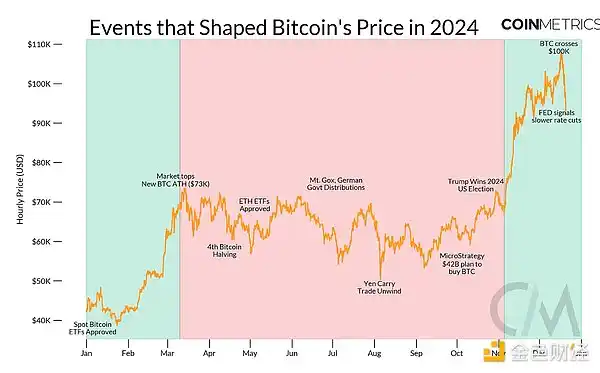
Fueled by the explosive success of the Bitcoin ETF in January, the cryptocurrency market experienced a strong growth phase in the first quarter, with Bitcoin surging to a historical high of $73,000. This was followed by a relatively calm consolidation phase characterized by a weakening catalyst and a significant redistribution of the major market participants' supply. As 2024 draws to a close, optimism has returned with the support of the U.S. government for cryptocurrency and the beginning of a rate-cutting cycle.
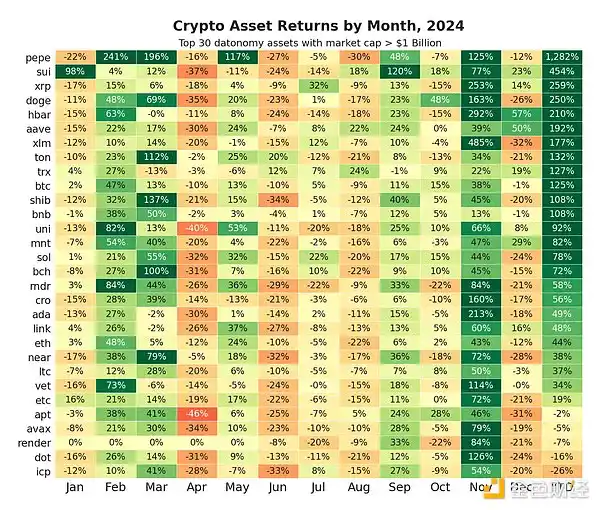
Bitcoin (BTC) has undoubtedly been the focus this year, with a year-to-date gain of 125%, outperforming both traditional asset classes and cryptocurrencies. Solana (SOL) has led the market multiple times in this cycle, ending the year with a 78% gain, while Ethereum (ETH) has continued to underperform, with a 44% increase for the year.
The chart above displays the top 30 crypto assets in the datonomy TM domain, with a market cap exceeding $10 billion. Driven by retail enthusiasm, meme coins like DOGE and PEPE have garnered widespread attention, while "dinosaur coins" like Ripple (XRP) and Stellar (XLM) have unexpectedly made a comeback. Alternative Layer-1 assets like SUI and mature DeFi protocols like Aave have also gained attention, reflecting investor sentiment and the thematic rotation shaping the 2024 market.
Q1: ETF Gate Opens, Memecoin Mania, Ethereum Scaling with Blob
The introduction of physically-backed Bitcoin ETFs triggered a wave of mass adoption, opening the floodgates to Wall Street. The assets under management (AUM) of the 11 issuers now exceed $105 billion, with these vehicles holding over 1.2 million Bitcoins. This is equivalent to 5.6% of Bitcoin's current supply, and the demand on corporate balance sheets has further accelerated the rate at which supply is being absorbed. In less than a year since their launch, physically-backed Bitcoin ETFs have seen strong inflows, cementing their position as the most successful debut in the history of any ETF category.
The weekly traffic showed a continuous accumulation, with net additions peaking at over $20 billion during peak weeks, despite occasional outflows during the summer market consolidation period.


As Bitcoin drove institutional adoption and lifted the overall market, meme coins began attracting significant attention, leading to an uptrend driven by extreme risk. In early March, meme coins' spot trading volume reached $130 billion, with the market capitalization of major meme coins hitting $600 billion.

While mature large-cap memecoins saw some growth, most of the activity originated from a plethora of newly launched meme coins on Solana. A platform named pump.fun emerged as the epicenter of memecoin explosive growth in the first quarter, facilitating the creation of over 75,000 tokens and propelling active wallets on Solana to a record-breaking 2.06 million at the time. Although these heightened activities failed to sustain, meme coins made a comeback, with November's trading volume surpassing $230 billion. New AI-driven platforms like Virtuals on Base injected fresh vigor into this phenomenon.

March also marked a significant milestone for Ethereum as Ethereum deployed EIP-4844 in the Dencun upgrade. Shortly after, Ethereum's Layer 2 Rollup adopted a new blob transaction fee market in parallel with the mainnet. This laid the groundwork for Ethereum to expand its execution capabilities with the help of Layer 2 solutions like Base, Optimism, and Arbitrum while reducing settlement costs at Layer 1, making transactions on the network more affordable. Demand for blob remained robust, with Ethereum consistently reaching its target capacity of three blobs per block just seven months after its launch.
While this made the Ethereum ecosystem more accessible, it could be argued that the devaluation of fees at Layer 1 hindered ETH's value accrual and led to a more fragmented user experience. However, there is no sign of stagnation in the space, with prominent exchanges like Kraken and Uniswap, Deutsche Bank, and multinational corporations (Sony) driving Layer 2 development, and an imminent increase in blob capacity.
Q2: Summer Market: Season of Plenty
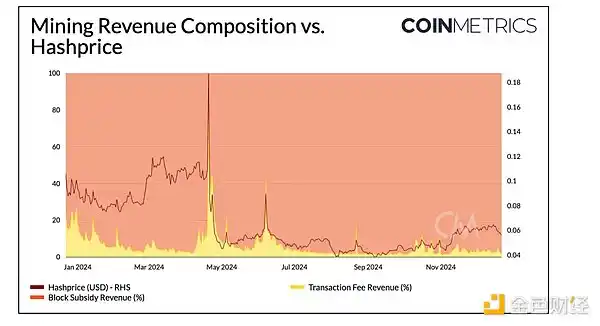
The second quarter was characterized by a consolidation phase, with the market experiencing range-bound volatility due to a lack of catalysts. In April, Bitcoin underwent its quadrennial halving event, reducing the daily issuance from 900 coins to 450 coins. Similar to the halving event, this signaled a turning point for the mining industry, forcing miners to adapt to the reduction in block rewards. This event spurred the upgrade to more efficient ASIC hardware, triggered further consolidation in the mining sector, and prompted some miners to repurpose their infrastructure for AI data centers to diversify their income streams.
As shown in the chart below, transaction fees have become a key part of mining revenue, partially offsetting the decline in block subsidies. Nonetheless, the overall hash price (daily USD income per TH/s) remains under pressure, reflecting miners' increasing reliance on network activity to sustain profitability.
Exacerbating these challenges is additional supply pressure. Most notably, the long-awaited Mt. Gox bankruptcy asset distribution has seen thousands of BTC re-enter the market. Similarly, the German government has sold over 50,000 seized BTC from a criminal investigation, adding to selling pressure and exacerbating the supply-side dynamics. Despite these sell-offs, Bitcoin's liquidity has shown resilience, absorbing the supply without causing significant disruptions to market stability. Looking ahead, as FTX creditors are set to receive cash distributions in 2025 and potentially re-enter the market, selling pressure may ease.
Q3: The Spring of Stablecoins and Tokenization
Stablecoins are recognized as the "killer app" of cryptocurrencies, with their global significance beginning to permeate beyond the cryptocurrency industry. Stablecoins continue to export the US dollar worldwide, with a total supply exceeding $210 billion. USDT ($138 billion) and USDC ($42 billion) still dominate, and most stablecoin supplies lean towards the Ethereum network, with a stablecoin supply of $122 billion. Overall, stablecoins facilitated $1.4 trillion in monthly (adjusted) transfer volume in November.
While the role of stablecoins as an exchange medium and store of value in emerging economies has been widely explored, their practical development in payment and financial service infrastructure has gained further momentum with Stripe's acquisition of Bridge. Furthermore, 99% of stablecoins are pegged to the dollar, with Tether and Circle directly investing nearly $100 billion in purchasing US Treasury bonds, solidifying their position as a key tool in maintaining the dollar's global dominance.

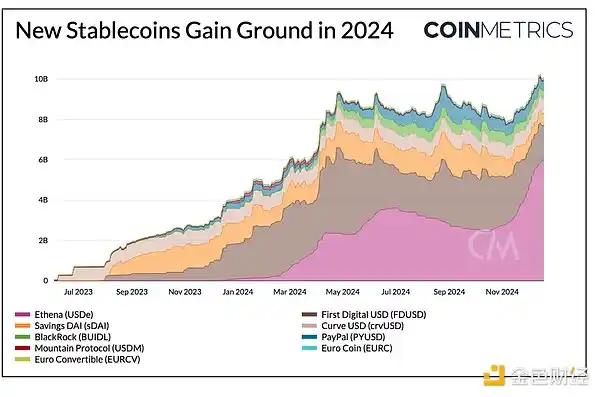
Meanwhile, BlackRock has entered the tokenization space, launching the BlackRock Institutional Digital Liquidity Fund (BUIDL), investing in dollar-equivalent assets like cash and US Treasury securities. BUIDL's supply quickly reached $500 million, expanding the landscape of tokenized securities on public blockchains. The ecosystem expanded in 2024, offering stablecoins with varying risk profiles, liquidity, collateral, and savings mechanisms. Ethena's USDe stood out, growing from a market cap of $91 million to $6 billion, becoming the third-largest stablecoin, leveraging positive financing rates in the market's upward trend to provide attractive yields for holders. Concurrently, the First Digital USD (FDUSD) has gained prominence as a source of liquidity and widely used quote currency on exchanges.
Regulatory agencies' focus on stablecoins continues to grow, reflecting the increasing importance of stablecoins in the global financial system. The EU has implemented specific requirements for stablecoins under the Markets in Crypto-Assets (MiCA) regulation, which has begun reshaping the stablecoin industry tied to the euro.
Q4: Election Fever
The 2024 U.S. presidential election had a profound impact on the digital asset market, propelling BTC above $100,000 for the first time. Specialized coins within Coin Metrics' datonomy TM realm (including meme and privacy coins) and smart contract platforms were standout areas, with returns of 129% and 84% respectively since the election.

Prior to the election, we also witnessed the rise of prediction markets like Polymarket, which played a key role in harnessing collective wisdom to predict election outcomes. At its peak, Polymarket had over $450 million in open interest. Though the platform's activity has since subsided, it showcased the utility and potential of information markets on public blockchains.
Post-election, market sentiment was bullish, fueled by government support for cryptocurrency contrasting sharply with previous SEC regulatory hurdles. Demand for ETFs and corporate bonds drove Bitcoin's surge, with MicroStrategy holding 444,262 BTC funded through stock and convertible bond issuances. Institutional interest in the derivatives market reached new highs, reflected in CME's Bitcoin futures open interest hitting a record $22.7 billion, totaling over $52 billion, alongside the introduction of options-based ETFs.
Despite the strong momentum, uncertainties persist regarding the implementation and timeline of crypto-friendly policies. While there are signs indicating a more supportive regulatory environment for cryptocurrency, such as appointing cryptocurrency advocates to key positions like the Chair of the SEC and Crypto Czar, the specific regulatory framework remains unclear. Market enthusiasm was also dampened by expectations of interest rate cuts, with participants cautiously optimistic about 2025.
Nevertheless, 2024 laid a solid foundation: the launch of physically-backed Bitcoin ETFs, accelerated stablecoin adoption, significant advancements in on-chain infrastructure and applications, and a pro-crypto government taking office as the easing cycle begins. As we move into the next year, stay tuned for our 2025 Cryptocurrency Outlook Report, where we will explore key themes and trends shaping the year ahead.
You may also like

CFTC Reportedly Plans New Prediction Market Rules Focused on Manipulation Risk and Public Interest Review
The CFTC is reportedly preparing new prediction market rules focused on manipulation risk, public interest review, and retail trader protections.

Meet the new WEEX trial fund—your gateway to greater profits

WEEX Labs Lands at Dutch Blockchain Week: A Disruptive Crypto × AI Conversation Sets Sail in Amsterdam

SK Hynix Reportedly Plans U.S. ADR Listing as Early as August, With SEC Approval Possible in Late June
SK Hynix may pursue a U.S. ADR listing as early as August, with SEC approval reportedly possible in late June amid strong AI chip supply chain demand.

SpaceX vs Tesla vs xAI: Which Elon Musk Trade Has the Biggest Upside in 2026?
OpenAI Reveals It Has Confidentially Submitted an S-1 to the SEC, Keeping the Door Open for a Future IPO
On June 9, according to an OpenAI announcement, the company recently confidentially submitted a draft S-1 registration statement to the U.S. Securities and Exchange Commission (SEC), beginning the preliminary compliance process for a potential initial public offering. OpenAI said it chose to disclose this proactively because it expected the news might leak; however, the company has not yet set a specific listing timeline, and related arrangements may still take some time.

Latest research from 13 top universities including Cornell University: The current state, challenges, and misconceptions of the fusion of Crypto and AI
Deconstructing Anthropic: The Best AI Company, Possibly Also a Type of Organizational Invention
Apollo and Blackstone Reportedly Back $35 Billion Anthropic Chip Financing as Deal Details Remain Unclear
On June 9, according to currently available news alerts, Apollo and Blackstone Group participated in a $35 billion financing for an Anthropic “chip project.” Based on the original wording of the report, the funding has already been raised, but public information remains limited. The financing structure, use of proceeds, project entity, and whether Apollo and Blackstone participated through equity, debt, or project financing have not yet been disclosed.

Humanity Protocol Security Incident Escalates: More Than $31 Million Stolen From Related Addresses as Attacker Continues Selling H for ETH
On June 9, according to monitoring by Onchain Lens, more than $31 million has been stolen from addresses linked to Humanity Protocol, and the attack is still ongoing, with the hacker continuously swapping H tokens for ETH. Project founder Terence Kwok later confirmed the security incident on X, saying the issue involved a private key leak.

Bloomberg: As Bitcoin Weakens, Stablecoins and RWA Continue to Drive Expansion in Crypto Businesses
In June, Bloomberg reported that despite Bitcoin falling below $60,000 last week, wiping out about $235 billion in market value within seven days, and dropping close to 50% from last year’s peak, some core businesses in the crypto industry are still expanding, mainly in stablecoins, real-world asset tokenization (RWA), payments, and infrastructure. The report also noted that overall altcoin activity has contracted significantly: altcoin market capitalization has fallen from a peak of about $431 billion in November 2021 to around $170 billion, and among the tens of millions of tokens issued in recent years, fewer than 1,700 still maintain meaningful trading activity.

Galaxy Deep Research Report: How Hyperliquid's HIP-4 Upgrade Changes the Landscape of Prediction Markets?
Binance Research: RWA Market Expected to Expand Nearly 6x from Early 2025, with Public Equities and Onchain Payments Heating Up Together
In June, Binance Research said in its monthly market report that the real-world asset (RWA) market is expected to grow by about 589% from the beginning of 2025. Bond- and money market fund-related RWA expanded by about $6.5 billion, up 83% year over year, while publicly traded equity RWAs grew by about 422%. The report also noted that monthly crypto debit card transaction volume exceeded $747 million in May, up 48.6% year to date.

Japan to Assess a Framework for Yen Stablecoins and Crypto ETFs as Asia’s Compliant Payments Narrative Heats Up
Recently, according to the original report, Japan is considering the launch of yen stablecoins and cryptocurrency ETFs. Public information remains limited at this stage, and there is still no complete policy text, regulatory draft, or clear implementation timeline, so this is better characterized as a “policy discussion” rather than formal implementation. The original wording also noted that advancing stablecoin regulation in Asia is driving XRP usage and supporting growth in the XRPL ecosystem. However, based on currently available public information, there is not enough evidence to directly establish a clear causal relationship between this round of discussion in Japan and XRP or XRPL.

ZachXBT: Humanity private key leak and abnormal surge in H token should be viewed separately
On June 9, according to related disclosures, on-chain investigator ZachXBT posted an update on Humanity’s roughly $31 million security incident, saying that after further analyzing fund flows, he currently tends to believe the project team was not involved in an “inside job” or a self-staged attack. According to him, the official explanation about the private key leak was broadly accurate, but before the token unlock, the price of H had been artificially pushed higher, and the hacker later took advantage of that market environment; therefore, the private key leak and the earlier abnormal price pumping should be regarded as two separate and independent events. This reframing has shifted the market’s understanding of the nature of the incident. Earlier discussion around Humanity had focused on whether the team directly participated in the attack or used the security incident to cover up internal operations. ZachXBT’s latest remarks shift the focus from “whether it was self-theft” to “whether there were pre-unlock market structure issues.” He also questioned whether the team may have.

Morning Report | OpenAI has submitted an S-1 registration statement draft to the U.S. SEC; Morpho completes $175 million financing

Morning Report | BitMine increased its holdings by 126,971 ETH last week; trader Eugene announced his exit from the crypto market

Wang Chuan: How can one not feel anxious after the neighbor Old Wang made thirty times profit by investing in storage stocks? (Seven) - A quarter-century cycle
CFTC Reportedly Plans New Prediction Market Rules Focused on Manipulation Risk and Public Interest Review
The CFTC is reportedly preparing new prediction market rules focused on manipulation risk, public interest review, and retail trader protections.
Meet the new WEEX trial fund—your gateway to greater profits
WEEX Labs Lands at Dutch Blockchain Week: A Disruptive Crypto × AI Conversation Sets Sail in Amsterdam
SK Hynix Reportedly Plans U.S. ADR Listing as Early as August, With SEC Approval Possible in Late June
SK Hynix may pursue a U.S. ADR listing as early as August, with SEC approval reportedly possible in late June amid strong AI chip supply chain demand.
SpaceX vs Tesla vs xAI: Which Elon Musk Trade Has the Biggest Upside in 2026?
OpenAI Reveals It Has Confidentially Submitted an S-1 to the SEC, Keeping the Door Open for a Future IPO
On June 9, according to an OpenAI announcement, the company recently confidentially submitted a draft S-1 registration statement to the U.S. Securities and Exchange Commission (SEC), beginning the preliminary compliance process for a potential initial public offering. OpenAI said it chose to disclose this proactively because it expected the news might leak; however, the company has not yet set a specific listing timeline, and related arrangements may still take some time.


