
 Buy Crypto
- Markets
 Futures
- Spot
- Copy Trade
- Earn
- More
CoinGlass: 2026 Q1 Cryptocurrency Market Share Research Report

Source: CoinGlass
1. Executive Summary and Key Findings
In Q1 2026, the overall cryptocurrency market remained highly active, but the trading volume gradually declined from the peak in January. The total spot market transaction volume in Q1 was approximately $19.4 trillion, the derivative market transaction volume was approximately $18.63 trillion, totaling around $20.57 trillion, with a derivative-to-spot trading ratio of about 9.6. Structurally, market activity still mainly concentrated in the derivative market, with a relatively larger contraction in spot trading volume.
In terms of key indicators, Binance continued to maintain an industry-leading position. The derivative trading volume was about $4.90 trillion, accounting for approximately 34.9% in Top 10 exchanges' terms; average daily open interest was around $239 billion, accounting for approximately 29.9%; user asset deposits were about $152.9 billion, representing around 73.5% in major CEX terms. Compared to the second-place, Binance's derivative trading volume is about 2.2 times that of OKX, average OI is about 2.2 times that of Bybit, and user asset scale is about 9.6 times that of OKX. The data reflects that Binance's leadership is not concentrated in a single dimension but is reflected in trading, open interest, liquidity, and fund retention simultaneously.
Looking at the Top 5 competitive landscape, the market has formed a relatively clear hierarchical structure. In terms of derivative trading volume, Binance, OKX, Bybit, Gate, and Bitget are the top five, with Bybit and Gate having similar volumes, OKX still being the platform closest to Binance in terms of centralized platforms; in terms of open interest, the ranking of the second-tier has changed to Bybit, Gate, OKX, Bitget. In terms of user asset deposits, after Binance, only OKX has remained above the tens of billions of dollars level, while Gate, Bitget, and Bybit are in the $5 billion to $7 billion range. Overall, internal competition within the Top 5 is relatively sufficient, but there is still a considerable gap between the leading platforms and the following tiers.
2. Spot and Derivative Trading Volume
2.1 Market-Wide Monthly Trading Volume Overview
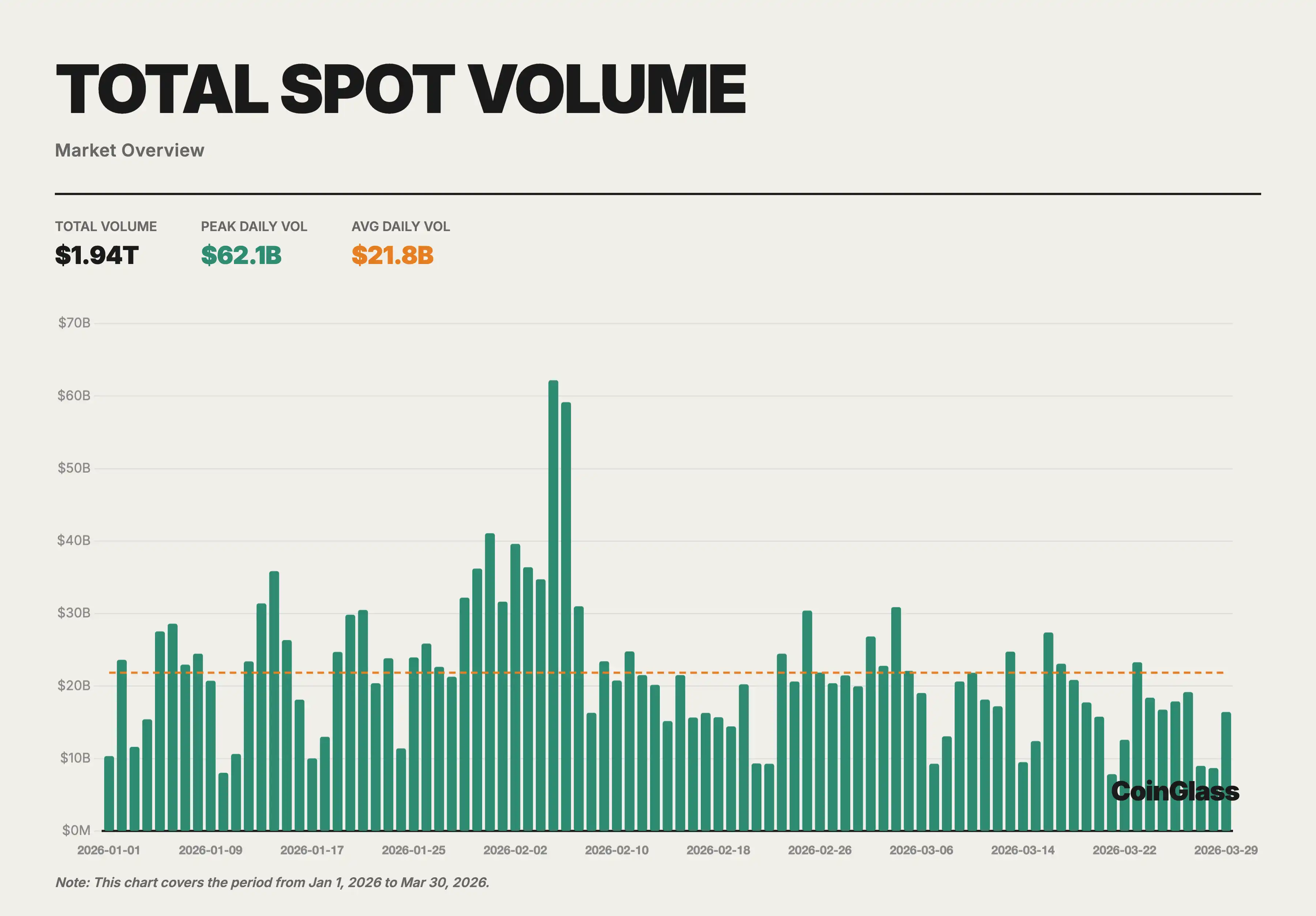
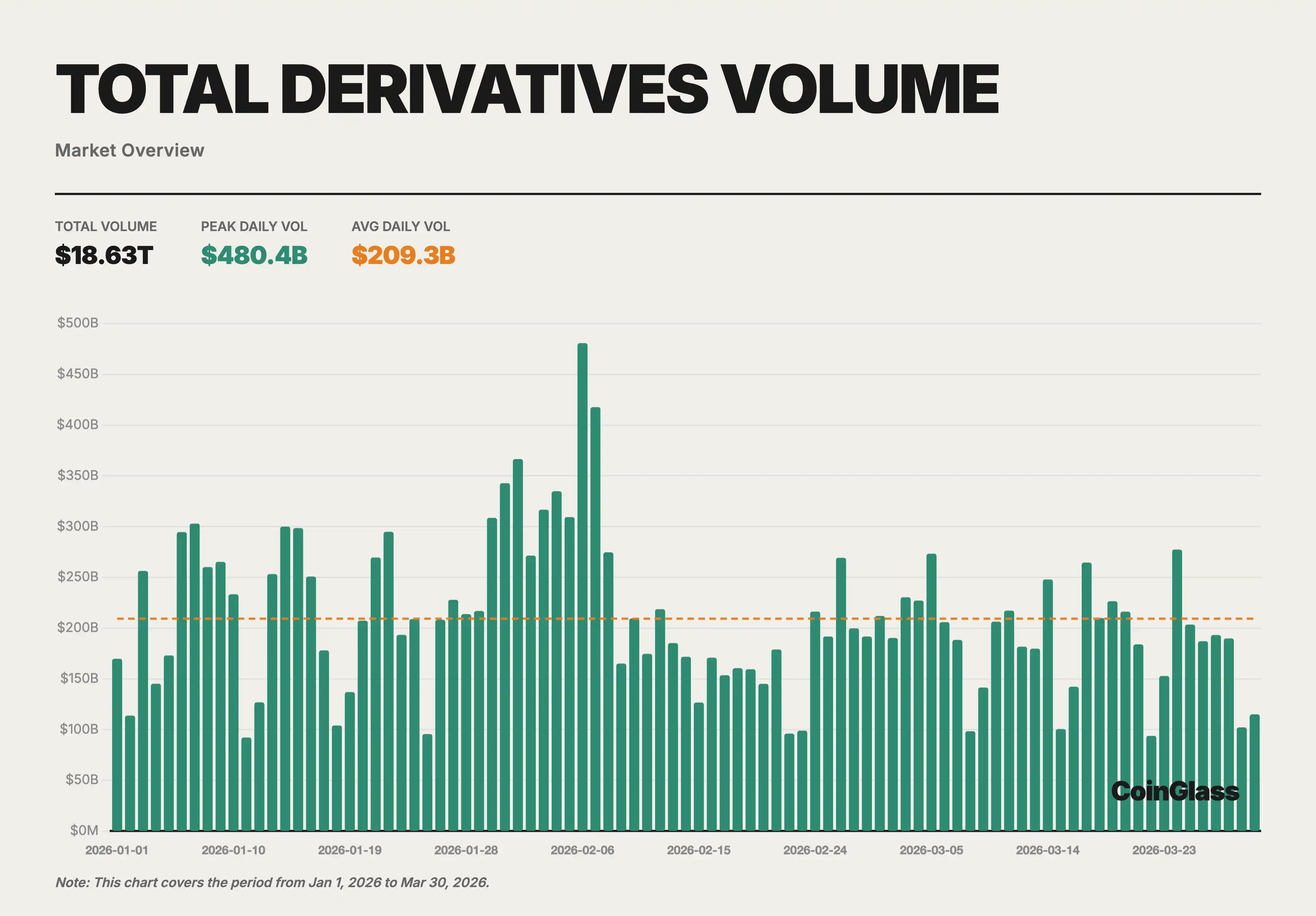
In Q1 2026, the total cryptocurrency trading volume for the entire market (spot + derivative) was approximately $20.57 trillion, with spot trading around $1.94 trillion and derivative trading around $18.63 trillion. Looking at the monthly distribution, the total trading volume was highest in January (spot $704.7 billion + derivative $6.73 trillion), slightly declined in February, and further contracted to a quarterly low in March. This trend corresponds to the cautious sentiment in the global macro environment at the same time, as the market, after experiencing a sharp deleveraging in Q4 2025, has not fully restored its risk appetite.
The average daily trading volume in the spot market is around $218 billion, while the average daily trading volume in the derivatives market is around $2,093 billion. The derivatives-to-spot ratio remained stable at around 9.6x in Q1, slightly higher than the full-year 2025 average. This indicates that during market adjustment phases, traders prefer to hedge and engage in short-term speculation through derivatives rather than directional allocation in the spot market.
2.2 Spot Trading Volume and Market Share
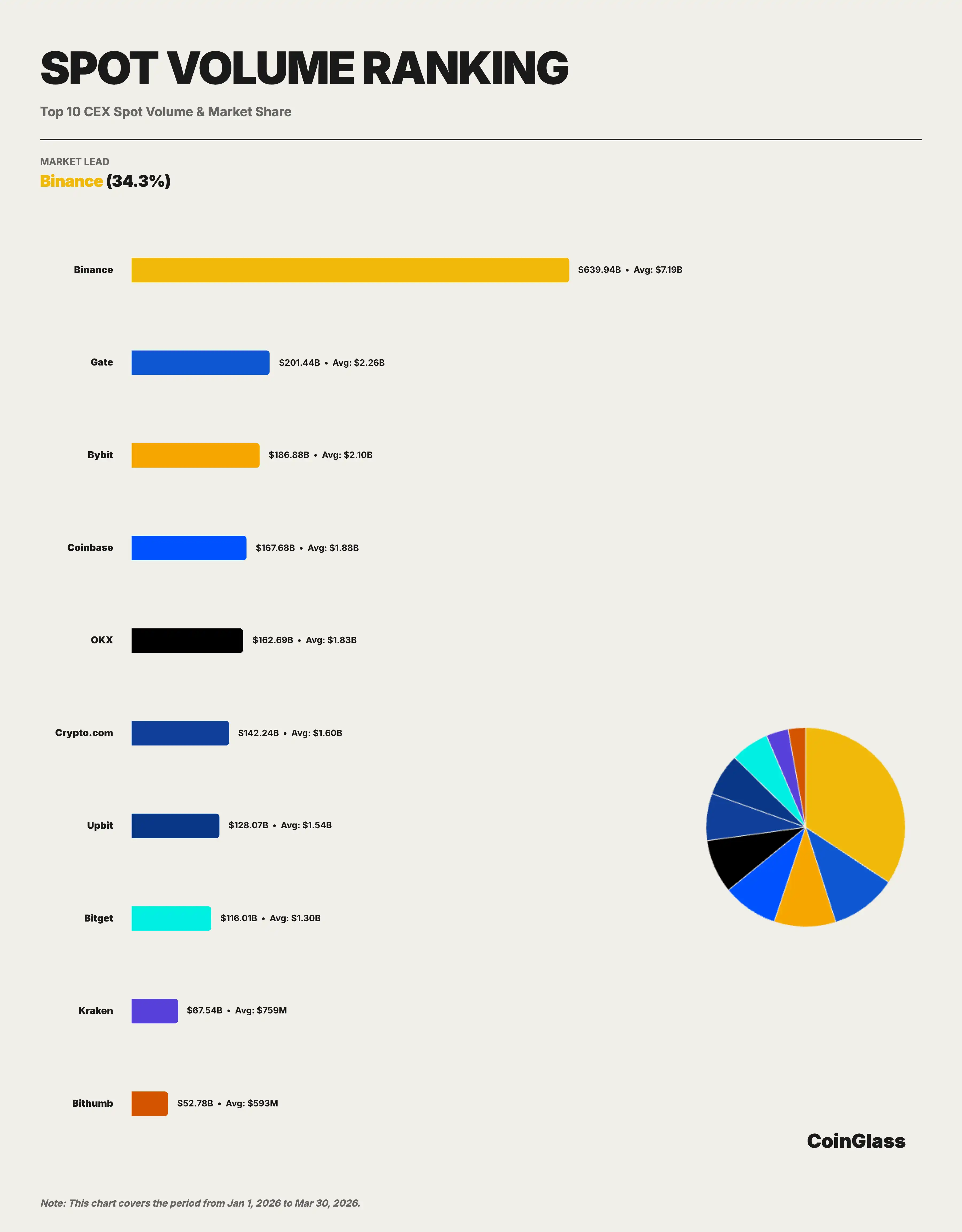
In Q1, Binance's total spot market trading volume was around $6,399 billion, with a corresponding average daily trading volume of $71.9 billion, representing a market share of approximately 34.3% according to the Top 10 exchange calculation methodology. Looking at the monthly trend, Binance's share in the Spot Top 10 exchanges remained relatively stable: 34.0% in January 2026, 33.7% in February, and a rebound to 35.4% in March. Despite the market contracting from $7,047 billion in January to $5,420 billion in March, a 23% decrease, Binance's share slightly increased. This indicates that while the overall spot market declined, liquidity continued to concentrate on a few top platforms.
Expanding the competitive landscape to the Top 5, the spot market's distribution is noticeably more diversified compared to the derivatives market. The top five platforms in cumulative spot trading volume in Q1 were Binance, Gate, Bybit, Coinbase, and OKX, with corresponding volumes of around $6,399 billion, $2,014 billion, $1,869 billion, $1,677 billion, and $1,627 billion, respectively. Calculated based on the entire market scope, excluding Binance, the market share of the other four platforms is roughly distributed in the 8% to 10% range. This means that Binance's leadership in the spot market is evident, but compared to the derivatives market, the distribution of the second tier of the spot market is more balanced, and the competition is more diversified.
2.3 Derivatives Trading Volume and Market Share
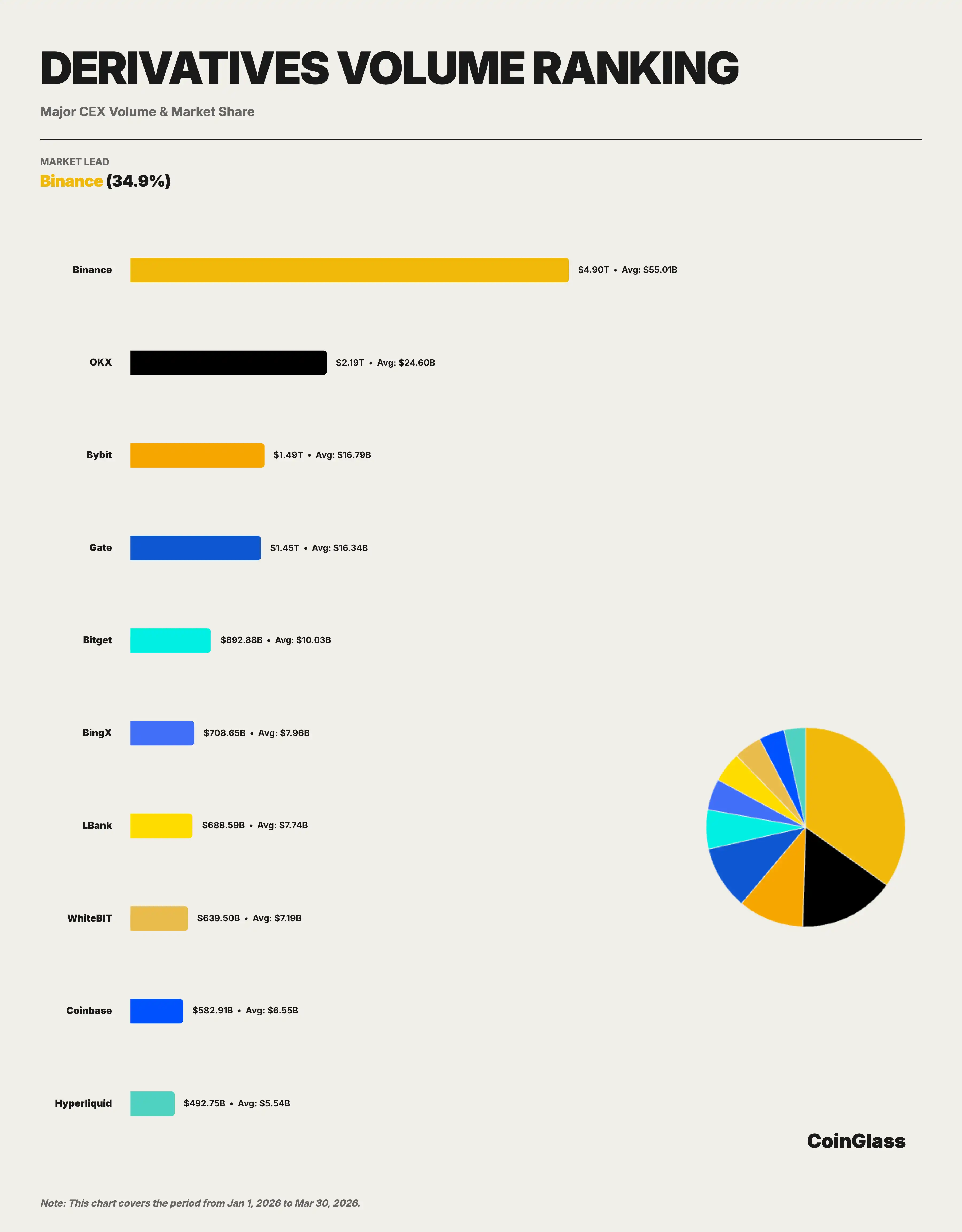
In Q1, Binance's total derivatives market trading volume was approximately $4.90 trillion, with an average daily trading volume of $550 billion. Under the Top 10 exchange calculation, Binance maintained the top position with a 34.9% share, surpassing the combined volume of second-placed OKX ($2.19 trillion) and third-placed Bybit ($1.49 trillion).
From a monthly trend perspective, Binance's trading volume share in the Derivatives Top 10 exchanges has remained relatively stable: 33.2% in January 2026, increased to 35.8% in February, and maintained at 35.7% in March. The trajectory of recovery after this downturn is consistent with the process where market liquidity returned to top platforms after the deleveraging impact in Q4 2025. In other words, at the beginning of the quarter, trading volume among platforms briefly diverged, but as the market gradually stabilized, liquidity continued to flow back to platforms with higher depth and stronger execution efficiency. Binance demonstrated a stronger capacity to handle this round of recovery.
OKX is currently the centralized platform closest to Binance, but its trading volume is still only about 45% of Binance's; Bybit and Gate have similar volumes, forming the second echelon; although Bitget ranks in the top five, there is a noticeable gap between it and the top four. In relative terms, Binance's derivatives trading volume is about 3.3 times that of Bybit, 3.4 times that of Gate, and 5.5 times that of Bitget.
2.4 Competitive Landscape Comparison
If we observe spot and derivatives markets within the same framework, we can see a clear difference in the competitive landscape between the two market types. In the spot market, Binance remains in the lead, but the second echelon is jointly formed by Gate, Bybit, Coinbase, and OKX, with relatively close shares; in the derivatives market, Binance's lead is more significant, and a certain hierarchy has also formed between the second-placed OKX and the third and fourth places. Thus, it is evident that Binance's leadership in the derivatives market is more concentrated, while the spot market exhibits a "top first, second echelon dispersed" structure.
From a platform positioning perspective, OKX consistently ranks second in derivatives trading volume, being the closest challenger to Binance; the competitive relationship between Bybit and Gate is closer to the same level, with the former having strong participation among global active traders and the latter maintaining a high presence in terms of trading volume and open interest. Platforms ranking beyond the Top 5 such as BingX, LBank, WhiteBIT, Coinbase, and Hyperliquid continue to sustain significant trading activity; however, they still lag behind the top five platforms in overall volume.
Of note is the entrance of decentralized derivatives platforms into the mainstream comparative view. Hyperliquid's Q1 derivative trading volume was approximately $492.7 billion, placing it in the top ten, and reaching an average open interest level of around $6 billion. This indicates that on-chain derivatives are no longer just a marginal supplement but are beginning to form actual competition in localized markets. However, in terms of current scale, their overall volume is still significantly lower than that of leading centralized platforms like Binance, OKX, Bybit, and Gate.
III. Derivative Holdings
3.1 Total Market Contract Holdings Trend
In Q1 2026, the average daily Open Interest (OI) of the total derivatives market was around $117.2 billion. The peak within the quarter occurred on January 15th, reaching around $152.5 billion. Looking at the monthly trend, the average daily OI in January was around $141.1 billion, sharply dropping to $102.6 billion in February, a decrease of about 27%, and slightly recovering to $106.0 billion in March.
3.2 OI Share and Ranking Changes
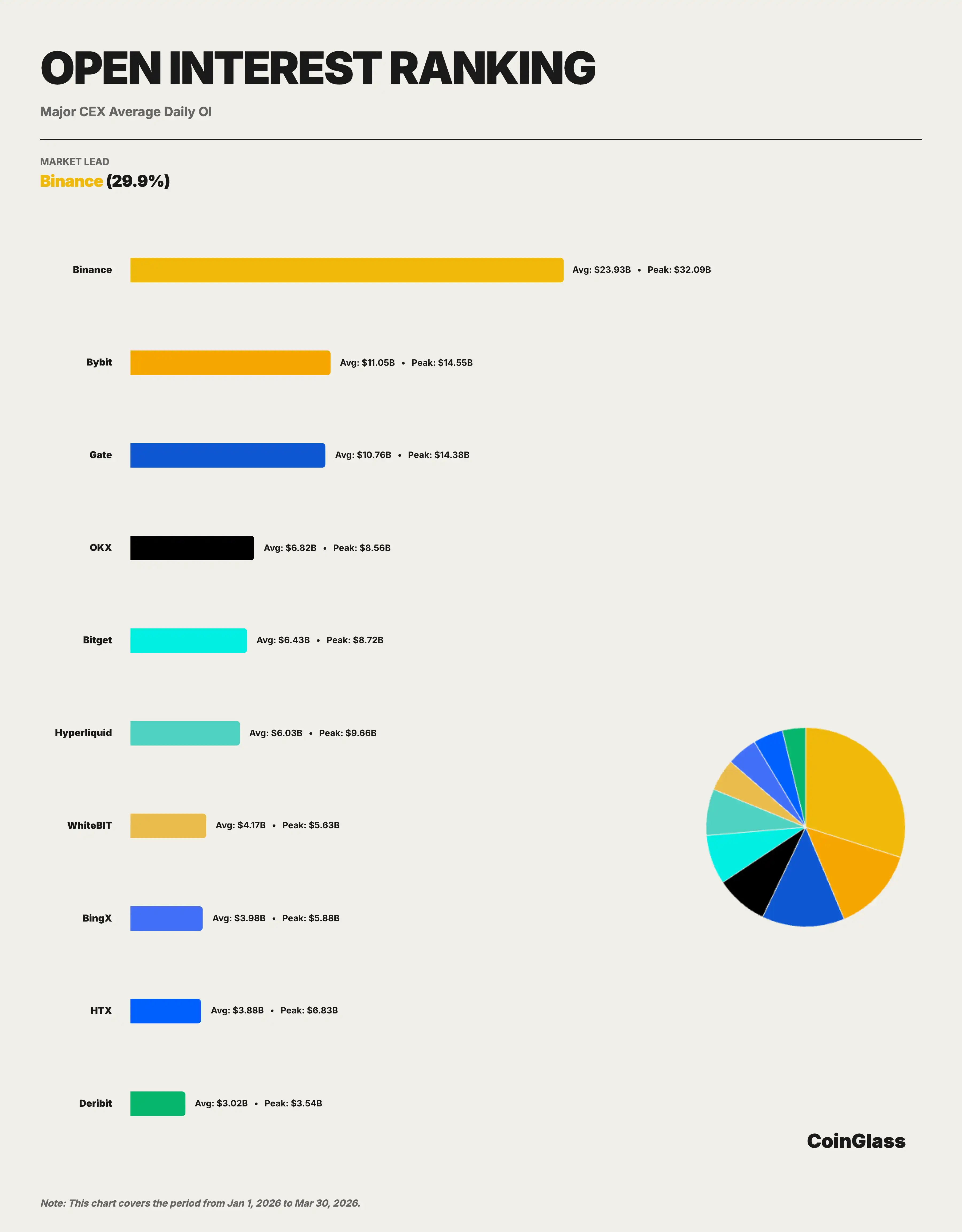
In Q1, Binance's average OI was around $23.9 billion, accounting for approximately 29.9% of the Top 10 exchanges, ranking first. The second to fifth positions were held by Bybit, Gate, OKX, and Bitget, with average OIs of around $11.0 billion, $10.8 billion, $6.8 billion, and $6.4 billion, respectively. Binance's average OI was about 2.2 times that of Bybit, 2.2 times that of Gate, 3.5 times that of OKX, and 3.7 times that of Bitget, showing a clear lead.
Binance's OI share remained in the 20%-21% range (total market) throughout the quarter, with limited fluctuations, indicating its relatively stable market position in terms of holdings. Of more significance, Binance's peak OI was around $32.1 billion, approximately 2.2 times Bybit's peak ($14.5 billion), demonstrating Binance's ability to attract more positions during intensified market fluctuations.
3.3 Market Structure Analysis
The holding market structure exhibits characteristics different from trading volume. In terms of trading volume, Binance leads by over 19 percentage points compared to the second-place; however, in OI terms, the gaps between Binance (29.9%), Bybit (13.8%), Gate (13.4%), OKX (8.5%) have narrowed. This reflects that different platforms have their respective competitive advantages in attracting long-term holdings.
The scale of Hyperliquid's holdings deserves special attention. Its average daily OI is around $6.0 billion, with a peak close to $9.7 billion, approaching Bitget and surpassing platforms like WhiteBIT, and BingX. The enhancement of on-chain platforms in terms of holdings indicates a continuously strengthening appeal in high-leverage and strategic trading. In the short term, this trend is not yet sufficient to challenge Binance's leading position. Still, for the second-tier platforms, the entry of on-chain competitors is increasing the complexity of future share competition. As a decentralized derivative protocol, the rapid growth of its holdings further validates the assessment in the 2025 report regarding the "shift of decentralized derivatives from conceptual validation to actual market share competition."
4. Liquidity Depth
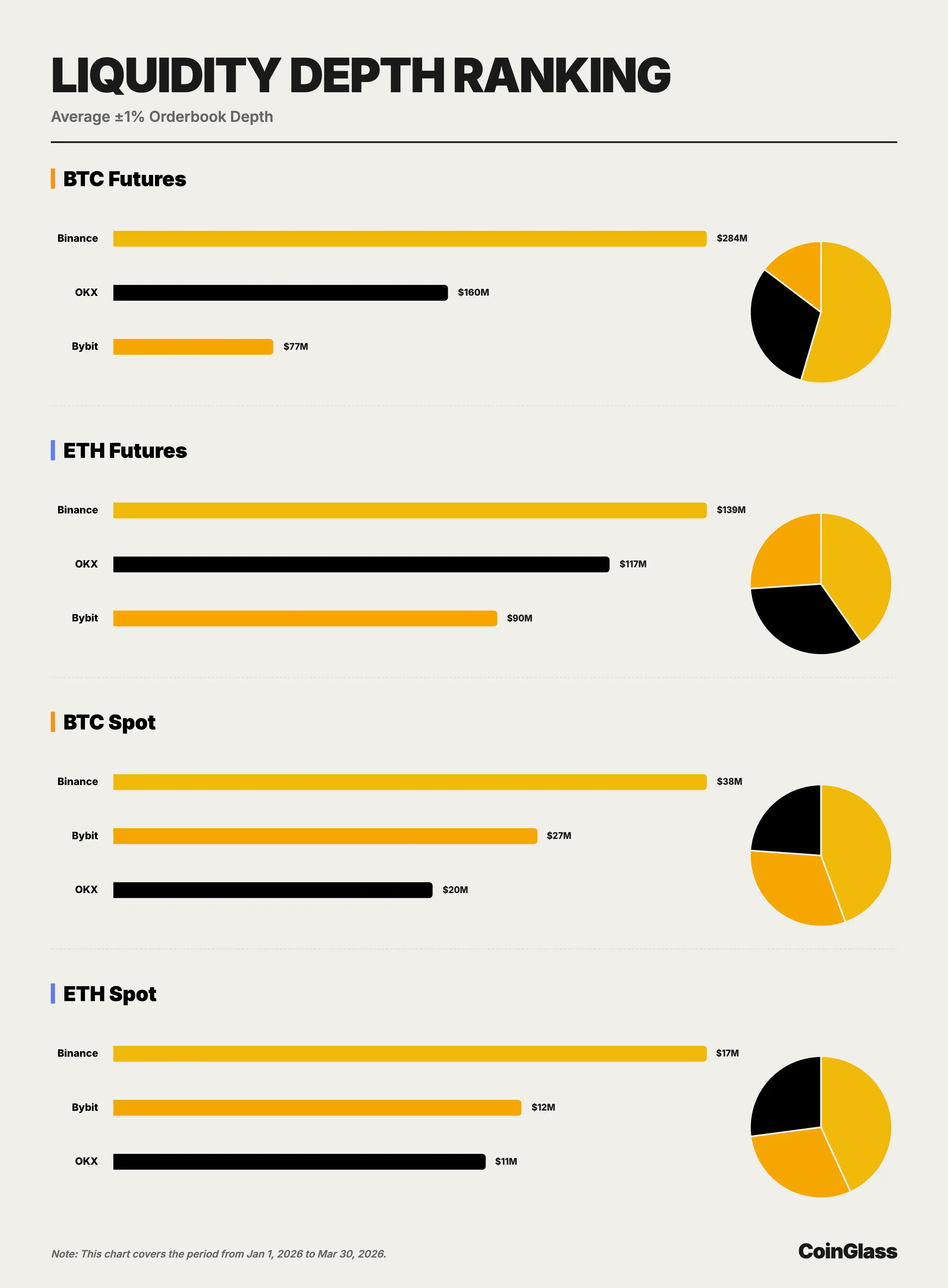
This chapter's data is based on order book snapshot data, comparing the major platforms' ±1% bid-ask depth in the BTC and ETH spot and derivatives markets. Compared to trading volume and open interest, depth more directly reflects a platform's true capacity to handle large transactions, making it a key metric for determining whether the leading platforms' "quality over volume" thesis holds.
4.1 BTC Market Depth
In the BTC derivatives market, Binance, OKX, and Bybit have an average ±1% bid-ask depth of approximately $284 million, $160 million, and $76.55 million, respectively. Binance is about 1.8 times that of OKX and 3.7 times that of Bybit, maintaining a significant lead. From an institutional trading perspective, this means that Binance can accommodate larger-scale orders in the BTC derivatives market without disproportionately increasing the impact cost, making its liquidity advantage directly executable.
In the BTC spot market, Binance, Bybit, and OKX have an average ±1% bid-ask depth of approximately $37.54 million, $26.82 million, and $20.18 million, respectively. Unlike the derivatives market, Bybit, not OKX, holds the second position in BTC spot, but Binance still leads Bybit by about 40% and OKX by about 86%. This indicates that Binance is in the first position in both the BTC spot and derivatives markets' two core liquidity pools, while the second-place platform rotates between different sub-markets.
4.2 ETH Market Depth
In the ETH derivatives market, Binance, OKX, and Bybit have an average ±1% bid-ask depth of approximately $139 million, $117 million, and $90.15 million, respectively. Compared to the BTC derivatives market, the competition in the ETH derivatives market is closer, with OKX narrowing the gap with Binance to about 16%, and Bybit's gap with Binance at about 35%. Nevertheless, Binance still maintains the lead, indicating that its leadership exists not only in BTC but also extends to the ETH derivatives market.
In the ETH spot market, Binance, Bybit, and OKX have an average ±1% bid-ask depth of approximately $16.84 million, $11.58 million, and $10.57 million, respectively. Similar to the BTC spot market, Bybit holds the second position, but Binance leads Bybit by about 45% and OKX by about 59%. Looking at the results, Binance ranks first in all four core sub-markets, while the second position alternates between OKX and Bybit, further illustrating that Binance's advantage is more comprehensive, rather than focused on a specific asset or market.
4.3 Relationship Between Depth and Trade Volume
From a performance perspective, depth is often a better measure of a platform's true liquidity quality than volume. Q1 data shows that Binance not only leads in spot and derivative trading volumes but also has the best depth in the primary BTC and ETH trading scenes. OKX is more competitive in contract depth, Bybit's spot depth is closer to the top, but currently, no platform exerts comprehensive pressure on Binance in all four core sub-markets simultaneously, indicating that Binance's leadership has strong structural stability.
Five, User Asset Immobilization
5.1 Asset Reserve Scale and Trend of Change
In Q1 2026, Binance's average daily custody assets were approximately $152.9 billion, accounting for about 73.5% of the share among the Top 10 exchanges. This ratio is much higher than Binance's market share in trading volume (about 34.9%) and holdings (about 29.9%), showing that Binance's concentration of funds at the custody level is significantly higher than at the trading activity level. For an exchange, user asset immobilization is usually related to brand trust, product ecosystem, on-chain/off-chain fund convenience, and multi-business cross-usage scenarios, making this metric more reflective of the platform's comprehensive competitive position in the medium to long term.
Looking at the monthly trend, Binance's custody assets experienced a decline followed by stability in Q1. In January, the daily average was around $172.7 billion, the quarterly peak, reflecting capital inflows at the beginning of the year under market optimism. In February, it dropped to around $136.4 billion, a decrease of about 21%, consistent with the declining trend of OI during the same period. In March, it slightly rebounded to around $147.8 billion, indicating that the trend of capital outflows has basically stabilized. The peak within the quarter occurred on January 15th, at around $182.1 billion.
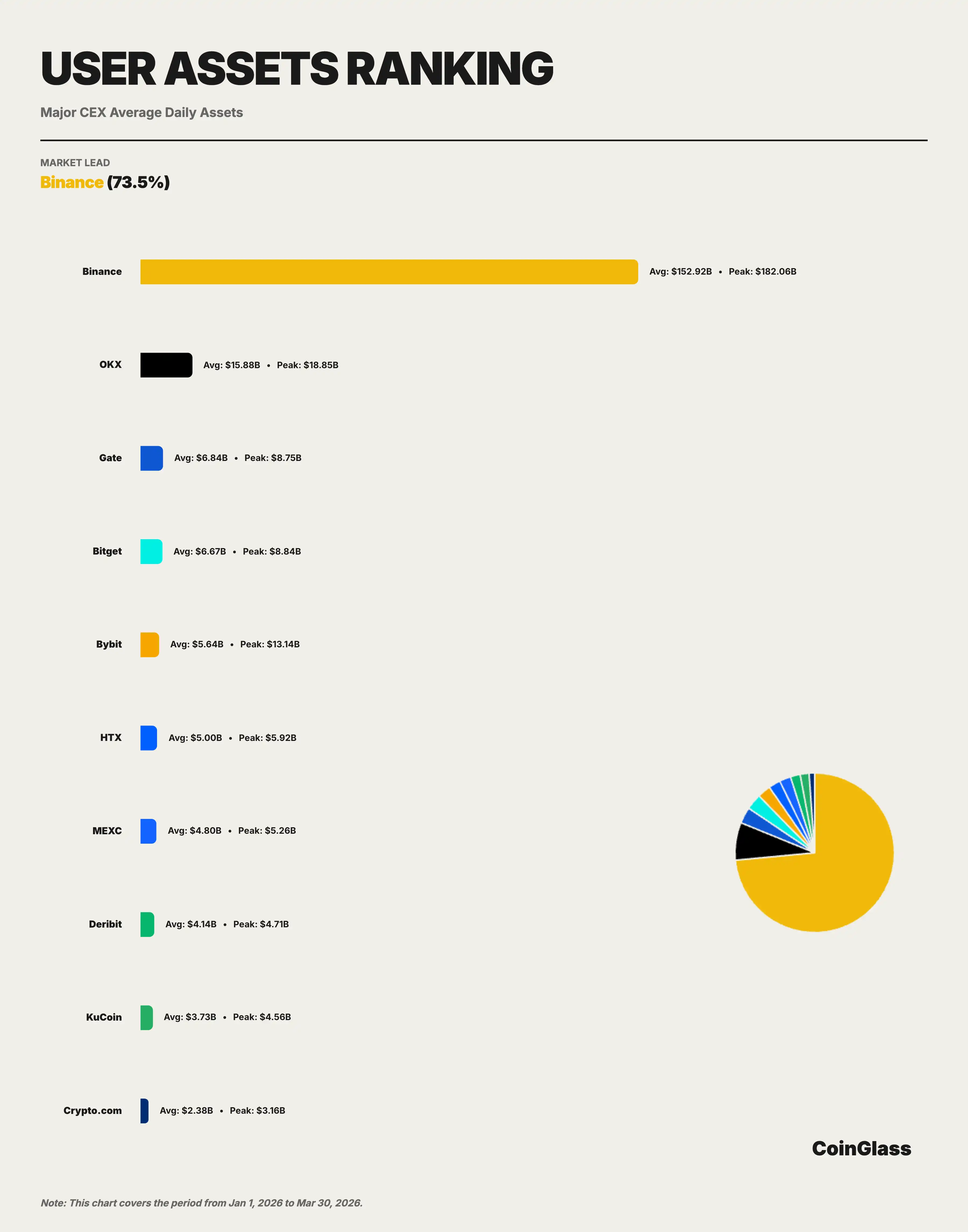
The top 5 platforms are Binance, OKX, Gate, Bitget, and Bybit, with average user assets of approximately $152.9 billion, $15.9 billion, $6.8 billion, $6.7 billion, and $5.6 billion, respectively. This means that under the main CEX caliber, only OKX maintains a level above $10 billion, while platforms ranked third to fifth are concentrated in the range of $5 billion to $7 billion, showing an overall pattern of "significant lead by the first, followed by the second, and the rest relatively close."
5.2 Comparison of Mainstream CEX Asset Stockpile
The market concentration of user asset stockpiles is much higher than that of trading volume and holdings. Among the Top 10 exchanges, Binance dominates with $152.9 billion, while the second-place OKX has a daily average of around $15.9 billion, only one-tenth of Binance's. The third to fifth places are Gate ($6.8 billion), Bitget ($6.7 billion), and Bybit ($5.6 billion) respectively. The three have similar volumes but are orders of magnitude smaller than Binance—Binance's asset size is approximately 8 times the sum of these three. The average user assets on Binance are about 9.6 times that of OKX, 22.4 times that of Gate, 22.9 times that of Bitget, and 27.1 times that of Bybit. Compared to its leading position in derivatives trading volume and OI dimensions, Binance's lead in asset stockpiling is even greater. This means that Binance's market position is not only reflected in trading activity but also in the platform preference for long-term fund detention. For the industry's competitive landscape, these types of leadership positions usually have higher stability and are harder to replicate in the short term. This extremely concentrated distribution pattern implies that Binance has actually assumed a role similar to "systemic infrastructure" at the user fund custody level, and its operations and compliance status have an amplifying effect on the overall stability of the crypto market.
In the second tier, HTX ($5.0 billion), MEXC ($4.8 billion), Deribit ($4.1 billion), KuCoin ($3.7 billion), Crypto.com ($2.4 billion) make up the long tail.
Six, Comprehensive Analysis and Outlook
By synthesizing data from four dimensions: trading volume, holdings, liquidity depth, and user asset stockpiling, the following core judgments can be made:
First, Binance's market leadership is comprehensive and solid. Binance ranks first in all core dimensions: derivative trading volume of around $4.9 trillion (Top 10 share of 34.9%), daily average OI of $23.9 billion (share of 29.9%), BTC contract depth of $2.84 billion (share of 54.6%), and user assets of $152.9 billion (share of 73.5%). More importantly, Binance's lead in liquidity depth and asset custody dimensions is much greater than the trading volume dimension, meaning its position as the core infrastructure of the cryptocurrency market is more robust than implied by simple trading volume rankings.
Second, the competitive landscape of the derivatives market is being reshaped. OKX is currently the platform closest to Binance, primarily reflected in derivative trading volume and contract depth; Bybit is characterized by relatively balanced trading volume, holdings, and spot liquidity performance; Gate maintains a high presence in derivative trading and OI dimensions, but relatively weak asset stockpiling; Bitget is an important platform in the second tier, maintaining top five positions in derivative trading volume and holdings dimensions. Meanwhile, the derivatives market traditionally dominated by a few leading CEXs is being simultaneously challenged by two forces: one end is the compliance institution channel represented by CME, and the other end is the decentralized protocol represented by Hyperliquid. The former mainly attracts hedging and basis trading demand, while the latter attracts some high-frequency and strategic traders with its anti-censorship, composability, and 24/7 characteristics.
Third, the overall market is moving forward in a cautious recovery. The trading volume in Q1 contracted month by month, and the OI stabilized after retreating from its high level, overall reflecting the characteristics of the market's recovery period after the extreme event in Q4 2025. Entering Q2, key variables to watch include: the clarification of the Federal Reserve's monetary policy path, changes in BTC spot ETF fund flows, and the progress of regulatory frameworks in major jurisdictions.
This article is a contributed piece and does not represent the views of BlockBeats.
You may also like

BIT Launches Landmark "Same Name Virtual Account" Feature: Ushering in a New Era of OTC Trading that is Convenient, Efficient, and Compliant

Further Oracle Integration Reveals Polymarket's Ambitions

Tiger Research: Analysis of the Current Situation of Retail Investors in Nine Major Asian Markets

Forbes: Does quantum technology threaten the encryption industry? But it is more likely an opportunity

What Is Auto Earn? How To Claim Extra Free Crypto On Auto Earn 2026
What is Auto Earn and how do you use it? This guide explains how Auto Earn works and how balance increases and referrals may qualify for extra rewards during Auto Earn Boost Fest.
Auto Earn Compared 2026: Which Exchange Gives The Most Extra Bonus?
What is Auto Earn in crypto? Compare Kraken, OKX, Bybit, Binance, and WEEX Auto Earn features in 2026 and see which platforms provide additional promotional rewards beyond standard yield mechanisms.

Nearly $300M Targeting U.S. Midterm Elections, Tether Exec Leads Crypto Industry's Second-Largest Political Fund

Anthropic's Triple Moment: Code Leak, Government Standoff, and Weaponization
OpenAI and Anthropic both announced acquisitions on the same day, causing dual IPO anxiety.

Forbes: Quantum Technology Threatens the Crypto Industry? But It's More Likely an Opportunity

Rhythm X Zhihu Hong Kong Event Recruitment Skills, Register Now for a Chance to Showcase Live

CLARITY Act 2026 Update: Stablecoin Yield Ban, Senate Compromise, and What It Means for Crypto Markets
The CLARITY Act may reshape stablecoin yield rules, DeFi incentives, and crypto liquidity in 2026. Learn the latest Senate updates, timeline changes, and what the regulation could mean for crypto traders.

Bitcoin mining companies flee for the Nth time

Stablecoin mergers: there will be no "winner takes all"

Warmonger Trump has forgotten about Americans waiting in airport lines for hours

Houthi Have a Checkpoint | Rewire News Morning Brief
The Money-Saving Philosophy of the AI Era: How to Spend Every Token Wisely

$240 Billion Dark Forest, The Fall of Iron Finance
BIT Launches Landmark "Same Name Virtual Account" Feature: Ushering in a New Era of OTC Trading that is Convenient, Efficient, and Compliant
Further Oracle Integration Reveals Polymarket's Ambitions
Tiger Research: Analysis of the Current Situation of Retail Investors in Nine Major Asian Markets
Forbes: Does quantum technology threaten the encryption industry? But it is more likely an opportunity
What Is Auto Earn? How To Claim Extra Free Crypto On Auto Earn 2026
What is Auto Earn and how do you use it? This guide explains how Auto Earn works and how balance increases and referrals may qualify for extra rewards during Auto Earn Boost Fest.
Auto Earn Compared 2026: Which Exchange Gives The Most Extra Bonus?
What is Auto Earn in crypto? Compare Kraken, OKX, Bybit, Binance, and WEEX Auto Earn features in 2026 and see which platforms provide additional promotional rewards beyond standard yield mechanisms.


 App
App