
Crypto pivots towards the application layer as Asian developers embrace a dividend period

 Prefer us on Google


Original Article Title: "IOSG: The Era of Applications Arrives, Asian Developers Enter the Golden Age"
Original Article Author: Jiawei, IOSG Ventures
In the mid-to-late 1990s, Internet investment focused heavily on infrastructure. The capital markets at that time were almost entirely betting on fiber optics, ISP service providers, CDNs, and server and router manufacturers. Cisco's stock price soared, surpassing a market cap of $500 billion by 2000, making it one of the most valuable companies globally; fiber equipment manufacturers like Nortel and Lucent also became hot commodities, attracting billions in funding.
During this frenzy, the United States added millions of kilometers of fiber optic cable between 1996 and 2001, far exceeding the actual demand at the time. The result was a severe overcapacity around 2000, with intercontinental bandwidth prices plummeting over 90% in just a few years, and the marginal cost of Internet access approaching zero.
While this infrastructure boom allowed later entrants like Google and Facebook to thrive on a cheap, ubiquitous network, it also brought pain to the once-zealous investors: the infrastructure valuation bubble quickly burst, with star companies like Cisco losing over 70% of their market cap in a few years.
Doesn't this sound a lot like the past two years of Crypto?
1. Perhaps the Era of Infrastructure is Temporarily Coming to a Close?
Block Space Transitions from Scarcity to Abundance
The scaling of block space, the exploration of the blockchain's "impossible trilemma," largely dominated the early years of the crypto industry's development, making it a suitable emblematic element to highlight.
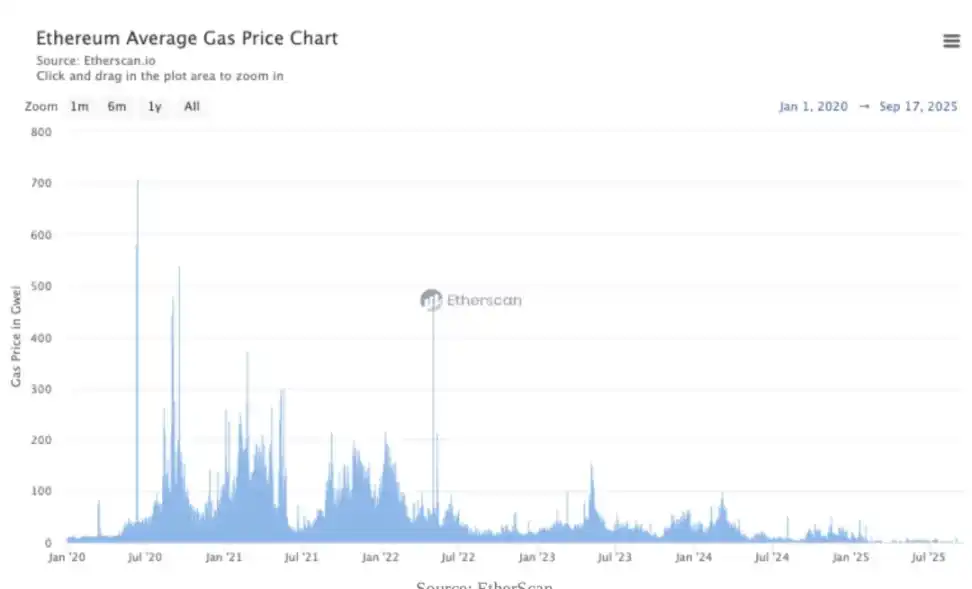
▲Source: EtherScan
In terms of outcomes, Ethereum's key upgrades (such as EIP-4844) have shifted L2 data availability from expensive calldata to lower-cost blob, significantly reducing the unit cost of L2. Transaction fees on mainstream L2 have generally dropped to the level of a few cents. The introduction of modular and Rollup-as-a-Service solutions has also significantly lowered the marginal cost of block space. Various Alt-L1s supporting different virtual machines have also emerged. As a result, block space has transitioned from a singular scarce asset to a highly substitutable commodity.
The above diagram shows the evolution of on-chain costs for various L2 solutions over the past few years. It can be seen that, from 23 to early 24, Calldata dominated the primary cost, with daily costs even approaching nearly $4 million. Subsequently, in mid-24, the introduction of EIP-4844 led Blobs to gradually replace Calldata as the dominant cost, resulting in a significant overall reduction in on-chain costs. Moving into 25, the overall expenditure trended towards lower levels.
As a result, more and more applications can directly place their core logic on-chain, rather than adopting complex off-chain processing architectures that are later submitted to the chain.
From this point onwards, we see value capture shifting from the underlying infrastructure towards the application and distribution layer that can directly handle traffic, boost conversion, and form a cash flow loop.
Evolution on the Revenue Front
Building on the discussion from the previous section, we can visually validate this point on the revenue side. During the infrastructure-centric narrative period, the market's valuation of L1/L2 protocols was primarily based on their technical capabilities, ecosystem potential, and the expected network effects, known as the "protocol premium."
The token value capture model is often indirect (such as through network staking, governance rights, and vague fee expectations).
Application value capture, on the other hand, is more direct: generating verifiable on-chain revenue through fees, subscriptions, service charges, and other means. This revenue can be directly used for token buybacks and burning, dividends, or reinvestment for growth, forming a tight feedback loop. The application's revenue sources have become solid—stemming more from actual service fee revenue rather than token incentives or market narratives.
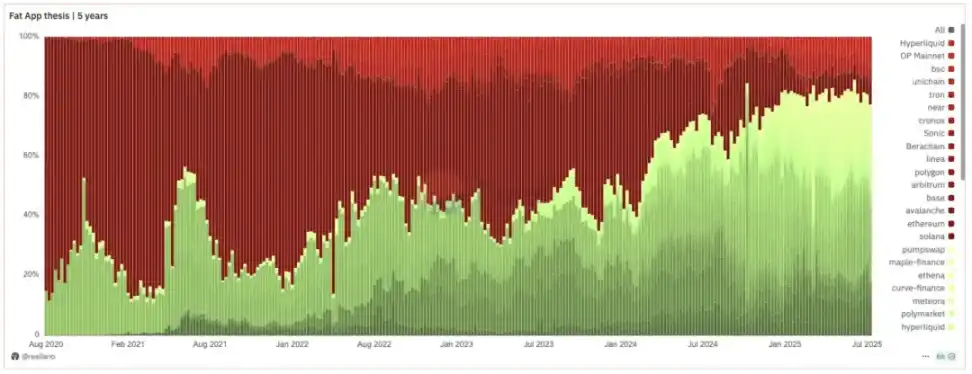
▲Source: Dune@reallario
The graph above roughly compares the revenue from protocols (in red) and applications (in green) from 2020 to the present. We can see that the value captured by applications is gradually increasing and has reached about 80% this year.
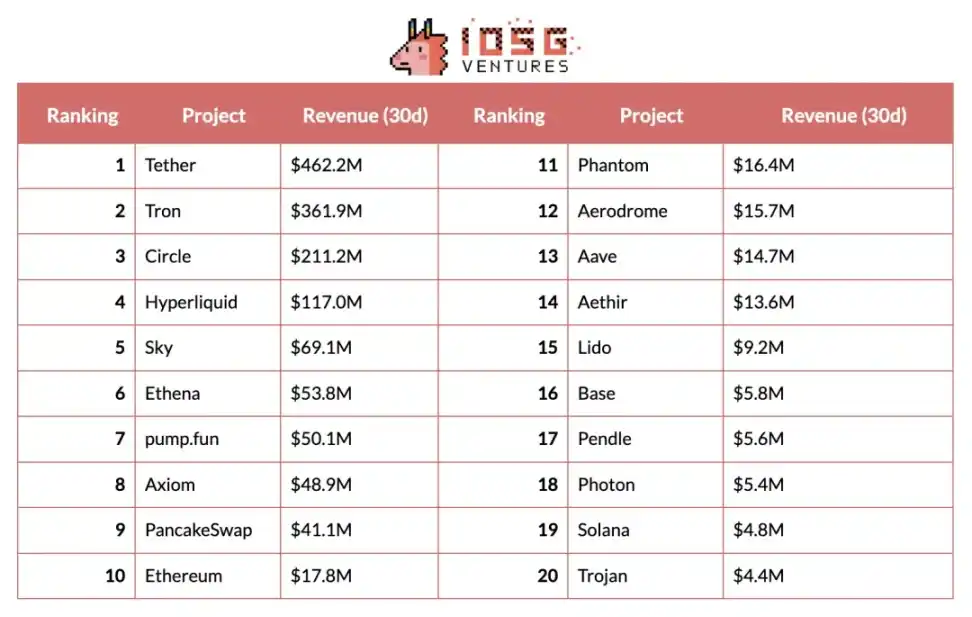
The table below lists TokenTerminal's 30-day protocol revenue rankings, where L1/L2 account for only 20% across 20 projects. Particularly notable are applications such as stablecoins, DeFi, wallets, and trading tools.
▲Source: ASXN
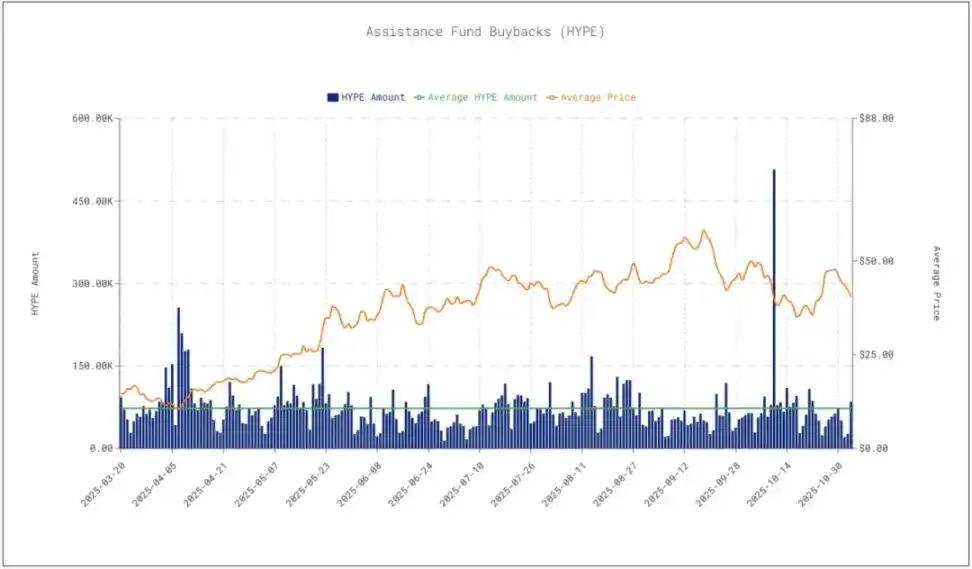
Furthermore, due to the market response brought by buybacks, the price performance of the utility token is gradually becoming more correlated with its revenue data.
Hyperliquid conducts daily buybacks of approximately $4 million, providing significant support for the token price. Buybacks are considered a key factor driving price rebounds. This indicates that the market is starting to directly link protocol revenue to buyback behavior with token value, rather than relying solely on sentiment or narrative. The author expects this trend to continue to strengthen.
-- Price
II. Embracing an Application-Centric New Cycle
The Golden Age of Asian Developers
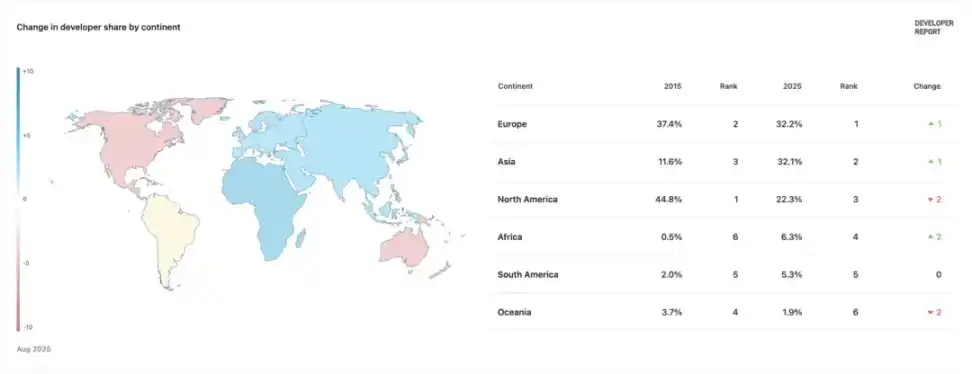
▲Source: Electric Capital
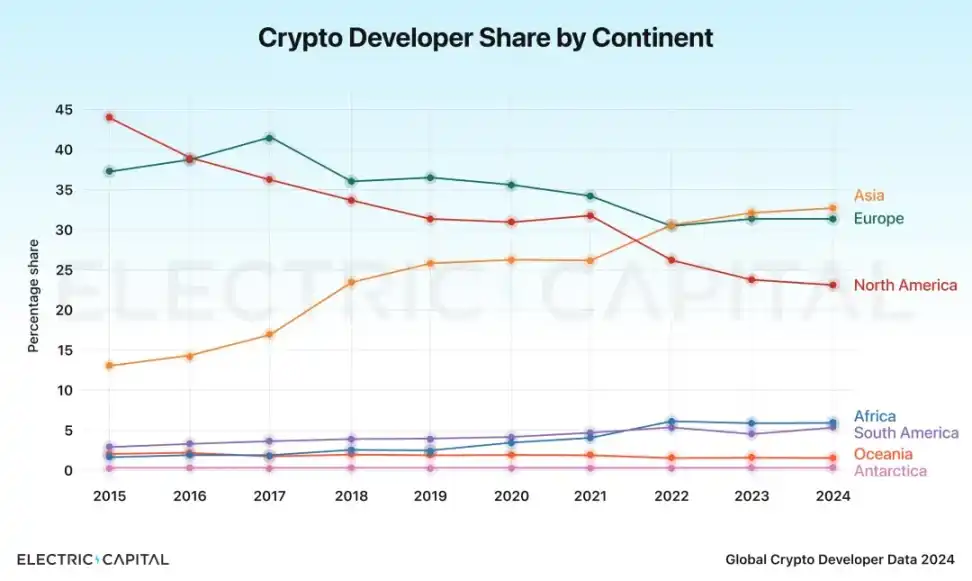
▲Source: Electric Capital
The Electric Capital 2024 Developer Report shows that blockchain developers in the Asian region have reached a record 32% share, surpassing North America to become the world's largest developer hub.
Over the past decade, globally acclaimed products such as TikTok, Temu, and DeepSeek have proven the outstanding capabilities of Chinese teams in engineering, product development, growth, and operations. Asian teams, especially Chinese teams, exhibit a strong iteration rhythm, can rapidly validate demands, and achieve international expansion and growth through localization strategies. Crypto aligns closely with these characteristics: the need for rapid iteration and adjustment to adapt to market trends; simultaneously serving a global user base, multilingual communities, and diverse market regulations.
Therefore, Asian developers, especially Chinese teams, possess a structural advantage in the Crypto application cycle: they have strong engineering capabilities and are sensitive to market speculation cycles with strong execution.
In this context, Asian developers have a natural advantage, allowing them to deliver globally competitive Crypto applications more quickly. In this cycle, we see representatives of Asian teams on the global stage, such as Rabby Wallet, gmgn.ai, and Pendle.
It is expected that we will soon see this shift: the market trend will move from the past U.S.-dominated narrative to Asian product deployment leading the way, followed by a comprehensive expansion into the European and American markets. Asian teams and markets will have more influence in the application cycle.
Primary Market Investment in Application Cycle
Here are some insights into primary market investment:
Trading, asset issuance, and financial application still have the best Product-Market Fit (PMF) and are almost the only products that can withstand a bear market. Examples include products like Hyperliquid for perpetuals, Launchpads like Pump.fun, and products like Ethena. The latter packages funding rate arbitrage into a product that can be understood and used by a wider user base.
For investments in niche tracks with significant uncertainty, one can consider investing in the Beta of the track and think about which projects will benefit from the track's development. A typical example is the prediction market—there are approximately 97 publicly available prediction market projects, with Polymarket and Kalshi being more obvious winners. In this scenario, the probability of overtaking a long-tail project is very low. However, investments in tool projects related to prediction markets, such as aggregators, chip analysis tools, etc., provide more certainty and allow for reaping the benefits of track development, transforming a difficult multiple-choice question into a single-choice question.
Once a product is launched, the next core step is how to truly bring these applications to the masses. In addition to common entry points like Social Login provided by tools like Privy, I believe that aggregative trading frontends and mobile applications are also crucial. In the application cycle, whether it's perpetuals or prediction markets, the mobile end will be the most natural user touchpoint. Whether it's a user's first deposit or daily high-frequency operations, the experience on the mobile end will be smoother.
The value of aggregate frontends lies in traffic distribution. Distribution channels directly determine user conversion rates and project cash flow.
Wallets are also a key part of this logic.
I believe wallets are no longer just asset management tools but are positioned similarly to Web2 browsers. Wallets directly capture order flow, distribute order flow to block builders and searchers, monetize traffic; at the same time, wallets are distribution channels, integrating third-party services such as built-in cross-chain bridges, built-in DEX, Staking, etc., to become the direct entry point for users to interact with other applications. In this sense, wallets control order flow and traffic distribution rights, serving as the primary entry point for user relationships.
For the entire infrastructure in this cycle, I believe some public chains created out of thin air have lost their relevance; whereas infrastructure that provides basic services around applications can still capture value. Here are a few specific points:
· Infrastructure that provides customized multi-chain deployment and application chain construction for applications, such as VOID;
· Companies that provide User Onboarding (including login, wallet, deposits, withdrawals, on/off-ramp, etc.) services, such as Privy, Fun.xyz; this can also include wallet and payment layer (fiat on/off ramps, SDK, MPC custody, etc.)
· Cross-chain Bridge: As the multi-chain world becomes a reality, the influx of application traffic will urgently need secure and compliant cross-chain bridges.
【Disclaimer】The market carries risks, and investment should be cautious. This article does not constitute investment advice. Users should consider whether any opinions, views, or conclusions in this article are suitable for their specific circumstances. Investment based on this is at your own risk.
This content is provided for general informational purposes only and doesn't constitute financial, investment, legal, or tax advice. Any events, rewards, online promotions, or related information mentioned herein should not be considered a recommendation, solicitation, or invitation to purchase, sell, trade, or otherwise deal in any crypto assets. Crypto assets are highly volatile and may result in loss. The availability of WEEX services, products, and related events may vary by region. You are responsible for ensuring that your participation is in accordance with applicable local laws and regulations.
You may also like

Digital wealth needs safer paths to liquidity, XPlace CEO says

Ethena's StablecoinX Releases First Financial Report, Holding 3 Billion ENA Worth Over $218 Million

Grayscale Completes Q2 2026 Multi-Asset Fund Rebalancing, DeFi Fund Sells UNI
Arthur Hayes Acquires 6 Million Ethena Tokens for $525,000

RootData: ENA will unlock tokens worth approximately $13.18 million in one week
StablecoinX completes SPAC merger and officially debuts on Nasdaq today

Asset management giant Janus Henderson Investors announced a strategic investment in Ethena, and the two parties have reached multiple cooperation agreements
Coinbase Ventures invests in ENA for the first time, Ethena will collaborate with Coinbase to develop on-chain financial and savings products

The tokenized market will reach a trillion-dollar scale, but there are still four major obstacles

Standard Chartered Bank: It is expected that by the end of 2028, the scale of on-chain tokenized assets will reach $4 trillion, with DeFi protocols being the biggest beneficiaries
How MegaETH Achieved a TVL of 700m Within a Week of TGE? Analyzing the Packaging Strategy

Ethena: The fifth season airdrop claim is now open, and 2% of the ENA supply will be distributed

BlackRock submitted a letter of opinion to the Office of the Comptroller of the Currency, opposing the 20% cap on tokenized reserves

Ethena has restored the LayerZero cross-chain bridge functionality for sUSDe and USDe and strengthened security configurations
DefiLlama founder responds to Aave TVL controversy: cyclical lending impact has been excluded

Annualized 11.5%, Wall Street Buzzing: Is MicroStrategy's STRC Bitcoin's Savior or Destroyer?
Ethena: The root cause analysis of the rsETH incident has not yet been received, and the temporary suspension period of the OFT bridge will be extended

Singapore's Bay Bank has launched a stablecoin minting and redemption service, supporting instant cross-border settlement for enterprises

The latest disclosed candidate asset list from Gray includes HYPE, STX, VIRTUAL, and others

Illustration of Kraken's 19 Web3 business partners: from product integration to on-chain financial entry

Ethena Labs Joins Hyperliquid for USDH Stablecoin Issuance Rights Competition
Q1 Grayscale Launches "Consideration List" with 36 Altcoins, Considers Them for Potential Investment Products
USDT Insolvent? Arthur Hayes Publicly Questions Tether

The total market capitalization of stablecoins has decreased by 0.45% over the past week, but still remains above $300 billion.
On-chain Yield: ZEROBASE Stablecoin APY Reaches 12%, Syrup USDC Pool APY Reaches 7.19%
$300 Billion New Frontier: The Three Pillars of the Stablecoin Ecosystem

DEX Terminal Finance, incubated by Ethena, achieves a TVL of over $280 million ahead of its launch.
Dogecoin Price Prediction on September 18, 2025: Will DOGE Slide Below $0.20 as Mutuum Finance (MUTM) Gains Traction?
Imagine Dogecoin as that beloved meme coin that’s always full of surprises, much like a playful puppy that…
Native Markets Secures Hyperliquid’s USDH Stablecoin Ticker After Intense Bidding Battle
Imagine stepping into a high-stakes auction where the prize isn’t a rare artifact, but a digital ticker that…
BNB Chain 2025 Annual Awards Winners Announced
Digital wealth needs safer paths to liquidity, XPlace CEO says
Ethena's StablecoinX Releases First Financial Report, Holding 3 Billion ENA Worth Over $218 Million
Grayscale Completes Q2 2026 Multi-Asset Fund Rebalancing, DeFi Fund Sells UNI
Arthur Hayes Acquires 6 Million Ethena Tokens for $525,000
RootData: ENA will unlock tokens worth approximately $13.18 million in one week
StablecoinX completes SPAC merger and officially debuts on Nasdaq today

Contents
Latest articles


Latest coin listings on WEEX


