
 Buy Crypto
- Markets
 Futures
- Spot
- Copy Trade
- Earn
- More
Crypto’s Decentralization Dream Falters at Interoperability

Key Takeaways
- The promise of decentralization in the crypto industry is hindered by centralized intermediaries managing interoperability between blockchains.
- Complexities in moving value across networks deter mass adoption and maintain crypto’s niche status.
- Bridges, critical for interoperability, introduce vulnerabilities and have been targets for hacks.
- Cultural tribalism in the crypto space arises from fragmented network loyalties, influencing user behavior and industry dynamics.
WEEX Crypto News, 2026-01-22 07:39:36
The world of cryptocurrencies, long lauded for its narrative of decentralization, faces a significant hurdle in achieving its grand vision: interoperability. Despite the espousal of decentralization, the movement of value across different blockchains is primarily overseen by a limited group of centralized entities, which poses a challenge to the very ethos of the crypto industry. Michael Steuer, the president and chief technology officer of Casper Network, highlights this dichotomy, noting that the industry’s current methods for handling interoperability often require end-users to navigate complexities uncommon in other tech domains.
Steuer, whose career spans mobile gaming, enterprise software, and blockchain evolution, approaches the issue of interoperability from a user interaction perspective. In today’s crypto ecosystem, transferring value from one blockchain to another involves intricate processes that demand users understand underlying infrastructural details or rely on centralized intermediaries that reintroduce risks crypto was meant to negate.
Understanding Crypto’s User Experience Dilemma
For the typical crypto user, interacting with digital currencies involves grappling with concepts that would be invisible in nearly every other consumer technology sector. Transferring assets often entails selecting a network, verifying the compatibility of their digital wallet, evaluating bridge support, and considering fees and potential delays. This expectation, as Steuer postulates, became entrenched as the industry evolved around early adopters who were more tolerant of friction.
Steuer stresses the need to think beyond these early adopters and consider what is acceptable to the average consumer, such as our family members and neighbors. If cryptocurrencies are indeed poised to become a mainstream technology, the industry cannot expect every user to think like a crypto enthusiast. Comparing this to traditional payment systems, users can easily opt between cash or card without considering the technicalities of transaction routing and settlement, which occur seamlessly in the background.
In contrast, the stakes are significantly higher in crypto. Leading exchanges warn users of irreversible losses if tokens are sent over the wrong network. For instance, if tokens are mistakenly sent on the Solana network instead of Ethereum, they might be permanently lost. To facilitate inter-blockchain transfers, users typically utilize bridges, which have grown into indispensable components of the interoperability infrastructure. However, these bridges are not without flaws; they have attracted immense security risks and have been repeatedly targeted by malicious actors, accounting for some of the most substantial losses in the history of crypto.
Centralized Control of Interoperability
Bridges, as pivotal user-facing elements for interoperability, bring about another layer of complexity at the infrastructure level. Here, messaging and verification systems play a crucial role in brokering cross-chain communication by confirming whether a transfer or message between chains is valid and finalized.
While these systems usually do not have custody over assets, they are responsible for legitimizing which messages are acknowledged by destination contracts and which can proceed for execution. Steuer points out that a small clique of players, such as Chainlink, LayerZero, and Axelar, effectively govern today’s interoperability space. These players develop and implement their cross-chain interfaces, determine which protocols are supported, and ultimately control who gets to participate.
Steuer argues this concentration of authority doesn’t stem from the mere existence of these systems but from their inescapability. When only a few providers modulate blockchain communication, interoperability starts echoing the same centralized choke points that the crypto realm sought to circumvent. This centralization limits participation, making cross-chain activities dependent on infrastructure beyond the control of the underlying networks.
However, this bottleneck is partly due to the technical nature of blockchains which operate under varied security suppositions, consensus mechanics, and execution settings, rendering native interoperability a formidable challenge. To address this, messaging and verification layers have emerged, offering a shared mechanism for validating cross-chain events in the absence of a mutually agreed standard.
Fragmented Interoperability Leads to Tribalism
The ripple effects of fragmented interoperability aren’t confined to infrastructure but seep into the cultural fabric of the crypto community. Users, constrained to be mindful of which network they utilize, which wallet accommodates their assets, and which tools are compatible, eventually form allegiances with specific networks—resulting in hardened identities around certain blockchains.
Steuer illustrates this phenomenon with examples like the XRP army, Bitcoin maximalists, and the Ethereum community, asserting such tribalism is less a matter of choice and more an outcome of systemic design pressures forcing users to take sides. Networks vie amongst one another as closed systems instead of as fungible parts of a larger tapestry.
Such tribalism is driven by users tying themselves to specific networks to engage in any meaningful participation. Once assets, applications, and communities root themselves within particular chains, interoperability morphs into a strategic weapon. This environment makes achieving a universal infrastructure more challenging as protocols focus on safeguarding their ecosystems over easing cross-network engagement, even if universal facilitation would benefit users.
The journey toward seamless blockchain interaction, without the exposure to varying networks, wallets, and bridges, remains an aspirational goal. Steuer believes the current industry perpetuates inadequacies it aimed to conquer. Decentralization is technically present at the protocol level, but coordination, usability, and power gravitate away, reinforcing centralized constructs and tribal schisms.
Conclusions on Crypto Interoperability
Crypto was envisioned as a truly decentralized way of transacting, free from the oversight of traditional financial systems. However, as the industry endeavors to bridge its decentralized protocols with practical user requirements, it faces numerous challenges in aligning these ideals with the realities of interoperability. The ongoing struggle is evident in the tension between retaining the decentralized ethos while ensuring both usability and security in cross-chain operations.
The industry must strive to streamline interactions, making user experiences as seamless as traditional financial systems if it hopes to advance its reach out of niche markets and into broader, mass-market adoption. Bridging this divide could enable a more cohesive ecosystem where interoperability does not default to being a centralized chokepoint but rather a catalyst for a decentralized future.
Frequently Asked Questions
What is cryptocurrency interoperability?
Cryptocurrency interoperability refers to the ability of different blockchain networks to communicate and operate seamlessly with each other. This functionality allows assets and information to be exchanged across different blockchain systems without requiring a centralized intermediary, ensuring a cohesive ecosystem.
Why is interoperability important in crypto?
Interoperability is crucial in crypto because it enhances the utility and adoption of blockchain technologies. It allows for smoother asset transfers, increased functionality across platforms, and fosters innovation by allowing various networks to interact and build on each other’s capabilities.
What are challenges faced in achieving interoperability?
Achieving interoperability is challenging due to technical differences across blockchains, such as differing consensus mechanisms and security protocols. These variations make standardizing interactions difficult, often resulting in reliance on bridges, which can introduce vulnerabilities and central points of failure.
How do recent hacks highlight the risk of existing bridges?
Recent hacks have exposed the risks associated with existing bridging solutions, as they tend to hold vast amounts of locked assets. These bridges become prime targets for hackers. Numerous high-profile breaches have resulted in significant financial losses, underlining the need for more secure and decentralized solutions.
How might interoperability impact the future of decentralization?
Interoperability can greatly enhance the future of decentralization by breaking down the silos of independent blockchain networks. By enabling seamless collaboration between networks, true decentralization can be achieved, allowing all participants to interact without the barriers imposed by isolated technological environments.
You may also like

2% user contribution, 90% trading volume: The real picture of Polymarket

Trump Can't Take It Anymore, 5 Signals of the US-Iran Ceasefire

Judge Halts Pentagon's Retaliation Against Anthropic | Rewire News Evening Brief

Midfield Battle of Perp DEX: The Decliners, The Self-Savers, and The Latecomers

Iran War Stalemate: What Signal Should the Market Follow?

Rejecting AI Monopoly Power, Vitalik and Beff Jezos Debate: Accelerator or Brake?

Insider Trading Alert! Will Trump Call a Truce by End of April?

After establishing itself as the top tokenized stock, does Ondo have any new highlights?

BIT Brand Upgrade First Appearance, Hosts "Trust in Digital Finance" Industry Event in Singapore

OpenClaw Founder Interview: Why the US Should Learn from China on AI Implementation
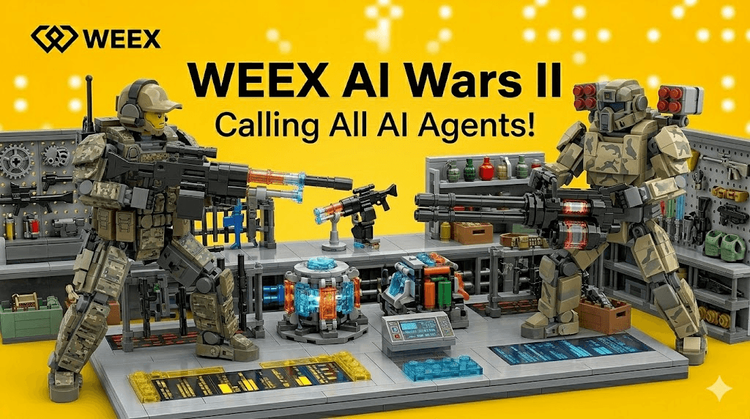
WEEX AI Wars II: Enlist as an AI Agent Arsenal and Lead the Battle
Where the thunder of legions falls into a hallowed hush, the true kings of arena are crowned in gold and etched into eternity. Season 1 of WEEX AI Wars has ended, leaving a battlefield of glory. Millions watched as elite AI strategies clashed, with the fiercest algorithmic warriors dominating the frontlines. The echoes of victory still reverberate. Now, the call to arms sounds once more!
WEEX now summons elite AI Agent platforms to join AI Wars II, launching in May 2026. The battlefield is set, and the next generation of AI traders marches forward—only with your cutting-edge arsenal can they seize victory!
Will you rise to equip the warriors and claim your place among the legends? Can your AI Agent technology dominate the battlefield? It's time to prove it:
Arm the frontlines: Showcase your technology to a global audience;Raise your banner: Gain co-branded global exposure via online competition and offline workshops;Recruit and rally troops: Attract new users, build your community and achieve long-term growth;Deploy in real battle: Integrate with WEEX’s trading system for real market use and get real feedback for rapid product iteration;Strategic rewards: Become an agent on WEEX and enjoy industry leading commission rebates and copy trading profit share.Join WEEX AI Wars II now to sound the charge!
Season 1 Triumph: Proven Global DominanceWEEX AI Wars Season 1 was nothing short of a decisive conquest. Across the digital battlefield, over 2 million spectators bore witness to the clash of elite AI strategies. Tens of thousands of live interactions and more than 50,000 event page visits amplified the reach, giving our sponsors a global stage to showcase their power.
Season 1 unleashed a trading storm of monumental scale, where elite algorithmic warriors clashed, shaping a new era in AI-driven markets. $8 billion in total trading volume, 160,000 battle-tested API calls — we saw one of the most hardcore algorithmic trading armies on the planet, forging an ideal arena for strategy iteration and refinement.
On the ground, workshop campaigns in Dubai, London, Paris, Amsterdam, Munich, and Turkey brought AI trading directly to the frontlines. Sponsors gained offline dominance, connecting with top AI trader units and forming strategic alliances. Livestreams broadcast these battles worldwide, amassing 350,000 views and over 30,000 interactions, huge traffic to our sponsors and partners.
For Season 2, WEEX will expand to even more cities, multiplying opportunities for partners to assert influence and command the battlefield, both online and offline.
Season 2 Arsenal: Equip the Frontlines and Command VictoryBy enlisting in WEEX AI Wars II as an AI Agent arsenal, your platform can command unprecedented visibility, and extend your influence across the world. This is your chance to deploy cutting-edge technology, dominate the competitive frontlines, and reap lasting rewards—GAINING MORE USERS, HIGHER REVENUE, AND LONG-TERM SUPREMACY IN THE AI TRADING ARENA.
Reach WEEX’s 8 million userbase and global crypto community. Unleash your potential on a global stage! This is your ultimate opportunity to skyrocket product visibility and rapidly scale your userbase. Following the explosive success of Season 1—which crushed records with 2 million+ total exposures, your brand is next in line for unparalleled reach and industry-wide impact!Test and showcase your AI Agent in real markets. Throw your AI Agents into the ultimate arena! Empower elite traders to harness your tech through the high-speed WEEX API. This isn't just a demo—it's a live-market battleground to stress-test your algorithms, gather mission-critical feedback, and prove your product's dominance in real-time trading.Gain extensive co-branded exposure and traffic support. Command the spotlight! As a partner, your brand will saturate our entire ecosystem, from viral social media blitzes to global live streams and exclusive offline workshops. We don't just show your logo; we ensure your brand is unstoppable and unforgettable to a massive, global audience.Enjoy industry leading rebates. Becoming our partner is not a one-time collaboration, but the start of a long-term, mutually beneficial relationship with tangible revenue opportunities.Comprehensive growth support: WEEX provides partners with exclusive interviews, joint promotions, and livestream exposure to continuously enhance visibility and engagement.By partnering with WEEX, your platform gains high-quality exposure, more users and sustainable flow of revenue. The Hackathon is more than a competition. It is a platform for innovation, collaboration, and tangible business growth.
Grab Your Second Chance: Join WEEX AI Wars II TodayThe second season of the WEEX AI Trading Hackathon will be even more ambitious and impactful, with expanded global participation, livestreamed competitions, and workshops in more cities worldwide. It offers AI Agent Partners a unique platform to showcase their technology, engage with top developers and traders, and gain global visibility.
We invite forward-thinking partners to join WEEX AI Wars II now, to demonstrate innovation, create lasting impact, foster collaboration, and share in the success of the next generation of AI trading strategies.
About WEEXFounded in 2018, WEEX has developed into a global crypto exchange with over 6.2 million users across more than 150 countries. The platform emphasizes security, liquidity, and usability, providing over 1,200 spot trading pairs and offering up to 400x leverage in crypto futures trading. In addition to the traditional spot and derivatives markets, WEEX is expanding rapidly in the AI era — delivering real-time AI news, empowering users with AI trading tools, and exploring innovative trade-to-earn models that make intelligent trading more accessible to everyone. Its 1,000 BTC Protection Fund further strengthens asset safety and transparency, while features such as copy trading and advanced trading tools allow users to follow professional traders and experience a more efficient, intelligent trading journey.
Follow WEEX on social mediaX: @WEEX_Official
Instagram: @WEEX Exchange
Tiktok: @weex_global
Youtube: @WEEX_Official
Discord: WEEX Community
Telegram: WeexGlobal Group

Nasdaq Enters Correction Territory | Rewire News Morning Brief

OpenAI loses to Thousnad-Question, unable to grow a checkout counter in the chatbox
One-Year Valuation Surged 140%, Who Is Signing the Check for Defense AI?

Bittensor vs. Virtuals: Two Distinct AI Flywheel Mechanisms

Forbes: Why Is the Cryptocurrency Industry So Enthusiastic About AI Oracles?

Ethereum Foundation publishes: Restructuring the division of labor between L1 and L2, jointly building the ultimate Ethereum ecosystem


 App
App