
Digital Renminbi: Rethinking Currency Value from Payment Innovation

 Prefer us on Google


In continuation of the previous article "US Dollar Stablecoins: When the Dollar, US Treasuries, and Digital Finance Begin to Connect," let's take a closer look at the digital renminbi.
As of the end of September 2025, the cumulative transaction amount in the pilot areas for digital renminbi reached 14.2 trillion yuan, with a total of 3.32 billion transactions and approximately 225 million personal wallets in the digital renminbi App. By the end of 2025, the cumulative transaction amount further increased to 19.5 trillion yuan, with a total of 3.57 billion transactions, and the digital renminbi App had opened approximately 230 million personal wallets, along with about 19.08 million unit wallets. (Data source: Xinhua News Agency)
In 2026, the digital renminbi underwent a significant institutional change.
Starting from January 1, 2026, the new generation of the digital renminbi system was launched, and the balance of real-name digital renminbi wallets began to accrue interest according to deposit rules; the official statement indicated that the digital renminbi transitioned from the "digital cash era" to the "digital deposit currency era."
However, why has its public attention noticeably decreased compared to when it was first launched?
The urgent issue may not be that "development has slowed," but rather "why must consumers switch?" This is precisely a unique problem faced by the digital renminbi.
When US dollar stablecoins entered many countries, they addressed a very obvious pain point: local currency instability, difficulty in opening US dollar bank accounts, expensive cross-border transfers, and low efficiency of traditional banking systems. Thus, USDT provided users with something that was previously hard to obtain: digital dollars.
However, the domestic environment faced by the digital renminbi is entirely different; China's existing digital payment infrastructure is already highly mature. Ordinary consumers can complete payments within seconds using Alipay or WeChat Pay.
Therefore, the digital renminbi is not faced with the question of "cash or digital payment?" but rather, "given that digital payments are already very convenient, why switch to another form of digital payment?" This leads to the necessity for the digital renminbi, despite its advanced technology, to create additional value to encourage users to migrate voluntarily.
Moreover, the publicly available statistics on the digital renminbi heavily rely on cumulative transaction amounts, cumulative transaction counts, and cumulative wallet numbers. These metrics can demonstrate the continued expansion of the digital renminbi's infrastructure and transaction scale, but they do not independently answer several more critical questions:
How many times do users actually use it each month?
What is the proportion of active wallets?
How many consumers actively use it as their primary payment tool?
If government subsidies and promotions decrease, will the usage rate still be sustainable?
These may be more worthy of observation than merely the cumulative number of wallets. The digital renminbi has not ceased to expand, but it has transitioned from the early stage of technological imagination to a stage where it must prove real user value.
The International Demand for Renminbi Cannot Be Solved by Technology Alone
The internationalization of the renminbi has made progress, quite the opposite; its advancements are very evident. Data from the Bank for International Settlements shows that the renminbi's share in global foreign exchange transactions increased from about 7% in 2022 to 8.5% in 2025, making it the fifth largest trading currency globally.
The proportion of trade settled in renminbi in China has also significantly increased. Research from the Reserve Bank of Australia in 2026 shows that since 2021, the proportion of trade settled in renminbi has risen from less than 20% to about 35% in the last two years.
However, the proportion of renminbi as an official reserve asset was only 1.99% in the first quarter of 2026. This reveals a particularly interesting discrepancy: the renminbi is increasingly becoming a "currency in transactions," but it still has a long way to go before it becomes an "asset currency" that global investors hold on a large scale for the long term.
The RBA (Responsible Business Alliance) research points to several very traditional issues that limit the further internationalization of the renminbi:
- Capital account restrictions still exist;
- China's financial market lacks sufficient depth compared to major reserve currency markets;
- Overseas investors' tools for managing exchange rate and interest rate risks still have room for improvement;
- The offshore liquidity of the renminbi still needs further development.
None of these issues can be resolved solely by the introduction of the digital renminbi.
So the real question is not whether the digital renminbi is advanced enough, but rather why others would be willing to hold renminbi long-term.
What can a foreign exporter do after receiving renminbi?
What assets can they purchase?
Is the renminbi bond market deep enough?
Can large amounts of capital flow in and out freely?
Are there enough safe assets?
Can risks be easily hedged?
Is market liquidity still present during financial crises?
Are overseas banks willing to establish long-term renminbi balance sheets?
These factors ultimately determine a currency's "holdability." The strength of the US dollar does not stem from any irreplaceable technology behind a $100 bill. What is truly difficult to replicate is the entire asset system behind the $100: US Treasuries, money market funds, repurchase markets, corporate bonds, stocks, bank deposits, dollar loans, foreign exchange markets, and the global derivatives market. The dollar has a vast financial asset universe behind it.
Thus, when a business receives dollars, it rarely needs to ask, "What can these dollars do next?"
It can almost always find assets.
This is one of the deepest moats of the dollar.
The Network of Currency Itself Can Create Value
From January to August 2026, the renminbi cross-border payment system CIPS processed approximately 6.023 million transactions, amounting to 139.7 trillion yuan. At the same time, RBA research indicates that the scale of CIPS (Cross-Border Interbank Payment System) has increased by over 400% since 2020; however, in 2025, its processing scale was still significantly smaller than that of the US CHIPS (Clearing House Interbank Payments System).
Cross-border experiments with the digital renminbi are also ongoing. By the end of 2025, mBridge had processed approximately 4,868 cross-border payments, with a transaction amount equivalent to about 477.8 billion yuan, of which the digital renminbi accounted for about 96% of the transaction amount across all currencies.
If future renminbi payments can be: cheaper, faster, easier to cross borders, more easily connected with renminbi financial assets, and easier for automated settlement, then the cost of using the renminbi as an international currency will decrease. A decrease in usage costs may increase the demand for renminbi. In other words:
Technology cannot create currency credit, but technology can create network effects.
After re-examining the digital renminbi and US dollar stablecoins, I found that what we really need to focus on is not the question of which is superior, the digital renminbi or US dollar stablecoins. What is truly happening is that two systems are advancing towards the digital financial era along completely different paths.
China is starting from central bank digital currency, payment infrastructure, and the national financial system.
The US, on the other hand, relies more on US dollar stablecoins, commercial banks, US Treasuries, capital markets, and private technology companies to promote tokenization.
Who will ultimately succeed is still far from conclusive. But one thing is becoming increasingly clear:
Future currency competition will not only occur at the currency level, nor will it only occur at the technology level.
The real competition is who can combine their currency, assets, banking system, capital market, and digital network into a complete ecosystem.
-- Price
This content is provided for general informational purposes only and doesn't constitute financial, investment, legal, or tax advice. Any events, rewards, online promotions, or related information mentioned herein should not be considered a recommendation, solicitation, or invitation to purchase, sell, trade, or otherwise deal in any crypto assets. Crypto assets are highly volatile and may result in loss. The availability of WEEX services, products, and related events may vary by region. You are responsible for ensuring that your participation is in accordance with applicable local laws and regulations.
You may also like

Bitcoin Pulls Back From $87,000| WEEX TradFi Daily Brief (September 24, 2026)
Bitcoin pulled back from about $87,000 to about $84,000, with Ethereum near $2,680. S&P Global PMI on September 23 ET far exceeded forecasts. The 10-year yield broke above 5.00%, while the 5-year and 30-year touched highs last seen in 2007 and 2004. The S&P 500 and Nasdaq slipped. Energy moved with oil and crypto-treasury stocks followed bitcoin lower. Investors await earnings from COST, BB, and others.

WEEX Exclusive:Bitcoin Pulls Back From $87,000| WEEX TradFi Daily Brief (September 24, 2026)
MIT Warns AI Bubble May Require 2.7x Productivity Increase by 2030
Davie Reveals BTC Strategy Data, Volume 205.42K, Rate +0.0016%

Stablecoins hold nearly $200 billion in US debt, but money funds bought the surge

Coin Metrics revises 19 months of Bitcoin ETF wallet data

HTX Research Analyst WZ: Crypto Market Pricing Extends Beyond Crypto, Regulation and Liquidity Become Key Variables

Ye Tan: The Internet Era is Coming to an End, the AI Era has Already Begun

Chainalysis: Crypto Economic Activity Down 1.6%, Market Value Shrinks by $2.1 Trillion

$1.7 Billion Inflow to Bitcoin ETFs in Two Days

Why Do You Always Make Small Profits and Then Lose Everything? Taleb Explained It with 'Asymmetric Leverage' Twenty Years Ago

Coinbase traced $1.1 million crypto trail behind AI phishing service EvilTokens
Over 70% of South Korean Crypto Investors Oppose Crypto Tax: What Are Their Concerns?

Nomura Warns of 'Double Whammy' Risk: The Next Market Storm May Start with Interest Rate Volatility

VVV Hits All-Time High: Founder’s Perspective on Models, Privacy, and Crypto

Binance Research Team: A Bull Market Requires the Resonance of Monetary Easing and Paradigm Innovation, with RWA as a Key Driving Force

Bitpace Partners with Fireblocks for Cross-Border Payments with Stablecoins
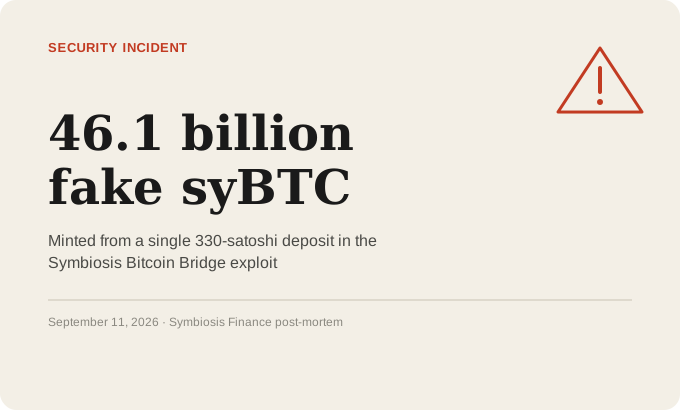
How Did a Hacker Create 46 Billion Fake Bitcoin in the Symbiosis Exploit? Decodes Bitcoin Hacker With WEEX Now
How two Symbiosis bridge bugs let a hacker mint 46.1 billion unbacked syBTC, drain Bitcoin pools and expose critical bridge risks.
[Interview] Lee Yun-ho, CEO of KIP: "We need to set the stage before the STO market opens... sharing RWA know-how with financial companies"
What is Fin.com? Understanding Cross-Border Payment Infrastructure via API

Uniswap (UNI) Price Jumps Toward $10 as CME Futures Launch Nears: What Traders Need to Know
Bernstein Research Report: Why Can Gold Still Surge to $5,700 Even with Continued Rate Hikes by the Fed?
Masayoshi Son is borrowing money again, betting billions on OpenAI

Hashed invests in $300 million digital-asset private credit fund
The IMF opens an office in Venezuela to supervise an economy that has already migrated to USDT

The Link Between Bitcoin and Stocks Strengthened by ETF Effects
Crypto firms still face full AML rules after CLARITY Act vote
Discord Cointribune: The New Crypto Hub of France?
Glassnode Indicates Shift Towards Altcoin Season

Serenity: AI Causes Valuation Mismatch, Changing Value Investment Logic
Bitcoin Pulls Back From $87,000| WEEX TradFi Daily Brief (September 24, 2026)
Bitcoin pulled back from about $87,000 to about $84,000, with Ethereum near $2,680. S&P Global PMI on September 23 ET far exceeded forecasts. The 10-year yield broke above 5.00%, while the 5-year and 30-year touched highs last seen in 2007 and 2004. The S&P 500 and Nasdaq slipped. Energy moved with oil and crypto-treasury stocks followed bitcoin lower. Investors await earnings from COST, BB, and others.
WEEX Exclusive:Bitcoin Pulls Back From $87,000| WEEX TradFi Daily Brief (September 24, 2026)
MIT Warns AI Bubble May Require 2.7x Productivity Increase by 2030
Davie Reveals BTC Strategy Data, Volume 205.42K, Rate +0.0016%
Stablecoins hold nearly $200 billion in US debt, but money funds bought the surge
Coin Metrics revises 19 months of Bitcoin ETF wallet data
Contents
Latest articles


Latest coin listings on WEEX


