
Dissecting Polymarket's Top 10 Whales' 27,000 Transactions: The Smart Money Mirage and the Law of Survival

Original Title: "In-Depth Analysis of Polymarket's Top 10 Whales' 27,000 Transactions: The Illusion of Smart Money's Win Rate and the Rule of Survival"
Original Author: Frank, PANews
Recently, the popularity of prediction markets has been steadily increasing, especially with smart money's arbitrage strategy being held in high regard. Many people have started to imitate and try, seemingly starting a new gold rush.
However, behind the popularity, how effective are these seemingly clever and reasonable strategies? How are they actually executed? PANews conducted an in-depth analysis of the 27,000 transactions of the top ten whales in profit ranking on Polymarket in December, exploring the truth behind their profits.
After the analysis, PANews found that although many of these "smart money" players executed hedging arbitrage strategies, this hedging is significantly different from the simple hedging interpreted on social media. The actual strategy is more complex, far from a simple "yes" or "no" combination, but rather utilizes rules like "spread" and "win/lose" in sports events to complete combination hedging. Another important finding is that behind the significantly high win rate based on historical positions, these whales have a large number of "zombie orders" still open but embellished to show results, with the actual win rate being far lower than the historical win rate.

Next, PANews will reveal the real operations of these "smart money" players through actual cases.
1. SeriouslySirius: A 73% Win Rate Embellished by "Zombie Orders," and a Complex Quantitative Hedging Network
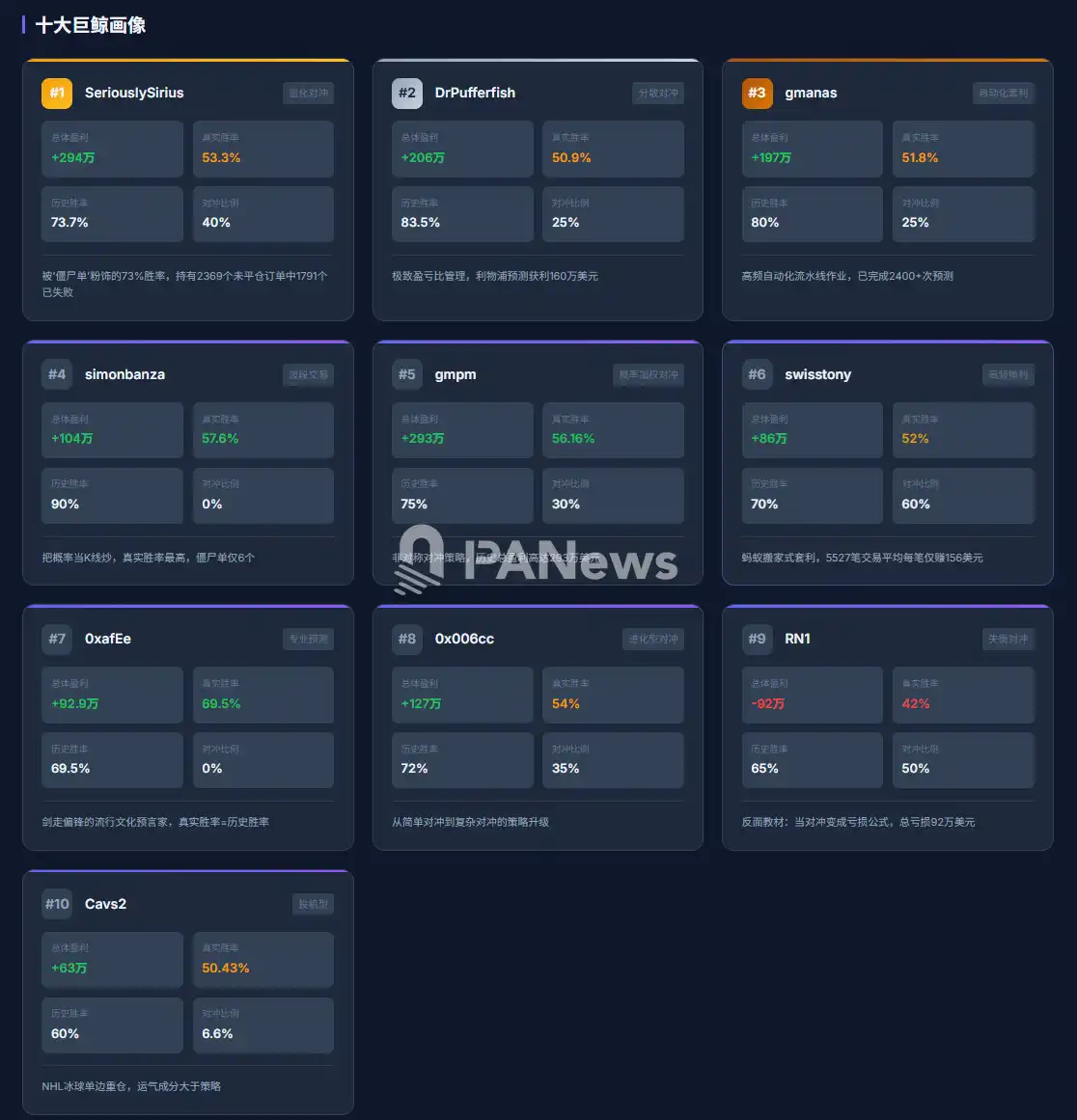
SeriouslySirius is the top-ranked address in December, with a profit of about $3.29 million in December and a total historical profit of $2.94 million. If only looking at his completed order records, his win rate is as high as 73.7%. However, the actual situation is that this address still has 2,369 open orders, with 4,690 orders settled. Among these, 1,791 of the open orders are actually complete failures, but the user has not closed them one by one. On the one hand, this can save a lot of effort and fees. On the other hand, since the orders he usually closes are profitable orders, the settled order data will show an extremely high win rate. However, if these uncleared "zombie orders" are considered, the actual win rate of this address drops to 53.3%, only slightly higher than randomly flipping a coin.
In his actual trades, about 40% of the orders are hedging orders betting on multiple directions for the same event. However, this hedging is not a simple "YES" + "NO." For example, in the NBA game between the 76ers and the Mavericks, he simultaneously bought Under (small spread), Over (large spread), 76ers (home team), Mavericks (away team), and 11 other directions, ultimately profiting $1,611. In this process, he did use an arbitrage strategy of insufficient probability, such as buying the 76ers' win probability at 56.8% and the Mavericks' at 39.37%, with a total cost of about 0.962, achieving a guaranteed profit state. In the end, in this game, he made $17,000 in profit.
However, this strategy is not always profitable. In a game between the Celtics and the Kings, for example, a total of 9 directions were involved, resulting in a loss of $2,900.
Furthermore, there was a significant imbalance in the allocation of funds for many orders. For instance, even though orders were placed in both directions, the difference in the amount of funds invested was more than 10x. This outcome was likely due to insufficient market liquidity, highlighting a key challenge in arbitrage strategies. While the opportunity may arise, executing balanced positions on both sides may not always be feasible.
Moreover, due to the automated execution, the buy and sell actions in such scenarios often lead to significant losses.
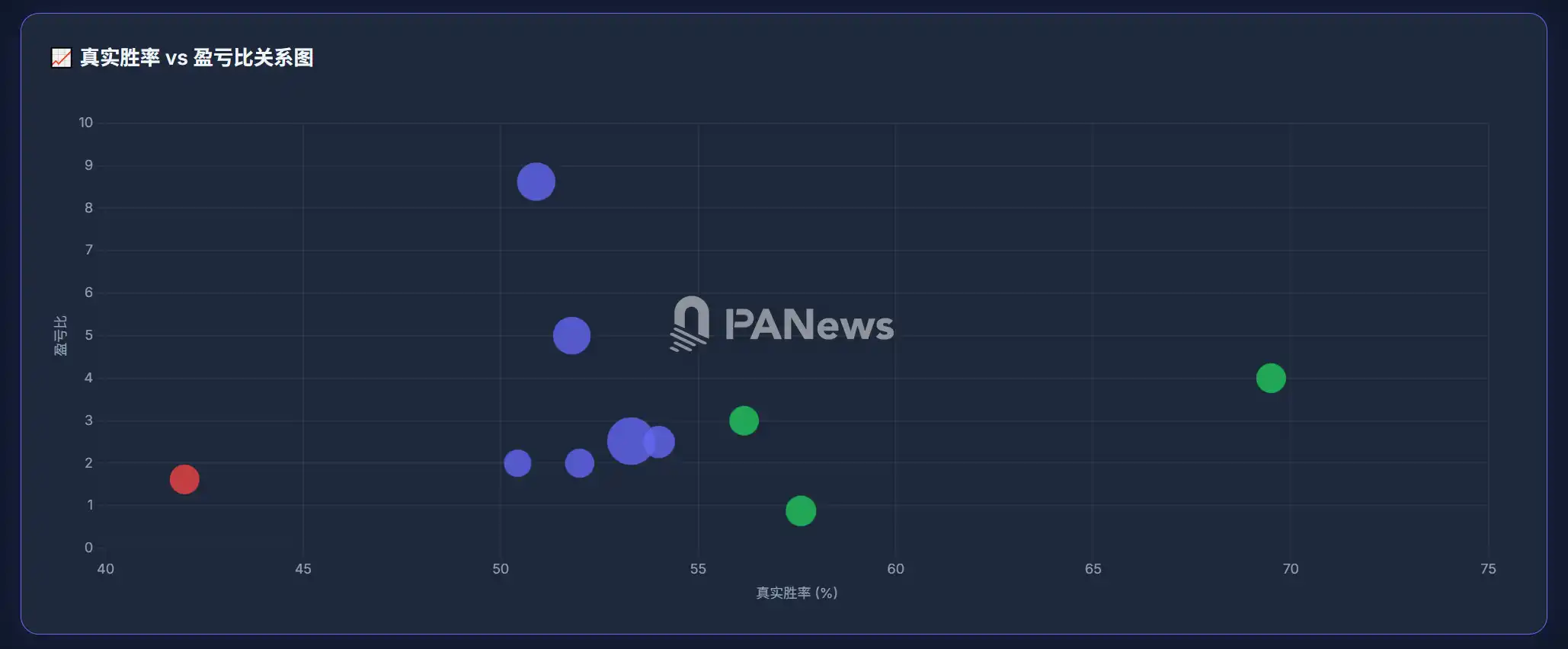
Nevertheless, the main reason SeriouslySirius was able to achieve substantial profits through this strategy was his sound position management, with a profit-to-loss ratio of about 2.52. This factor allowed him to realize profits despite a relatively low actual win rate.
Additionally, this strategy was not always profitable. Prior to December, the P&L of this address was not optimistic, remaining below the breakeven line for an extended period, with the maximum loss even reaching $1.8 million. The current maturity of the strategy raises questions about its ability to maintain such profit expectations in the long run.
2. DrPufferfish: Transforming Low Probability into High Probability, the Ultimate "Risk-Reward Ratio" Management Art
DrPufferfish was the second most profitable address in December, with a monthly profit of around $2.06 million. His historical win rate is even more impressive, reaching 83.5%. However, considering a large number of "zombie orders" in his portfolio, his win rate has returned to 50.9%. Yet, DrPufferfish's trading strategy differs significantly from SeriouslySirius's. While nearly 25% of his orders are hedging orders, this hedging is not in the opposite direction but rather through diversified bets. For instance, regarding the final championship of the MLB, he simultaneously bought into 27 low-probability teams, whose combined probability exceeded 54%. Through this strategy, he transformed a series of low-probability events into a high-probability event.
Furthermore, his ability to achieve substantial gains lies in his control of the risk-reward ratio. Taking Liverpool as an example (his favorite EPL team), he predicted the outcomes of this team 123 times, resulting in approximately $1.6 million in profits. Among the profitable predictions, the average gain was around $37,200, while the average loss from failed predictions was about $11,000. Additionally, he usually sells most of these losing orders early to manage position losses.
This operational approach also allowed his overall profit-loss ratio to reach 8.62, with a high profit expectation. However, overall, his strategy was not a simple arbitrage hedge, but rather a massive profit achieved through professional prediction analysis and strict position management. Another point is that most of his hedge trades were in a loss-making state, with the total P&L of these orders amounting to -$2.09 million. Therefore, it seems that the majority of this whale's hedge trades were used as a form of insurance.
3. gmanas: High-Frequency Automated Assembly Line Operation
The third-ranked address gmanas had a similar style to DrPufferfish and achieved an overall profit of $1.97 million in December. Their actual win rate of 51.8% was close to DrPufferfish's. However, their trading frequency was higher, with over 2400 predictions completed so far, indicating that their strategy is the result of automated program execution. Regarding their betting style, it is similar to the previous address, but we won't go into detail here.
4. Hunter simonbanza: Riding Prediction Probabilities like Candlestick Waves
The fourth-ranked address simonbanza is a professional prediction hunter. Unlike the previous addresses, his strategy contains no hedge orders, and he has achieved a profit of around $1.04 million, with a "zombie order" position loss of only $130,000. Compared to the previous addresses, although his fund size and trading volume are not high, his actual win rate is the highest at around 57.6%. Additionally, in settled orders, his average profit is around $32,000, and the average loss is $36,500. While the profit-loss ratio data is not high, with the high win rate, he ultimately achieved good returns.
Furthermore, this address has very few "zombie orders," only 6. This is because he usually does not wait for the event to end before settling but seizes the opportunity of probability fluctuations to profit. In simple terms, he takes profits when available and does not linger on the final outcome.
This is also a unique prediction market investment strategy. In his logic, these probability changes are more like the ups and downs of financial investment. Of course, we do not know the specific logic behind his high win rate; it is his exclusive survival secret.
5. Whale gmpm: Asymmetric Hedge Strategy, Using "Large Positions" to Seek Certainty
The fifth-ranked address, gmpm, while only fifth in December's profit-loss ranking, has a total historical profit higher than the previous addresses, reaching $2.93 million. Additionally, their actual win rate of about 56.16% is also at a high level. Their operational approach is similar to the fourth-ranked address, but the core strategy has its exclusive secret.
For example, you will see this address often placing both-sided bets on the same event. However, their strategy seems not to aim for arbitrage opportunities between these two directions but rather to allocate a higher amount of funds to the side with a greater probability and a smaller amount to the side with a lower probability. This way, they can have a larger position when a high-probability outcome wins, yet the potential loss isn't too high when a low-probability event occurs, achieving a hedging effect.
From a practical standpoint, this is a more advanced hedging strategy that does not solely rely on the mathematical arbitrage condition of "yes" + "no" < 1 but combines comprehensive event analysis with hedge loss mitigation.
6. Model Worker swisstony: "Ant Moving" High-Frequency Arbitrage
The sixth address, swisstony, is a super high-frequency arbitrage address and has the highest trading frequency among these addresses, with a total of 5527 transactions. Despite accumulating over $860,000 in profit, the average profit per transaction is only $156. Strategically, this address falls into the "Ant Moving" style. Similar to other arbitrage addresses, this address commonly buys all outcomes of a single event. For instance, in a Jazz vs. Clippers game, this address bought a total of 23 outcome directions. Due to the small investment amount, the fund allocation is relatively balanced, enabling a certain level of hedging effect.
However, this strategy seems to heavily rely on the details of the purchases, such as the requirement that "yes" + "no" must be less than 1. For some reason, the hedging orders made by swisstony often result in a total amount exceeding 1, leading to inevitable losses for these orders. Nevertheless, with reasonable risk-reward ratios and win rate data, the profitability situation remains positive.
7. Maverick 0xafEe: Unconventional "Pop Culture Prophet"
The seventh address, 0xafEe, is a truly low-frequency, high-winning-rate player. Their trading frequency is remarkably low, with an average of only 0.4 transactions per day, achieving a real win rate of 69.5%.
Through their completed orders, they have earned around $929,000 in profit with very few "zombie orders" and approximately $8,800 in unrealized losses. Moreover, they never engage in hedge orders but rather focus on predictions. Their predictions mainly revolve around Google search trends and pop culture-related content, such as "Will Pope Leo XIV become the most Googled person this year?" or "Will Gemini 3.0 be released before October 31?" In these prediction categories, they seem to have a unique analytical approach, resulting in an exceptionally high win rate. Among the top-ranking whales, they stand out as a "Maverick," being the only address outside of sports.
8. Manual Hedge Player 0x006cc: Strategy Upgrade from Simple Hedge to Complex Hedge
The eighth-ranked address 0x006cc is similar to several of the above-mentioned complex hedge addresses, with an overall net profit of approximately $1.27 million and a true win rate of around 54%. However, compared to other addresses executing automated programs, their trading frequency is very low, with an average of only 0.7 trades per day. Based on their early operations, this address may have initially adopted a "simple hedge strategy" through manual trading.
However, after entering December, this simple hedge strategy has also been upgraded to a complex hedge strategy. From their trading history, it can be observed that as the hedge strategy becomes more widely understood in this market, it is gradually evolving.
9. Case Study in What Not to Do RN1: When "Hedging" Turns into a "Loss Formula"
The ninth-ranked address RN1 is one of the top ten profitable addresses in December but currently represents an overall loss. Their realized profit is about $1.76 million, but their unrealized losses amount to $2.68 million, resulting in a total loss of $0.92 million. As a negative example, there are many aspects to consider in RN1's case.
Firstly, their true win rate is only 42%, which is the lowest among these addresses, with a profit-loss ratio of only 1.62. Considering these two data points together, their profit expectation is negative, indicating that this strategy is not profitable overall.
A closer look at their details reveals that this address is also clearly engaged in an arbitrage strategy. However, in many of their hedge trades, although the condition of "yes" + "no" <1 is met, they tend to allocate more to the side with the lower probability and less to the side with the higher probability. This imbalance in actual positions leads to real losses when events with higher probabilities occur.
10. Gambler Cavs2: Heavy Position on One Side in Ice Hockey Matches, Where Luck Outweighs Strategy
The tenth-ranked address Cavs2 is also a predictive gambler who enjoys taking a heavy position on one side, specializing in NHL ice hockey matches. However, from the overall data perspective, their total actual profit is approximately $0.63 million, with a true win rate of about 50.43% and a lower risk hedge ratio of 6.6%. The data is relatively average, with luck playing a significant role. They have successfully predicted the outcomes of several high-return individual matches, but the actual strategic value is not high.
5 Harsh Truths Behind the "Smart Money" Hype
After a deep dive into the transactions of this "smart money," PANews has summarized the reality behind the predictive market "wealth narrative."
1. The "Arbitrage Hedge Strategy" is far from simply achieving a probability condition. In a fiercely competitive market with liquidity constraints, it is highly likely to become a self-defeating loss formula. Blindly following and imitating is not advisable.
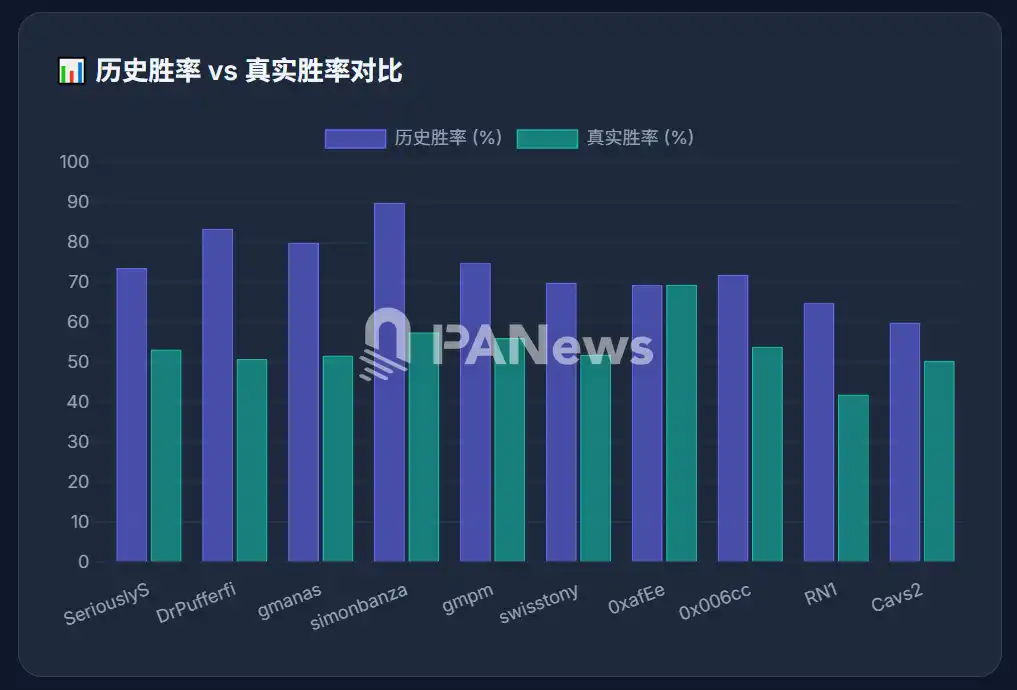
2. "Copy Trading" seems equally unsustainable in the predictive market. The main reasons include several points. First, the ranking or win rate seen is based on historical settled profit data, resulting in "distorted" data. Behind such data, a large amount of "smart money" is not as "smart" as it seems, with a real win rate of over 70% being extremely rare; most win rates are similar to flipping a coin. In addition, the trading depth in the predictive market is currently relatively poor, and the same arbitrage opportunities may only accommodate very small amounts of capital, leading to copy traders likely being squeezed out in this process.
3. Managing the risk-reward ratio and position size is more important than pursuing win rate. Among the addresses of several outstanding-performing strategies, they share a common characteristic of being very good at managing the risk-reward ratio. Even addresses like gmpm and DrPufferfish will exit positions promptly based on changes in probability trends to minimize losses and enhance the risk-reward ratio.
4. The real secret lies beyond the "mathematical formula." Currently, there are many interpretations of "arbitrage formulas" on social media. At first glance, these strategies seem very reasonable, but in actual operation, the true ability of this smart money seems to lie beyond these "mathematical formulas." Either they have a very strong judgment ability for certain events or they have a unique analysis model for popular culture. These invisible decision-making algorithms are the key to their success. For users without such "decision-making algorithms," the predictive market is also a ruthless "dark forest."
5. The profit scale of the predictive market is still quite small. Looking at the earnings of these top smart money players in December, the address with the highest total earnings has only around $3 million in current earnings. Compared to the crypto derivatives market, the profit potential of this market seems to have a clear limit. For those who entered with dreams of overnight riches, the scale of this market is clearly not large enough. In a market that is both unique in its professionalism and small in scale, it is probably not very attractive to institutions at the moment. I wonder if this is also a significant reason limiting the growth of the predictive market.

In the Polymarket, a seemingly gold-filled predictive market, most of the so-called "whale" players are merely surviving gamblers or hardworking day laborers. The true wealth code is not hidden in those overly optimistic win rate rankings but in the algorithms bet with real money by a few top players after eliminating noise.
You may also like

Bitcoin Market Analysis 2026: Can BTC Reach $150K by Year-End?

STRC unanchored by 11%, can the perpetual motion machine of Strategy still operate?

Bitcoin ETF Outflows Hit a Record $4.4 Billion: What Are Traders Doing With Their Cash?

WEEX App Just Got Smarter – New Tabs for Faster Trades & Easy Asset Management

Blockchain Capital Partner: The Core Secret of Arbitrage

WEEX All-New Search Features: Find, Trade & Earn Faster Than Ever

Will MicroStrategy fall into a death spiral? What will the macro trend be in the second half of the year?

Morning Report | Illinois signs the strictest digital asset tax law in the U.S.; RWA tokenization market size surpasses $43 billion, institutions accelerate the migration of on-chain assets

Full version of the debut Q&A! Federal Reserve Chairman Waller: Sticking to the 2% inflation target, establishing five special working groups, individual did not submit the dot plot

From Disruptor to Shadow Market: The Crypto Market is Becoming a Colony of Traditional Finance
Dalio's important long article: How to position in the current market environment?

OKX Star analyzes Binance's competitive advantages: when regulation levels the playing field, competition has just begun

New gameplay for participating in initial offerings on cryptocurrency exchanges
Why Is Bitcoin Down Today? What the Hawkish FOMC Means for SpaceX, Gold and Nasdaq

DeepSeek Financing Story

Morning Report | DeepSeek completes over $7 billion in financing, with a valuation exceeding $50 billion; Musk's personal wealth has surpassed the total market value of Bitcoin
Cursor, why did you get on Musk's spaceship?
In the name of charity, for the benefit of the family: How the Trump family turned charity into profit?
Bitcoin Market Analysis 2026: Can BTC Reach $150K by Year-End?
STRC unanchored by 11%, can the perpetual motion machine of Strategy still operate?
Bitcoin ETF Outflows Hit a Record $4.4 Billion: What Are Traders Doing With Their Cash?
WEEX App Just Got Smarter – New Tabs for Faster Trades & Easy Asset Management
Blockchain Capital Partner: The Core Secret of Arbitrage
WEEX All-New Search Features: Find, Trade & Earn Faster Than Ever

Popular coins
Latest Crypto News


