
 Buy Crypto
- Markets
 Futures
- Spot
- Copy Trade
- Earn
- More
Doubling in a single day won't make up for a 98% crash - Did Parcl's 'Polymarket Story' Hold Up?

Original Title: "Hard to Conceal 98% Plummet Even with Daily Doubling, Polymarket Won't Be Parcl's Lifesaver"
Original Author: Sanqing, Foresight News
On January 5th, the real estate RWA protocol Parcl partnered with the prediction market giant Polymarket. This collaboration will introduce Parcl's daily house price index to Polymarket's newly launched real estate prediction market series. The two parties will introduce prediction products centered around the housing market, with settlement based on Parcl's published house price index.
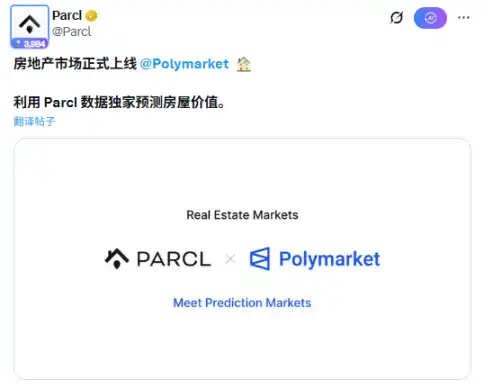
Image - Parcl Twitter Announcement of Partnership with Polymarket (Translated)
Polymarket will be responsible for listing and operating the market, while Parcl will provide independent index data. Encouraged by this news, the PRCL token showed strong performance on the day. According to Bitget's market data, PRCL reached a daily high of 0.05217 USDT, marking a 94.21% daily increase, with an intraday peak increase of approximately 138%.
The Lingering "Airdrop Fiasco"
For many long-time users, the name Parcl is associated with "betrayal." Despite the project team stating in their technical papers that their mission was to "break the asymmetry of real estate data and empower users," the token issuance in April 2024 became a turning point in community trust.
After a long-running point system activity, PRCL opened below the listing price, and in the following days, over $120 million was withdrawn from the protocol, leading to a TVL drop of over 60%.
Over time, Parcl's token performance has been significantly disconnected from its narrative, with the PRCL token price falling below $0.02 by the end of 2025, a drop of approximately 97.6% from the April 2024 peak of $0.737.
Now, it is attempting to "whitewash" its identity through a partnership with Polymarket, rebranding itself as a high-quality real estate data platform and oracle.
Is the Daily Updated House Price Index Genuine?
Parcl's selling point is its House Price Index published by Parcl Labs, providing "daily updated" city-level house price data. In its whitepaper, Parcl claims that its data has a high correlation of 0.98 with the traditional Case-Shiller index.
Lack of Transparency in Data Source. The team emphasizes a 24/7 operational data retrieval process to maintain a high-quality, real-time real estate data ecosystem. However, the specific details of original data providers and weighting are not disclosed in the documentation.
Reliance of Data Source on Listing Information. Parcl's real-time nature relies heavily on active listing information rather than just sales transactions.
Listed prices often reflect seller optimism, usually higher than the actual transaction price. This data structure may cause the index to appear more aggressive during market upswings or exhibit larger fluctuations during volatile periods.
Lack of Independent Validation and Institutional Endorsement. While Parcl has outlier filtering mechanisms (such as sampling only the 35th to 65th percentiles), the daily update mechanism is heavily reliant on real-time input of massive amounts of data.
Compared to widely referenced indices like the Case-Shiller Index used by institutions such as the Federal Reserve, Parcl currently relies mainly on self-attestation and endorsements from partners.
Low Transaction Activity
Internal Platform Data: Based on the platform's records over the past six months, only a few markets have transaction volumes in the millions: namely Austin (12.95M), Chicago (3.85M), Miami Beach (2.94M), and Brooklyn (2.2M).
However, most markets have holdings below ten thousand dollars, with only a few maintaining levels in the hundreds of thousands, such as Austin at 321K, Brooklyn at 360K, and Chicago peaking at around 950K.
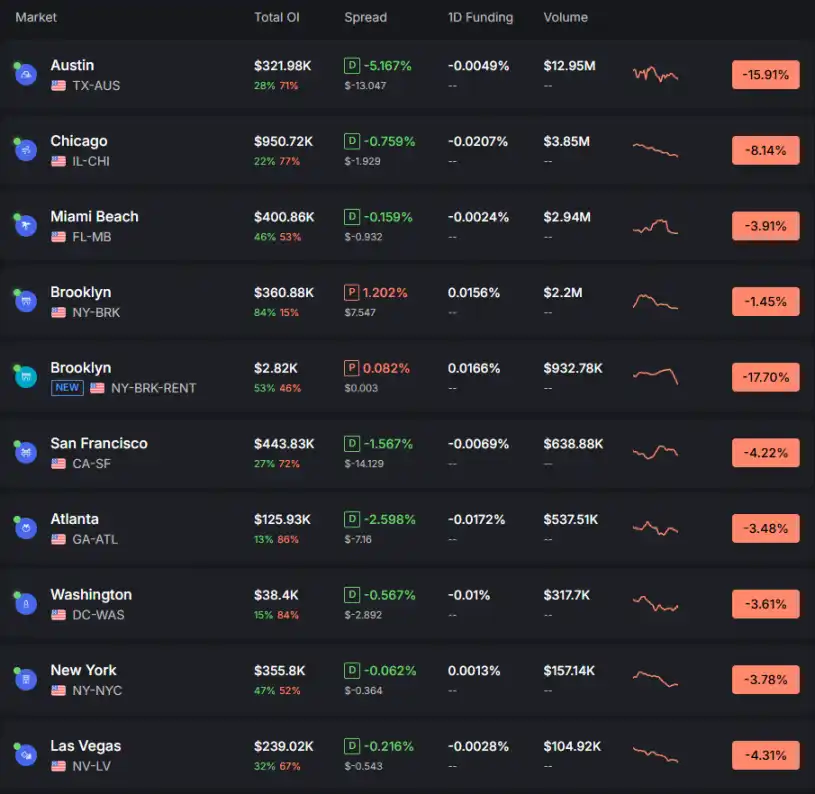
Figure - Top 10 Markets by Transaction Volume in the Past Six Months on Parcl
Polymarket Market Performance: Polymarket has currently launched six real estate prediction markets, including Los Angeles, San Francisco, Austin, Miami, New York, and a nationwide U.S. market.
Despite leveraging Polymarket's significant platform traffic, actual engagement is very low. The market with the highest volume currently is San Francisco, with a transaction volume of only about 11K at the time of writing, while other market transactions are even quieter.
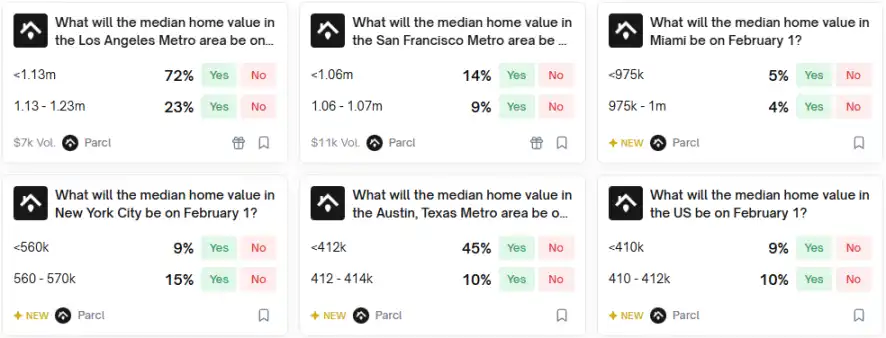
Figure - Polymarket Real Estate Prediction Market
The Regulatory Minefield of the "Dangerous Game"
While the collaboration aims to enhance the transparency of prediction markets, products tied to real estate indices are bound to play a "dangerous game" on thin ice.
Due to the nature of such products as event contracts, Polymarket, upon re-entering the U.S. market, must strictly adhere to CFTC compliance requirements regarding consumer protection and market integrity.
These markets transform housing price fluctuations into bettable agreements, a nature that regulatory bodies like the CFTC may easily deem as unlicensed binary options or financial derivatives.
Given the societal sensitivity of real estate data, the impact of such markets on the pricing power of actual housing prices may become one of the factors policy-makers consider when assessing the need for regulatory intervention. The real-time nature of real estate data may also involve compliance with state privacy or data protection regulations.
Furthermore, the proposed "Public Trust Act for the 2026 Financial Prediction Market" sets higher transparency requirements for the market. As real estate price indices are highly correlated with interest rate adjustments, housing regulations, and other policy changes, the platform would face institutional pressures to prevent insider trading and conflicts of interest.
Additionally, the operational fairness of the Polymarket real estate prediction market inherently depends on the verifiability of the Parcl index. Based on the CFTC's guidelines for event contracts, settlement rules must have an independent verification mechanism to mitigate the risk of data manipulation.
You may also like

Cyber Taoist Fortune Teller: Fake Taoist, AI Fortune Telling, and Northeastern Metaphysics History

Bloomberg: Stablecoin Payments Emerge as Crypto VC's Newest Favorite Thing
BeatSwap is evolving towards a full-stack Web3 infrastructure, covering the entire lifecycle of IP rights.
BeatSwap, a global Web3 Intellectual Property (IP) infrastructure project, is attempting to overcome the current fragmentation limitations of the Web3 ecosystem, building a full-stack system that covers the entire lifecycle of IP rights.
Currently, most Web3 projects are still in the stage of functional fragmentation, often focusing only on a single aspect, such as IP asset tokenization, transaction functionality, or a simple incentive model. This structural dispersion has become a key bottleneck hindering the industry's scale application.
BeatSwap's approach is more integrated, integrating multiple core modules into the same system, including:
· IP authentication and on-chain registration
· Authorization-based revenue sharing mechanism
· User-engagement-driven incentive system
· Transaction and liquidity infrastructure
Through the above integration, the platform builds an end-to-end closed-loop path, allowing IP rights to complete a full cycle of "creation, use, and monetization" within the same ecosystem.
BeatSwap is not limited to existing crypto users but is attempting to take the global music industry as a starting point, actively creating new market demand. Its core strategies include:
Exploring and incubating music creators (Artist discovery)
Building a fan community
Igniting IP-centric content consumption demand
The current global music industry is valued at around $260 billion, with over 2 billion digital music users. This means that the potential market corresponding to the tokenization and financialization of IP far exceeds the traditional crypto user base.
In this context, BeatSwap positions itself at the intersection of "real-world content demand" and "on-chain infrastructure," attempting to bridge the structural gap between content production and financial flow.
BeatSwap's upcoming core product "Space" is scheduled to launch in the second quarter of 2026. This product is defined as the SocialFi layer in the ecosystem, aiming to directly connect creators with users and achieve deep integration with other platform modules.
Key designs include:
A fan-centric interactive mechanism
Exposure and distribution logic based on $BTX staking
User paths connected to DeFi and liquidity structures
Thus, a complete user behavior loop is formed within the platform: Discovery → Participation → Consumption → Rewards → Trading
$BTX is designed to be a core utility asset within the ecosystem, rather than just a simple incentive token, with its value directly tied to platform activity and IP use cases.
Main features include:
· Yield distribution based on on-chain authorized actions
· Value reflection based on IP usage and user engagement dynamics
· Support for staking and DeFi participation mechanisms
· Value growth driven by ecosystem expansion
With the increased frequency of IP use, the utility and value support of $BTX will enhance simultaneously, helping alleviate the "disconnect between value and utility" issue present in traditional Web3 token models to some extent.
Currently, $BTX has been listed on several mainstream exchanges, including:
Binance Alpha
Gate
MEXC
OKX Boost
As the launch of "Space" approaches, BeatSwap is actively pursuing more exchange listings to further enhance liquidity and global accessibility, laying a foundation for future market expansion.
BeatSwap's goal is no longer limited to the traditional Web3 narrative but aims to target over 2 billion digital music users and a trillion KRW-scale content market.
By integrating content creators, users, capital, and liquidity into a blockchain framework centered around IP rights, BeatSwap is striving to build a next-generation infrastructure focused on "IP tokenization."
BeatSwap integrates IP authentication, authorization distribution, incentive mechanism, transaction system, and market construction to establish a unified structure that bridges the full lifecycle path of IP rights.
With the launch of the Q2 2026 "Space," the project is expected to become a key infrastructure connecting content and finance in the IP-RWA (Real World Assets) track.

Mag 7 Evaporates $2 Trillion | Rewire News Morning Edition

Losing $19K per Coin Mined, Bitcoin Mining Firms Collective AI Defection

Morning Report | Tom Lee predicts that the cryptocurrency winter will end in April; xStocks introduces a new on-chain private equity fund; Sui mainnet upgraded to V1.68.1

Polymarket rules have changed, how should airdrop participants respond?

Crypto ETF Weekly | Last week, the net outflow of Bitcoin spot ETFs in the U.S. was $296 million; the net outflow of Ethereum spot ETFs in the U.S. was $206 million

This Week's Key News Preview | The U.S. Releases March Non-Farm Payroll Data; Polymarket Expands Fee Structure

Slow Down, That's the Answer to the Age of the Agent

From Cash to Cryptocurrency: Moving Towards a Unified Regulatory Path for Illegal Payments
Who will own the most Bitcoin in 2026

A private feud lasting 10 years, if not for OpenAI's "hypocrisy," would not have led to the world's strongest AI company, Anthropic

"Crypto Tsar" steps down: 130 days of political performance come to an end, how much of Trump's crypto promise remains?

From Utopian Narratives to Financial Infrastructure: The "Disenchantment" and Shift of Crypto VC
A decade-long personal feud, if not for OpenAI's "hypocrisy," there would be no globally leading AI company Anthropic

a16z: The True Meaning of Strong Chain Quality, Block Space Should Not Be Monopolized
a16z: The True Meaning of Strong Chain Quality, Block Space Should Not Be Monopolized
Cyber Taoist Fortune Teller: Fake Taoist, AI Fortune Telling, and Northeastern Metaphysics History
Bloomberg: Stablecoin Payments Emerge as Crypto VC's Newest Favorite Thing
BeatSwap is evolving towards a full-stack Web3 infrastructure, covering the entire lifecycle of IP rights.
BeatSwap, a global Web3 Intellectual Property (IP) infrastructure project, is attempting to overcome the current fragmentation limitations of the Web3 ecosystem, building a full-stack system that covers the entire lifecycle of IP rights.
Currently, most Web3 projects are still in the stage of functional fragmentation, often focusing only on a single aspect, such as IP asset tokenization, transaction functionality, or a simple incentive model. This structural dispersion has become a key bottleneck hindering the industry's scale application.
BeatSwap's approach is more integrated, integrating multiple core modules into the same system, including:
· IP authentication and on-chain registration
· Authorization-based revenue sharing mechanism
· User-engagement-driven incentive system
· Transaction and liquidity infrastructure
Through the above integration, the platform builds an end-to-end closed-loop path, allowing IP rights to complete a full cycle of "creation, use, and monetization" within the same ecosystem.
BeatSwap is not limited to existing crypto users but is attempting to take the global music industry as a starting point, actively creating new market demand. Its core strategies include:
Exploring and incubating music creators (Artist discovery)
Building a fan community
Igniting IP-centric content consumption demand
The current global music industry is valued at around $260 billion, with over 2 billion digital music users. This means that the potential market corresponding to the tokenization and financialization of IP far exceeds the traditional crypto user base.
In this context, BeatSwap positions itself at the intersection of "real-world content demand" and "on-chain infrastructure," attempting to bridge the structural gap between content production and financial flow.
BeatSwap's upcoming core product "Space" is scheduled to launch in the second quarter of 2026. This product is defined as the SocialFi layer in the ecosystem, aiming to directly connect creators with users and achieve deep integration with other platform modules.
Key designs include:
A fan-centric interactive mechanism
Exposure and distribution logic based on $BTX staking
User paths connected to DeFi and liquidity structures
Thus, a complete user behavior loop is formed within the platform: Discovery → Participation → Consumption → Rewards → Trading
$BTX is designed to be a core utility asset within the ecosystem, rather than just a simple incentive token, with its value directly tied to platform activity and IP use cases.
Main features include:
· Yield distribution based on on-chain authorized actions
· Value reflection based on IP usage and user engagement dynamics
· Support for staking and DeFi participation mechanisms
· Value growth driven by ecosystem expansion
With the increased frequency of IP use, the utility and value support of $BTX will enhance simultaneously, helping alleviate the "disconnect between value and utility" issue present in traditional Web3 token models to some extent.
Currently, $BTX has been listed on several mainstream exchanges, including:
Binance Alpha
Gate
MEXC
OKX Boost
As the launch of "Space" approaches, BeatSwap is actively pursuing more exchange listings to further enhance liquidity and global accessibility, laying a foundation for future market expansion.
BeatSwap's goal is no longer limited to the traditional Web3 narrative but aims to target over 2 billion digital music users and a trillion KRW-scale content market.
By integrating content creators, users, capital, and liquidity into a blockchain framework centered around IP rights, BeatSwap is striving to build a next-generation infrastructure focused on "IP tokenization."
BeatSwap integrates IP authentication, authorization distribution, incentive mechanism, transaction system, and market construction to establish a unified structure that bridges the full lifecycle path of IP rights.
With the launch of the Q2 2026 "Space," the project is expected to become a key infrastructure connecting content and finance in the IP-RWA (Real World Assets) track.


 App
App