
Ethereum in a Bull Market: An Undervalued Blue Chip or a Slowing Giant?



Original Article Title: "Ethereum in a Bull Market: Undervalued Blue Chip or Slow-moving Giant?"
Original Article Author: Frank, PANews
As the bull market transitions into alt season, time seems to be running out for ETH. Since the beginning of this bull cycle in late 2023, ETH's performance has been closely watched. However, it seems that ETH has somewhat underperformed over the past year. Most notably, in terms of price appreciation, from October 2023 to the present, the maximum increase has been 170%, struggling to break through the $4000 mark significantly. On the other hand, during the same period, BTC saw a maximum increase of over 300%, and SOL's surge exceeded 1300%. Many believed that ETH represented an opportunity in the alt season, but with several older altcoins experiencing significant short-term gains recently, ETH's momentum appears to be lacking.
As the flagship public blockchain, is Ethereum objectively undervalued by the market or is it performing as expected? Though old, is it still able to deliver?
On-chain Data Stagnant for a Year
From on-chain data, PANews can clearly observe that Ethereum has not experienced significant growth over the past year, showing a lack of decline but not much growth either.
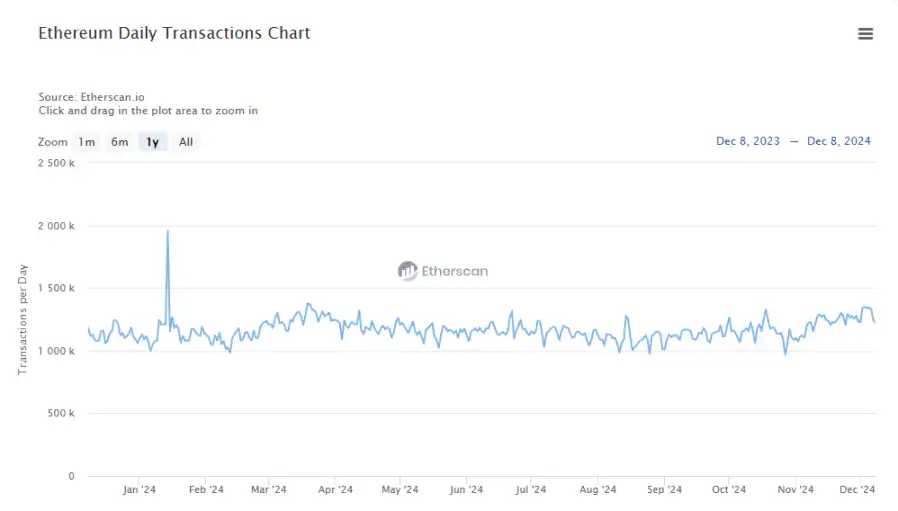
The daily transaction count is a crucial indicator of activity. Looking at the Ethereum daily transaction count chart over the past year resembles an ECG graph, showing stable but slightly fluctuating activity. On December 8, 2023, the total transaction volume on the Ethereum mainnet was 1.18 million transactions, and after a year, on December 8, 2024, this figure was 1.22 million transactions, nearly unchanged. During this year, only in January 2024 did it briefly spike to 1.96 million transactions. The rest of the time, it remained between 1 million and 1.3 million transactions.
The trend of Gas fees more vividly reflects on-chain activity. At the end of 2023 and the beginning of 2024, Ethereum's Gas fees were still relatively high, averaging above 40 Gwei and reaching around 100 Gwei at peak times. With the rise of new public chains like Solana, one can clearly see the reduction in Ethereum's Gas fees on the chart, especially in July to September, dropping to as low as 0.3 Gwei. Even with a recent rebound, it mostly hovers below 20 Gwei. Initially, the Layer 2 solutions surged mainly due to Ethereum's high Gas fees. Now, Ethereum's Gas fees have finally come down, but it seems users have disappeared. Or rather, as users leave, Ethereum truly lowers its fees.
As for active addresses, it also follows a curve pattern similar to the daily average transaction signing. According to data from the Ethereum browser, the daily active Ethereum address count and ERC20 address count have not seen significant growth, and the data level remains similar to the period before the bull market started.
User Flow to L2, Funds Stay on L1
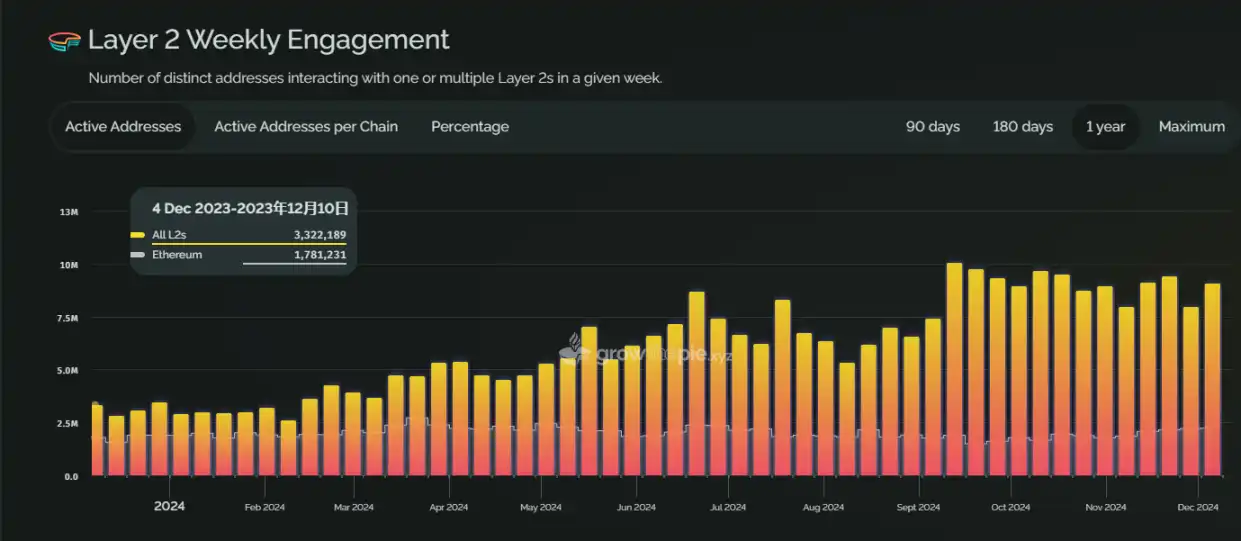
Where did Ethereum's users specifically go? Looking at the weekly on-chain activity data from a year ago, the on-chain active address count of Ethereum accounted for approximately 50% of all Layer2. However, as time has passed, up to the current data, we can see that the active address count on Layer2 is generally on the rise, while the proportion of active addresses on the Ethereum mainnet is around 24% of the overall Layer2.
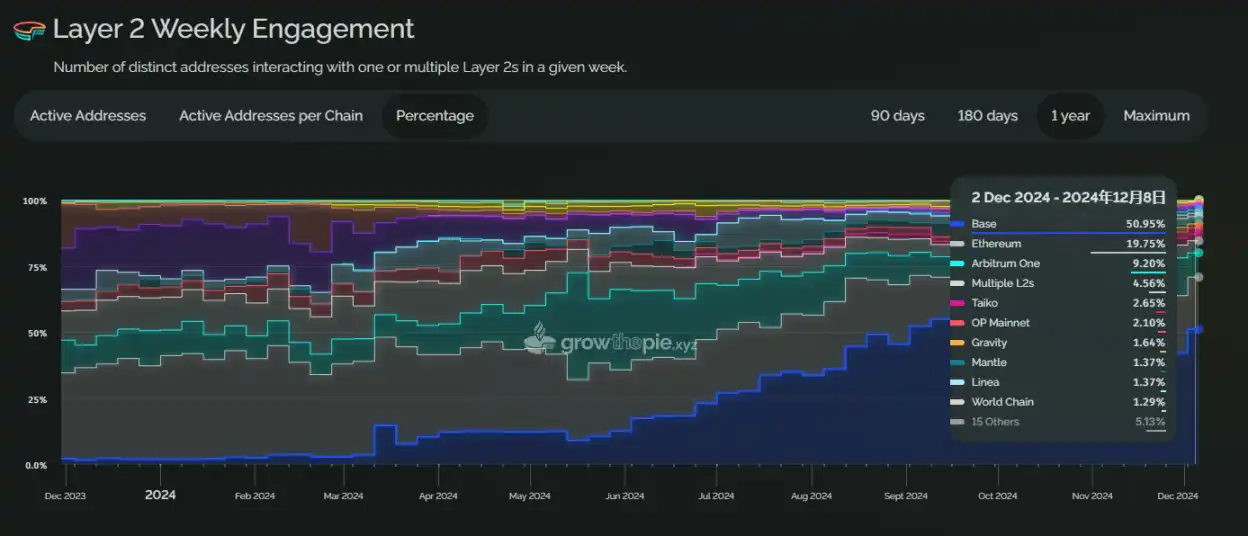
Looking at the performance of each chain separately, in December 2023, the Ethereum mainnet had the highest activity rate, accounting for about 32.48%. By December 2024, the most active chain had changed to Base, with a share rising to 50%, Ethereum mainnet in second place at 19%, and Arbitrum in third at 9.2%.
However, in Total Value Locked (TVL), the Ethereum mainnet still appears to be the first choice for whales. Looking at the total amount of stablecoins locked on-chain, the proportion on the Ethereum mainnet was around 95% in December of last year, slightly down now but still around 91%. Moreover, TVL data has almost been the only data showing a significant increase on the Ethereum mainnet over the past year. In December 2023, the TVL on the Ethereum mainnet was about $28.8 billion, and by December 2024, this data had risen to around $77.5 billion. The growth rate is about 2.69 times, surpassing the growth rate of Ethereum's price. This growth is also related to the price surge during the bull market. In Layer2, Arbitrum and Base are second and third, respectively, in stablecoin TVL.

In terms of revenue, the Ethereum mainnet is also the most profitable chain within the Ethereum ecosystem. Over the past year, Ethereum's revenue share has consistently remained above 80%, reaching 92% as of December 8. Base Chain has become the second-highest revenue-generating chain in the Ethereum ecosystem this year.
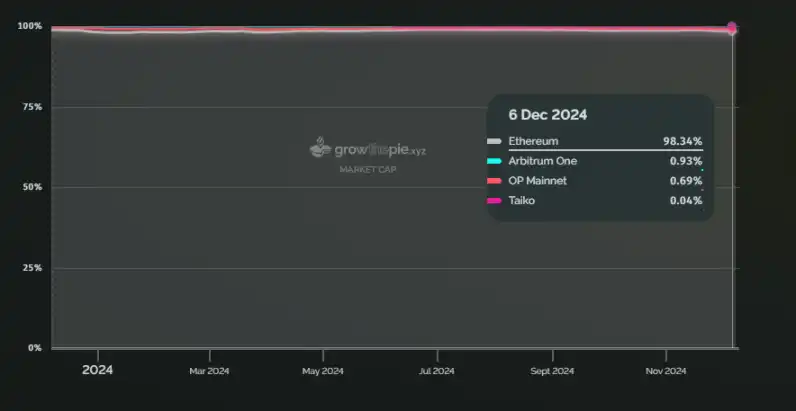
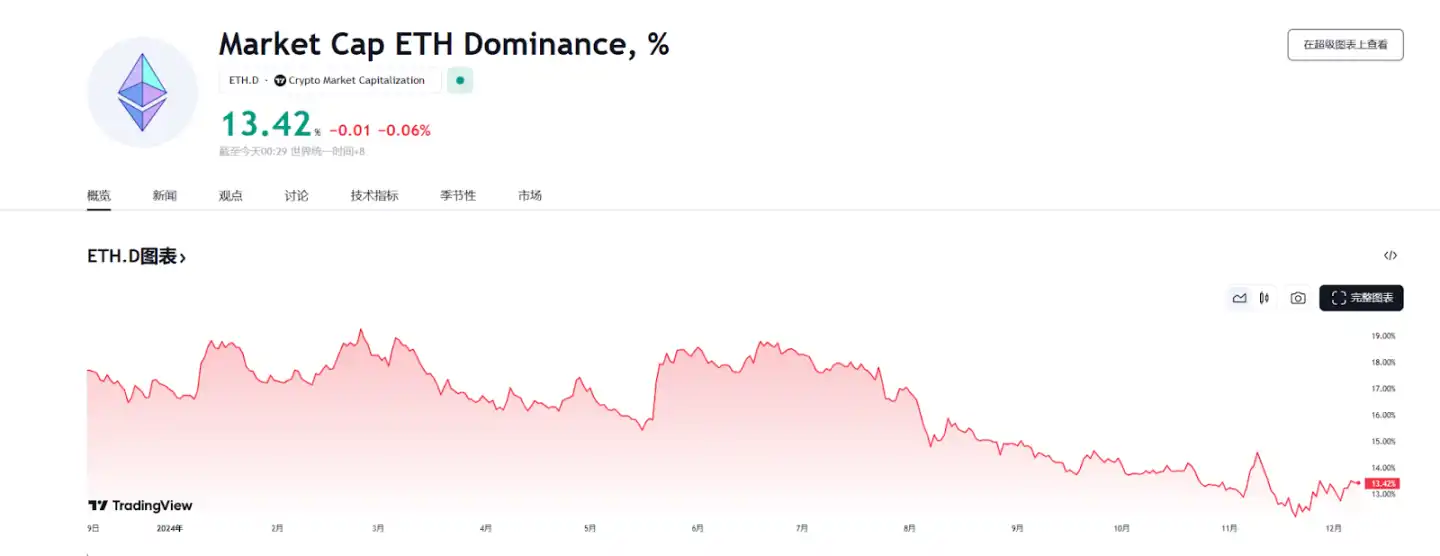
Ethereum's market capitalization has also remained at around 98%, despite a decrease in on-chain activity. The market cap proportion seems to be generally consistent with the TVL proportion. Additionally, looking at the entire crypto market share, Ethereum's market cap proportion has indeed been continuously decreasing over the past year, currently standing at around 13.4%.
However, considering the growth of TVL, most large funds still choose to keep their funds on the Ethereum mainnet. Comparing the ratio of total TVL to active user count, Ethereum's mainnet has a value of $178,700, Base is around $3,315, and Solana is around $1,972. From this perspective, Ethereum still maintains the highest value per user across the entire network.
Uniswap Exodus Could Spell Greater Concern
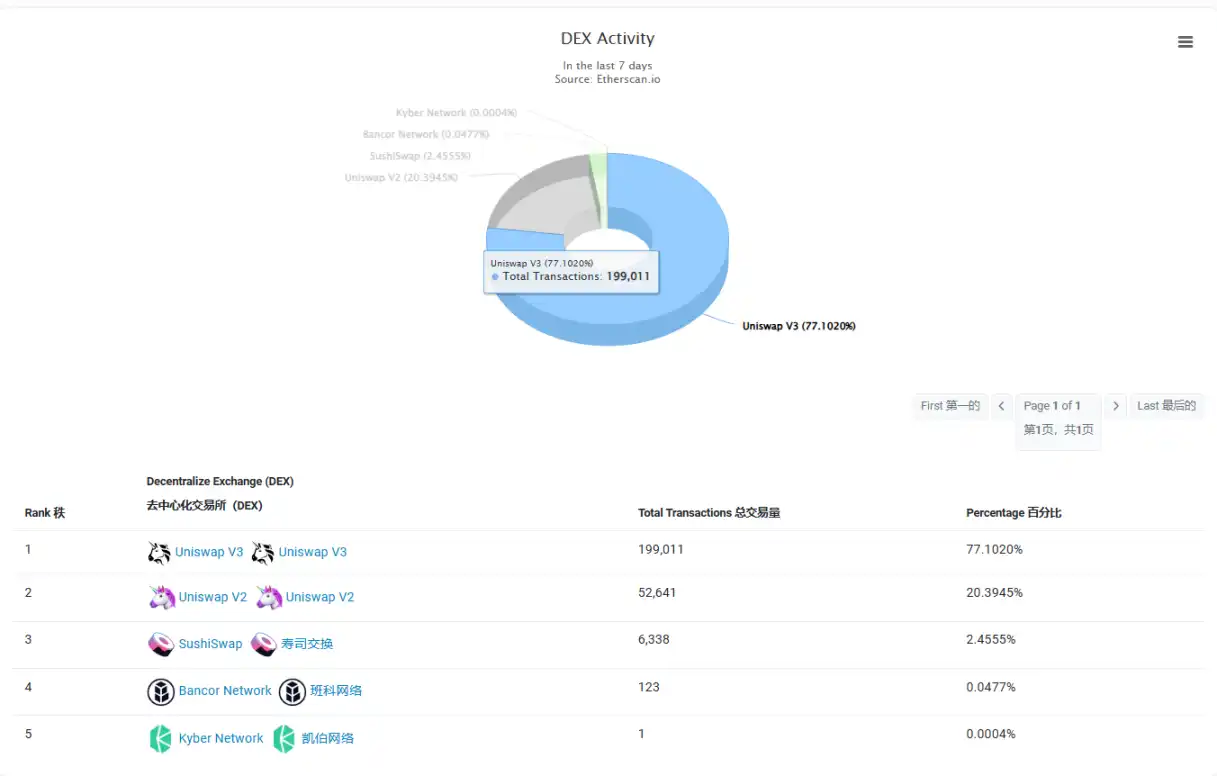
From various data points, Uniswap is currently the undisputed largest application on Ethereum. In terms of DEX activity, Uniswap V2 and V3 together account for over 97% of the transaction volume on the Ethereum mainnet. On Ethereum's burn leaderboard, Uniswap has also consistently held the top position. As of December 9, in the past 30 days, Uniswap burned a total of 6,372 Ether, while Ethereum transfers only burned 4,594 Ether.
Once Uniswap shifts most of its trading activity to its self-built Unichain, Ethereum mainnet's activity and burn count may drop significantly. According to Forbes, as Uniswap transitions to its own chain, Ethereum network validators could lose an estimated $400 million to $500 million in annual revenue. However, more concerning than this economic loss is the threat to Ethereum's fundamental narrative as a deflationary currency. Uniswap's general router is the largest gas fee consumer, accounting for 14.5% of Ethereum's gas fees, equivalent to burning $1.6 billion worth of Ether.
Summarizing the performance of the above indicators, we can draw some key conclusions. Ethereum mainnet's on-chain network activity has not grown in the past year and its share within the entire Ethereum ecosystem is gradually declining. At least, this suggests that new users are mostly opting for other Layer 2 solutions or other blockchains (after all, emerging blockchains like Solana, Sui, Aptos, etc., are showing rapid growth in these metrics).
Therefore, circling back to the initial topic, has Ethereum's fundamental changed significantly? Or is ETH undervalued? Considering the data above, Ethereum mainnet seems to be transforming into a reservoir for whales and institutional funds. Even with a significant decrease in gas fees, Ethereum Mainnet still cannot compete with Layer 2 or other blockchains in terms of transaction fees and speed. Thus, Ethereum mainnet is clearly no longer just a retail investor club and does not have a community size advantage in the current popular MEME and other trends. It is more suited for players with lower frequency requirements and higher asset security demands. From this perspective, we can only say that Ethereum mainnet's ecosystem role is undergoing a transformation, with liquidity and security becoming Ethereum mainnet's final moat.
You may also like

Meet the new WEEX trial fund—your gateway to greater profits

WEEX Labs Lands at Dutch Blockchain Week: A Disruptive Crypto × AI Conversation Sets Sail in Amsterdam

SK Hynix Reportedly Plans U.S. ADR Listing as Early as August, With SEC Approval Possible in Late June
SK Hynix may pursue a U.S. ADR listing as early as August, with SEC approval reportedly possible in late June amid strong AI chip supply chain demand.

SpaceX vs Tesla vs xAI: Which Elon Musk Trade Has the Biggest Upside in 2026?
OpenAI Reveals It Has Confidentially Submitted an S-1 to the SEC, Keeping the Door Open for a Future IPO
On June 9, according to an OpenAI announcement, the company recently confidentially submitted a draft S-1 registration statement to the U.S. Securities and Exchange Commission (SEC), beginning the preliminary compliance process for a potential initial public offering. OpenAI said it chose to disclose this proactively because it expected the news might leak; however, the company has not yet set a specific listing timeline, and related arrangements may still take some time.

Latest research from 13 top universities including Cornell University: The current state, challenges, and misconceptions of the fusion of Crypto and AI
Deconstructing Anthropic: The Best AI Company, Possibly Also a Type of Organizational Invention
Apollo and Blackstone Reportedly Back $35 Billion Anthropic Chip Financing as Deal Details Remain Unclear
On June 9, according to currently available news alerts, Apollo and Blackstone Group participated in a $35 billion financing for an Anthropic “chip project.” Based on the original wording of the report, the funding has already been raised, but public information remains limited. The financing structure, use of proceeds, project entity, and whether Apollo and Blackstone participated through equity, debt, or project financing have not yet been disclosed.

Humanity Protocol Security Incident Escalates: More Than $31 Million Stolen From Related Addresses as Attacker Continues Selling H for ETH
On June 9, according to monitoring by Onchain Lens, more than $31 million has been stolen from addresses linked to Humanity Protocol, and the attack is still ongoing, with the hacker continuously swapping H tokens for ETH. Project founder Terence Kwok later confirmed the security incident on X, saying the issue involved a private key leak.

Bloomberg: As Bitcoin Weakens, Stablecoins and RWA Continue to Drive Expansion in Crypto Businesses
In June, Bloomberg reported that despite Bitcoin falling below $60,000 last week, wiping out about $235 billion in market value within seven days, and dropping close to 50% from last year’s peak, some core businesses in the crypto industry are still expanding, mainly in stablecoins, real-world asset tokenization (RWA), payments, and infrastructure. The report also noted that overall altcoin activity has contracted significantly: altcoin market capitalization has fallen from a peak of about $431 billion in November 2021 to around $170 billion, and among the tens of millions of tokens issued in recent years, fewer than 1,700 still maintain meaningful trading activity.

Galaxy Deep Research Report: How Hyperliquid's HIP-4 Upgrade Changes the Landscape of Prediction Markets?
Binance Research: RWA Market Expected to Expand Nearly 6x from Early 2025, with Public Equities and Onchain Payments Heating Up Together
In June, Binance Research said in its monthly market report that the real-world asset (RWA) market is expected to grow by about 589% from the beginning of 2025. Bond- and money market fund-related RWA expanded by about $6.5 billion, up 83% year over year, while publicly traded equity RWAs grew by about 422%. The report also noted that monthly crypto debit card transaction volume exceeded $747 million in May, up 48.6% year to date.

Japan to Assess a Framework for Yen Stablecoins and Crypto ETFs as Asia’s Compliant Payments Narrative Heats Up
Recently, according to the original report, Japan is considering the launch of yen stablecoins and cryptocurrency ETFs. Public information remains limited at this stage, and there is still no complete policy text, regulatory draft, or clear implementation timeline, so this is better characterized as a “policy discussion” rather than formal implementation. The original wording also noted that advancing stablecoin regulation in Asia is driving XRP usage and supporting growth in the XRPL ecosystem. However, based on currently available public information, there is not enough evidence to directly establish a clear causal relationship between this round of discussion in Japan and XRP or XRPL.

ZachXBT: Humanity private key leak and abnormal surge in H token should be viewed separately
On June 9, according to related disclosures, on-chain investigator ZachXBT posted an update on Humanity’s roughly $31 million security incident, saying that after further analyzing fund flows, he currently tends to believe the project team was not involved in an “inside job” or a self-staged attack. According to him, the official explanation about the private key leak was broadly accurate, but before the token unlock, the price of H had been artificially pushed higher, and the hacker later took advantage of that market environment; therefore, the private key leak and the earlier abnormal price pumping should be regarded as two separate and independent events. This reframing has shifted the market’s understanding of the nature of the incident. Earlier discussion around Humanity had focused on whether the team directly participated in the attack or used the security incident to cover up internal operations. ZachXBT’s latest remarks shift the focus from “whether it was self-theft” to “whether there were pre-unlock market structure issues.” He also questioned whether the team may have.

Morning Report | OpenAI has submitted an S-1 registration statement draft to the U.S. SEC; Morpho completes $175 million financing

Morning Report | BitMine increased its holdings by 126,971 ETH last week; trader Eugene announced his exit from the crypto market

Wang Chuan: How can one not feel anxious after the neighbor Old Wang made thirty times profit by investing in storage stocks? (Seven) - A quarter-century cycle
Cryptocurrency CEXs are flocking to sell US stocks, and traditional brokerages are facing an "uninvited guest."
Meet the new WEEX trial fund—your gateway to greater profits
WEEX Labs Lands at Dutch Blockchain Week: A Disruptive Crypto × AI Conversation Sets Sail in Amsterdam
SK Hynix Reportedly Plans U.S. ADR Listing as Early as August, With SEC Approval Possible in Late June
SK Hynix may pursue a U.S. ADR listing as early as August, with SEC approval reportedly possible in late June amid strong AI chip supply chain demand.
SpaceX vs Tesla vs xAI: Which Elon Musk Trade Has the Biggest Upside in 2026?
OpenAI Reveals It Has Confidentially Submitted an S-1 to the SEC, Keeping the Door Open for a Future IPO
On June 9, according to an OpenAI announcement, the company recently confidentially submitted a draft S-1 registration statement to the U.S. Securities and Exchange Commission (SEC), beginning the preliminary compliance process for a potential initial public offering. OpenAI said it chose to disclose this proactively because it expected the news might leak; however, the company has not yet set a specific listing timeline, and related arrangements may still take some time.
Latest research from 13 top universities including Cornell University: The current state, challenges, and misconceptions of the fusion of Crypto and AI


