
Full text of the draft of "U.S. Strategic Bitcoin Reserve": Manage BTC as a permanent national asset

Original source: Bitcoin Policy Institute
Original translation: BitpushNews
On December 17, 2024, the Bitcoin Policy Institute drafted an executive order proposing to establish a strategic Bitcoin reserve under the Trump administration's U.S. Treasury Exchange Stabilization Fund (ESF), which needs to be signed after Trump takes office to take effect.
Bitpush Note: The Bitcoin Policy Institute is a nonpartisan, nonprofit organization dedicated to studying the policy and social impact of Bitcoin and emerging currency networks.
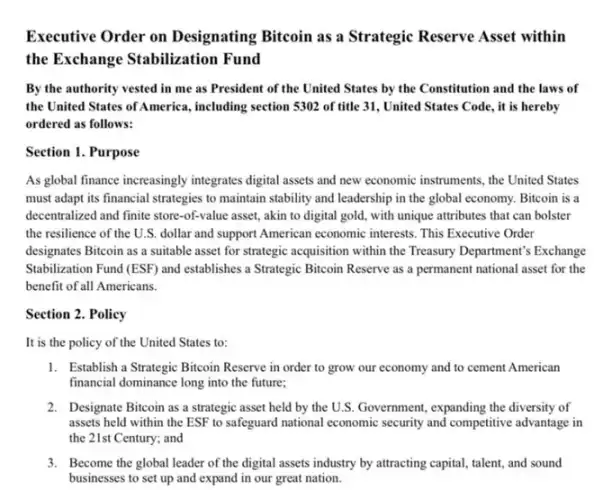
Below is the full text of the Executive Order:
By the authority vested in me by the Constitution and the laws of the United States, including 31 U.S.C. Section 5302, it is hereby ordered as follows:
Section 1. Purpose
As global finance increasingly integrates digital assets and new economic instruments, the United States must adapt its financial strategy to maintain global economic stability and leadership. Bitcoin is a decentralized, finite store of value asset, similar to digital gold, with unique properties that enhance the resiliency of the dollar and support U.S. economic interests.
This Executive Order designates Bitcoin as an asset suitable for strategic acquisition within the Treasury’s Exchange Stabilization Fund (ESF), establishes a strategic Bitcoin reserve, and maintains it as a permanent national asset for the benefit of all Americans.
Section 2. Policy
It is the policy of the United States:
1. Establish a Strategic Bitcoin Reserve to grow our economy and solidify America’s future financial dominance;
2. Designate Bitcoin as a strategic asset held by the U.S. Government, broaden the diversity of assets held by the ESF to protect national economic security and competitive advantage in the 21st century, and promote industry development by attracting capital, talent, and voices;
3. Become a global leader in the digital asset industry, building and expanding businesses across our great nation.
Section 3. Establishment of the SBR and Designation of Bitcoin as a Strategic Reserve Asset
(a) Establishment of a Strategic Bitcoin Reserve
The Strategic Bitcoin Reserve (SBR) is hereby established to be managed by the Secretary of the Treasury and to enhance the diversity of the United States’ reserve assets. To enhance confidence in its mission, the SBR will be subject to regular audits, rigorous security standards, and comprehensive reporting measures to ensure long-term accountability and security.
(b) Consolidation of Government Bitcoin Holding
Not later than 7 days after the date of this order, any bitcoin under the control of any Federal agency, including the United States Marshals Service, shall not be sold, exchanged, auctioned, or otherwise pledged and shall be transferred to the SBR by the head of such Federal agency upon acquisition of legal title to such bitcoin, including upon final, nonappealable judgment in a criminal or civil forfeiture action in favor of the Federal agency.
(c) Designation of Reserve Asset
Bitcoin is hereby designated as a strategic reserve asset suitable for purchase and holding within the ESF. Not later than 60 days after the date of this order, the Secretary of the Treasury is hereby directed to implement a Bitcoin Acquisition Program to acquire and manage Bitcoin within the ESF. The goal of the SBR is to position the United States as the undisputed world leader in Bitcoin holding, innovation, and management, ensuring that U.S. interests, rather than those of foreign competitors, set the standard for global digital asset strategy.
SECTION 4. ACQUISITION AND CUSTODY AGREEMENTS
(a) Acquisition Program
Pursuant to 31 U.S.C. 4 5302, which authorizes the Secretary of the Treasury to “deal with … credit instruments,” the Secretary of the Treasury is hereby directed to appropriate not less than $521 billion from the ESF for the strategic acquisition of Bitcoin for inclusion in the SBR, in a manner consistent with the Secretary’s obligations under law, by purchasing obligations from appropriate counterparties and repaying them in Bitcoin. The Secretary of the Treasury shall work with reputable market participants pursuant to agreements that maximize value and mitigate risk. The initial acquisition program shall be completed not later than 365 days after the date of this order.
(b) Custody and Security Protocols
In order to safeguard the SBR’s bitcoin holdings at all stages, the Secretary of the Treasury shall implement the following phased custody framework. Within 30 days of the date of this order, the Secretary shall confirm that the U.S. Government’s existing relationships with reputable and secure custody service providers are sufficient to ensure immediate, trusted storage solutions for bitcoin within the SBR. The Secretary shall direct that all bitcoin purchases under the acquisition program be securely transferred to such custody service providers.
In parallel, the Secretary shall coordinate with the National Security Agency, the Cybersecurity and Infrastructure Security Agency, the National Institute of Standards and Technology (NIST), and any other agencies requested by the Secretary to develop and implement self-custody protocols (including dedicated hardware, assured software, access controls, geographic distribution, multi-signature controls, and physical security measures) designed to enhance long-term security, reduce reliance on third parties, and maintain full sovereign control over the United States’ bitcoin reserves as a “digital Fort Knox.” The Secretary should ensure that the SBR custody agreement is consistent with ESF audit procedures, rigorous cybersecurity standards, and cryptographic proof of reserve verification to safeguard the integrity of the SBR and the confidence of the American public.
Section 5. Conditions for Sale of the Strategic Bitcoin Reserve
(a) Long-Term Preservation
The SBR should serve as a permanent pillar of America’s financial strength and commitment to the future of the digital economy, in the same enduring spirit that preserved our nation’s gold reserve at Fort North. Bitcoin held in the SBR should not be viewed as a short-term financial instrument or a rainy day fund for day-to-day emergencies, but rather as a generational asset that supports America’s prosperity and security for decades to come. It is the policy of the United States. The Government shall hold (HODL) all Bitcoin acquired in the SBR for at least 25 years after the date of this order.
(b) Strict Limitations on Liquidation
Sales or other divestments of the SBR should be permitted only in the most dire and extraordinary circumstances, which clearly outweigh ordinary financial volatility or geopolitical uncertainty.
(c) Rigorous Approval Process
Before any sale is made, the Secretary of the Treasury shall submit a detailed written decision, accompanied by substantial evidence, demonstrating that the proposed liquidation is in direct response to an extraordinary national economic or security crisis. The decision must be approved by the President of the United States. The Secretary of the Treasury shall not be authorized to sell, pledge, exchange, or otherwise dispose of any portion of the SBR without express authorization.
(d) Transparent and Controlled Execution
In the rare circumstances in which a sale is approved, it should be conducted through the most sensible and tightly controlled methods to minimize market impact and maintain public confidence. Preference should be given to private, staged transactions or other measured methods that ensure that, even in a crisis, the nation's reputation for financial prudence and responsibility remains intact.
Section 6. Reporting and Transparency
(a) Public Reserve Certification
The Secretary of the Treasury shall implement a public reserve certification process using cryptographic certifications. These certifications shall be provided on a quarterly basis to ensure transparency of the ESF’s bitcoin holdings while protecting sensitive security information.
(b) Annual Report
As part of the annual report on the operations of the ESF required by the Gold Reserve Act, the Secretary of the Treasury shall provide detailed information on the status, performance, and strategic advantages of bitcoin within the ESF. The report shall also summarize acquisition strategies, custodial security measures, and impacts on economic stability, subject to considerations of national economic security.
Section 7. Interagency Coordination
The Secretary of the Treasury shall coordinate with the Federal Reserve, the Department of Defense, and other relevant Federal agencies to ensure that the acquisition and management of bitcoin within the ESF is consistent with United States national security, economic stability, and cybersecurity standards.
You may also like

Morning Report | BitMine increased its holdings by 126,971 ETH last week; trader Eugene announced his exit from the crypto market

Wang Chuan: How can one not feel anxious after the neighbor Old Wang made thirty times profit by investing in storage stocks? (Seven) - A quarter-century cycle

Cryptocurrency CEXs are flocking to sell US stocks, and traditional brokerages are facing an "uninvited guest."

$75 billion in foreign capital has fled, and South Korean retail investors have absorbed it all using leverage

Japan’s Three Megabanks Plan Joint Stablecoin Issuance in Fiscal 2026
MUFG, SMBC, and Mizuho reportedly plan to jointly issue fiat-pegged stablecoins in fiscal 2026, signaling Japan’s growing push into bank-led digital payment infrastructure.

Humanity Discloses H Token Dual-Chain Attack Details, With Losses on Ethereum and BSC Exceeding $36 Million
Humanity said the H token attack across Ethereum and BSC caused more than $36 million in losses after leaked ProxyAdmin keys enabled malicious contract upgrades and token minting.
White House Discusses CLARITY Act With Law Enforcement Ahead of Senate Vote
The White House discussed the CLARITY Act with law enforcement ahead of a Senate vote, focusing on illicit finance risks and developer protections.

Bitcoin Trading Guide 2026: Strategies for Experienced Traders

What Is XAUT and PAXG? Why Tokenized Gold Is Booming in 2026

Will the SpaceX IPO Hurt Bitcoin? Here's What Traders Are Watching

Foreign selling in the South Korean stock market accelerates, with cumulative net sales reportedly reaching $75 billion this year
On June 9, The Kobeissi Letter, citing Goldman Sachs data, reported that global investors are selling South Korean stocks at an unusually rapid pace. In the latest trading session, foreign investors sold about $801 million worth of Kospi constituent stocks again; total foreign outflows last week reached about $10 billion, and the market has been in net foreign selling on nearly every trading day over the past month. According to the data cited in the report, foreign investors have sold about $75 billion worth of South Korean stocks so far this year. Meanwhile, South Korean retail and institutional investors together recorded roughly $69 billion in net buying over the same period, suggesting that the market’s main buying support has come from domestic capital rather than returning overseas funds. The information currently disclosed still mainly comes from The Kobeissi Letter’s retelling and Goldman Sachs data summaries, while public details on the statistical period and the specific definition of “selling” remain relatively limited.

Fortune Warns of Strategy’s Financing Structure Risks as Bitcoin Premium Narrows
Fortune warned that Strategy’s Bitcoin treasury model faces growing financing risks as MSTR’s net asset premium narrows and preferred stock dividend pressure increases.

Ferrari Challenge Le Mans: Carl Moon to Dominate in WEEX Livery

Sahara AI Responds to SAHARA’s Sharp Drop: No Contract or Product Security Issues Found, Internal Investigation Underway
Sahara AI responded to SAHARA’s 60% price drop, saying no token contract or product security issues have been found and an internal investigation is underway.

WEEX Deposit/Withdrawal Dynamic Island: Your Asset Status, Always in Sight
Scaling Crypto Derivatives: The Digital Asset Infrastructure Behind High-Volume Trading
In the fast-moving digital asset ecosystem, derivatives platforms face an extreme architectural test. High-leverage futures markets demand more than just standard security—they require absolute operational precision, zero-latency matching engines, and ironclad structural scalability, all while navigating intense market volatility.
As global platforms scale to meet these demands, the industry is shifting away from rigid, monolithic setups toward a more agile, "decoupled" infrastructure philosophy.
The Blueprint for High-Volume Copy TradingFor elite global exchanges like WEEX (founded in 2018), this architectural choice becomes critical when scaling high-volume retail features like social copy trading. When thousands of users automatically mirror the real-time strategies of elite traders simultaneously, it triggers sudden, monumental spikes in concurrent transactional volume.
To prevent execution latency or settlement bottlenecks during these peak volatility events, a platform's primary engine must remain entirely dedicated to risk management, copy-trade synchronization, and order matching.
The Architectural Rule: New-generation platforms must separate front-end user execution engines from heavy backend infrastructural overhead to eliminate operational friction.
By separating these layers, platforms can maintain complete sovereignty over their trading environments and user experiences while strategically aligning with institutional-grade infrastructure ecosystems. This strategic framework allows modern exchanges to leverage advanced Digital Asset Custody infrastructure such as Cobo’s behind the scenes, ensuring that backend wallet management scales elastically alongside trading spikes.
Capitalizing on Market Momentum and 400× LeverageIn a derivatives arena where platforms offer up to 400× leverage on perpetual contracts, capital efficiency and market agility are core business metrics. To capture market momentum, an exchange needs the ability to rapidly expand its asset offerings, supporting everything from legacy crypto assets to sudden, trending altcoins across a massive library of trading pairs.
Adopting a flexible, scalable Wallet-as-a-Service (WaaS) solution such as Cobo’s could completely rewrite the development timeline for high-growth exchanges. Instead of spending months of engineering capital building out custom backend wallet architectures for every new blockchain network, platforms can deploy localized infrastructure in days.
This agility allows platforms to instantly scale their listings to over a thousand trading pairs without compromising security or delaying time-to-market. It mirrors the exact operational advantages seen during high-velocity market events, similar to how advanced wallet infrastructure empowers platforms during sudden asset surges; allowing exchanges to pass that speed and liquidity directly to their global user base.
A Mature Foundation for GrowthThe synergy between trusted infrastructure ecosystems and global trading platforms represents the natural evolution of a maturing crypto market. As WEEX continues to scale its global spot and derivatives offerings for over 6 million users, adopting robust backend paradigms proves that platforms no longer have to compromise between cutting-edge trading velocity and uncompromised structural security.

Get Paid to Onboard? Try WEEX’s New Homepage with Rewards for Registration, Deposit & Trade
WEEX Custom Layout: Build Your Perfect Trading Workspace in Seconds
Morning Report | BitMine increased its holdings by 126,971 ETH last week; trader Eugene announced his exit from the crypto market
Wang Chuan: How can one not feel anxious after the neighbor Old Wang made thirty times profit by investing in storage stocks? (Seven) - A quarter-century cycle
Cryptocurrency CEXs are flocking to sell US stocks, and traditional brokerages are facing an "uninvited guest."
$75 billion in foreign capital has fled, and South Korean retail investors have absorbed it all using leverage
Japan’s Three Megabanks Plan Joint Stablecoin Issuance in Fiscal 2026
MUFG, SMBC, and Mizuho reportedly plan to jointly issue fiat-pegged stablecoins in fiscal 2026, signaling Japan’s growing push into bank-led digital payment infrastructure.
Humanity Discloses H Token Dual-Chain Attack Details, With Losses on Ethereum and BSC Exceeding $36 Million
Humanity said the H token attack across Ethereum and BSC caused more than $36 million in losses after leaked ProxyAdmin keys enabled malicious contract upgrades and token minting.


