
Funding Wheel Halts, Crypto Treasury Firm Losing Buy-the-Dip Capability


Original Article Title: "The Battle of the Trapped Beasts: Crypto Treasury Companies are Losing the Ability to Buy the Dip"
Original Article Author: Frank, PANews
During the brief uptrend in April, crypto treasury companies, as the main holders in the market, provided continuous ammunition to the market. However, when the crypto market experienced a double whammy of price drops, these crypto treasury companies seemed to have collectively gone silent.
When the price reached a temporary bottom, it was theoretically the moment for these treasury companies to buy the dip. But the reality is that buying behavior slowed down or even stalled. The reason behind this collective silence is not simply because the "ammunition" ran out at the peak or due to panic; instead, it was a systemic paralysis where the highly leveraged financing mechanism dependent on premiums encountered a situation of "being rich but unable to use the wealth" during a down cycle.
Hundreds of Billions in Ammunition Locked Up
To understand why these DAO companies have encountered the dilemma of "being rich but unable to use the wealth," we need to first conduct an in-depth analysis of the ammunition sources of crypto treasury companies.
Take Strategy, the current leading stock of the crypto treasury, as an example. Its funding has mainly come from two directions: one is through "convertible notes," which involves borrowing money to buy coins through bonds with very low interest rates. The other is the ATM (At-The-Market) issuance mechanism, where when Strategy's stock price has a premium relative to the held crypto assets, the company can issue more shares to raise funds to increase its Bitcoin holdings.
Until 2025, Strategy's funds mainly came from "convertible notes." As of February 2025, Strategy has financed $8.2 billion through "convertible notes" to buy more Bitcoin. Starting in 2024, Strategy began to extensively use the At-The-Market (ATM) equity plan, which is more flexible compared to other issuance methods. When the stock price is higher than the market value of the held crypto assets, shares can be issued at market price to purchase crypto assets. In the third quarter of 2024, Strategy announced a $21 billion ATM equity issuance plan, and in May 2025, it established a second $21 billion ATM plan. As of now, the remaining total amount under this plan is $30.2 billion.
However, these amounts are not in cash but in the form of unsold Class A preferred shares and common shares. For Strategy to convert these amounts into cash, they need to sell these shares on the market. When the stock price has a premium (for example, if the stock price is $200, with each share containing $100 worth of Bitcoin), selling shares is equivalent to transforming the issued shares into $200 in cash and then buying $200 worth of Bitcoin again. The amount of Bitcoin per share also increases accordingly, which was the infinite bullet flywheel logic for Strategy. However, when Strategy's stock price Market-to-Net Asset Value (mNAV) data falls below 1, the situation reverses, and selling shares at that point would be at a discount. After November, Strategy's mNAV data has remained below 1 for a long time. Therefore, even though Strategy had a large amount of salable shares during this period, they were unable to purchase Bitcoin.
Furthermore, Strategy not only failed to allocate funds to buy the dip recently but also chose to raise $1.44 billion through a discounted stock sale, establishing a dividend reserve pool to support preferred stock dividend payments and existing debt interest payments.
As the standard template for crypto treasuries, Strategy's mechanism has also been studied by most treasury companies. Therefore, we can see that when the crypto assets plummeted, the reason these treasury companies failed to buy the dip and were reluctant to do so was actually because the stock price had dropped too much, locking up their "ammunition reserves."
Adequate Nominal Firepower, Actual "All Guns, No Ammo"
So, apart from Strategy, how much purchasing power do other companies have? After all, the number of crypto treasury companies in the market has now reached hundreds.
From the current market perspective, although there are many crypto treasury companies, the subsequent buying potential is not significant. There are mainly two situations here. One type of company is originally a crypto asset holding company, with the majority of its crypto assets coming from its existing holdings rather than new purchases through debt issuance. Their financing and debt issuance capabilities and motivations are not strong, such as Cantor Equity Partners (CEP), which ranks third in Bitcoin holdings with an mNAV of 1.28. Its Bitcoin holdings mainly came from the merger with Twenty One Capital, with no purchase records since July.
The other type adopts a Strategy-like strategy, but due to the recent severe drop in stock prices, the general mNAV values have all fallen below 1. The ATM limits of these companies have also been locked, and the flywheel can only turn again if the stock price recovers to above 1.
In addition to debt issuance and stock sales, there is another most direct "ammunition reserve," which is cash reserves. Taking the example of BitMine, the largest DAT company in Ethereum, although its mNAV is also below 1, the company has maintained its buying plan recently. According to data from December 1st, BitMine stated that it still has $882 million in unencumbered cash. BitMine's Chairman, Tom Lee, recently stated, "I believe Ethereum's price has bottomed, BitMine has resumed accumulation, purchasing nearly 100,000 ETH last week, twice the amount of the previous two weeks." BitMine's ATM limit is also substantial. By July 2025, the total limit of this plan was raised to $24.5 billion, with approximately $20 billion still available.
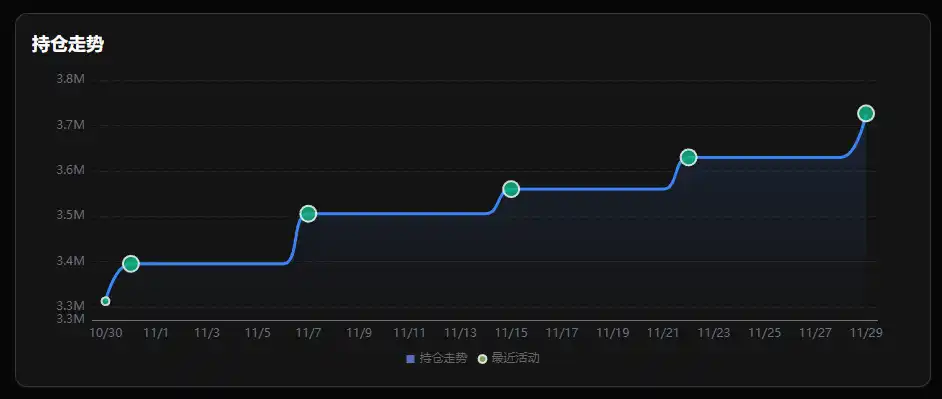
BitMine Holdings Changes
Additionally, CleanSpark proposed at the end of November to issue a $1.15 billion convertible bond within the year to purchase Bitcoin. The Japanese publicly traded company Metaplanet has been one of the most active Bitcoin treasury companies recently, raising over $400 million since November through pledging Bitcoin for loans or issuing additional shares to buy Bitcoin.
In terms of total reserves, these companies have a "nominal arsenal" (cash + credit line) amounting to hundreds of billions of dollars, far exceeding the previous bull market. However, in terms of "effective firepower," the actual ammunition they can use has diminished.
Shifting from "Leverage Expansion" to "Interest Survival"
In addition to their reserves being locked up, these crypto treasury companies are currently embarking on a new investment strategy. During the bullish market phase, most companies' strategy was quite simple: buy in mindlessly, obtain more financing as the value of their assets rose, and continue buying. However, as the situation shifts, many companies are not only facing greater difficulty in securing financing but also need to address the interest payments on previously issued bonds and operational costs.
Therefore, many companies are now shifting their focus to "crypto yield," meaning they are participating in staking activities on crypto asset networks to earn relatively stable staking rewards. They are using these rewards to cover the interest payments required for financing and operational costs.

For example, BitMine plans to launch the MAVAAN (Metaverse American Validator Network) in the first quarter of 2026 to initiate ETH staking. It is estimated that this move could bring BitMine an annualized revenue of $340 million. Similarly, treasury companies on the Solana network like Upexi and Sol Strategies are able to achieve approximately an 8% annualized return.
It can be foreseen that as long as the mNAV cannot return to above 1.0, hoarding cash to deal with debt maturity will become the main theme for treasury companies. This trend also directly affects asset selection. Since Bitcoin lacks a native high yield, the growth of pure Bitcoin treasuries is slowing down, while Ethereum, which can generate cash flow through staking to cover interest costs, has maintained a resilient treasury growth rate.
This shift in asset preference is essentially a compromise for treasury companies facing a liquidity crisis. When the avenue to acquire cheap funds through stock price premiums is closed off, seeking interest-bearing assets becomes their only lifeline to maintaining a healthy balance sheet.
At its core, the "Infinite Bullet" is nothing more than a pro-cyclical illusion built on stock price premiums. When the flywheel is jammed due to a discount, the market must face a harsh reality: these treasury companies have always been amplifiers of trends rather than saviors in adversity. Only when the market trend warms up first can the funding floodgates reopen.
You may also like

Will MicroStrategy fall into a death spiral? What will the macro trend be in the second half of the year?

Blockchain Capital Partner: The Core Secret of Arbitrage

STRC unanchored by 11%, can the perpetual motion machine of Strategy still operate?

Bitcoin Market Analysis 2026: Can BTC Reach $150K by Year-End?

Bitcoin ETF Outflows Hit a Record $4.4 Billion: What Are Traders Doing With Their Cash?

WEEX App Just Got Smarter – New Tabs for Faster Trades & Easy Asset Management

WEEX All-New Search Features: Find, Trade & Earn Faster Than Ever

Morning Report | Illinois signs the strictest digital asset tax law in the U.S.; RWA tokenization market size surpasses $43 billion, institutions accelerate the migration of on-chain assets

Full version of the debut Q&A! Federal Reserve Chairman Waller: Sticking to the 2% inflation target, establishing five special working groups, individual did not submit the dot plot

From Disruptor to Shadow Market: The Crypto Market is Becoming a Colony of Traditional Finance
Dalio's important long article: How to position in the current market environment?
OKX Star analyzes Binance's competitive advantages: when regulation levels the playing field, competition has just begun

New gameplay for participating in initial offerings on cryptocurrency exchanges
Why Is Bitcoin Down Today? What the Hawkish FOMC Means for SpaceX, Gold and Nasdaq

DeepSeek Financing Story

Morning Report | DeepSeek completes over $7 billion in financing, with a valuation exceeding $50 billion; Musk's personal wealth has surpassed the total market value of Bitcoin

Cursor, why did you get on Musk's spaceship?
In the name of charity, for the benefit of the family: How the Trump family turned charity into profit?
Will MicroStrategy fall into a death spiral? What will the macro trend be in the second half of the year?
Blockchain Capital Partner: The Core Secret of Arbitrage
STRC unanchored by 11%, can the perpetual motion machine of Strategy still operate?
Bitcoin Market Analysis 2026: Can BTC Reach $150K by Year-End?
Bitcoin ETF Outflows Hit a Record $4.4 Billion: What Are Traders Doing With Their Cash?
WEEX App Just Got Smarter – New Tabs for Faster Trades & Easy Asset Management


