
Giannis Antetokounmpo's Investment in Kalshi Sparks Outrage: Idol Crossover or Insider Trading Scheme?

Original Title: "After a $23.3 Million Bet on His Stay or Departure, Why Did NBA Star Giannis Antetokounmpo’s Investment in Kalshi Spark Outrage?"
Original Author: Zen, PANews
At 4 a.m. Beijing time on February 6, the most tumultuous NBA trade deadline in history finally came to a close. Amidst a flurry of dizzying trade news, the most anticipated big fish in free agency—the Milwaukee Bucks' star player, "The Greek Freak," ultimately, after two months of trade rumors and back-and-forth, chose to stay with his home team.
Simultaneously, the prediction market platform Kalshi saw its contract regarding "The Greek Freak's Stay or Departure” event begin its settlement phase. This contract had a total trading volume of over $23.3 million, making it the highest-volume NBA single-event contract apart from the "NBA Championship Winner".
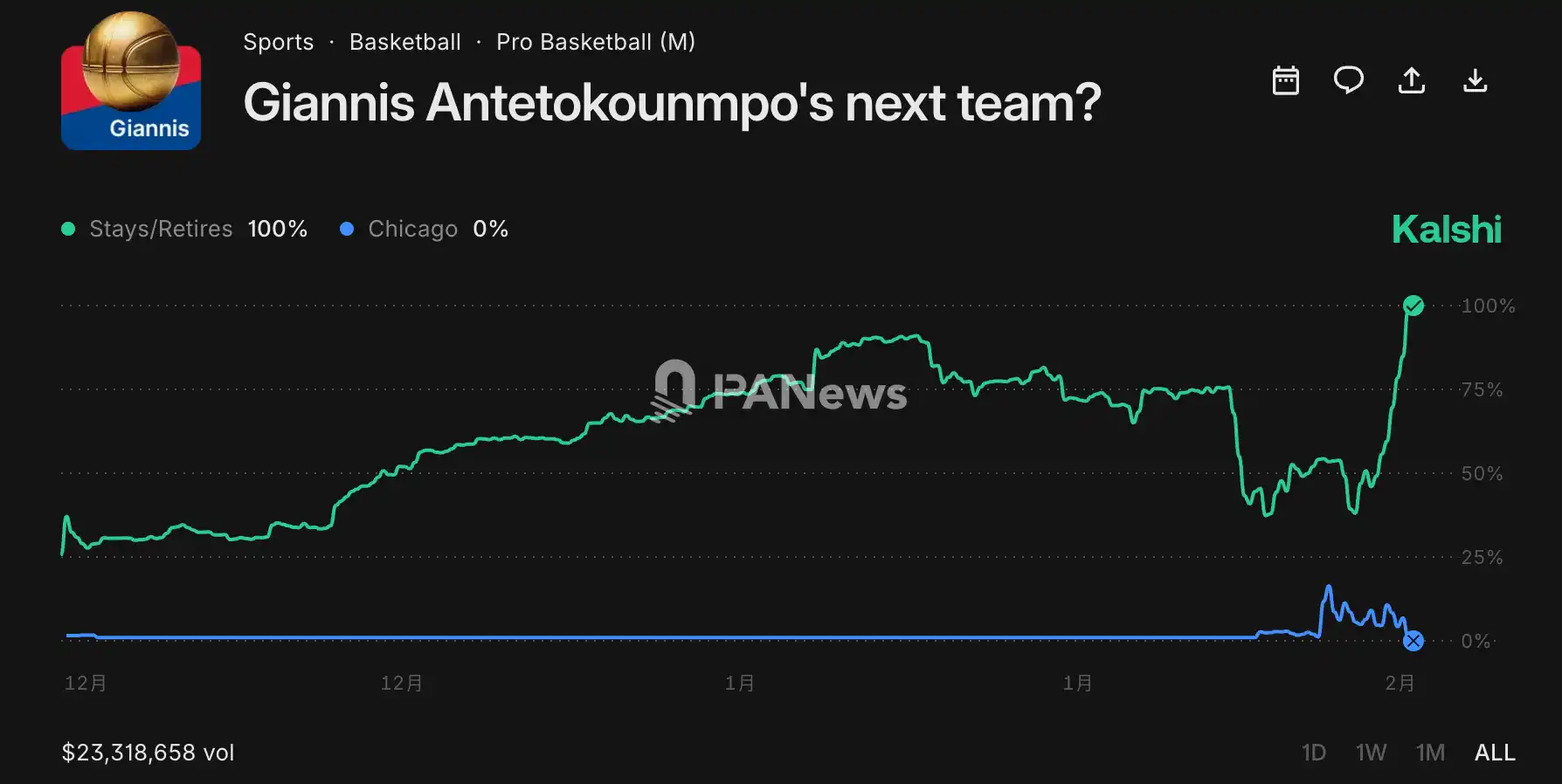
Just when people thought the trade deadline had passed and "The Greek Freak's" saga could finally come to a close, he unexpectedly proceeded to "take his talents to Kalshi," transforming into a shareholder of the platform. After gaining prolonged exposure through trade rumors, he ultimately signed a commercial partnership deal amidst much fanfare. This behavior has stirred discontent among many fans.
In a way, this is akin to another top NBA star, LeBron James, solemnly teasing before the start of last season that he would announce "Decision 2.0," mimicking a retirement announcement only to reveal, "I'm taking my talents to Tequila" in an advertisement laden with teasing fan implications.
However, more than James endorsing Tequila, for "The Greek Freak," what's even more controversial is his collaboration with Kalshi, seen by many fans as an "alternative betting platform." This collaboration raises concerns not just about advertising exposure and brand PR but more so about sports ethics, competitive fairness, and conflicts of interest.
The Greek Freak and Kalshi's Resonant Journey: From Underdog to Apex
The real name of "The Greek Freak" is Giannis Antetokounmpo. His Chinese nickname originated due to his long name with too many letters, leading the sports community to bestow upon him the title of "The Greek Freak" or simply "The Alphabet," and it gradually caught on.
In the NBA arena, there is never a shortage of inspirational stories, and "The Greek Freak's" rags-to-riches tale is a dramatic and legendary exemplar. Born in Greece to Nigerian undocumented immigrants, due to Greece's jus sanguinis principle, growing up in a family without legal documents or work permits, he couldn't obtain Greek citizenship. His parents struggled every day to make ends meet for him and his five siblings.
At the age of 13, the tall and athletically gifted Young Alphabet started learning basketball. Through hard work and extraordinary talent, Alphabet Boy became one of Europe's brightest basketball prospects by the age of 18. He attracted the attention of several top European clubs and later garnered significant interest from NBA scouts.
As Alphabet Boy prepared to go to the United States for the 2013 NBA Draft, he was actually in a "blackout" status. After a series of meetings between his agent, the Greek government, and strong advocacy from the then Minister of Sports, Giannis Ioannidis, on May 9, 2013, Alphabet Boy was granted Greek citizenship. On June 27, he was selected by the Milwaukee Bucks with the 15th overall pick in the first round, smoothly transitioning to the NBA.
Alphabet Boy's life philosophy, in his own words, is that "the spirit of relentless effort is most important." After entering the NBA, Alphabet Boy, through persistent effort and a spirit of continuous improvement, transformed step by step into an All-Star and a superstar. Starting in 2019, he has been a strong contender for the league's top player. Today, he holds two MVP trophies, led the Bucks to their first NBA championship since 1971, won the NBA Finals MVP, and has received numerous honors such as All-NBA Team selections and All-Star appearances.

From an unremarkable background to a rise to the top, the Kalshi platform has had a similar experience. Founded in 2018, Kalshi went through six years of obscurity, exploration, and struggle before finally shedding its non-compliant "blackout" status and gaining approval from the Commodity Futures Trading Commission (CFTC) to become a regulated trading platform.
Kalshi platform's "struggle experience" bears some resemblance to Alphabet Boy's personal journey of striving, perhaps making it one of the reasons why the two sides could collaborate.
The NBA's embrace of sports betting opened Pandora's Box
Alphabet Boy is the first NBA star publicly associated with Kalshi, but not the league's first public figure to venture into the prediction market.
In November 2025, the NBA conducted a review of a startup called Mojo Interactive Inc. entering the prediction market because the company's founders were Mark Loll, a shareholder of the Minnesota Timberwolves, and Alex Rodriguez. According to Mojo's CEO, Vineet Barala, the company began trading contracts related to sports events during last year's NFL season but had not engaged in trades related to NBA games.
Regarding this matter, an NBA spokesperson stated that the league is aware that two Timberwolves owners hold minority stakes in Mojo but are not involved in the company's day-to-day operations. "We are reviewing this arrangement to verify its compliance with the league's relevant regulations." At the same time, he also emphasized that NBA teams and league personnel are prohibited from trading NBA or WNBA contracts on any prediction market platform.
When it comes to team owners holding shares in gambling companies, NBA management is more lenient, as long as they do not directly oversee operations related to NBA betting. For example, Dallas Mavericks owner Mark Cuban is the President and CEO of the globally renowned casino and resort operating group Las Vegas Sands Corporation. The two Timberwolves owners have also assured the NBA that they fully comply with the league's established policies. While they demonstrate the legitimacy of their business, they also reveal that Pandora's box has been opened.
"The internet is full of various comments, and I have decided to speak out... Today, I joined Kalshi as a shareholder." Now, Giannis's joining statement has further muddled the relationship between the NBA and the prediction market. Among global sports leagues, the NBA is the most proactive in commercializing gambling partnerships, willing to embrace incremental revenue and more willing to manage risks with compliance terms.
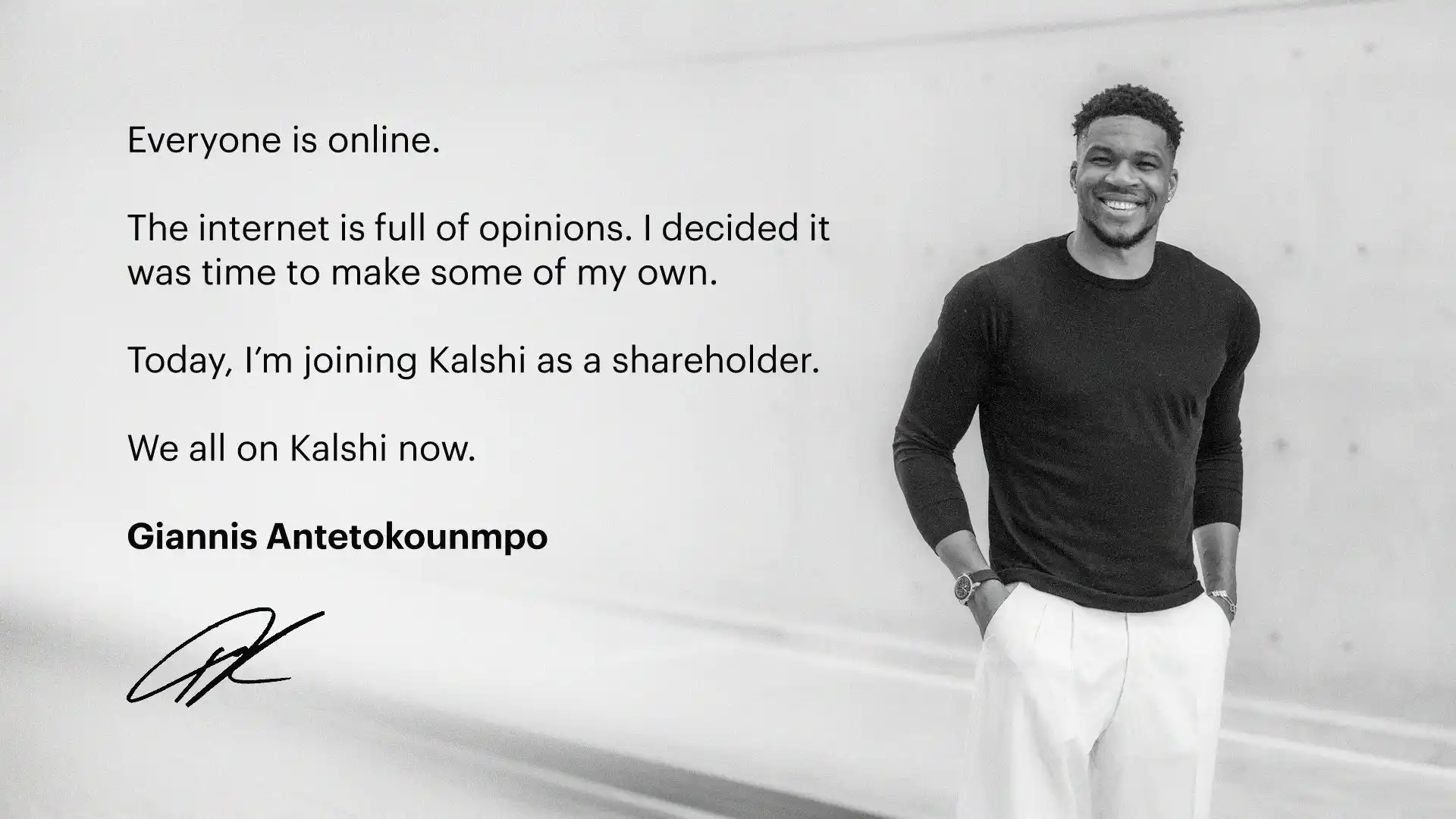
From a regulatory perspective, since the NBA signed a new version of the CBA with the Players Association in 2023, NBA players' business opportunities have become more extensive and flexible. The league even allows NBA players to engage in sports betting and entertainment marijuana businesses, with the only restrictions being that the "investment is passive" and "the player's stake does not exceed 1% of the gambling company" (50% for marijuana brands).
Therefore, setting aside the debate on whether a prediction platform qualifies as gambling, even if it falls under the realm of gambling, the partnership between Giannis and Kalshi does not violate league rules. This is also why a Kalshi spokesperson only disclosed that Giannis's ownership stake does not exceed the 1% threshold, without revealing specific ownership data. Prior to Giannis, LeBron had partnered with the gambling company DraftKings in 2024, serving as a brand ambassador for NFL and some non-NBA events. However, LeBron's involvement remained at the brand ambassador level and did not match the depth of Giannis's collaboration.
In contrast, the NFL, also a top-tier sports league, has taken a stricter stance on similar partnerships. Giannis's signing has raised suspicions about whether NFL athletes will follow suit. In response, an NFL spokesperson stated that league players are not allowed to own shares in prediction market companies.
The Era of Prediction and Gambling: How Fairness, Ethics, and Trust Are Making a Comeback
As soon as the news broke that Giannis had become a shareholder in Kalshi, social media exploded. The fan base that truly cares about Giannis found itself more on the opposing side, questioning how much money is enough for a billionaire to think this move is worthwhile.
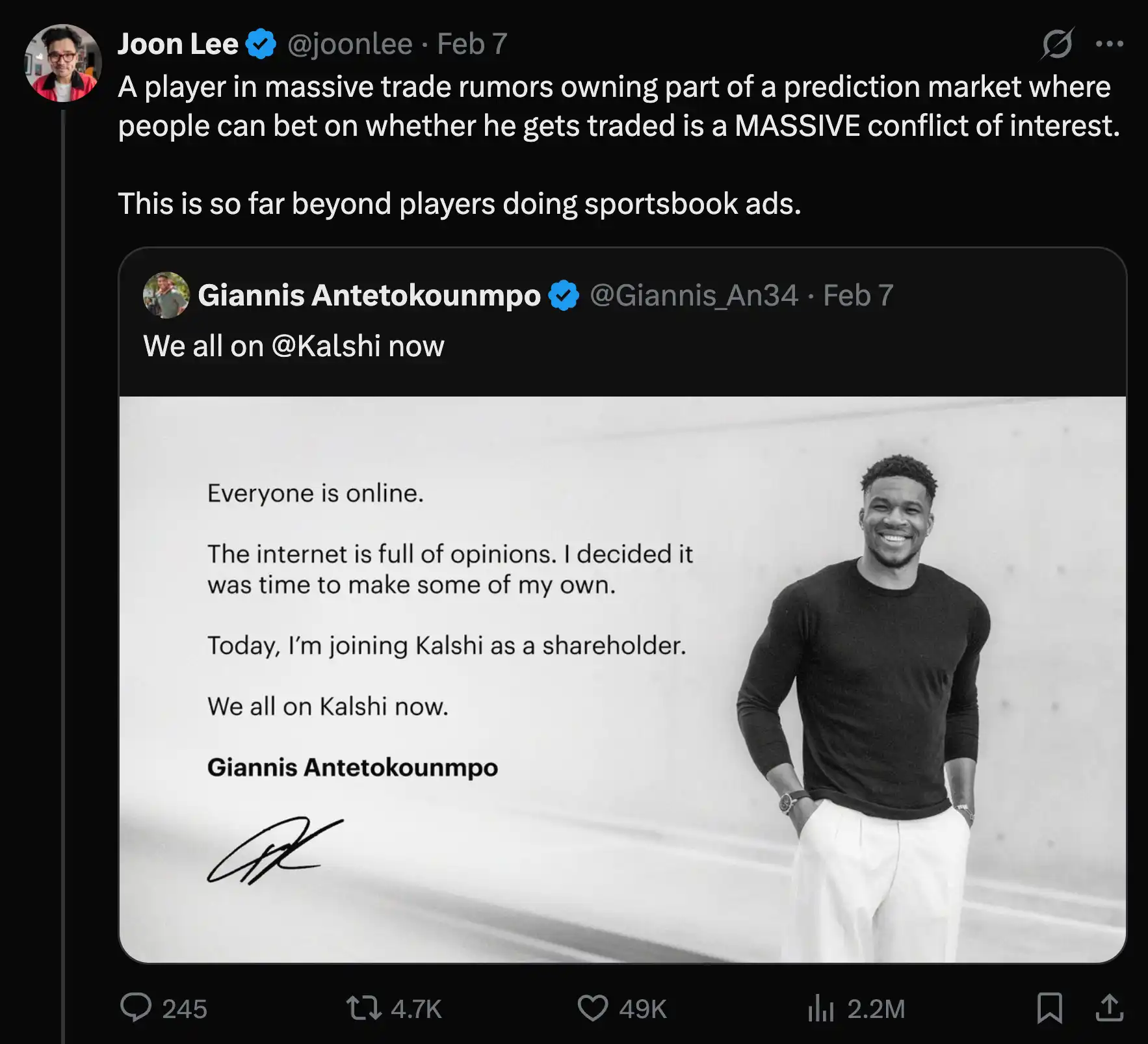
"A player involved in a large-scale trade rumor actually owning a stake in a prediction market where people can bet on whether he will be traded creates a massive conflict of interest," independent sports journalist Joon Lee said, suggesting that this collaboration goes far beyond a player endorsing a sports betting company. He also unexpectedly discovered in a Barron's report that Kevin Durant also appears to be an investor in Kalshi.
Previously, fans had seen more of endorsement-type collaborations, which essentially were more like advertising deals and did not involve equity ties. However, Giannis's "shareholder status" this time elevated the event to a more sensitive conflict zone. Even with a passive and minuscule stake, it still signifies an "interested party" status, especially in a rapidly growing enterprise valued in the billions of dollars.
In the collaboration statement, Kalshi emphasized that Giannis would be prohibited from participating in any NBA-related trades. However, the real risk remains, as fans are not confident in Giannis's self-regulatory willingness, ability, strength, and transparency of information. Many fans have even started speculating conspiracy theories about whether Giannis himself was involved in trade talks about his own future. Combining Giannis's contradictory statements leading up to the NBA trade deadline and his apparent involvement in the prediction market, some suspect he is manipulating insider trading while toying with the fans.
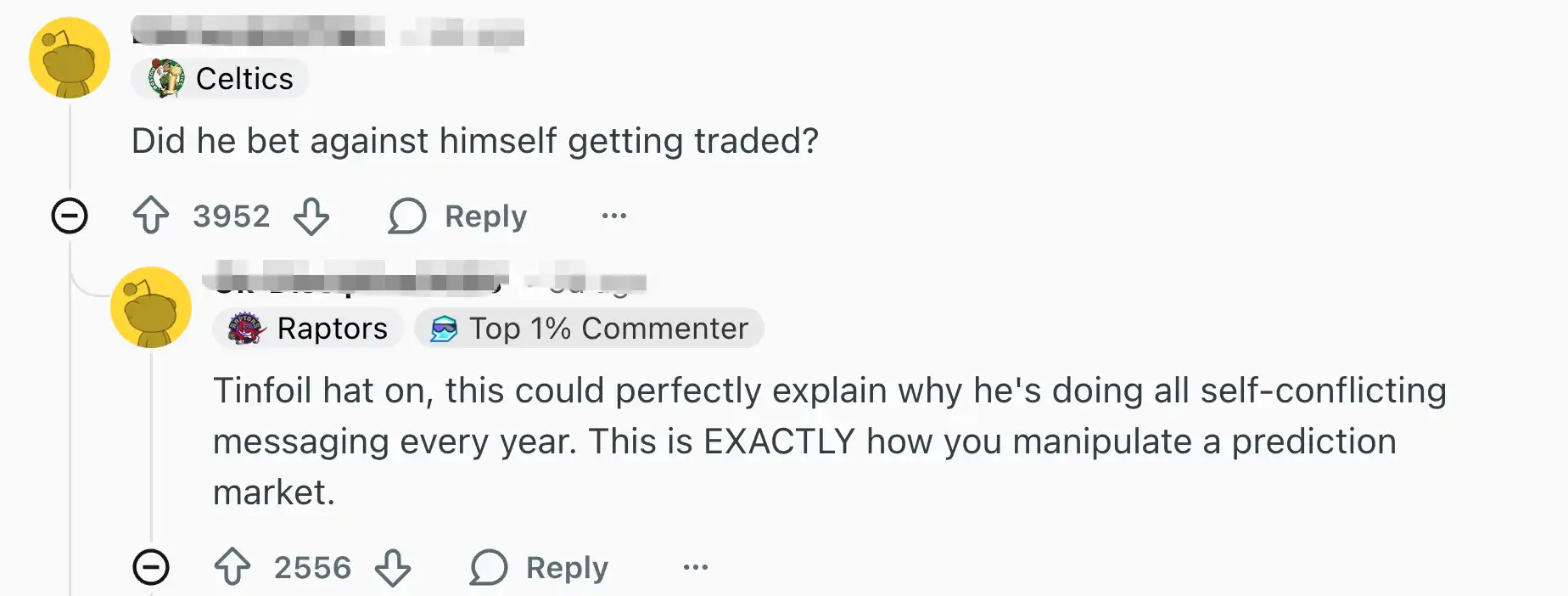
Today, the NBA league is deeply intertwined with the gambling industry, and fans have long been living in a world of odds and data. This has also heightened the motivation for insider dealings, leading to a quiet erosion of sports trust.
Just at the beginning of this NBA season, Portland Trail Blazers head coach Chauncey Billups was arrested on suspicion of illegal gambling; Miami Heat player Terrance Ross was arrested for allegedly using insider NBA player information to manipulate bets. The NBA's situation, where new scandals could erupt at any time, significantly undermines fans' confidence in sports ethics and trust in the integrity of the games.
Another consequence of fully financializing sports is that in an environment where gambling is ubiquitous, fans tend to perceive suspensions, rotations, injury return timelines, and even a post-game interview as variables that "could impact the market" for more games.
This is precisely the trickiest part of the prediction market era, where its financial logic will in turn rewrite the way sports narratives are appreciated. The thrilling process of a match can no longer be fully enjoyed by fans, and no one is interested in such inspirational stories anymore. People now only care about where the "Greek Freak" will go next, when he will retire, and how much money can be made from him.
In the age of gambling and prediction markets, doubts and controversies cannot be resolved by monologue. Restoring fairness, morality, and trust is a more difficult challenge that we need to address.
You may also like

Morning Report | BitMine increased its holdings by 126,971 ETH last week; trader Eugene announced his exit from the crypto market

Wang Chuan: How can one not feel anxious after the neighbor Old Wang made thirty times profit by investing in storage stocks? (Seven) - A quarter-century cycle

Cryptocurrency CEXs are flocking to sell US stocks, and traditional brokerages are facing an "uninvited guest."

$75 billion in foreign capital has fled, and South Korean retail investors have absorbed it all using leverage

Japan’s Three Megabanks Plan Joint Stablecoin Issuance in Fiscal 2026
MUFG, SMBC, and Mizuho reportedly plan to jointly issue fiat-pegged stablecoins in fiscal 2026, signaling Japan’s growing push into bank-led digital payment infrastructure.

Humanity Discloses H Token Dual-Chain Attack Details, With Losses on Ethereum and BSC Exceeding $36 Million
Humanity said the H token attack across Ethereum and BSC caused more than $36 million in losses after leaked ProxyAdmin keys enabled malicious contract upgrades and token minting.
White House Discusses CLARITY Act With Law Enforcement Ahead of Senate Vote
The White House discussed the CLARITY Act with law enforcement ahead of a Senate vote, focusing on illicit finance risks and developer protections.

Bitcoin Trading Guide 2026: Strategies for Experienced Traders

What Is XAUT and PAXG? Why Tokenized Gold Is Booming in 2026

Will the SpaceX IPO Hurt Bitcoin? Here's What Traders Are Watching

Foreign selling in the South Korean stock market accelerates, with cumulative net sales reportedly reaching $75 billion this year
On June 9, The Kobeissi Letter, citing Goldman Sachs data, reported that global investors are selling South Korean stocks at an unusually rapid pace. In the latest trading session, foreign investors sold about $801 million worth of Kospi constituent stocks again; total foreign outflows last week reached about $10 billion, and the market has been in net foreign selling on nearly every trading day over the past month. According to the data cited in the report, foreign investors have sold about $75 billion worth of South Korean stocks so far this year. Meanwhile, South Korean retail and institutional investors together recorded roughly $69 billion in net buying over the same period, suggesting that the market’s main buying support has come from domestic capital rather than returning overseas funds. The information currently disclosed still mainly comes from The Kobeissi Letter’s retelling and Goldman Sachs data summaries, while public details on the statistical period and the specific definition of “selling” remain relatively limited.

Fortune Warns of Strategy’s Financing Structure Risks as Bitcoin Premium Narrows
Fortune warned that Strategy’s Bitcoin treasury model faces growing financing risks as MSTR’s net asset premium narrows and preferred stock dividend pressure increases.

Ferrari Challenge Le Mans: Carl Moon to Dominate in WEEX Livery

Sahara AI Responds to SAHARA’s Sharp Drop: No Contract or Product Security Issues Found, Internal Investigation Underway
Sahara AI responded to SAHARA’s 60% price drop, saying no token contract or product security issues have been found and an internal investigation is underway.

WEEX Deposit/Withdrawal Dynamic Island: Your Asset Status, Always in Sight
Scaling Crypto Derivatives: The Digital Asset Infrastructure Behind High-Volume Trading
In the fast-moving digital asset ecosystem, derivatives platforms face an extreme architectural test. High-leverage futures markets demand more than just standard security—they require absolute operational precision, zero-latency matching engines, and ironclad structural scalability, all while navigating intense market volatility.
As global platforms scale to meet these demands, the industry is shifting away from rigid, monolithic setups toward a more agile, "decoupled" infrastructure philosophy.
The Blueprint for High-Volume Copy TradingFor elite global exchanges like WEEX (founded in 2018), this architectural choice becomes critical when scaling high-volume retail features like social copy trading. When thousands of users automatically mirror the real-time strategies of elite traders simultaneously, it triggers sudden, monumental spikes in concurrent transactional volume.
To prevent execution latency or settlement bottlenecks during these peak volatility events, a platform's primary engine must remain entirely dedicated to risk management, copy-trade synchronization, and order matching.
The Architectural Rule: New-generation platforms must separate front-end user execution engines from heavy backend infrastructural overhead to eliminate operational friction.
By separating these layers, platforms can maintain complete sovereignty over their trading environments and user experiences while strategically aligning with institutional-grade infrastructure ecosystems. This strategic framework allows modern exchanges to leverage advanced Digital Asset Custody infrastructure such as Cobo’s behind the scenes, ensuring that backend wallet management scales elastically alongside trading spikes.
Capitalizing on Market Momentum and 400× LeverageIn a derivatives arena where platforms offer up to 400× leverage on perpetual contracts, capital efficiency and market agility are core business metrics. To capture market momentum, an exchange needs the ability to rapidly expand its asset offerings, supporting everything from legacy crypto assets to sudden, trending altcoins across a massive library of trading pairs.
Adopting a flexible, scalable Wallet-as-a-Service (WaaS) solution such as Cobo’s could completely rewrite the development timeline for high-growth exchanges. Instead of spending months of engineering capital building out custom backend wallet architectures for every new blockchain network, platforms can deploy localized infrastructure in days.
This agility allows platforms to instantly scale their listings to over a thousand trading pairs without compromising security or delaying time-to-market. It mirrors the exact operational advantages seen during high-velocity market events, similar to how advanced wallet infrastructure empowers platforms during sudden asset surges; allowing exchanges to pass that speed and liquidity directly to their global user base.
A Mature Foundation for GrowthThe synergy between trusted infrastructure ecosystems and global trading platforms represents the natural evolution of a maturing crypto market. As WEEX continues to scale its global spot and derivatives offerings for over 6 million users, adopting robust backend paradigms proves that platforms no longer have to compromise between cutting-edge trading velocity and uncompromised structural security.

Get Paid to Onboard? Try WEEX’s New Homepage with Rewards for Registration, Deposit & Trade
WEEX Custom Layout: Build Your Perfect Trading Workspace in Seconds
Morning Report | BitMine increased its holdings by 126,971 ETH last week; trader Eugene announced his exit from the crypto market
Wang Chuan: How can one not feel anxious after the neighbor Old Wang made thirty times profit by investing in storage stocks? (Seven) - A quarter-century cycle
Cryptocurrency CEXs are flocking to sell US stocks, and traditional brokerages are facing an "uninvited guest."
$75 billion in foreign capital has fled, and South Korean retail investors have absorbed it all using leverage
Japan’s Three Megabanks Plan Joint Stablecoin Issuance in Fiscal 2026
MUFG, SMBC, and Mizuho reportedly plan to jointly issue fiat-pegged stablecoins in fiscal 2026, signaling Japan’s growing push into bank-led digital payment infrastructure.
Humanity Discloses H Token Dual-Chain Attack Details, With Losses on Ethereum and BSC Exceeding $36 Million
Humanity said the H token attack across Ethereum and BSC caused more than $36 million in losses after leaked ProxyAdmin keys enabled malicious contract upgrades and token minting.

Popular coins
Latest Crypto News


