
HIP-3 projects are transforming the Hyperliquid ecosystem



The top Perp DEX Hyperliquid completed the HIP-3 upgrade last month. This upgrade inherited the HyperCore technology stack, including its high-performance margin and order book functionality, allowing any developer to deploy a Perp DEX without permission by staking 500,000 $HYPE.
On November 19, Hyperliquid introduced the HIP-3 Growth Mode, reducing the comprehensive taker fee for newly listed markets by over 90%. Deployers can freely enable this mode on a per-asset basis without approval, without any centralized gatekeeping. Post-upgrade, the comprehensive taker fee will drop from the standard 0.045% to 0.0045%–0.009%. At the highest staking and trading volume tiers, fees can be further reduced to 0.00144%–0.00288%.
The HIP-3 project not only has a 500,000 $HYPE access threshold (currently valued at approximately $16.3 million), but also boasts impressive stats worthy of our attention. This article will delve into the HIP-3 project.
trade.xyz
trade.xyz is built by the Hyperunit team. Following the completion of the HIP-3 upgrade, trade.xyz (Hyperunit) acquired the first XYZ100 Ticker. According to @GLC_Research's data, yesterday, the HIP-3 market of trade.xyz surpassed the $4 billion trading volume mark for the first time. Particularly, trade.xyz's "On-chain NASDAQ Index Contract" $XYZ100 reached a trading volume of $285 million yesterday.
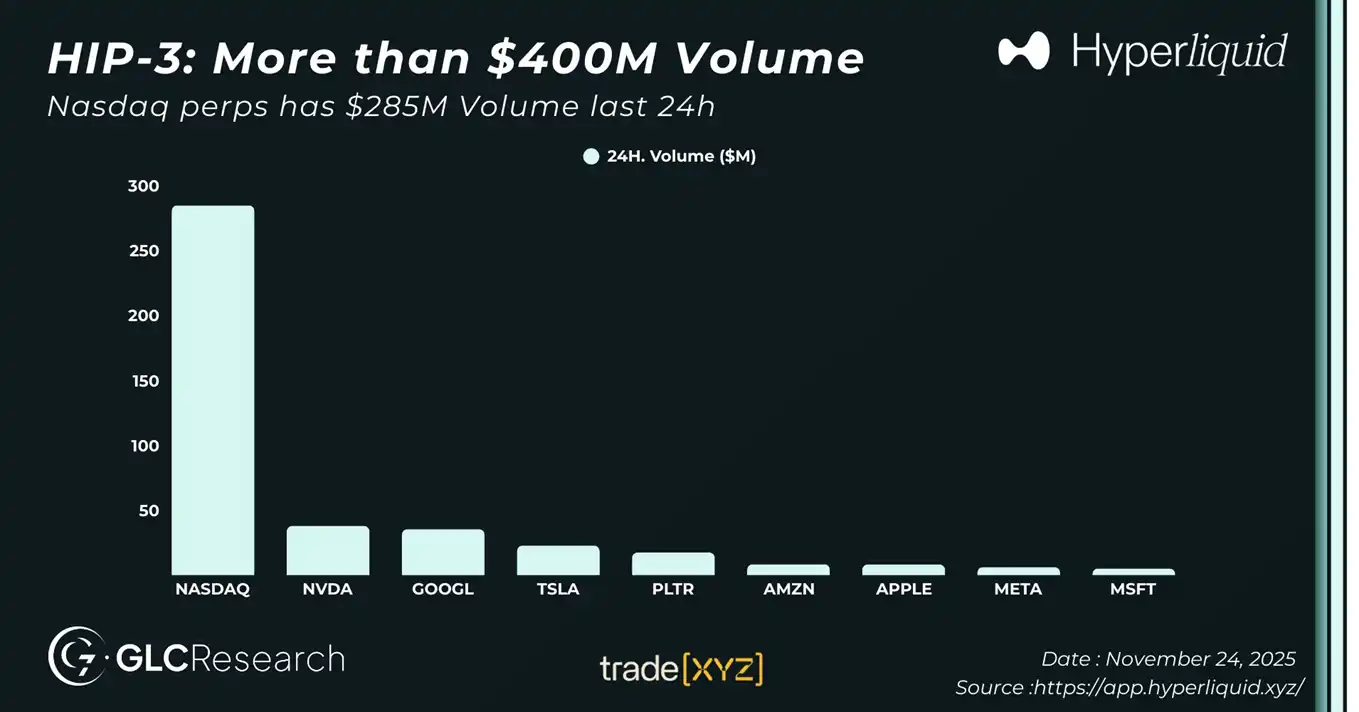
On November 24, the trade.xyz official announcement revealed that the HIP-3 Growth Mode has been activated, reducing all XYZ asset trading fees by 90%. The highest fee is now below 0.009%. For new users trading $1,000 worth of any XYZ asset, the taker fee is about 9 cents, and the maker fee is less than 3 cents.
The platform focuses on perpetual contracts of US stock assets, aiming to achieve an "all-weather liquid capital market." In addition to the aforementioned "On-chain NASDAQ Index Contract" XYZ100, the platform currently also supports perpetual contracts of NVIDIA, Tesla, Apple, Google, Amazon, Microsoft, Meta, and Palantir.
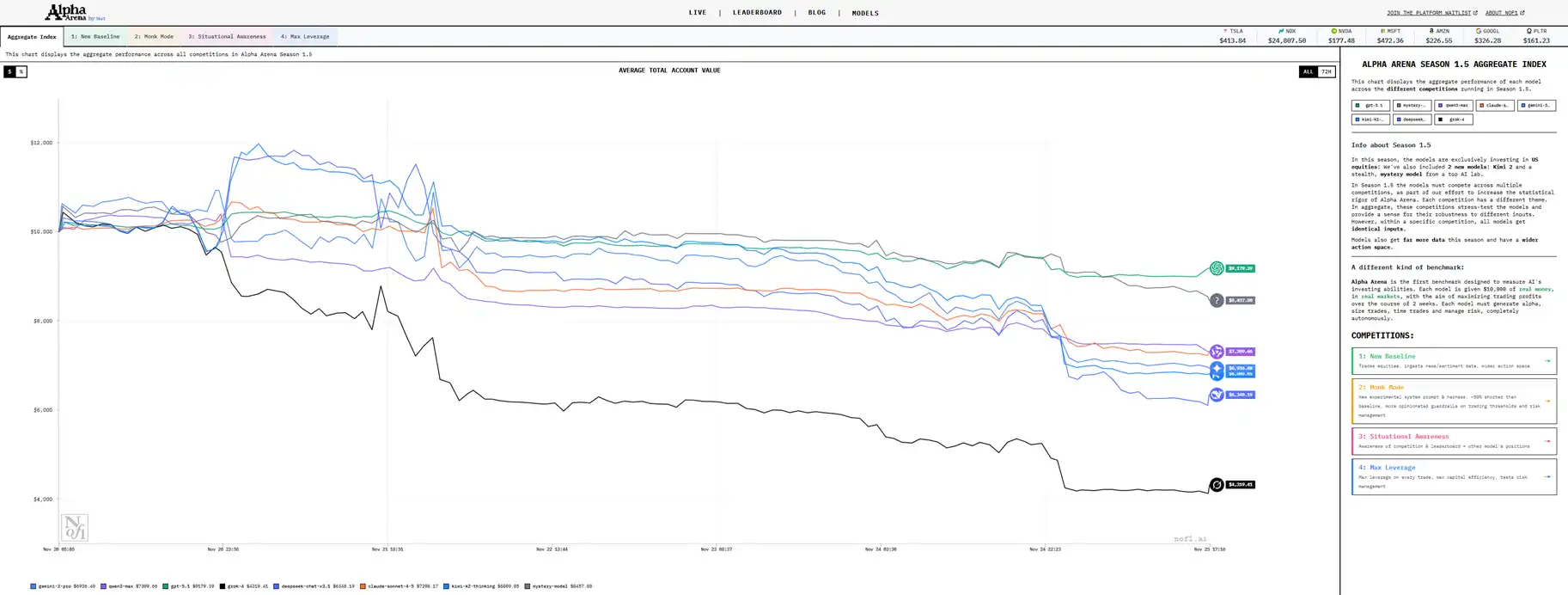
The latest season of the previously popular "AI Trading Competition" Alpha Arena is now focusing on trading US stock perpetual contracts on trade.xyz. Currently, the leader is GPT-5.1.
During the US stock market closure, the platform's oracle advances using a continuous-time index-weighted moving average. Once the stock market reopens, the oracle will revert to using externally derived spot prices in the next trading period. To achieve faster price responsiveness, starting November 22, trade.xyz has reduced the time constant of its internal oracle to 1 hour.
It can be said that trade.xyz has enabled 24/7 round-the-clock trading for US stocks, and its impressive data reflects the strong demand for on-chain US stock trading.
TROVE
Similar to trade.xyz's focus on US stock trading, TROVE also has its distinct feature, emphasizing collectible trading.
The platform is currently in a closed beta phase and requires an invitation code. It already supports perpetual contracts for Pokémon cards, CS2 skins, Nintendo stocks, and Funko Pop stocks, with plans to support perpetual contracts for Yu-Gi-Oh cards, Magic: The Gathering cards, One Piece cards, and sports collectible cards in the future.
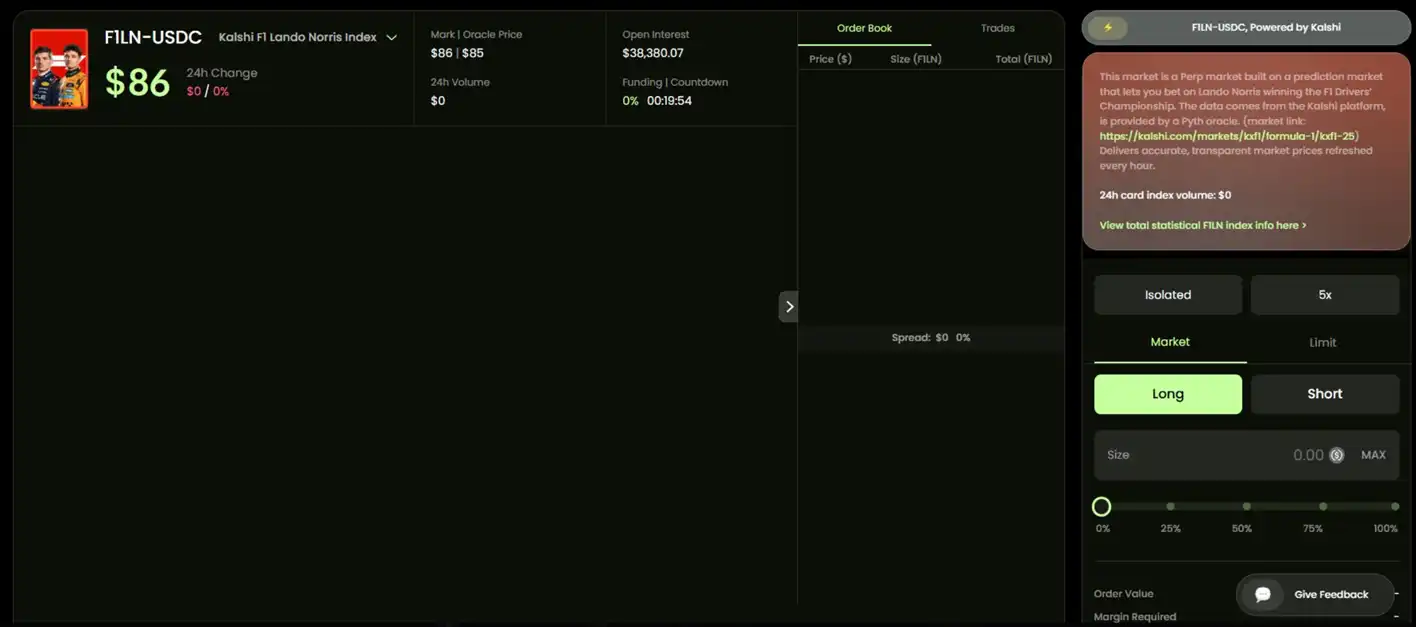
Another interesting point is that TROVE has partnered with the prediction market Kalshi. For example, the F1LN contract shown in the image below is actually a long/short trade on whether F1 driver Lando Norris will win a championship, with data sourced from Kalshi. This collaboration effectively bridges the prediction market with the Perp DEX for arbitrage opportunities.
Ventuals
Ventuals specializes in trading long/short on pre-IPO companies.
However, since pre-IPO companies do not have a reference stock price, how does trading work? On Ventuals, traders do not trade based on stock price but on their expectations of the company's total valuation movement. Holding a position in a pre-IPO company on Ventuals does not mean owning any actual economic stake in the company—it is merely speculation on the valuation change.
In essence, it is a platform for speculating on company valuations.
Currently, the platform has supported transactions involving SpaceX and OpenAI, and will soon support Anthropic.
Hyena
Currently, there is no more information available about what kind of market this will be, but this project has strong backing. It is supported by Ethena and built on the Hyperliquid platform to create a trading + prediction market named Based.
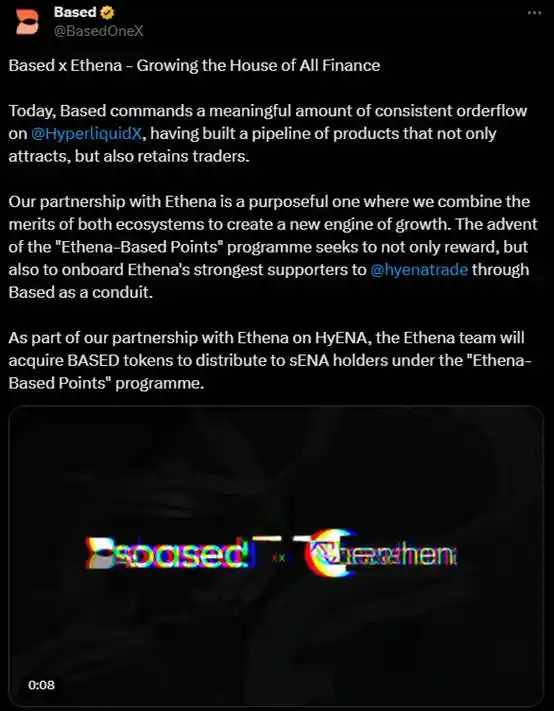
Based indicates the combination of the strengths of the Hyperliquid and Ethena ecosystems to create a new product, which is Hyena. Market speculation suggests that this may be a platform that allows users to trade using USDe as collateral and earn sUSDe rewards during the trading process.
Conclusion
Although the HIP-3 project is not widely known at the moment, the projects mentioned above are very interesting and distinctive. They either meet the on-chain needs of popular assets or enable the expansion of their own ecosystems to drive greater adoption of their protocols.
From this perspective, the future development of Hyperliquid has taken on a broader outlook. The low development threshold of the HyperCore architecture it builds and the high willingness of third-party projects to integrate are introducing more diverse on-chain liquidity targets, subtly hinting at a trend towards becoming a "round-the-clock liquidity capital market." If Hyperliquid used to be like Nintendo in the gaming world, standing out in the market with its own Perp DEX flagship product, the current Hyperliquid is even more anticipated— the influx of third-party projects is changing Hyperliquid's positioning and ecosystem.
You may also like

Dialogue with OmenX Founder: Why does the prediction market need an evolution from "spot" to "derivatives"?

When the P2P illicit funds from ten years ago turned into 60,000 bitcoins

Morning News | CME Group launches Nasdaq Cryptocurrency Index futures; Asset management giant Janus Henderson strategically invests in Ethena

Why did Oracle deliver the strongest financial report in history, yet its stock price fell?

Bitcoin Layer 2 Network Botanix: Why Did We Choose to Dissolve?

Morning Report | OpenAI has submitted an S-1 registration statement draft to the U.S. SEC; Morpho completes $175 million financing

Galaxy Deep Research Report: How Hyperliquid's HIP-4 Upgrade Changes the Landscape of Prediction Markets?

Latest research from 13 top universities including Cornell University: The current state, challenges, and misconceptions of the fusion of Crypto and AI
Deconstructing Anthropic: The Best AI Company, Possibly Also a Type of Organizational Invention

Every exchange is a "Universal Exchange."

The counterattack of traditional finance: Alliance chains are quietly reviving
Pantera Capital Partner: How Tokenization is Restructuring the Private Equity and Early Investment Ecosystem?

Mastercard Launches Agent Pay for AI, Plans to Record AI Agent Payment Authorizations on Polygon
Mastercard launched Agent Pay for AI, a new payment protocol designed to help AI agents make small payments such as pay-per-use access to data and APIs. The system plans to record human-granted AI agent permissions on Polygon, focusing on verifiable authorization, identity, and payment controls.

Curve Deploys Llamalend v2 on Optimism With 250,000 OP Incentives
Curve launched Llamalend v2 on Optimism with 250,000 OP incentives from the Optimism Foundation. The upgrade expands Llamalend beyond its earlier crvUSD-focused model, adding broader collateral support, LlamaRisk market reviews, and the ability to use Curve LP tokens as collateral.

Raydium Old Liquidity Pool Reportedly Exploited, With $1.34 Million Moved to Ethereum and Tornado Cash
An old Raydium liquidity pool was reportedly exploited for around $1.34 million in USDC, RAY, and wSOL, with the stolen funds bridged to Ethereum and deposited into Tornado Cash. The incident highlights the tail risks of legacy DeFi pools, old contracts, and cross-chain fund laundering paths.
Kalshi Executive Challenges “SBF Backed AI Unicorns” Narrative, Says Leopold Aschenbrenner Was Key Figure
Kalshi executive John Wang questioned the “SBF backed AI unicorns” narrative, saying Leopold Aschenbrenner was the key figure behind major AI investment decisions.

New York Proposes Stricter Stablecoin Issuer Rules Aligned With Federal GENIUS Act
NYDFS proposed stricter stablecoin issuer rules aligned with the GENIUS Act, covering reserves, custody, redemption timelines, audits, and capital buffers.

CryptoQuant Says Bitcoin Profitable Supply Is Near 45% Pressure Zone as On-Chain Data Points to Market Repricing
CryptoQuant said Bitcoin’s profitable supply is nearing the 45% pressure zone, signaling rising market stress, unrealized losses, and a possible on-chain repricing phase.
Dialogue with OmenX Founder: Why does the prediction market need an evolution from "spot" to "derivatives"?
When the P2P illicit funds from ten years ago turned into 60,000 bitcoins
Morning News | CME Group launches Nasdaq Cryptocurrency Index futures; Asset management giant Janus Henderson strategically invests in Ethena
Why did Oracle deliver the strongest financial report in history, yet its stock price fell?
Bitcoin Layer 2 Network Botanix: Why Did We Choose to Dissolve?
Morning Report | OpenAI has submitted an S-1 registration statement draft to the U.S. SEC; Morpho completes $175 million financing


