
Humanity Discloses H Token Dual-Chain Attack Details, With Losses on Ethereum and BSC Exceeding $36 Million

 Prefer us on Google


On June 9, according to TechFlow, Humanity released a new statement on the H token security incident, saying that attackers carried out a coordinated attack on related contracts across both Ethereum and BSC on the evening of June 8. The total amount stolen and sold across the two chains has now exceeded $36 million.
According to the project team, the incident was caused by the compromise of an employee’s laptop, which led to the leakage of multiple owner keys for the Gnosis Safe that controlled the Hyperlane bridge ProxyAdmin.
Based on Humanity’s disclosed attack path, the attacker first gained control of the ProxyAdmin on Ethereum and upgraded the contract to a malicious implementation. In a single transaction, the attacker then transferred approximately 141.2 million H tokens. After that, the attacker used a similar method on BSC, taking control of the ProxyAdmin, deploying a malicious implementation with unlimited minting functionality, and minting 200 million H tokens in two transactions before continuing to sell them into the market.
Humanity said it has paused deposits and withdrawals for the related cross-chain bridge and is working with exchanges and law enforcement to investigate the incident. The team also said it is attempting to recover part of the stolen assets.
The core issue in this case is not a traditional bridge exploit in the narrow sense. Instead, the incident highlights the failure of administrative permissions supporting the bridge and token management system. In other words, the attacker obtained the key authority needed to upgrade contract logic, rather than simply gaining access to a normal transfer wallet.
Once the ProxyAdmin and multisig control path were compromised, the attacker was able to directly rewrite token logic through contract upgrades. This allowed the attacker to transfer assets, mint new tokens, and then use on-chain liquidity to sell them.
Different sources have reported different figures, and some details still require official confirmation. Earlier on-chain monitoring and third-party reports cited losses of more than $19 million, $31 million, and $34 million, with different accounts of the number of affected wallets, minted tokens, and selling activity.
However, based on Humanity’s latest statement, the incident has clearly expanded into a dual-chain coordinated attack involving contract upgrades, malicious minting, and token dumping. The full impact is still being clarified as the investigation continues.
Why It Matters
The market impact of this type of incident lies first in permission risk, rather than a single smart contract vulnerability. Even when a project uses multisig, cross-chain infrastructure, and upgradeable contracts, weaknesses in administrator key management can still allow attackers to bypass surface-level security designs and directly rewrite asset logic.
For projects that rely on bridges, proxy contracts, and multi-chain issuance, this incident raises the market’s requirements for operational security, key custody, and separation of upgrade permissions.
Second, a dual-chain token dumping event can directly disrupt pricing anchors across exchanges and on-chain markets. When the same asset trades across different chains, liquidity pools, and centralized platforms at the same time, continuous selling of stolen or newly minted tokens can amplify price discovery confusion, drain liquidity, and distort cross-market spreads.
Some key data points remain inconsistent at this stage. Further disclosure from Humanity, trading platforms, and on-chain security firms will be needed to clarify the full scope of the incident.
WEEX View
The core market question is no longer simply whether Humanity was hacked. The real issue is whether the stolen and newly minted H tokens can continue moving through market infrastructure and trigger a second round of forced clearing.
For CEXs, the first-line impact usually appears in three areas: whether deposits and withdrawals remain isolated, whether spot and derivatives pricing begin to depeg, and whether market makers are still willing to provide two-sided liquidity.
If tainted on-chain tokens continue flowing into external addresses while platforms have not completed address profiling and risk control synchronization, arbitrage traders may be the first to step in and capture spreads. But these spreads come with liquidation, freeze, and compliance risks, leaving very little safe room for execution.
The more practical business conflict is also clear. The project team wants to secure pauses, freezes, and recovery cooperation. Exchanges care more about asset tradability, user exposure, and potential compensation disputes. Market makers will quickly reassess inventory value and hedging costs.
If on-chain spot prices, cross-chain mapped token prices, and CEX derivatives prices remain split for too long, H could enter a fragmented “same name, different price” state. In that environment, institutional capital and high-frequency liquidity usually withdraw first, leaving behind a high-friction and low-depth risk market.
The next four variables are the most important to watch. First, whether Humanity discloses the affected contracts, the number of leaked keys, and a complete remediation plan. Second, whether exchanges expand quantitative risk controls, including freezing suspicious deposits, adjusting leverage parameters, or delisting related trading pairs. Third, whether any residual malicious permissions remain on BSC or Ethereum. Fourth, whether the team can provide a verifiable supply repair and circulating supply reconstruction plan.
As long as any of these remain unclear, liquidity recovery is likely to be slow, while arbitrage, liquidation, and legal recovery efforts continue to pressure each other.
Timeline
- 2026-06-07: Humanity Protocol announced the launch of staking and supported cross-chain deposits through its official bridge.
- 2026-06-08 23:59: Early monitoring indicated that wallets related to Humanity may have been attacked, with more than 17 wallets affected and reported losses initially exceeding $19 million.
- 2026-06-09 00:34: On-chain monitoring later suggested that losses from related addresses had exceeded $31 million, and the attacker began swapping H tokens for ETH.
- 2026-06-09 09:36: Further monitoring showed that the attacker was still minting and selling H tokens on BSC, with cumulative proceeds reported at around $34 million.
-- Price
This content is provided for general informational purposes only and doesn't constitute financial, investment, legal, or tax advice. Any events, rewards, online promotions, or related information mentioned herein should not be considered a recommendation, solicitation, or invitation to purchase, sell, trade, or otherwise deal in any crypto assets. Crypto assets are highly volatile and may result in loss. The availability of WEEX services, products, and related events may vary by region. You are responsible for ensuring that your participation is in accordance with applicable local laws and regulations.
You may also like

When is the launch date of Bitcoin Hyper? Testnet, tokens, and mainnet are separate milestones

Jon Leaves Hyperlane to Join Open Standard as Marketing Head

TRON Industry Weekly Report: Stagflation May Lead BTC to Test $80,000 Support Again, Detailed Explanation of Building Chain Abstract Web3 Experience Infrastructure Newton

Autheo THEO token plunges 92% after suspected bridge exploit

Radix Foundation Fixes Vault Authorization Vulnerability, Cross-Chain Asset Withdrawal Incident Resolved

3-year-old bug triggers $1.3 million drain and forces 10-day blockchain halt

$7.6 Trillion AI Infrastructure Investment Pressures Hyper-scalers' Cash Flow
Hyperliquid opens low-latency data access under $1K

What is revenge trading? The trading minute

Circle vs OUSD: The Battle Between Open Standard (OUSD) and Floating Reserves of Stablecoins

Iore Acquires Cryptocurrency HYPE, First Acquisition by a Listed Company in Japan

Trump Media adds 1,510 Bitcoin in Q3 as treasury reaches $1.17B

Bank of Korea: Consider Existing Financial Regulations When Introducing Stablecoins

Dormant Ethereum Wallet Moves $4.6 Million. Scammers Set a Trap in Three Minutes
47% Top Tax Rate Approaches: Seven Tax Reduction Strategies for Australian Crypto Investors

WEEX P2P now supports ILS, BHD, OMR & QAR —Merchant Recruitment Now Open

Hyperliquid Strategies Reports 38.5M HYPE Treasury After $802M Deployment

No Music App on Work Laptops: The Small Rules Behind WEEX Security

SoftBank Reports First Quarterly Net Loss in Two Years, Intel and Data Center Dragging Down Performance
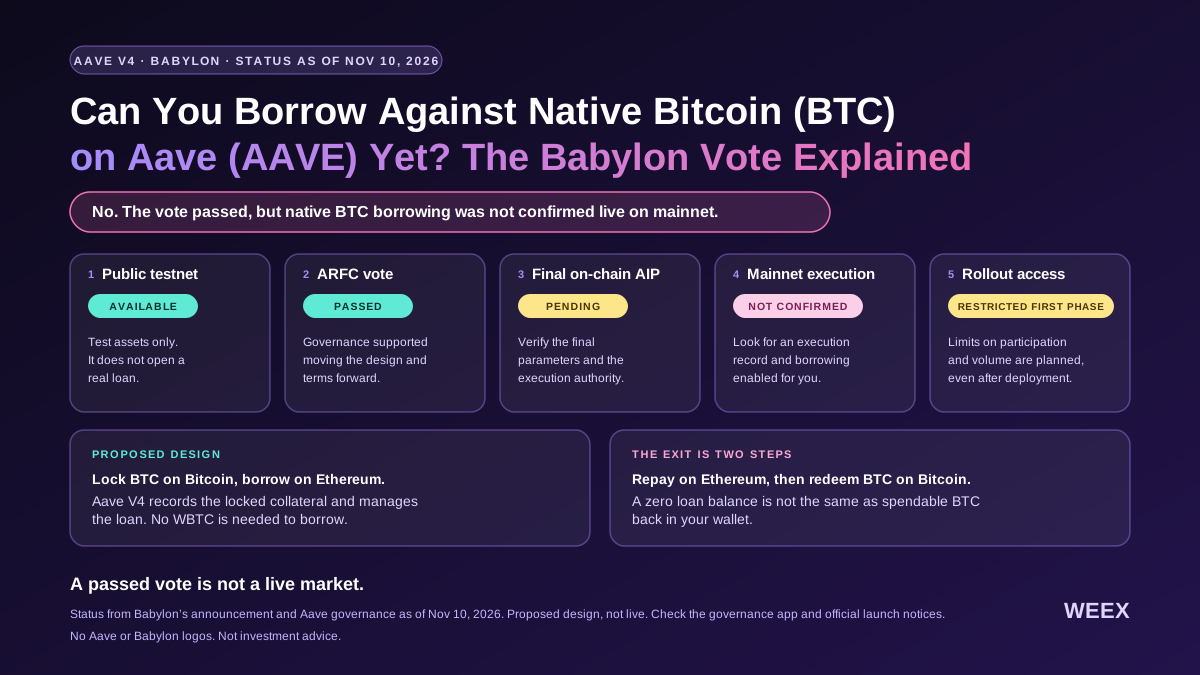
Can You Borrow Against Native Bitcoin (BTC) on Aave (AAVE) Yet? The Babylon Vote Explained
Can you borrow against native Bitcoin on Aave yet? See what the Babylon vote approved, what still needs to launch, and how BTC liquidation would work.
Why Doesn't Bitcoin Always Rise When Stocks Rally?
Financial Commission to Manage Stock Market Volatility with Sidecars and High-Frequency Trading Checks
IMF urges Kenya to make crypto firms share customer data under Travel Rule

Kim & Chang Lawyer: "Excessive Responsibility Should Not Be Imposed on Stablecoin Issuers"
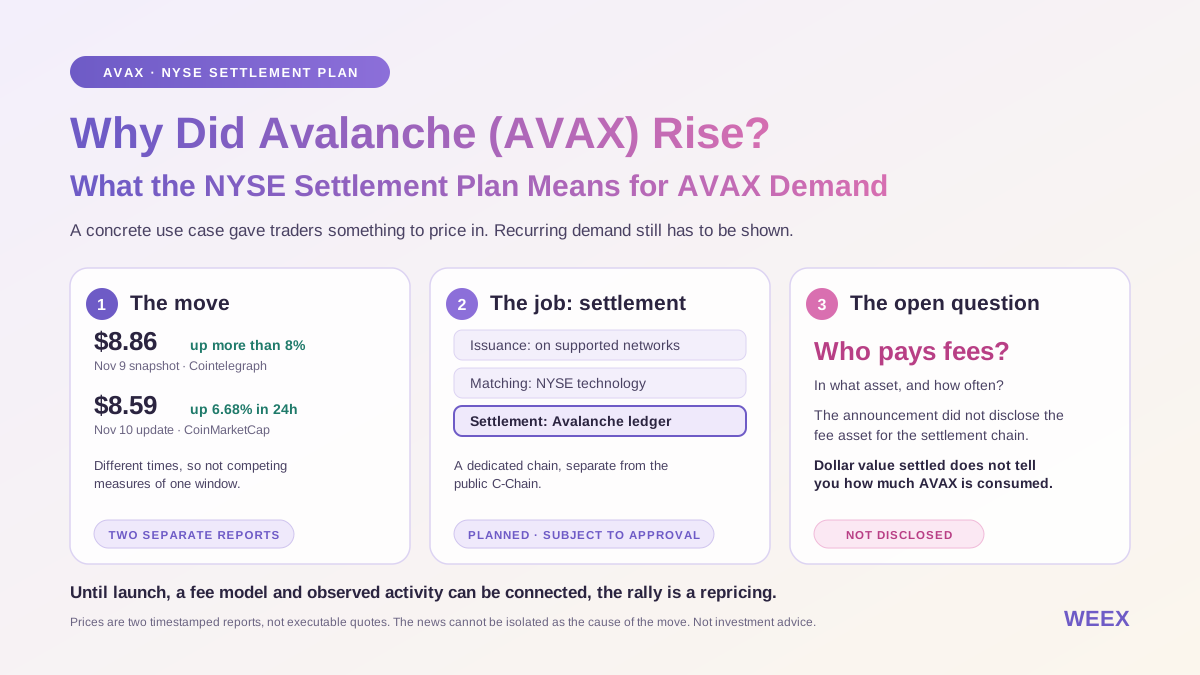
Why Did Avalanche (AVAX) Rise? What the NYSE Settlement Plan Means for AVAX Demand
See why Avalanche (AVAX) rallied after the NYSE settlement announcement, how the dedicated chain would work, and what could create demand for AVAX.

Cryptocurrency Security Checklist: Four Lessons from Phemex Safety Hub Vol. 05–08

Solana's Former DEX Leader Prepares to Go All In on US Stocks

PIEVERSE Price Up Nearly 80% in a Week: Futures Activity, the November 14 Unlock and What Is Confirmed
PIEVERSE rose about 79% in seven days with futures volume far above spot. See what is confirmed about the November 14 unlock and the WEEX Lucky Eggs campaign.

Unauthorized Access to Gnosis Pay's Old Card System Leads to Customer Data Breach

Alchemy Pay Says Mississippi Licence Expands US Money Transmission Coverage to 20 States
When is the launch date of Bitcoin Hyper? Testnet, tokens, and mainnet are separate milestones
Jon Leaves Hyperlane to Join Open Standard as Marketing Head
TRON Industry Weekly Report: Stagflation May Lead BTC to Test $80,000 Support Again, Detailed Explanation of Building Chain Abstract Web3 Experience Infrastructure Newton
Autheo THEO token plunges 92% after suspected bridge exploit
Radix Foundation Fixes Vault Authorization Vulnerability, Cross-Chain Asset Withdrawal Incident Resolved
3-year-old bug triggers $1.3 million drain and forces 10-day blockchain halt
Latest articles


Latest coin listings on WEEX


