
Market Prediction Fallacy: Is Trading Based on Fact or Rule?

 Prefer us on Google


Original Title: "Prediction Market Plunged into Another Major Controversy: Are You Trading on Fact or Rule?"
Original Author: Asher, Odaily Planet Daily
The prediction market can be said to be the most hotly debated track in the current Web3 discussion.
Prediction trading around macro events, the crypto industry, and even entertainment topics continues to heat up, with the level of discussion and participation constantly rising. However, as the market rapidly develops, some discordant voices have gradually emerged—certain events have deviated from users' expectations based on common sense or "real-world understanding" at settlement, triggering controversies regarding rule design, fairness, and platform credibility.
Recently, the prediction market has seen two consecutive high-controversy events. Below, the Odaily Planet Daily will sort out and discuss them.
Polymarket: U.S. Rescue of American Pilot in Iran Determined as U.S. Invasion of Iran
On April 3, a U.S. F-15E Strike Eagle fighter jet was shot down by the Iranian air defense system in southwestern Iran. Two crew members (one pilot, one weapon systems officer/WSO) parachuted out, with one quickly rescued and the other missing for several days, hiding in the Iranian mountains.
The U.S. military then launched a search and rescue (SAR) operation, involving armed aircraft, helicopters, etc., and successfully rescued the second severely injured crew member (Trump personally announced "WE GOT HIM"). The rescue operation involved U.S. military entering Iranian territory (mountain search and rescue, possible ground or low-altitude operations), which raised concerns against the current backdrop of sensitive geopolitical conflicts.
As the U.S. military entering Iranian territory can be considered to some extent as a U.S. invasion of Iran, it directly affected the prediction event on the Polymarket platform regarding when the U.S. military would invade Iran (US forces enter Iran by?).
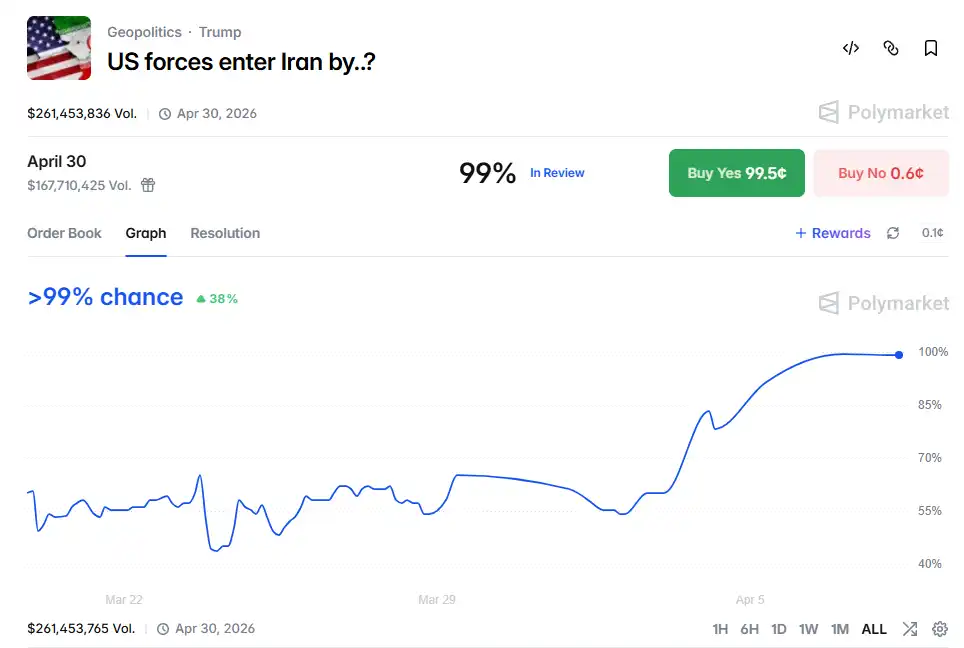
According to the settlement rules, active-duty U.S. military personnel (including special operations forces) entering Iranian land territory before a specified date would be considered an invasion, with the downed pilot not counting as an invasion, but U.S. special forces did indeed enter Iranian territory to rescue the pilot. Therefore, the special forces entering Iran to rescue the pilot met the standard for determining the U.S. invasion of Iran as Yes on Polymarket.
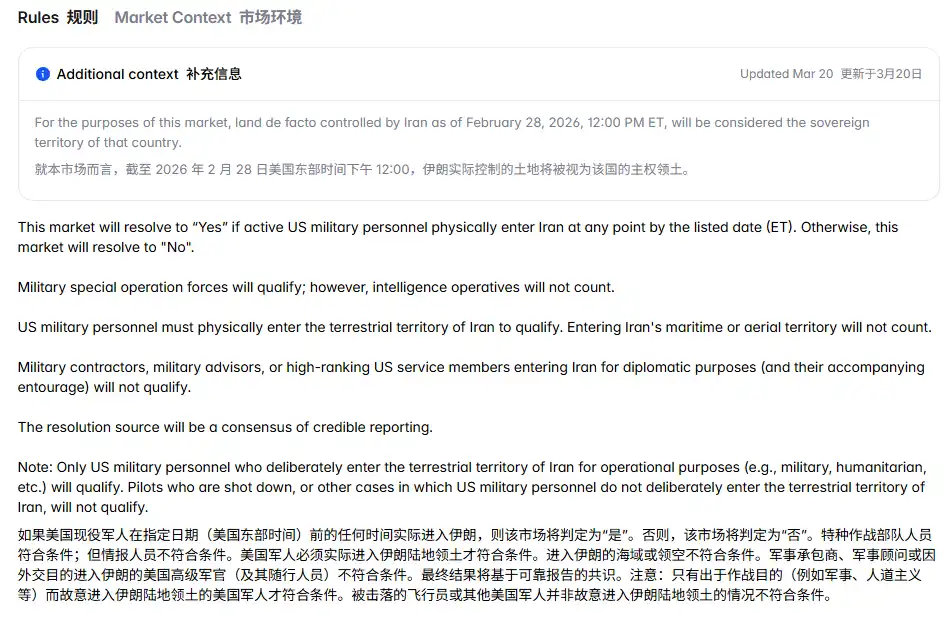
The "Pilot Rescue" event has been judged by Polymarket as the U.S. invasion of Iran, sparking strong community controversy.
Supporters of the "Count as Entry" (Yes side) believe that this action meets the definition of "entry" as per the rules. The U.S. Special Forces actively entered Iranian territory to carry out a mission, and the rules explicitly state that "special operation forces will qualify," including "for operational purposes (including humanitarian)." From an objective standpoint, this is the first confirmed U.S. ground penetration behavior in the current conflict context, with U.S. personnel indeed stepping on Iranian soil, hence should be considered an "entry."
Opponents of the "Count as Entry" (No side) argue that this definition is overly broad. They believe that this action was essentially a short-term, limited humanitarian rescue operation, not an invasion or occupation, and does not align with the general understanding of the public regarding "U.S. troops entering Iran."
Furthermore, the rules explicitly exclude that "pilots who are shot down... will not qualify," and this action revolves around the downed pilot, having the nature of "forced entry," which logically should fall into a similar exception category. Referring to past cases (such as similar regional actions not being considered invasions), rescue actions should not be equated with military entry; if judged as Yes, it may encourage marginal interpretations of the rules, weakening the seriousness and consistency of the market.
The Chinese community also generally believes that "entering Iran" should more specifically refer to large-scale ground or amphibious operations, rather than short-term actions of "rescue and leave."
Predict.fun: Polymarket Issuing Stablecoin Deemed as Token Launch
On the evening of April 6, Polymarket officially announced on X that it would undergo a comprehensive platform upgrade:
Rebuilding the trading engine, upgrading smart contracts; introducing a new native collateral token, Polymarket USD (1:1 pegged to USDC, to replace USDC.e, reducing bridging risks).
Notably, the second point mentioned the launch of the native collateral token Polymarket USD, directly impacting the probabilities of two related prediction events on Predict.fun.
One is token launch; the other is post-launch market cap:
1. When will Polymarket launch a token (Will Polymarket launch a token by ___ ?).
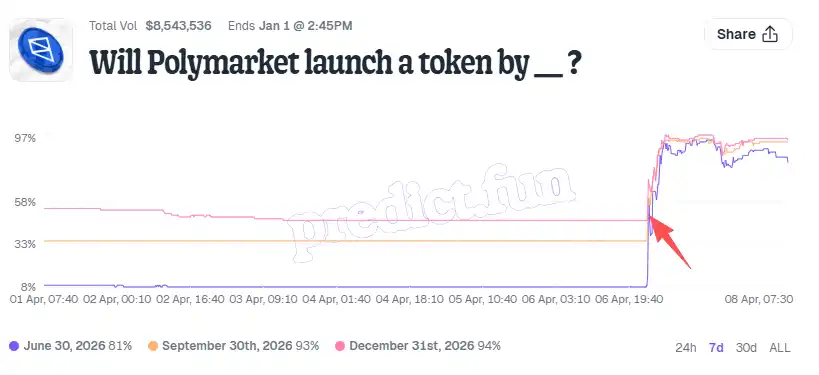
2. One day after opening, what was the FDV of Polymarket (Polymarket FDV above ___ one day after launch?)?
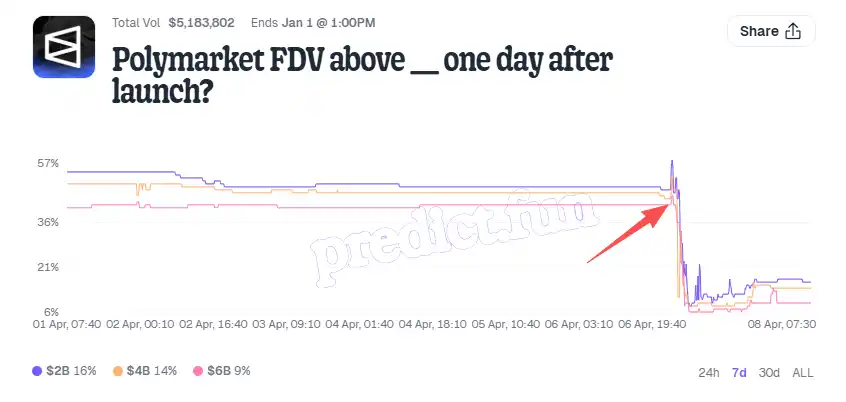
According to the settlement rules document, it is clearly stated that "any fungible token issued by Polymarket counts as 'issuance' for this event," and stablecoins are no exception. Therefore, Polymarket's stablecoin meets the criteria to be judged as Yes.
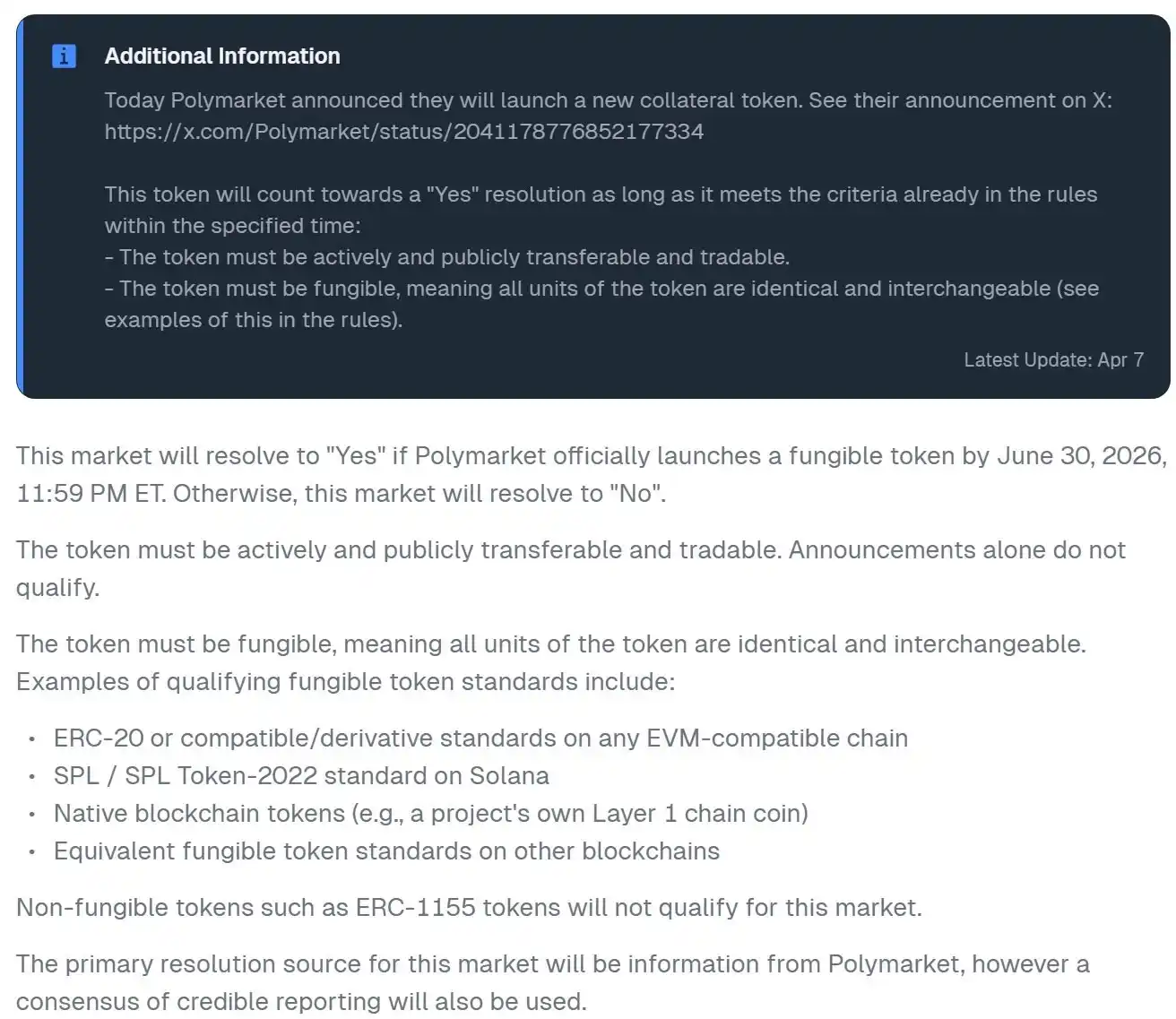
Settlement Rules Explanation
The community has engaged in a debate on this matter.
Supporters argue that based on the literal interpretation of the rules, "token issuance" is not limited to being a "governance token," but is a general reference to all tokens. Under this premise, Polymarket USD, as an ERC20/SPL fungible token issued by Polymarket, fundamentally meets the definition of "issuance." Furthermore, subsequent official clarifications are more of a reiteration of the original rules rather than a temporary rule change, making them somewhat reasonable in terms of compliance.
However, skeptics do not accept this explanation. On the one hand, they believe that including stablecoins in the category of "issuance" is an overinterpretation of the rules and a typical play on words. On the other hand, even if stablecoins are considered "issuance," the core of this prediction market is still the "Polymarket FDV," not the "Polymarket USD FDV." Stablecoins serve more as collateral or settlement tools, and their market value structure differs fundamentally from that of the project's native token (such as the POLY governance token), so they should not be directly equated or substituted for the overall project valuation logic.
Whose Side Are You On?
Overall, the controversial event in the prediction market actually revolves around a central question: are you betting on "reality" or on "rules"? Many times, these two do not completely overlap.
For those of us involved in prediction markets, understanding the rules themselves may be more important than predicting the outcome. How the information source is defined, whether there are any exceptions, whether there is room for interpretation—these details can directly determine the outcome at critical moments.
It is also for this reason that some high-probability events that appear to be a "financial management trap" may not be without risk, but may instead be a potential "loss trap." Many reversals occur precisely in these overlooked details. Instead of blind betting, take a closer look at the rules. It is more useful to do so than to complain after losing money.
This content is provided for general informational purposes only and doesn't constitute financial, investment, legal, or tax advice. Any events, rewards, online promotions, or related information mentioned herein should not be considered a recommendation, solicitation, or invitation to purchase, sell, trade, or otherwise deal in any crypto assets. Crypto assets are highly volatile and may result in loss. The availability of WEEX services, products, and related events may vary by region. You are responsible for ensuring that your participation is in accordance with applicable local laws and regulations.
You may also like

Morgan Stanley Expands Cryptocurrency Offerings with New Ethereum and Solana Products

Roger Ver Bitcoin: Does Freedom Still Disturb the State?

August Brings Increases in Transportation, Rent, Health Insurance, and More: All the Price Hikes That Will Hit Wallets
What is the Squeezy Dumpling, the viral toy being pulled from the market for being toxic
CEO of Major Firm Exits XRP. What’s Behind This Move?

Fixed-term deposits continue to stagnate: what you earn by investing $1,200,000
BloFin Research: Silver, 50 Years of Boom and Bust

WEEX GOGOGO Ep.5 Goes Live July 31: Trade Smarter, Move Faster
WEEX GOGOGO Ep.5 goes live July 31, 19:00 (UTC+8). Watch the WEEX product launch for the 1000 BTC Protection Fund, TG Mini App, Passkey security, and a live prize pool worth thousands. Set your reminder now.

P2MR: How the First Quantum-Resistant Bitcoin Address Works Technically

Alphabet: Record Profit and Worst Cash Flow in Its History, at the Same Time
The inside story of how a hike in Hong Kong changed crypto trading forever

Tiger Research: AI Agent Wallets Become New Battlefield in Cryptocurrency, Giants like Coinbase Prepare for Micro Payments

New Cardano partnership promises to monetize your private data, but payouts likely start at just $1.25 a year

The Tranquil Corner of San Luis to Disconnect from Routine Among Dikes and Hills
Tokenized Gold: How the Crypto Technology Works That Allows You to Buy a Gram of Precious Metal Without Holding It in Your Hand

Dash RSI: The Detail of the Movement That Challenges Imminent Reversal
Kalshi: A White House Employee Loses Job After Betting on Trump's Speeches

Bernstein cuts Circle price target to $140, says Open USD threat will fade
18 confirmed dead after earthquake in Japan: search for missing continues

XRP Reaches $100 Trillion? Analysts Point Out That Collateral is Key
Four women accuse actor and musician Jared Leto of sexual offenses

Salary, Schedule, and Booking: What Motivates Ukrainians to Change Jobs
Real Vision Founder: Rethinking the Long-Term Value of Cryptocurrency After 13 Years of Bull and Bear Markets

Ondo Buries Its Own Blockchain for a Private Network Tailored for Institutional Perpetuals
Nextflow AI OS Unveils at Malaysia Blockchain Week, Launching the World’s First AI Smart Body Phone to Ignite Southeast Asia's Web3 Market

STRC Dividend Becomes a 'Poison Pill', $500 Million in DeFi Synthetic Dollars Trapped
They survived the crypto crash of 2022, but they are closing down in 2026
Primitive Ventures: After US Brokerages Exit, Chinese Retail Investors Are Searching for the 'Missing Buy Button'
Institutions and Ethereum Whales Send Important Signal. Is There Unnecessary Rush?
Nine Major Doubts Smart People Have About Bitcoin
Morgan Stanley Expands Cryptocurrency Offerings with New Ethereum and Solana Products
Roger Ver Bitcoin: Does Freedom Still Disturb the State?
August Brings Increases in Transportation, Rent, Health Insurance, and More: All the Price Hikes That Will Hit Wallets
What is the Squeezy Dumpling, the viral toy being pulled from the market for being toxic
CEO of Major Firm Exits XRP. What’s Behind This Move?
Fixed-term deposits continue to stagnate: what you earn by investing $1,200,000
Contents
Latest articles




Latest coin listings on WEEX


