
MEET48 will launch the first AI Idol platform in the opBNB ecosystem, Mars Protocol.


On November 29, MEET48 announced that the Beta testing of Mars Protocol will take place in Q4 2024, with the official launch scheduled for Q1 2025. Mars Protocol is the first AI Idol platform in the OPBNB ecosystem, aiming to achieve an innovative combination of "Idol-Meme + AI-Agent," marking a new era in the Web3 Idol economy.
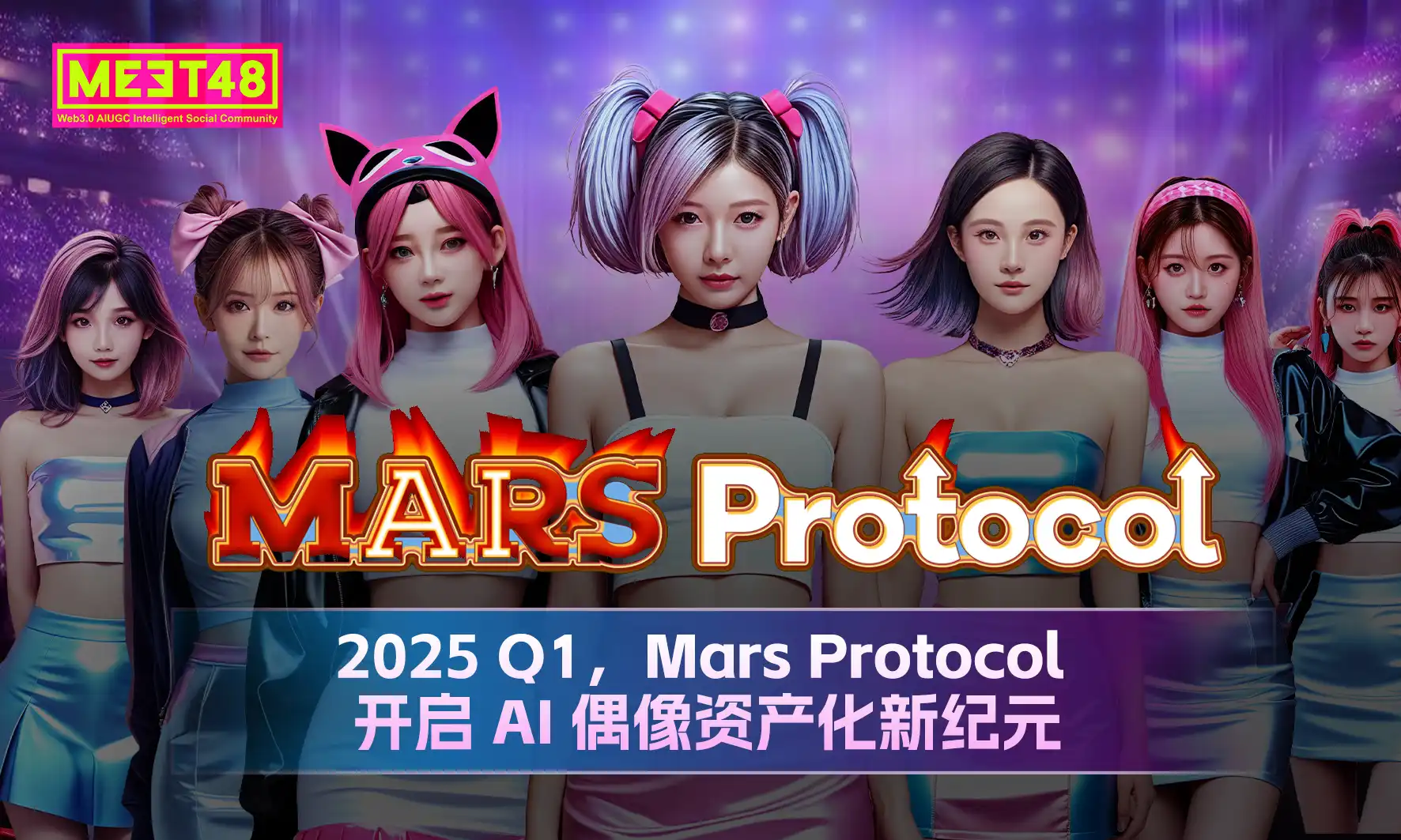
Mars Protocol deeply integrates AI technology with an on-chain assetization path, assisting users in swiftly issuing, circulating, and trading Meme coins through a one-click on-chain tool. At its core, the platform combines "Idol-Meme and AI-Agent" to tokenize Idol IP and enable value circulation. By utilizing a customizable Bounding Curve model, tokens can be rapidly listed on DEX, with every on-chain operation directly advancing the AI Idol from concept to value.
The platform offers a robust AISHOWBOX tool covering everything from music and dance videos to the generation and production of virtual idol images, providing creators and community members with convenient and efficient creative support. The functionality of AISHOWBOX not only serves as a creative medium but also acts as an entry point for users to participate in the construction of the Web3 Idol ecosystem, with each content production directly contributing to the idol economy.
MEET48 will host an annual Virtual Idol Incubation Competition to select promising AI idols and drive them to maximize their value in the Web3 scenario. The platform will provide comprehensive support for outstanding AI idols, including official Meme coin buybacks, liquidity injections, and facilitating listings on top exchanges. These exceptional AI idols will also participate in global tours in the future, gradually evolving into Web3 native idols with super-chain consensus.
The long-term development direction of Mars Protocol includes further incubating AI idol IPs in entertainment, gaming, metaverse, and digital art fields. Platform revenues will be used for MEET48 community incentives, AI Agent's live ecosystem construction, Idol IP brand building, and offline concert support, forming a complete chain of the idol economy. Mars Protocol will openly support idols' transition from Web3 native assets to global application scenarios, paving the way for new paths in digital entertainment and value creation.
It is worth noting that MEET48, as an AI UGC intelligent social metaverse project, has surpassed 3,000K registered users, with over 196K daily active users, and a UAW of up to 717K in the past 30 days. It has also been selected for the 8th season of the MVB (Most Valuable Builder) accelerator program in collaboration with BNB Chain, Binance Labs, and CMC Labs. Additionally, MEET48 owns the IP of SNH48, the world's largest face-to-face developed idol group, with over 30 million active fans and annual revenue generated from fan voting reaching as high as 100 million US$.
About MEET48
MEET48 is considered one of the largest Web3 application project teams globally, with a 500-person strong technical and R&D team covering regional operational networks in Singapore, Hong Kong, Taipei, Tokyo, Seoul, and Dubai. MEET48 aims to create an AI UGC content ecosystem focused on AIGC (Animation, IDOL, GAME, and Comics) Z-generation trendy entertainment content, as well as a graphical, intelligent metaverse social base to achieve the mass adoption of Web3 technology.
MEET48 Website: https://www.meet48.xyz/
Twitter (X): https://x.com/meet_48
Telegram: https://t.me/MEET_48
Discord: https://discord.gg/meet48
You may also like

Pantera Capital Partner: How Tokenization is Restructuring the Private Equity and Early Investment Ecosystem?

New York Proposes Stricter Stablecoin Issuer Rules Aligned With Federal GENIUS Act
NYDFS proposed stricter stablecoin issuer rules aligned with the GENIUS Act, covering reserves, custody, redemption timelines, audits, and capital buffers.
Every exchange is a "Universal Exchange."

The counterattack of traditional finance: Alliance chains are quietly reviving

CryptoQuant Says Bitcoin Profitable Supply Is Near 45% Pressure Zone as On-Chain Data Points to Market Repricing
CryptoQuant said Bitcoin’s profitable supply is nearing the 45% pressure zone, signaling rising market stress, unrealized losses, and a possible on-chain repricing phase.

Bitcoin Falls Below 200-Week Moving Average as On-Chain Data Shows Over Half of Supply in Loss
Bitcoin dropped below its 200-week moving average as on-chain data showed over 50% of circulating supply is now in loss, signaling rising market stress.

CFTC Reportedly Plans New Prediction Market Rules Focused on Manipulation Risk and Public Interest Review
The CFTC is reportedly preparing new prediction market rules focused on manipulation risk, public interest review, and retail trader protections.

Meet the new WEEX trial fund—your gateway to greater profits

WEEX Labs Lands at Dutch Blockchain Week: A Disruptive Crypto × AI Conversation Sets Sail in Amsterdam

SK Hynix Reportedly Plans U.S. ADR Listing as Early as August, With SEC Approval Possible in Late June
SK Hynix may pursue a U.S. ADR listing as early as August, with SEC approval reportedly possible in late June amid strong AI chip supply chain demand.

SpaceX vs Tesla vs xAI: Which Elon Musk Trade Has the Biggest Upside in 2026?
OpenAI Reveals It Has Confidentially Submitted an S-1 to the SEC, Keeping the Door Open for a Future IPO
On June 9, according to an OpenAI announcement, the company recently confidentially submitted a draft S-1 registration statement to the U.S. Securities and Exchange Commission (SEC), beginning the preliminary compliance process for a potential initial public offering. OpenAI said it chose to disclose this proactively because it expected the news might leak; however, the company has not yet set a specific listing timeline, and related arrangements may still take some time.

Latest research from 13 top universities including Cornell University: The current state, challenges, and misconceptions of the fusion of Crypto and AI
Deconstructing Anthropic: The Best AI Company, Possibly Also a Type of Organizational Invention
Apollo and Blackstone Reportedly Back $35 Billion Anthropic Chip Financing as Deal Details Remain Unclear
On June 9, according to currently available news alerts, Apollo and Blackstone Group participated in a $35 billion financing for an Anthropic “chip project.” Based on the original wording of the report, the funding has already been raised, but public information remains limited. The financing structure, use of proceeds, project entity, and whether Apollo and Blackstone participated through equity, debt, or project financing have not yet been disclosed.

Humanity Protocol Security Incident Escalates: More Than $31 Million Stolen From Related Addresses as Attacker Continues Selling H for ETH
On June 9, according to monitoring by Onchain Lens, more than $31 million has been stolen from addresses linked to Humanity Protocol, and the attack is still ongoing, with the hacker continuously swapping H tokens for ETH. Project founder Terence Kwok later confirmed the security incident on X, saying the issue involved a private key leak.

Bloomberg: As Bitcoin Weakens, Stablecoins and RWA Continue to Drive Expansion in Crypto Businesses
In June, Bloomberg reported that despite Bitcoin falling below $60,000 last week, wiping out about $235 billion in market value within seven days, and dropping close to 50% from last year’s peak, some core businesses in the crypto industry are still expanding, mainly in stablecoins, real-world asset tokenization (RWA), payments, and infrastructure. The report also noted that overall altcoin activity has contracted significantly: altcoin market capitalization has fallen from a peak of about $431 billion in November 2021 to around $170 billion, and among the tens of millions of tokens issued in recent years, fewer than 1,700 still maintain meaningful trading activity.

Galaxy Deep Research Report: How Hyperliquid's HIP-4 Upgrade Changes the Landscape of Prediction Markets?
Pantera Capital Partner: How Tokenization is Restructuring the Private Equity and Early Investment Ecosystem?
New York Proposes Stricter Stablecoin Issuer Rules Aligned With Federal GENIUS Act
NYDFS proposed stricter stablecoin issuer rules aligned with the GENIUS Act, covering reserves, custody, redemption timelines, audits, and capital buffers.
Every exchange is a "Universal Exchange."
The counterattack of traditional finance: Alliance chains are quietly reviving
CryptoQuant Says Bitcoin Profitable Supply Is Near 45% Pressure Zone as On-Chain Data Points to Market Repricing
CryptoQuant said Bitcoin’s profitable supply is nearing the 45% pressure zone, signaling rising market stress, unrealized losses, and a possible on-chain repricing phase.
Bitcoin Falls Below 200-Week Moving Average as On-Chain Data Shows Over Half of Supply in Loss
Bitcoin dropped below its 200-week moving average as on-chain data showed over 50% of circulating supply is now in loss, signaling rising market stress.


