
MicroStrategy Joins Nasdaq 100, Bitcoin Buy Pressure Flywheel Activated


Original Article Title: How I Missed My First 100X as a VC
Original Article Author: Marco Manoppo
Original Article Translation: Azuma, Odaily Planet Daily
Editor's Note: Marco Manoppo, an investor at Primitive Ventures, has been quite productive recently. Following his article last week on missing out on Virtuals (see "VC Account: How I Missed a 100X Return Opportunity on Virtuals"), Manoppo has published a new article today.
In this article, Manoppo outlines the trend of Bitcoin moving closer to traditional finance, especially after MicroStrategy (Ticker: MSTR) officially entered the Nasdaq 100 index, and the potential impact of passive investment funds on Bitcoin buying pressure. Against this backdrop, Manoppo states that despite some recent retracements in the cryptocurrency market, it is currently in a price discovery range, but he is more bullish on Bitcoin than ever before.
Below is the full content of Manoppo's article, translated by Odaily Planet Daily.

After eight consecutive weeks of gains, the cryptocurrency market has finally seen some pullback. Despite us being in a price discovery area, my bullish sentiment for Bitcoin is stronger than ever. The reason is simple: Bitcoin as an asset class is now entering the TradFi (Traditional Finance) system.
Growth of Passive Funds
To understand what the TradFi system is, one needs to evaluate the growth of passive funds in investing. Simply put, passive funds are investment products that aim to track and replicate the performance of specific market indices or market segments, rather than trying to outperform them. They follow a set of rules and methodologies to cater to their target market and required risk allocation.
SPY (SPDR S&P 500 ETF Trust) and VTI (Vanguard Total Stock Market ETF) are well-known passive funds. Most investment enthusiasts may still remember Buffett's bet with a hedge fund manager, believing that the performance of the S&P 500 index would outperform most active fund managers — Buffett has been proven correct. Since 2009, passive funds have consistently performed well, becoming the preferred investment method for most people.
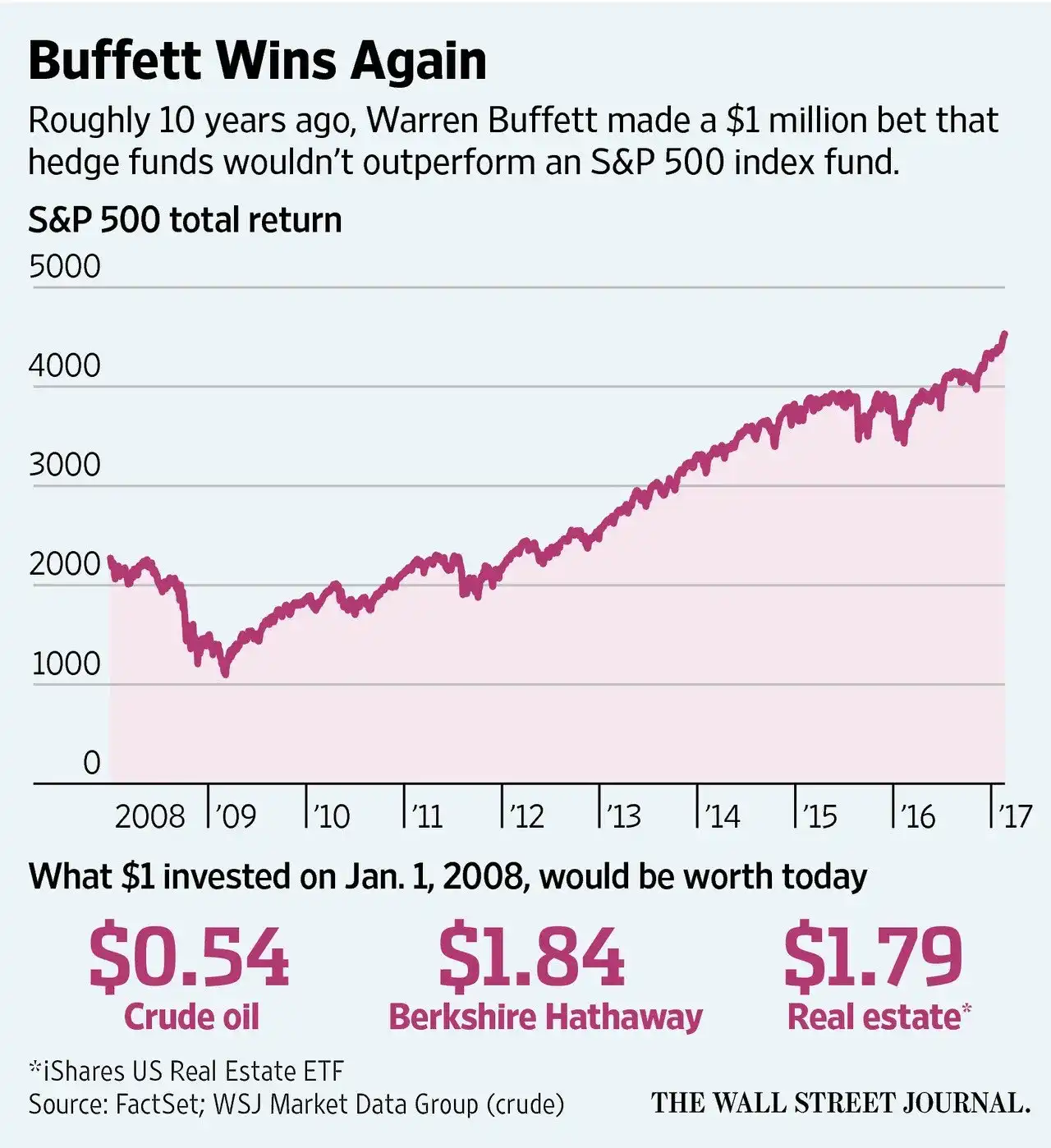
To delve into all the intricate factors driving the development of passive funds, a lengthy article would be needed, but we can summarize it into a few simple factors:
Better Cost Efficiency
Compared to actively managed funds, passive funds (such as index funds and ETFs) typically have a much lower expense ratio. This is because they do not require fund managers to do a significant amount of "active work." Once the rules and methods are set, algorithms take over, with only some human intervention during quarterly rebalancing. Lower costs usually mean better investment net returns, making passive funds more attractive to cost-conscious investors.
Lower Entry Barriers, Wider Distribution
In short, you have easier access to passive funds. Compared to active funds, investors do not need to struggle to select a fund manager; an industry already exists around distributing financial products to your grandparents. For regulatory reasons, passive funds often integrate more easily into the financial supply chain. Most active funds are often restricted in distribution materials, while passive funds have truly integrated into 401k plans, pension systems, and more.
More Stable Performance
The wisdom of the crowd often leads to better outcomes. Over the past 15 years, most active fund managers have failed to outperform the benchmark. While investing in passive funds, you may never get a 10x return as you might from early investment in Tesla or Shopify, but on the flip side, most people are not willing to put 50% of their net worth on a single stock. High risk, high reward is not always so appealing.
Here are some more interesting statistics:
· In the U.S., passive fund assets have quadrupled over the past decade, growing from $3.2 trillion at the end of 2013 to $15 trillion by the end of 2023.
· As of December 2023, passive funds' total assets under management (AUM) in the U.S. officially exceeded active funds for the first time in history.
· As of October 2024, U.S. equity index funds held $13.13 trillion in global assets, with $10.98 trillion in U.S. assets; while actively managed equity funds held $9.78 trillion in global assets, with $7.26 trillion in U.S. assets.
· Currently, index funds account for 57% of U.S. stock fund assets, up from 36% in 2016.
· In the first ten months of 2024, U.S. stock index funds saw inflows of $415.4 billion, while actively managed funds saw outflows of $341.5 billion during the same period.
This is why the entire traditional financial sector or cryptocurrency fund managers with experience in the traditional financial sector are so enthusiastic about the Bitcoin ETF narrative. They know that this is the starting point to open a larger gate, one that will truly bring Bitcoin into the average person's retirement portfolio.
Cryptocurrency Investment Products
But what is the relationship between Bitcoin ETFs and passive funds?
Although the three major index providers (S&P Dow Jones Indices, FTSE Russell, MSCI) have been tirelessly developing cryptocurrency indices, adoption has been relatively slow and currently only single-asset cryptocurrency investment products are available. Of course, this is because these products are easier to launch, so every institution is racing to become the first to launch a Bitcoin ETF. Today, we are seeing major institutions working on advancing an ETH staking ETF and more investment products based on altcoins.
However, the real game-changing product would be one that is a mix of Bitcoin with other investments. Imagine an investment portfolio composed of 95% S&P 500 Index and 5% Bitcoin, or 50% gold and 50% Bitcoin. Fund managers would be keen to promote such a product — they are also more easily integrated into the financial supply chain, increasing their distribution channels.
Nevertheless, the launch and promotion of these products will still take time. And given that they will be introduced as a new product, it is not expected to automatically benefit from the existing monthly purchasing power that popular passive products have.
MSTR Makes TradFi (3,3) Possible
Now it's MicroStrategy's (MSTR) turn to step into the spotlight.
With MSTR being included in the Nasdaq 100 Index, passive funds like QQQ (Invesco QQQ Trust, an ETF that tracks the Nasdaq 100 Index) will be forced to automatically purchase MSTR, and MSTR, in turn, will be able to use these funds to buy more Bitcoin. In the future, new "Bitcoin-Equity-Gold" hybrid passive investment products may take over MSTR's role, but in the foreseeable 3-5 years, MSTR, as a "Bitcoin treasury company," is more likely to play this role more easily because they are a mature U.S. publicly traded company and are more qualified to be included in top passive fund indices faster than newly launched passive investment products.
Therefore, as long as MSTR continues to utilize these funds to purchase more Bitcoin, the buy-side pressure on Bitcoin will continue to increase.
If this sounds too good to be true... that's because there are a few minor caveats to enabling MSTR to more effectively play this role. For example, the current requirement for inclusion in the S&P 500 index mandates that a company has been profitable in the most recent quarter as well as the last four quarters cumulatively, making it unlikely for MSTR to be included. However, new accounting rules set to take effect starting January 2025 will allow MSTR to declare the value change of its held BTC as net income, potentially making MSTR eligible for S&P 500 inclusion.
This is essentially the TradFi's (3, 3) system.
5-Minute Mental Math and Assumptions
I spent 5 minutes doing some quick calculations. If there are any errors in the calculations or suggestions on the assumptions made, feel free to point them out.
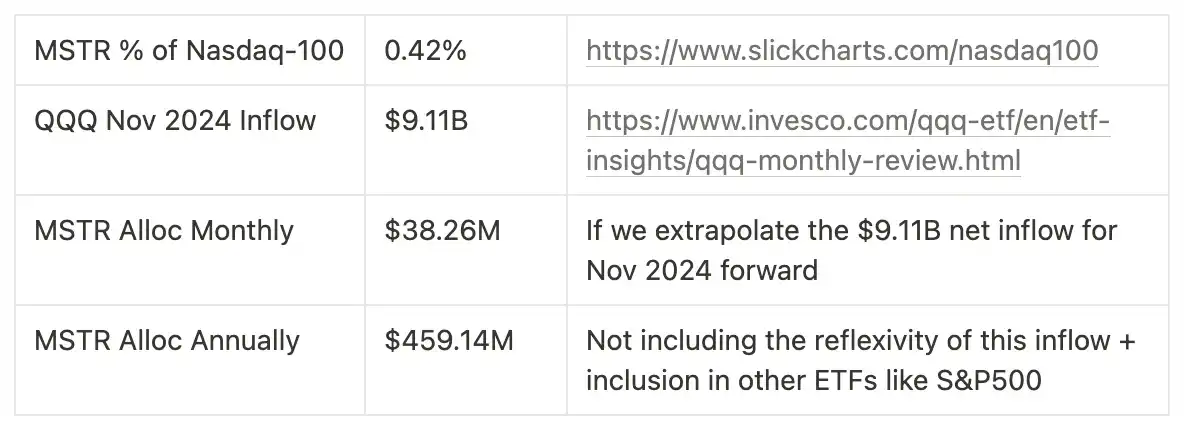
Odaily Note: Taking MSTR's 0.42% weight in the Nasdaq 100 index as an example, with QQQ's net inflow of $9.11 billion in 2024, this corresponds to a monthly net inflow into MSTR of $38.26 million, totaling $459 million annually.
In essence—the entire traditional finance passive investment ecosystem will unknowingly buy more Bitcoin due to MicroStrategy (MSTR) being included in major indices, similar to how they all hold Nvidia stock without realizing it, creating a (3, 3)-like effect on Bitcoin's price.
You may also like

Meet the new WEEX trial fund—your gateway to greater profits

WEEX Labs Lands at Dutch Blockchain Week: A Disruptive Crypto × AI Conversation Sets Sail in Amsterdam

SK Hynix Reportedly Plans U.S. ADR Listing as Early as August, With SEC Approval Possible in Late June
SK Hynix may pursue a U.S. ADR listing as early as August, with SEC approval reportedly possible in late June amid strong AI chip supply chain demand.

SpaceX vs Tesla vs xAI: Which Elon Musk Trade Has the Biggest Upside in 2026?
OpenAI Reveals It Has Confidentially Submitted an S-1 to the SEC, Keeping the Door Open for a Future IPO
On June 9, according to an OpenAI announcement, the company recently confidentially submitted a draft S-1 registration statement to the U.S. Securities and Exchange Commission (SEC), beginning the preliminary compliance process for a potential initial public offering. OpenAI said it chose to disclose this proactively because it expected the news might leak; however, the company has not yet set a specific listing timeline, and related arrangements may still take some time.

Latest research from 13 top universities including Cornell University: The current state, challenges, and misconceptions of the fusion of Crypto and AI
Deconstructing Anthropic: The Best AI Company, Possibly Also a Type of Organizational Invention
Apollo and Blackstone Reportedly Back $35 Billion Anthropic Chip Financing as Deal Details Remain Unclear
On June 9, according to currently available news alerts, Apollo and Blackstone Group participated in a $35 billion financing for an Anthropic “chip project.” Based on the original wording of the report, the funding has already been raised, but public information remains limited. The financing structure, use of proceeds, project entity, and whether Apollo and Blackstone participated through equity, debt, or project financing have not yet been disclosed.

Humanity Protocol Security Incident Escalates: More Than $31 Million Stolen From Related Addresses as Attacker Continues Selling H for ETH
On June 9, according to monitoring by Onchain Lens, more than $31 million has been stolen from addresses linked to Humanity Protocol, and the attack is still ongoing, with the hacker continuously swapping H tokens for ETH. Project founder Terence Kwok later confirmed the security incident on X, saying the issue involved a private key leak.

Bloomberg: As Bitcoin Weakens, Stablecoins and RWA Continue to Drive Expansion in Crypto Businesses
In June, Bloomberg reported that despite Bitcoin falling below $60,000 last week, wiping out about $235 billion in market value within seven days, and dropping close to 50% from last year’s peak, some core businesses in the crypto industry are still expanding, mainly in stablecoins, real-world asset tokenization (RWA), payments, and infrastructure. The report also noted that overall altcoin activity has contracted significantly: altcoin market capitalization has fallen from a peak of about $431 billion in November 2021 to around $170 billion, and among the tens of millions of tokens issued in recent years, fewer than 1,700 still maintain meaningful trading activity.

Galaxy Deep Research Report: How Hyperliquid's HIP-4 Upgrade Changes the Landscape of Prediction Markets?
Binance Research: RWA Market Expected to Expand Nearly 6x from Early 2025, with Public Equities and Onchain Payments Heating Up Together
In June, Binance Research said in its monthly market report that the real-world asset (RWA) market is expected to grow by about 589% from the beginning of 2025. Bond- and money market fund-related RWA expanded by about $6.5 billion, up 83% year over year, while publicly traded equity RWAs grew by about 422%. The report also noted that monthly crypto debit card transaction volume exceeded $747 million in May, up 48.6% year to date.

Japan to Assess a Framework for Yen Stablecoins and Crypto ETFs as Asia’s Compliant Payments Narrative Heats Up
Recently, according to the original report, Japan is considering the launch of yen stablecoins and cryptocurrency ETFs. Public information remains limited at this stage, and there is still no complete policy text, regulatory draft, or clear implementation timeline, so this is better characterized as a “policy discussion” rather than formal implementation. The original wording also noted that advancing stablecoin regulation in Asia is driving XRP usage and supporting growth in the XRPL ecosystem. However, based on currently available public information, there is not enough evidence to directly establish a clear causal relationship between this round of discussion in Japan and XRP or XRPL.

ZachXBT: Humanity private key leak and abnormal surge in H token should be viewed separately
On June 9, according to related disclosures, on-chain investigator ZachXBT posted an update on Humanity’s roughly $31 million security incident, saying that after further analyzing fund flows, he currently tends to believe the project team was not involved in an “inside job” or a self-staged attack. According to him, the official explanation about the private key leak was broadly accurate, but before the token unlock, the price of H had been artificially pushed higher, and the hacker later took advantage of that market environment; therefore, the private key leak and the earlier abnormal price pumping should be regarded as two separate and independent events. This reframing has shifted the market’s understanding of the nature of the incident. Earlier discussion around Humanity had focused on whether the team directly participated in the attack or used the security incident to cover up internal operations. ZachXBT’s latest remarks shift the focus from “whether it was self-theft” to “whether there were pre-unlock market structure issues.” He also questioned whether the team may have.

Morning Report | OpenAI has submitted an S-1 registration statement draft to the U.S. SEC; Morpho completes $175 million financing

Morning Report | BitMine increased its holdings by 126,971 ETH last week; trader Eugene announced his exit from the crypto market

Wang Chuan: How can one not feel anxious after the neighbor Old Wang made thirty times profit by investing in storage stocks? (Seven) - A quarter-century cycle
Cryptocurrency CEXs are flocking to sell US stocks, and traditional brokerages are facing an "uninvited guest."
Meet the new WEEX trial fund—your gateway to greater profits
WEEX Labs Lands at Dutch Blockchain Week: A Disruptive Crypto × AI Conversation Sets Sail in Amsterdam
SK Hynix Reportedly Plans U.S. ADR Listing as Early as August, With SEC Approval Possible in Late June
SK Hynix may pursue a U.S. ADR listing as early as August, with SEC approval reportedly possible in late June amid strong AI chip supply chain demand.
SpaceX vs Tesla vs xAI: Which Elon Musk Trade Has the Biggest Upside in 2026?
OpenAI Reveals It Has Confidentially Submitted an S-1 to the SEC, Keeping the Door Open for a Future IPO
On June 9, according to an OpenAI announcement, the company recently confidentially submitted a draft S-1 registration statement to the U.S. Securities and Exchange Commission (SEC), beginning the preliminary compliance process for a potential initial public offering. OpenAI said it chose to disclose this proactively because it expected the news might leak; however, the company has not yet set a specific listing timeline, and related arrangements may still take some time.
Latest research from 13 top universities including Cornell University: The current state, challenges, and misconceptions of the fusion of Crypto and AI


