
Mr. Beast Acquires Step: Top Streamer Enters Teen Finance Race?


Original Title: "The Most Generous KOL, MrBeast, Sets His Sights on Teen Digital Wallets"
Original Author: ChandlerZ, Foresight News
On February 9, well-known YouTube creator MrBeast, under Beast Industries, announced the acquisition of the teen-focused mobile banking app Step, venturing into the fintech sector. This move marks the company's first official action after announcing a $200 million equity investment from the Ethereum treasury company BitMine.
Step is an all-in-one financial management app designed to help young people embark on their financial journey through a digital banking platform. The company has long provided a range of services to teenagers and young adults, including savings accounts, a credit-building Visa card similar to a debit card, and cash advances. Step is not a bank itself but provides banking services through a partnership with Federal Deposit Insurance Corporation (FDIC) member Evolve Bank & Trust.
Both companies did not disclose the terms of the transaction. In 2022, Step announced that it had raised $500 million in equity and debt financing from institutional investors including General Catalyst, companies like Stripe, and individual investors like TikTok star Charli D'Amelio.
Expansion Beyond YouTube
MrBeast, whose real name is Jimmy Donaldson, has evolved from a solo creator to the core of a business organization spanning content, consumer products, and offline experiences. Public records show that he has over 4.66 billion YouTube subscribers, with his main channel and multilingual matrix reaching a massive combined audience, placing him at the top in terms of reach and user engagement on global internet platforms.
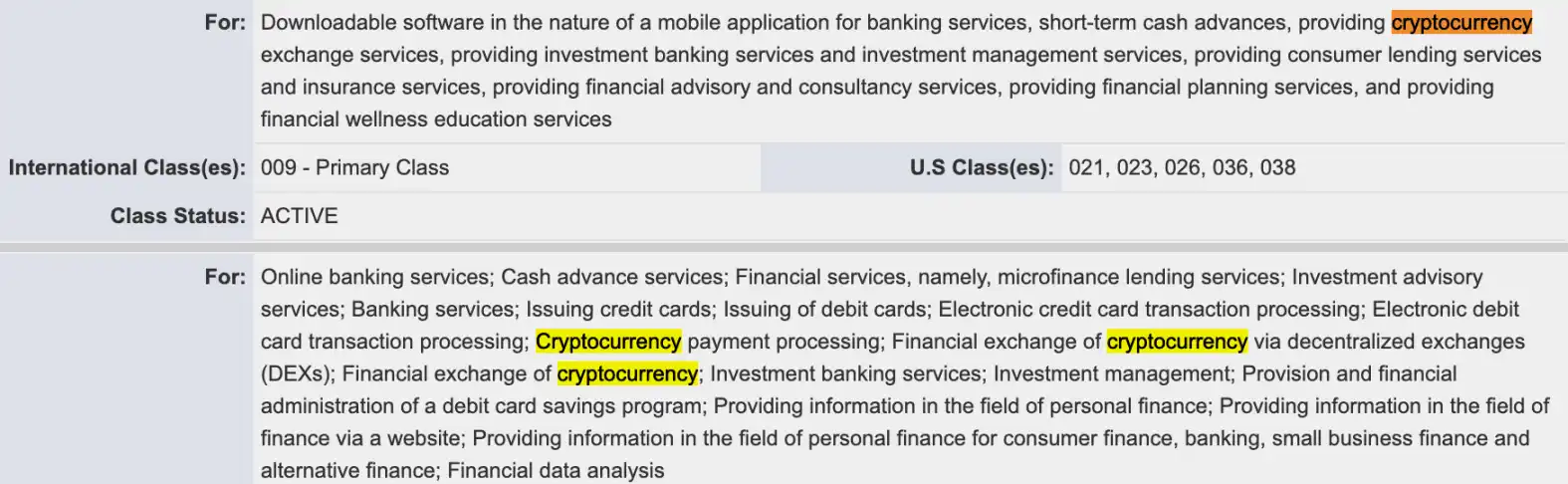
The influencer had been planning to enter the fintech sector for months. In October 2025, Beast Holdings, LLC filed a trademark application for "MrBeast Financial" with the US Patent and Trademark Office, with plans to offer cryptocurrency trading services, crypto payment processing, and crypto transactions via DEX.
Although a trademark application itself only represents a pre-set business scope and does not directly equate to product launch, there is still a time gap between regulatory approval and business implementation. Nevertheless, this is the first time MrBeast's intentions in the financial and crypto direction have been formally documented.
Fast forward one month, to January 2026, Ethereum treasury company BitMine announced a $200 million equity investment in Beast Industries, with the transaction expected to be completed around January 19, 2026. Beast Industries CEO Jeff Housenbold stated that they plan to explore further collaboration and introduce DeFi into their financial services platform in the future. Both parties plan to explore integrating DeFi into the upcoming financial services platform. Beast Industries is an entertainment and consumer goods company founded by popular YouTube creator MrBeast.
MrBeast has previously discussed his personal financial situation, seeing the acquisition of Step as an opportunity to "provide a financial foundation I never had for millions of young people." As the company prepares to enter the financial industry, MrBeast expressed his desire to create videos about finance, such as "educating people on how to invest and showing them what a Roth IRA is."
Previously Accused of Profiting Over $10 Million by Pumping and Dumping Cryptocurrencies
However, this is not MrBeast's first foray into the crypto space. On October 11, 2024, blockchain sleuth SomaXBT publicly released an on-chain investigation. The investigation claimed that MrBeast was involved in multiple projects' initial decentralized exchange (IDO) and token promotion events, profiting significantly as the token prices surged post-endorsement.
The projects involved included SuperFarm (SUPER), Polychain Monsters (PMON), SPLYT (SHOPX), among others, with some tokens experiencing over a 90% price drop after MrBeast's sell-off.
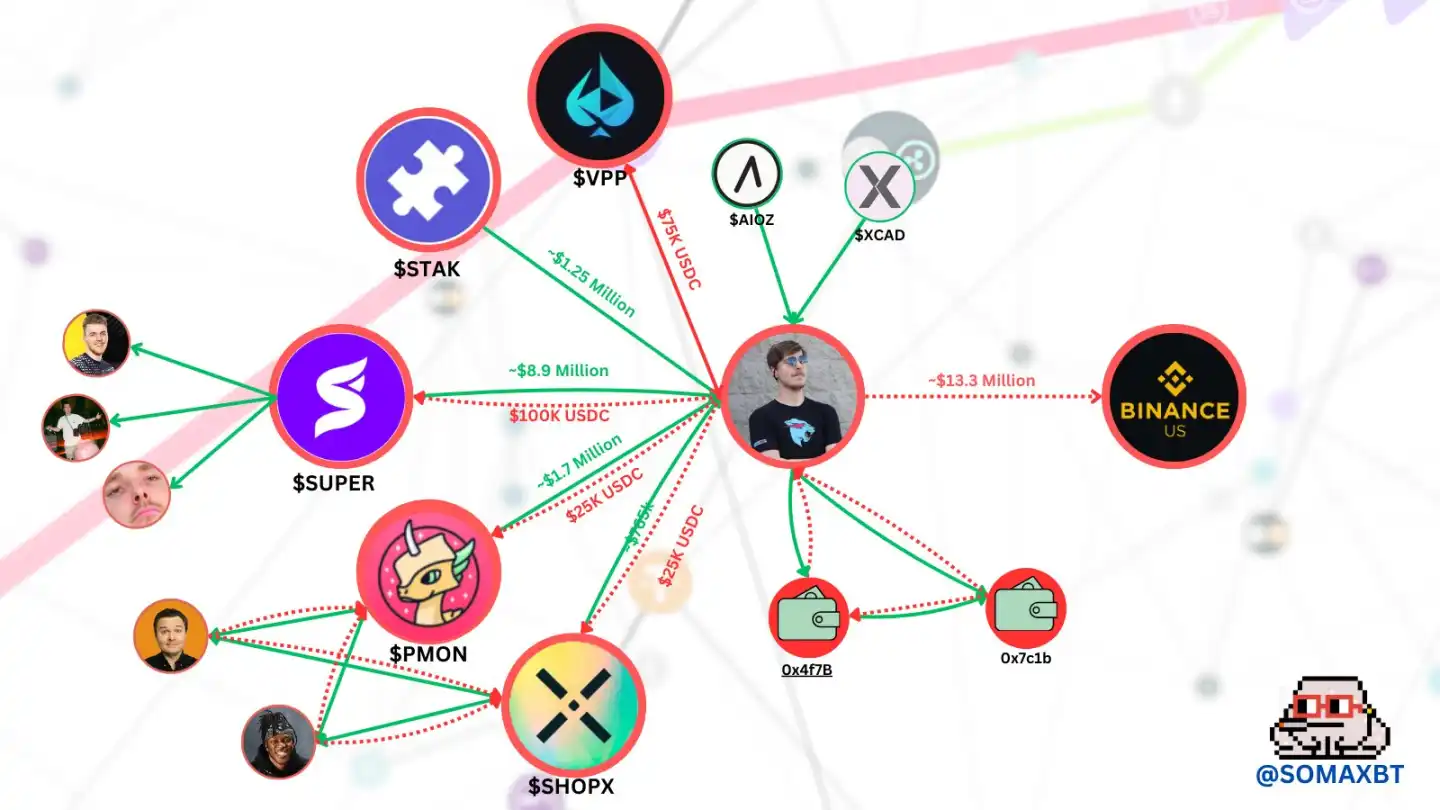
SomaXBT uncovered several cases, using the SUPER token as an example, a project backed by Elliot Trades.
According to SomaXBT, MrBeast invested $100,000 in the project and received 1 million SUPER tokens as a reward. After his investment, the token price skyrocketed, and on March 30, 2021, MrBeast transferred his SUPER tokens to a separate wallet, where they were sold off through a series of transactions, totaling 1,900 ETH (roughly $3.7 million at the time). MrBeast received additional SUPER tokens per a vesting agreement, which he later sold for $5.5 million, bringing his total earnings from the project to around $9 million.
The SomaXBT report also highlighted MrBeast's involvement with Polychain Monsters (PMON), another low-cap token project. In this case, MrBeast invested $25,000 and received 25,000 PMON tokens. On March 31, 2021, he transferred these tokens to another wallet and sold them through a series of transactions, resulting in a profit of 685 ETH (approximately $1.3 million).
The investigation also included projects like SHOPX, STAK, VPP in the same pattern discussion, noting that after MrBeast was accused of completing the sell-off, the prices of these tokens experienced significant retracements, with some falling over 90% from their peaks. This was considered a "pump and dump," emphasizing that a combination of influencer promotion and low liquidity tokens amplifies volatility and shifts the risk to retail investors.
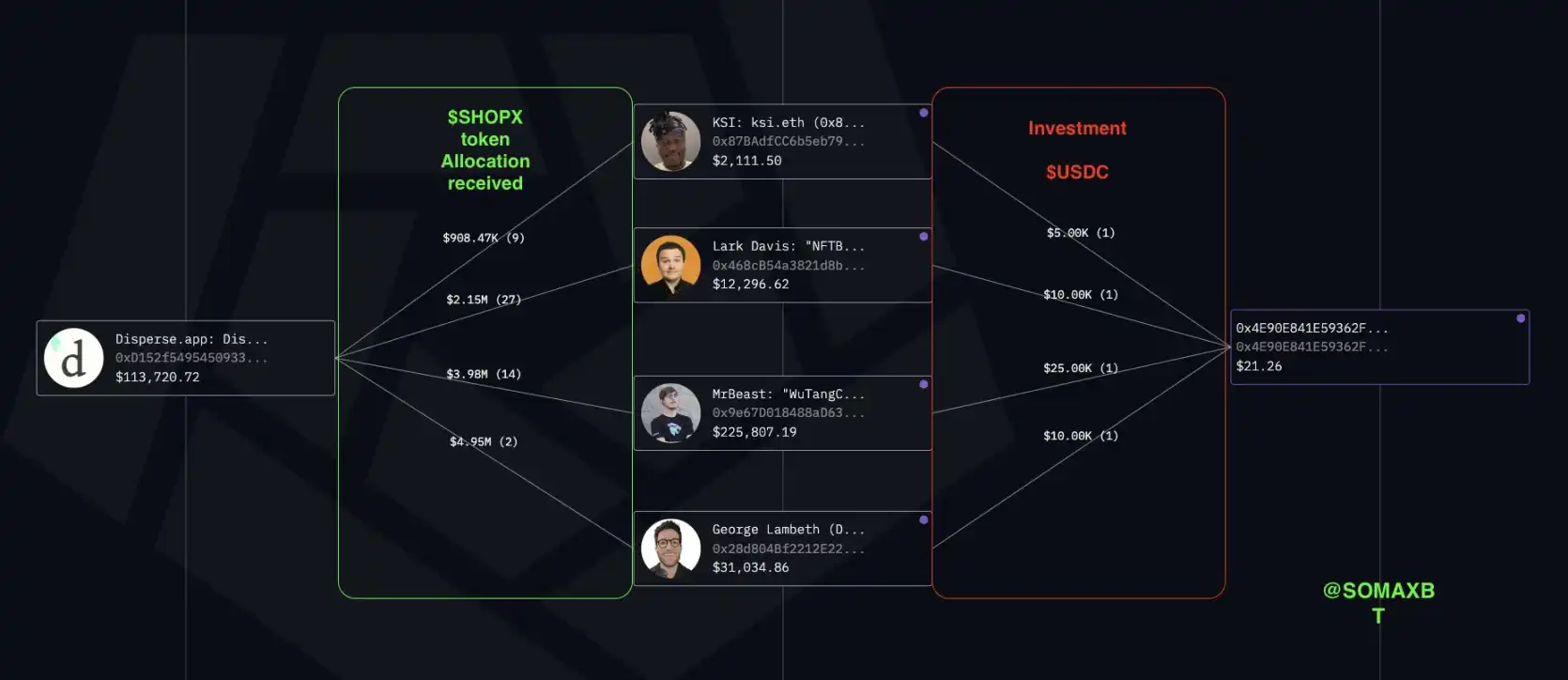
In addition, MrBeast also accumulated 705,821 ASTER tokens in September 2025, worth about $1.28 million at the time.
Overall, Beast Industries' financial foray has made a critical move, with their crypto capabilities still in the planning and exploration stage. Historical on-chain controversies may continue to affect external trust thresholds for their financial and crypto businesses.
You may also like

Morning Report | BitMine increased its holdings by 126,971 ETH last week; trader Eugene announced his exit from the crypto market

Wang Chuan: How can one not feel anxious after the neighbor Old Wang made thirty times profit by investing in storage stocks? (Seven) - A quarter-century cycle

Cryptocurrency CEXs are flocking to sell US stocks, and traditional brokerages are facing an "uninvited guest."

$75 billion in foreign capital has fled, and South Korean retail investors have absorbed it all using leverage

Japan’s Three Megabanks Plan Joint Stablecoin Issuance in Fiscal 2026
MUFG, SMBC, and Mizuho reportedly plan to jointly issue fiat-pegged stablecoins in fiscal 2026, signaling Japan’s growing push into bank-led digital payment infrastructure.

Humanity Discloses H Token Dual-Chain Attack Details, With Losses on Ethereum and BSC Exceeding $36 Million
Humanity said the H token attack across Ethereum and BSC caused more than $36 million in losses after leaked ProxyAdmin keys enabled malicious contract upgrades and token minting.
White House Discusses CLARITY Act With Law Enforcement Ahead of Senate Vote
The White House discussed the CLARITY Act with law enforcement ahead of a Senate vote, focusing on illicit finance risks and developer protections.

Bitcoin Trading Guide 2026: Strategies for Experienced Traders

What Is XAUT and PAXG? Why Tokenized Gold Is Booming in 2026

Will the SpaceX IPO Hurt Bitcoin? Here's What Traders Are Watching

Foreign selling in the South Korean stock market accelerates, with cumulative net sales reportedly reaching $75 billion this year
On June 9, The Kobeissi Letter, citing Goldman Sachs data, reported that global investors are selling South Korean stocks at an unusually rapid pace. In the latest trading session, foreign investors sold about $801 million worth of Kospi constituent stocks again; total foreign outflows last week reached about $10 billion, and the market has been in net foreign selling on nearly every trading day over the past month. According to the data cited in the report, foreign investors have sold about $75 billion worth of South Korean stocks so far this year. Meanwhile, South Korean retail and institutional investors together recorded roughly $69 billion in net buying over the same period, suggesting that the market’s main buying support has come from domestic capital rather than returning overseas funds. The information currently disclosed still mainly comes from The Kobeissi Letter’s retelling and Goldman Sachs data summaries, while public details on the statistical period and the specific definition of “selling” remain relatively limited.

Fortune Warns of Strategy’s Financing Structure Risks as Bitcoin Premium Narrows
Fortune warned that Strategy’s Bitcoin treasury model faces growing financing risks as MSTR’s net asset premium narrows and preferred stock dividend pressure increases.

Ferrari Challenge Le Mans: Carl Moon to Dominate in WEEX Livery

Sahara AI Responds to SAHARA’s Sharp Drop: No Contract or Product Security Issues Found, Internal Investigation Underway
Sahara AI responded to SAHARA’s 60% price drop, saying no token contract or product security issues have been found and an internal investigation is underway.

WEEX Deposit/Withdrawal Dynamic Island: Your Asset Status, Always in Sight
Scaling Crypto Derivatives: The Digital Asset Infrastructure Behind High-Volume Trading
In the fast-moving digital asset ecosystem, derivatives platforms face an extreme architectural test. High-leverage futures markets demand more than just standard security—they require absolute operational precision, zero-latency matching engines, and ironclad structural scalability, all while navigating intense market volatility.
As global platforms scale to meet these demands, the industry is shifting away from rigid, monolithic setups toward a more agile, "decoupled" infrastructure philosophy.
The Blueprint for High-Volume Copy TradingFor elite global exchanges like WEEX (founded in 2018), this architectural choice becomes critical when scaling high-volume retail features like social copy trading. When thousands of users automatically mirror the real-time strategies of elite traders simultaneously, it triggers sudden, monumental spikes in concurrent transactional volume.
To prevent execution latency or settlement bottlenecks during these peak volatility events, a platform's primary engine must remain entirely dedicated to risk management, copy-trade synchronization, and order matching.
The Architectural Rule: New-generation platforms must separate front-end user execution engines from heavy backend infrastructural overhead to eliminate operational friction.
By separating these layers, platforms can maintain complete sovereignty over their trading environments and user experiences while strategically aligning with institutional-grade infrastructure ecosystems. This strategic framework allows modern exchanges to leverage advanced Digital Asset Custody infrastructure such as Cobo’s behind the scenes, ensuring that backend wallet management scales elastically alongside trading spikes.
Capitalizing on Market Momentum and 400× LeverageIn a derivatives arena where platforms offer up to 400× leverage on perpetual contracts, capital efficiency and market agility are core business metrics. To capture market momentum, an exchange needs the ability to rapidly expand its asset offerings, supporting everything from legacy crypto assets to sudden, trending altcoins across a massive library of trading pairs.
Adopting a flexible, scalable Wallet-as-a-Service (WaaS) solution such as Cobo’s could completely rewrite the development timeline for high-growth exchanges. Instead of spending months of engineering capital building out custom backend wallet architectures for every new blockchain network, platforms can deploy localized infrastructure in days.
This agility allows platforms to instantly scale their listings to over a thousand trading pairs without compromising security or delaying time-to-market. It mirrors the exact operational advantages seen during high-velocity market events, similar to how advanced wallet infrastructure empowers platforms during sudden asset surges; allowing exchanges to pass that speed and liquidity directly to their global user base.
A Mature Foundation for GrowthThe synergy between trusted infrastructure ecosystems and global trading platforms represents the natural evolution of a maturing crypto market. As WEEX continues to scale its global spot and derivatives offerings for over 6 million users, adopting robust backend paradigms proves that platforms no longer have to compromise between cutting-edge trading velocity and uncompromised structural security.

Get Paid to Onboard? Try WEEX’s New Homepage with Rewards for Registration, Deposit & Trade
WEEX Custom Layout: Build Your Perfect Trading Workspace in Seconds
Morning Report | BitMine increased its holdings by 126,971 ETH last week; trader Eugene announced his exit from the crypto market
Wang Chuan: How can one not feel anxious after the neighbor Old Wang made thirty times profit by investing in storage stocks? (Seven) - A quarter-century cycle
Cryptocurrency CEXs are flocking to sell US stocks, and traditional brokerages are facing an "uninvited guest."
$75 billion in foreign capital has fled, and South Korean retail investors have absorbed it all using leverage
Japan’s Three Megabanks Plan Joint Stablecoin Issuance in Fiscal 2026
MUFG, SMBC, and Mizuho reportedly plan to jointly issue fiat-pegged stablecoins in fiscal 2026, signaling Japan’s growing push into bank-led digital payment infrastructure.
Humanity Discloses H Token Dual-Chain Attack Details, With Losses on Ethereum and BSC Exceeding $36 Million
Humanity said the H token attack across Ethereum and BSC caused more than $36 million in losses after leaked ProxyAdmin keys enabled malicious contract upgrades and token minting.


