
Not Just Guessing Right or Wrong, Market Prediction Is Getting More and More “Fun”





Original Article Title: "As Someone Who Plays Prediction Markets Every Day, I Have Seen These Innovations and Changes"
Original Article Author: Asher, Odaily Planet Daily
“Polymarket has such great liquidity, besides farming points for token airdrops, why would anyone still use other prediction market platforms?” This is a question I have been pondering constantly as I recently experienced multiple prediction markets.
Indeed, during the token issuance phase of Polymarket's parent company Blockratize, a trademark application for "POLY" was submitted, coupled with previous statements by Polymarket executives indicating plans to launch a native token and conduct an airdrop, leading the market to generally expect that farming Polymarket may be the next "big thing." However, unlike other emerging prediction markets, Polymarket has not yet launched a clear points or task incentive system. Users find it difficult to dynamically adjust their "farming" strategy based on points incentive feedback, to some extent still in a challenging mode of "blind farming".
In contrast, most of these emerging prediction market platforms have introduced a points mechanism, allowing users to have a clearer "airdrop strategy path" while participating in platform trades. Although these prediction market platforms are mostly still in the early stages, with certain bugs and occasional community complaints, in the actual experience process, some differentiation highlights "distinct from Polymarket" can indeed be found.
Below, I will introduce several highlights summarized from experiencing different prediction market platforms recently.
Highlight One: Idle Funds Will No Longer Be "Flat," Predictive Positions Can Continue to Generate Revenue
In traditional prediction markets (such as Polymarket, Kalshi), after users buy YES/NO positions, the funds are usually locked until event settlement. During this time, these funds cannot participate in other strategies and do not generate any income, essentially representing a "idle fund" with significant opportunity cost.
predict.fun is attempting to change this. The platform will access the BNB Chain's low-risk interest rate strategy for the collateral funds users use for predictions, allowing positions to automatically generate stablecoin revenue during the holding period. According to an official announcement on January 8, 2026, predict.fun has partnered with the Venus Protocol, and the USDT collateral assets locked by users will be automatically deposited into Venus's money market for interest, thereby continuously generating additional revenue while waiting for the event results.
In other words, users' funds are still actively "working" on the chain during the holding period, with the typical stablecoin annualized yield ranging around 3%–5% (specifically depending on the underlying DeFi strategy and market conditions). More importantly, this portion of yield is independent of the prediction outcome—whether the ultimate prediction is successful or not, the yield generated during the holding period can be claimed separately, essentially adding an extra layer of passive income beyond predicting gains or losses.
From a product mechanism perspective, this design effectively transforms the "idle funds" in traditional prediction markets into "active funds," which is one of the most distinctive features of predict.fun. The platform has now enabled the feature to claim holding rewards, allowing users to collect accumulated holding rewards at a fixed time every Tuesday, providing a clearer compound yield logic for long-term holding at the strategy level.
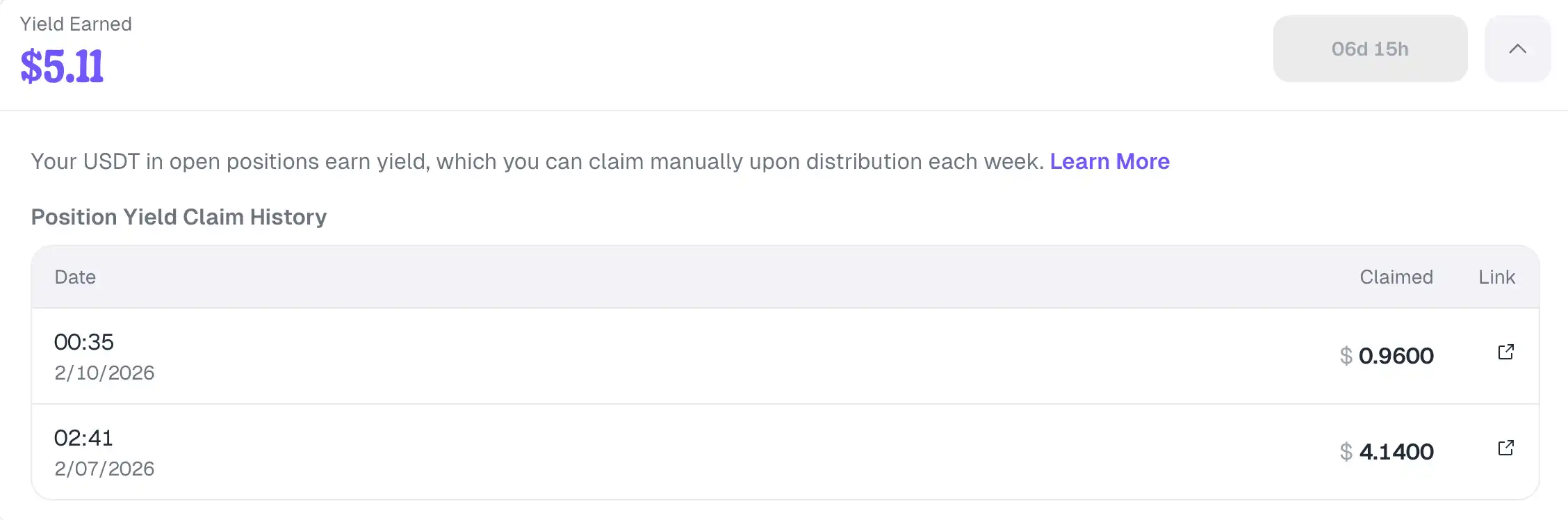
predict.fun Holding Reward Claiming Diagram
Highlight 2: Short Video-Style Swipe Experience, Bringing the Prediction Market Closer to "Content Consumption Products"
Different from the traditional transaction terminal-oriented interface of prediction markets, some emerging prediction market platforms have notably leaned towards content platforms in interactive design, seeking to lower the entry barrier and increase user engagement time. For example, in the mobile interface of predict.fun, each screen corresponds to a prediction event, allowing users to quickly browse through different markets by swiping up and down. The overall experience is more akin to the information feed pattern of short video platforms. This design enables users to naturally discover interesting prediction targets through continuous "market browsing" without actively searching for events, significantly enhancing browsing efficiency and participation frequency.
Similarly, Probable adopts a left-to-right swipe interaction, making the prediction behavior more closely resemble the information matching logic of social product experiences. From a product perspective, the core of such designs is not just about optimizing the UI but rather attempting to transform the prediction market from a "low-frequency trading tool" to a "high-frequency content consumption gateway."
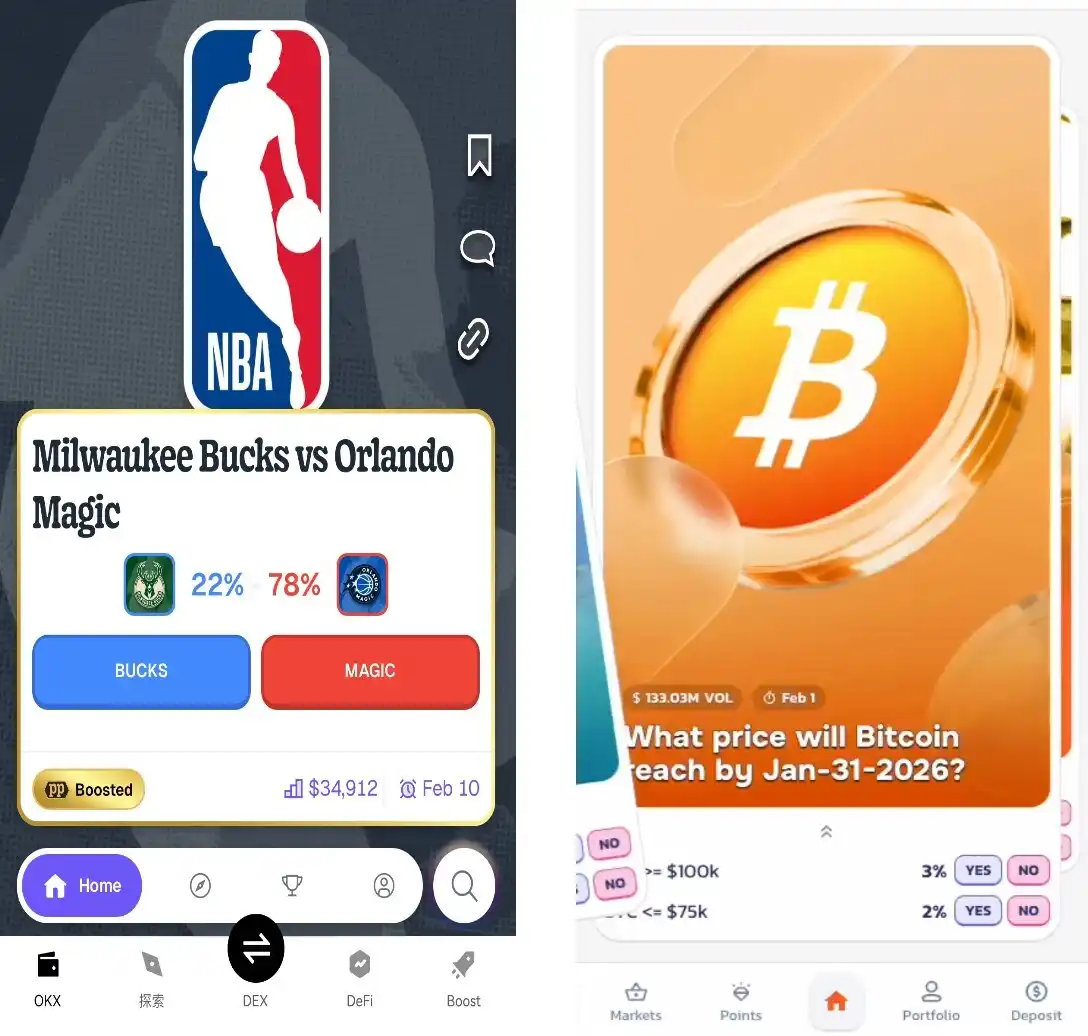
Illustrative Diagram of the Mobile Interaction Styles of Two Prediction Market Platforms (Left: predict.fun; Right: Probable)
The founder of predict.fun, Dingaling, has also mentioned in a Space that he hopes to build the prediction market into a scenario similar to a short video app—where users can place bets while browsing daily hot events and interesting topics, enhancing community engagement and user stickiness further through features like comments and interactions.
From the experiential perspective, this kind of information flow-based interaction is itself a highly attractive product innovation. Compared to the traditional way of actively seeking out the market, scrolling browsing allows users to continuously "market surf" in fragmented time, naturally engaging in participation while browsing content, making the user experience of prediction markets more lightweight and seamless.
Highlight Three: The "Exclusive Event Market" around Community Hot Topics, Enhancing Localization Engagement
In addition to product mechanics and interaction experience, some emerging prediction market platforms have also begun to explore a differentiated route in market content design. They no longer simply replicate the generic events on Polymarket or Kalshi but instead focus on topics with high internal community interest within the crypto community, introducing more niche "exclusive event markets." For example, events on predict.fun related to Binance and community hot topics, including "Bitcoin balance changes in the March 1st Binance SAFU Fund Wallet" and "The number of CZ tweets from February 7th to 14th, 2026," belong to the type of topics that are closer to daily discussions among crypto users.
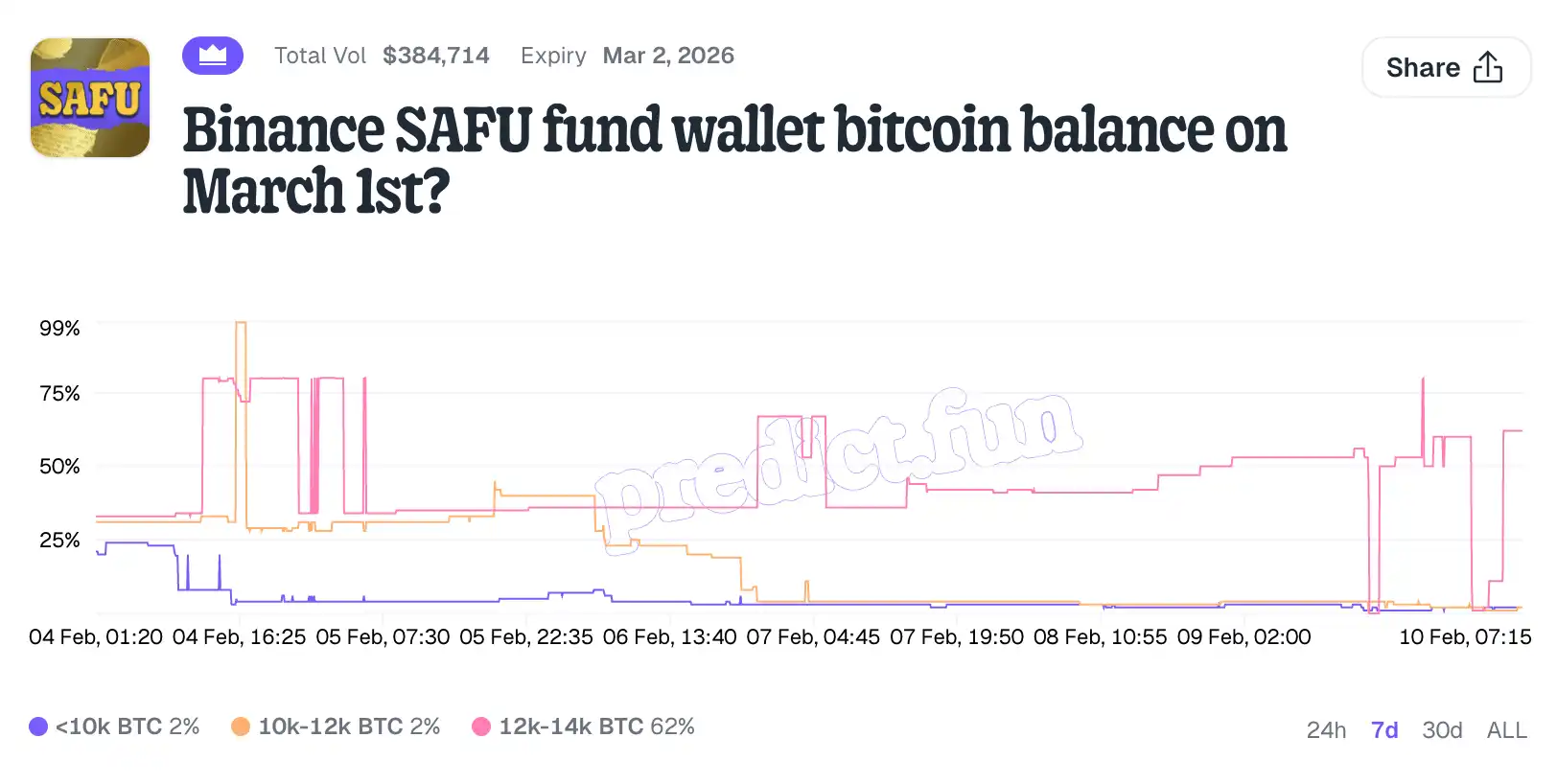
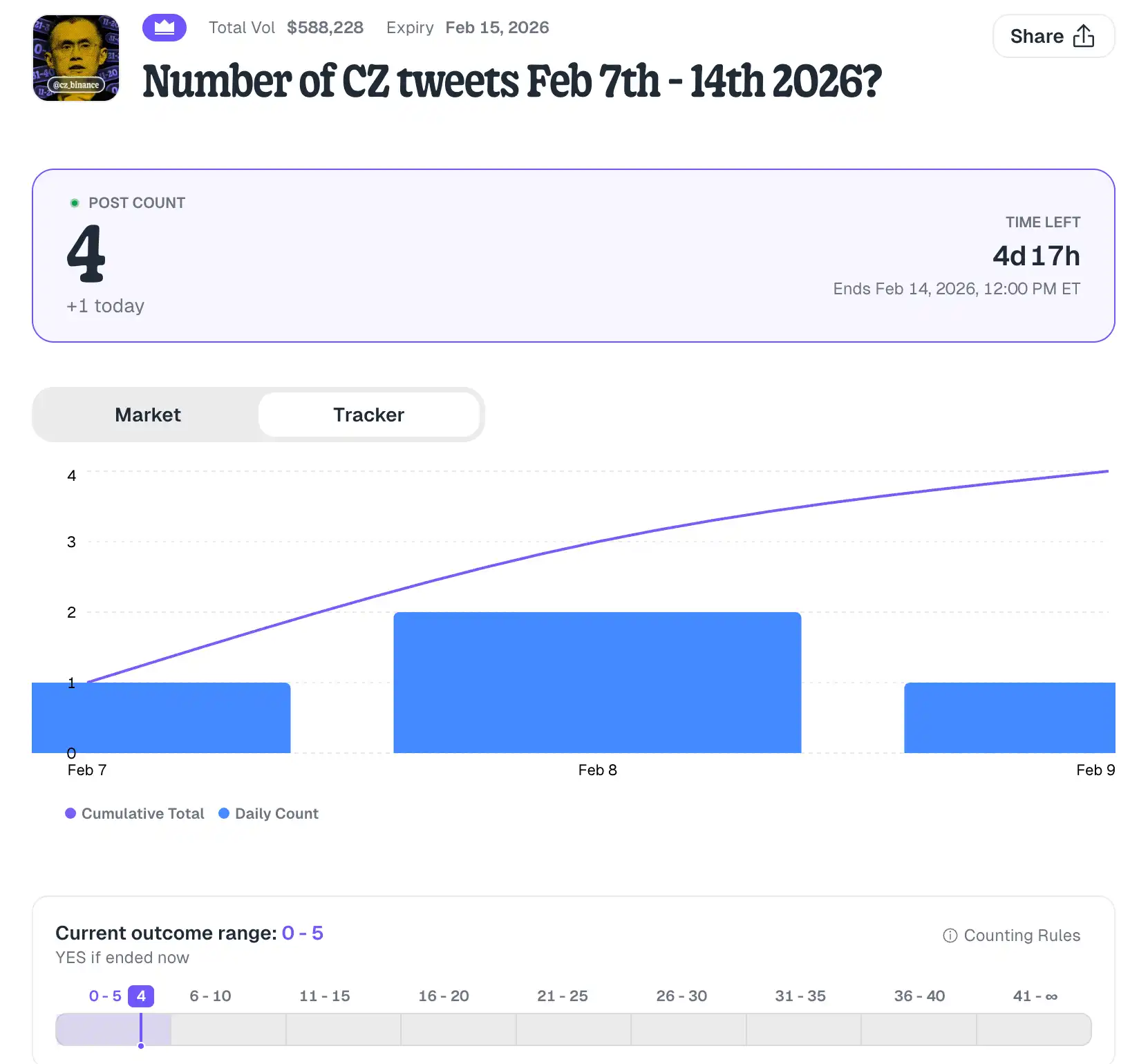
predict.fun Launches Exclusive Prediction Events
Compared to traditional macro events or general political and sports markets, these prediction events with obvious community attributes are more likely to stimulate user discussions and dissemination, and are also more likely to generate participation heat within specific user groups. From the perspective of platform operation, the continuous introduction of exclusive events is essentially building a platform-specific content supply, making the prediction market not just a "trading venue" but gradually becoming a gathering place for community hot emotions and narratives.
From the above events, it can be seen that predict.fun is consciously differentiating itself at the "event supply" level, rather than simply replicating markets already available on Polymarket or Kalshi. Designing prediction events around CZ, the Binance ecosystem, and community hot topics makes the platform more likely to foster dissemination and participation within specific user groups. This content strategy is also becoming an important operational direction for some emerging prediction markets.
It is worth noting that among the currently active emerging prediction markets, a considerable number of projects come from the BNB Chain ecosystem, and their user base is noticeably more inclined towards the Asian community. In this context, community culture, subculture, and even more "stan culture"-like participation behavior are gradually becoming important factors influencing the design and dissemination of prediction market events. In this context, for emerging prediction market platforms, the Asian community culture formed around differentiated event design and the more "stan culture"-like participation behavior are becoming directions worthy of in-depth study, and the related impacts will be further discussed in subsequent articles.
You may also like

Morning Report | BitMine increased its holdings by 126,971 ETH last week; trader Eugene announced his exit from the crypto market

Wang Chuan: How can one not feel anxious after the neighbor Old Wang made thirty times profit by investing in storage stocks? (Seven) - A quarter-century cycle

Cryptocurrency CEXs are flocking to sell US stocks, and traditional brokerages are facing an "uninvited guest."

$75 billion in foreign capital has fled, and South Korean retail investors have absorbed it all using leverage

Japan’s Three Megabanks Plan Joint Stablecoin Issuance in Fiscal 2026
MUFG, SMBC, and Mizuho reportedly plan to jointly issue fiat-pegged stablecoins in fiscal 2026, signaling Japan’s growing push into bank-led digital payment infrastructure.

Humanity Discloses H Token Dual-Chain Attack Details, With Losses on Ethereum and BSC Exceeding $36 Million
Humanity said the H token attack across Ethereum and BSC caused more than $36 million in losses after leaked ProxyAdmin keys enabled malicious contract upgrades and token minting.
White House Discusses CLARITY Act With Law Enforcement Ahead of Senate Vote
The White House discussed the CLARITY Act with law enforcement ahead of a Senate vote, focusing on illicit finance risks and developer protections.

Bitcoin Trading Guide 2026: Strategies for Experienced Traders

What Is XAUT and PAXG? Why Tokenized Gold Is Booming in 2026

Will the SpaceX IPO Hurt Bitcoin? Here's What Traders Are Watching

Foreign selling in the South Korean stock market accelerates, with cumulative net sales reportedly reaching $75 billion this year
On June 9, The Kobeissi Letter, citing Goldman Sachs data, reported that global investors are selling South Korean stocks at an unusually rapid pace. In the latest trading session, foreign investors sold about $801 million worth of Kospi constituent stocks again; total foreign outflows last week reached about $10 billion, and the market has been in net foreign selling on nearly every trading day over the past month. According to the data cited in the report, foreign investors have sold about $75 billion worth of South Korean stocks so far this year. Meanwhile, South Korean retail and institutional investors together recorded roughly $69 billion in net buying over the same period, suggesting that the market’s main buying support has come from domestic capital rather than returning overseas funds. The information currently disclosed still mainly comes from The Kobeissi Letter’s retelling and Goldman Sachs data summaries, while public details on the statistical period and the specific definition of “selling” remain relatively limited.

Fortune Warns of Strategy’s Financing Structure Risks as Bitcoin Premium Narrows
Fortune warned that Strategy’s Bitcoin treasury model faces growing financing risks as MSTR’s net asset premium narrows and preferred stock dividend pressure increases.

Ferrari Challenge Le Mans: Carl Moon to Dominate in WEEX Livery

Sahara AI Responds to SAHARA’s Sharp Drop: No Contract or Product Security Issues Found, Internal Investigation Underway
Sahara AI responded to SAHARA’s 60% price drop, saying no token contract or product security issues have been found and an internal investigation is underway.

WEEX Deposit/Withdrawal Dynamic Island: Your Asset Status, Always in Sight
Scaling Crypto Derivatives: The Digital Asset Infrastructure Behind High-Volume Trading
In the fast-moving digital asset ecosystem, derivatives platforms face an extreme architectural test. High-leverage futures markets demand more than just standard security—they require absolute operational precision, zero-latency matching engines, and ironclad structural scalability, all while navigating intense market volatility.
As global platforms scale to meet these demands, the industry is shifting away from rigid, monolithic setups toward a more agile, "decoupled" infrastructure philosophy.
The Blueprint for High-Volume Copy TradingFor elite global exchanges like WEEX (founded in 2018), this architectural choice becomes critical when scaling high-volume retail features like social copy trading. When thousands of users automatically mirror the real-time strategies of elite traders simultaneously, it triggers sudden, monumental spikes in concurrent transactional volume.
To prevent execution latency or settlement bottlenecks during these peak volatility events, a platform's primary engine must remain entirely dedicated to risk management, copy-trade synchronization, and order matching.
The Architectural Rule: New-generation platforms must separate front-end user execution engines from heavy backend infrastructural overhead to eliminate operational friction.
By separating these layers, platforms can maintain complete sovereignty over their trading environments and user experiences while strategically aligning with institutional-grade infrastructure ecosystems. This strategic framework allows modern exchanges to leverage advanced Digital Asset Custody infrastructure such as Cobo’s behind the scenes, ensuring that backend wallet management scales elastically alongside trading spikes.
Capitalizing on Market Momentum and 400× LeverageIn a derivatives arena where platforms offer up to 400× leverage on perpetual contracts, capital efficiency and market agility are core business metrics. To capture market momentum, an exchange needs the ability to rapidly expand its asset offerings, supporting everything from legacy crypto assets to sudden, trending altcoins across a massive library of trading pairs.
Adopting a flexible, scalable Wallet-as-a-Service (WaaS) solution such as Cobo’s could completely rewrite the development timeline for high-growth exchanges. Instead of spending months of engineering capital building out custom backend wallet architectures for every new blockchain network, platforms can deploy localized infrastructure in days.
This agility allows platforms to instantly scale their listings to over a thousand trading pairs without compromising security or delaying time-to-market. It mirrors the exact operational advantages seen during high-velocity market events, similar to how advanced wallet infrastructure empowers platforms during sudden asset surges; allowing exchanges to pass that speed and liquidity directly to their global user base.
A Mature Foundation for GrowthThe synergy between trusted infrastructure ecosystems and global trading platforms represents the natural evolution of a maturing crypto market. As WEEX continues to scale its global spot and derivatives offerings for over 6 million users, adopting robust backend paradigms proves that platforms no longer have to compromise between cutting-edge trading velocity and uncompromised structural security.

Get Paid to Onboard? Try WEEX’s New Homepage with Rewards for Registration, Deposit & Trade
WEEX Custom Layout: Build Your Perfect Trading Workspace in Seconds
Morning Report | BitMine increased its holdings by 126,971 ETH last week; trader Eugene announced his exit from the crypto market
Wang Chuan: How can one not feel anxious after the neighbor Old Wang made thirty times profit by investing in storage stocks? (Seven) - A quarter-century cycle
Cryptocurrency CEXs are flocking to sell US stocks, and traditional brokerages are facing an "uninvited guest."
$75 billion in foreign capital has fled, and South Korean retail investors have absorbed it all using leverage
Japan’s Three Megabanks Plan Joint Stablecoin Issuance in Fiscal 2026
MUFG, SMBC, and Mizuho reportedly plan to jointly issue fiat-pegged stablecoins in fiscal 2026, signaling Japan’s growing push into bank-led digital payment infrastructure.
Humanity Discloses H Token Dual-Chain Attack Details, With Losses on Ethereum and BSC Exceeding $36 Million
Humanity said the H token attack across Ethereum and BSC caused more than $36 million in losses after leaked ProxyAdmin keys enabled malicious contract upgrades and token minting.


