
On-Chain Data Analysis: When Will the Next Season of Altcoins Begin?

Original Author: Murphy, On-chain Data Analyst
On-chain Data Evaluation Model - Altseason
One day while I was in class, Xiaochi from @FC_0X0 sent me a message on WeChat saying, "There is a piece of data that shows the scissor difference between the total stablecoin inflow into exchanges and the USD value of withdrawn BTC, indicating the remaining potential buying power and the volatility of altcoins may have a direct relationship. Can we use this logic to explore the timing of altcoin seasons?"
Coincidentally, my lecture also mentioned observing data on the potential conditions of "capital outflow," which aligned with certain high-market-cap altcoins' launch timeframes. However, at that time, it was just a rough outline, vaguely hinting at some overlooked areas...
When I returned, I organized the data and, inspired by Xiaochi's idea, reconsidered a set of visual indicators that can effectively assess the "Altseason." Here, I share my train of thought:
Altseason Condition 1: Capital Outflow Evaluation
(Chart 1)
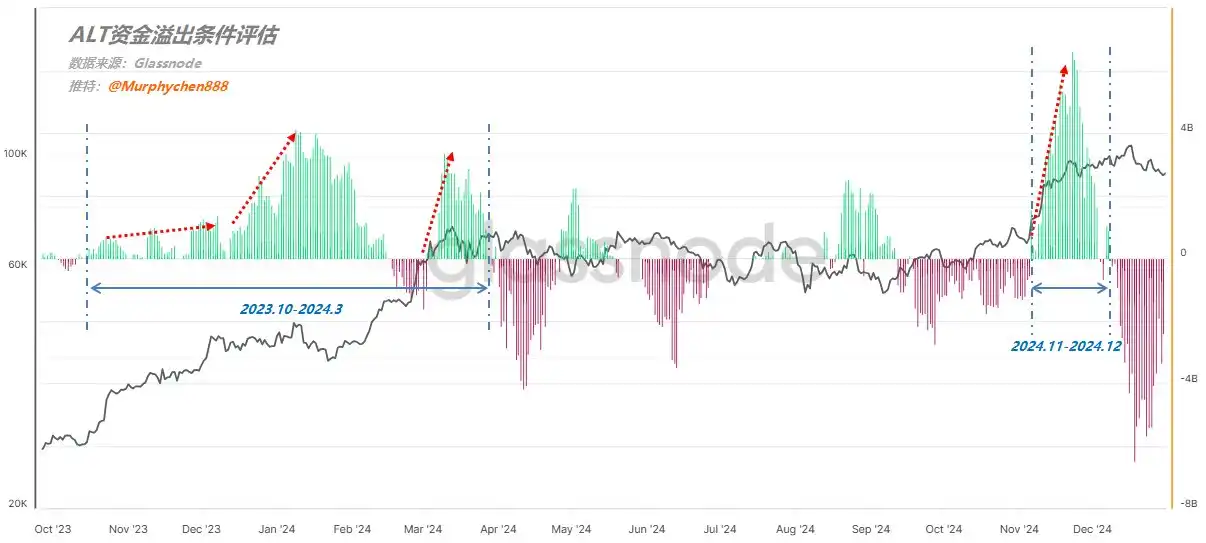
In Chart 1, the green color indicates whether the total stablecoin inflow into exchanges in the last 30 days is greater than the USD value of BTC withdrawn from exchanges. If it is, it means that, besides buying BTC, there is also a possibility of outflow into altcoins. The higher the green signal bar, the greater the theoretical outflow value, indicating a stronger prerequisite for the Altseason initiation.
From the data perspective, during the periods of 2023.10-2024.3 and 2024.11-2024.12, the theoretical outflow value was the highest, implying a higher likelihood of the Altseason occurring during these two periods. Additionally, there was a brief period between August and September, but in terms of both scale and duration, it was not as strong as the two aforementioned periods, making its influence relatively weaker.
Altseason Condition 2: Inflow of Mainstream Assets
(Chart 2)
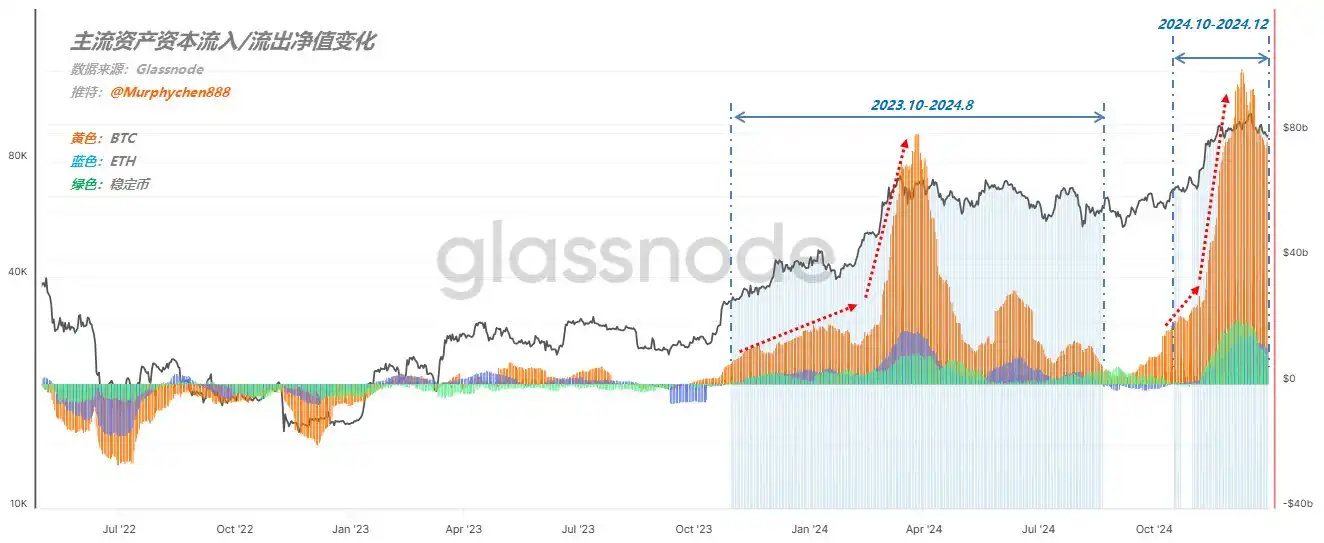
Historically, BTC often leads the overall sentiment of the crypto market, followed by market confidence flowing into other high-market-cap mainstream coins before further tilting towards alts. Visualizing this capital rotation involves using the 30-day change in realized market cap of BTC and ETH, along with the total supply of stablecoins (as shown in Chart 2). When all three major mainstream assets experience net capital inflows, it signals that the market sentiment is becoming exuberant, overall risk appetite is rising, which is also one of the macro necessary conditions to kickstart the Altseason.
From the data, it can be seen that during the periods of 2023.10-2024.8 and 2024.10-2024.12, all three major mainstream assets experienced net capital inflows, peaking in March 2024 and December 2024. This is also the most FOMO moment in market sentiment so far in this cycle.
Altcoin Season Indicator 3: Positive Momentum in Altcoin Market Cap Disparity
(Figure 3)
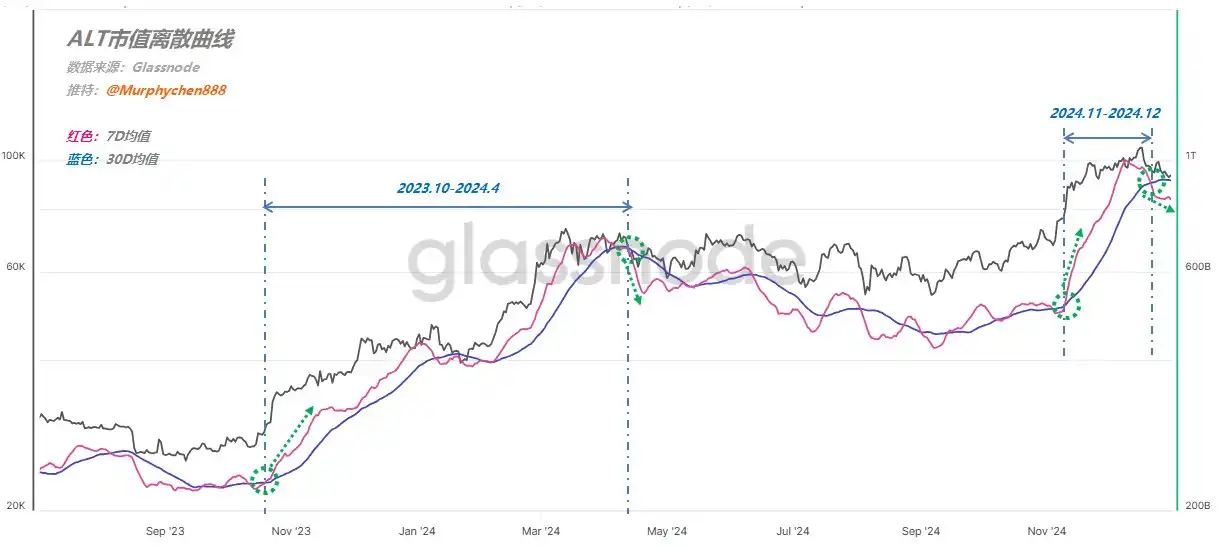
The third condition required to determine the start of the altcoin season is the isolation of positive momentum in the disparity of altcoin total market capitalization. We need to identify time periods within the altcoin space where the 7D SMA of total valuation is greater than the 30D SMA of total valuation. Because this can represent an amplification of altcoin valuation in the short term, and liquidity flowing into altcoins is rapidly increasing.
In Figure 3, the red line represents the 7D average, and the blue line represents the 30D average; from the data, during the periods of 2023.10-2024.4 and 2024.11-2024.12, the red line crossed above the blue line, indicating that liquidity in the crypto space is starting to tilt towards altcoins, and altcoin market cap is shifting towards positive momentum growth.
Summary
These three conditions are considered from different perspectives: Condition 1 represents the potential for capital overflow; Condition 2 represents overall sentiment and risk appetite; Condition 3 represents liquidity skew. When all three conditions are met simultaneously, it is highly likely that the altcoin season is approaching.
The current Condition 2 is met, but Conditions 1 and 3 are not; therefore, we can consider that the foundation for the altcoin season is there, but liquidity is still concentrated in mainstream assets (especially BTC), and on-chain funds have not overflowed significantly into altcoins.
However, we can also see that the "negative overflow" in Condition 1 is gradually diminishing, which is a positive signal. Although altcoin season anticipation may require some more patience, what is supposed to happen will happen.
The content shared in this article is for communication and research purposes only and should not be considered as investment advice.
You may also like

Morning Report | OpenAI has submitted an S-1 registration statement draft to the U.S. SEC; Morpho completes $175 million financing

Galaxy Deep Research Report: How Hyperliquid's HIP-4 Upgrade Changes the Landscape of Prediction Markets?

Latest research from 13 top universities including Cornell University: The current state, challenges, and misconceptions of the fusion of Crypto and AI

Deconstructing Anthropic: The Best AI Company, Possibly Also a Type of Organizational Invention

Every exchange is a "Universal Exchange."

The counterattack of traditional finance: Alliance chains are quietly reviving
Pantera Capital Partner: How Tokenization is Restructuring the Private Equity and Early Investment Ecosystem?

Mastercard Launches Agent Pay for AI, Plans to Record AI Agent Payment Authorizations on Polygon
Mastercard launched Agent Pay for AI, a new payment protocol designed to help AI agents make small payments such as pay-per-use access to data and APIs. The system plans to record human-granted AI agent permissions on Polygon, focusing on verifiable authorization, identity, and payment controls.

Curve Deploys Llamalend v2 on Optimism With 250,000 OP Incentives
Curve launched Llamalend v2 on Optimism with 250,000 OP incentives from the Optimism Foundation. The upgrade expands Llamalend beyond its earlier crvUSD-focused model, adding broader collateral support, LlamaRisk market reviews, and the ability to use Curve LP tokens as collateral.

Raydium Old Liquidity Pool Reportedly Exploited, With $1.34 Million Moved to Ethereum and Tornado Cash
An old Raydium liquidity pool was reportedly exploited for around $1.34 million in USDC, RAY, and wSOL, with the stolen funds bridged to Ethereum and deposited into Tornado Cash. The incident highlights the tail risks of legacy DeFi pools, old contracts, and cross-chain fund laundering paths.
Kalshi Executive Challenges “SBF Backed AI Unicorns” Narrative, Says Leopold Aschenbrenner Was Key Figure
Kalshi executive John Wang questioned the “SBF backed AI unicorns” narrative, saying Leopold Aschenbrenner was the key figure behind major AI investment decisions.

New York Proposes Stricter Stablecoin Issuer Rules Aligned With Federal GENIUS Act
NYDFS proposed stricter stablecoin issuer rules aligned with the GENIUS Act, covering reserves, custody, redemption timelines, audits, and capital buffers.

CryptoQuant Says Bitcoin Profitable Supply Is Near 45% Pressure Zone as On-Chain Data Points to Market Repricing
CryptoQuant said Bitcoin’s profitable supply is nearing the 45% pressure zone, signaling rising market stress, unrealized losses, and a possible on-chain repricing phase.

Bitcoin Falls Below 200-Week Moving Average as On-Chain Data Shows Over Half of Supply in Loss
Bitcoin dropped below its 200-week moving average as on-chain data showed over 50% of circulating supply is now in loss, signaling rising market stress.

CFTC Reportedly Plans New Prediction Market Rules Focused on Manipulation Risk and Public Interest Review
The CFTC is reportedly preparing new prediction market rules focused on manipulation risk, public interest review, and retail trader protections.

Meet the new WEEX trial fund—your gateway to greater profits

WEEX Labs Lands at Dutch Blockchain Week: A Disruptive Crypto × AI Conversation Sets Sail in Amsterdam
SK Hynix Reportedly Plans U.S. ADR Listing as Early as August, With SEC Approval Possible in Late June
SK Hynix may pursue a U.S. ADR listing as early as August, with SEC approval reportedly possible in late June amid strong AI chip supply chain demand.
Morning Report | OpenAI has submitted an S-1 registration statement draft to the U.S. SEC; Morpho completes $175 million financing
Galaxy Deep Research Report: How Hyperliquid's HIP-4 Upgrade Changes the Landscape of Prediction Markets?
Latest research from 13 top universities including Cornell University: The current state, challenges, and misconceptions of the fusion of Crypto and AI
Deconstructing Anthropic: The Best AI Company, Possibly Also a Type of Organizational Invention
Every exchange is a "Universal Exchange."
The counterattack of traditional finance: Alliance chains are quietly reviving


