
- Buy Crypto
- Markets
 Futures
- Spot
- Copy Trade
- Earn
- More
On-Chain Options Explosion.ActionEvent

Original Title: Crypto Options Are Waking Up
Original Source: Delphi Digital
Original Translation: AididiaoJP, Foresight News
The scale of the cryptocurrency options market far exceeds most people's awareness. The cryptocurrency derivatives trading volume on the Chicago Mercantile Exchange (CME) hit a record high last year, up 46%. Institutional investors need explicit risk management tools to hedge large positions, and options are the only cryptocurrency tool that can provide this functionality.
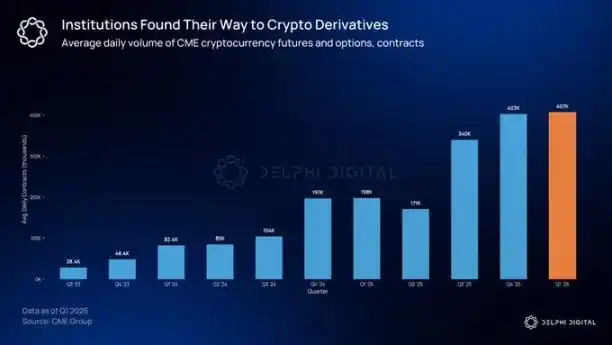
Reshaping the Landscape
By mid-2025, the total outstanding notional value of Bitcoin options reached $65 billion, surpassing for the first time the outstanding notional value of futures. Futures are a leverage tool, while options allow funds to cap losses on their $500 million Bitcoin positions by paying a premium. This turning point indicates that tools with risk definition capabilities are gradually replacing purely leverage-based tools.
This growth is primarily concentrated on two platforms. Deribit has been the mainstream platform for cryptocurrency options trading for years and gained institutional endorsement after being acquired by Coinbase for $29 billion in 2025. IBIT Options, launched at the end of 2024, has brought traditional financial capital into this space. The options market is rapidly expanding, but the majority of trades still require intermediaries.
On-Chain Options Still in Early Stages
The market share of decentralized derivatives has grown from 2% to over 10% in two years. Hyperliquid has demonstrated that decentralized exchanges (DEXs) can rival centralized exchanges in speed and transparency. However, on-chain options have not yet seen a similarly representative project.
@DeriveXYZ remains the leading on-chain options protocol, with nominal options trading volume exceeding $700 million in the last 30 days. The protocol was launched in August 2021 as Lyra Nominal Options Automated Market Maker (AMM), underwent a full restructuring after the bear market, and is now based on a proprietary OP Stack Layer 2, establishing a gas-free central limit order book.
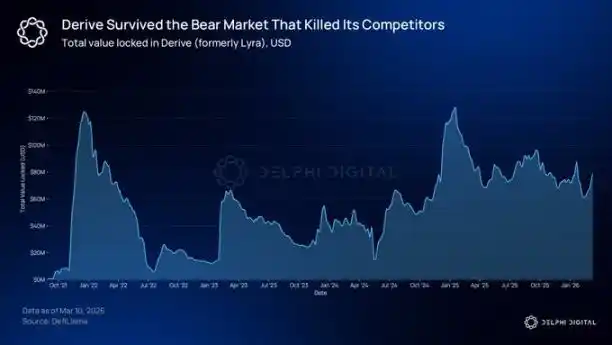
This restructuring has completely changed the pricing mechanism. Liquidity providers directly quote on the order book, narrowing spreads, improving pricing accuracy, and supporting larger-scale trades. Traders can enjoy zero gas fees and sub-second execution speed.
The portfolio margin system has also attracted institutional attention. The system evaluates overall position risk through scenario analysis. For example, if a trader holds both a long call option and a short put option on the same underlying asset, the system will not require margin for each leg separately.
The collateral required for the post-hedge position is less than a simple sum of individual positions, following the common logic in traditional financial derivatives trading. Derive also offers perpetual contracts and lending services on the same Layer 2, supporting cross-product cross-margin.
@KyanExchange is moving forward in a different way towards the same direction. The platform combines an order book matching engine with on-chain portfolio margin, enabling multi-leg operations to be completed in a single atomic transaction. Traders can deploy iron condor strategies with just a few clicks.
Kyan's liquidation mechanism also differs from most DeFi protocols. When the margin threshold is breached, the platform does not liquidate the entire account but instead performs partial liquidation, closing only enough positions to bring the account back to the minimum required margin. Kyan is currently in the Arbitrum testing phase, with the mainnet launch imminent.
Who Needs Options?
Asset management firms building structured products urgently need the clearly defined risk-return structure provided by options. Take JPMorgan’s Equity Premium Income ETF, for example. This fund is one of the world's largest actively managed funds, based on a covered call strategy. The total AUM of derivative-based yield products has exceeded a trillion dollars. With more institutional funds entering the chain, the corresponding hedging demand will also migrate.
Currently, an increasing number of institutional investors have or plan to allocate digital assets in the near term. IBIT open interest in options has surpassed the gold ETF GLD. By 2025, CME had processed a nominal trading volume of $30 trillion in cryptocurrency derivatives.
Timing is Ripe
Most early on-chain options protocols have not survived, mainly due to regulatory uncertainty. For instance, Opyn was fined by the CFTC for operating an unlicensed derivative trading platform. At that time, the team developing the product could not foresee if the product would be deemed illegal in the next quarter.
The current situation is improving. In September 2025, the U.S. Securities and Exchange Commission (SEC) and the Commodity Futures Trading Commission (CFTC) jointly issued a statement allowing regulated trading platforms to conduct spot trading of crypto assets. The CLARITY Act has passed in the House of Representatives, aiming to place the digital commodity spot market under CFTC regulation. The Senate version is still being negotiated and is currently on hold. The CME Group will launch 24/7 cryptocurrency options trading on May 29. While this does not guarantee the inevitable success of on-chain protocols, the overall landscape has undergone a substantial shift.
You may also like

The underlying business agreement of the trillion-dollar Agent economy: Understanding ERC-8183, it's not just about payments, but the future

When Wall Street's ETH begins to "yield": Looking at the asset properties of Ethereum from BlackRock's ETHB

The Power of Agency: The Agentic Wallet and the Next Decade of Wallets

Understanding x402 and MPP in One Article: Two Routes for Agent Payments

Particle Founder: The entrepreneurial insights I have gained the most from in the past year

Huang Renxun's latest podcast transcript: The future of Nvidia, the development of embodied intelligence and agents, the explosion of inference demand, and the public relations crisis of artificial intelligence

OKX Ventures Research Report: AI Agent Economic Infrastructure Research Report (Part 1)

The migration of settlement rights: B18 and the institutional starting point of on-chain banks

From Tencent and Circle: Looking at the Simple and Difficult Questions of Investment

The second half of stablecoins no longer belongs to the crypto circle

Cursor "Shell" Kimi Controversy Reversed: From Copyright Infringement Allegations to Authorized Collaboration, China's Open Source Model Once Again Becomes a Global AI Foundation

The Real Reason Tokens Don't Sell: 90% of Crypto Projects Overlook Investor Relations

Is the income of pump.fun real, earning a million dollars a day despite the market downturn?

The real reason why tokens are not selling: 90% of crypto projects neglect investor relations

Who is the true winner of the "Tokenization" narrative?

Moss: The Era of AI-Traded by Anyone | Project Introduction
Chip Smuggling Case Exposes Regulatory Loophole | Rewire News Evening Update

How a Structured AI Crypto Trading Bot Won at the WEEX Hackathon
Ritmex demonstrates how disciplined risk control and structured signals can make an AI crypto trading bot more stable and reliable on WEEX, highlighting the importance of combining execution discipline with scalable AI trading systems.


 App
App