Policy Tailwinds and Bewilderment Behavior run in parallel, is Trump a true Crypto Builder or a larger Scythe?

By: blockbeats|2025/02/06 17:30:04
0
Share
copy

Ever since former President Trump and his wife launched their own meme coins $Trump and $MELANIA, attracting a huge amount of funds, the cryptocurrency market has quickly fallen into a liquidity crisis. On the other hand, the impact of the domestic AI giant model DeepSeek, the cancellation of Bitcoin's legal tender status by sovereign nations, and a series of bearish news such as the U.S. imposing tariffs have further worsened the already sluggish market.

The first major post-New Year drop was triggered by Trump's tariff hike.

Related Read: "The Most Miserable Crypto News You Might Have Missed During the Spring Festival Holiday"

Policy Impacting Price? The Highly Sensitive Cryptocurrency Market

Trump's tariff policy is severely impacting the market. U.S. President Donald Trump signed a tariff order on February 1 local time, imposing an additional 25% tariff on imported products from Canada and Mexico, a 10% tariff on energy resources from Canada, set to take effect on the 4th. In addition, on the 1st, Trump signed an executive order to impose an additional 10% tariff on goods imported from mainland China.

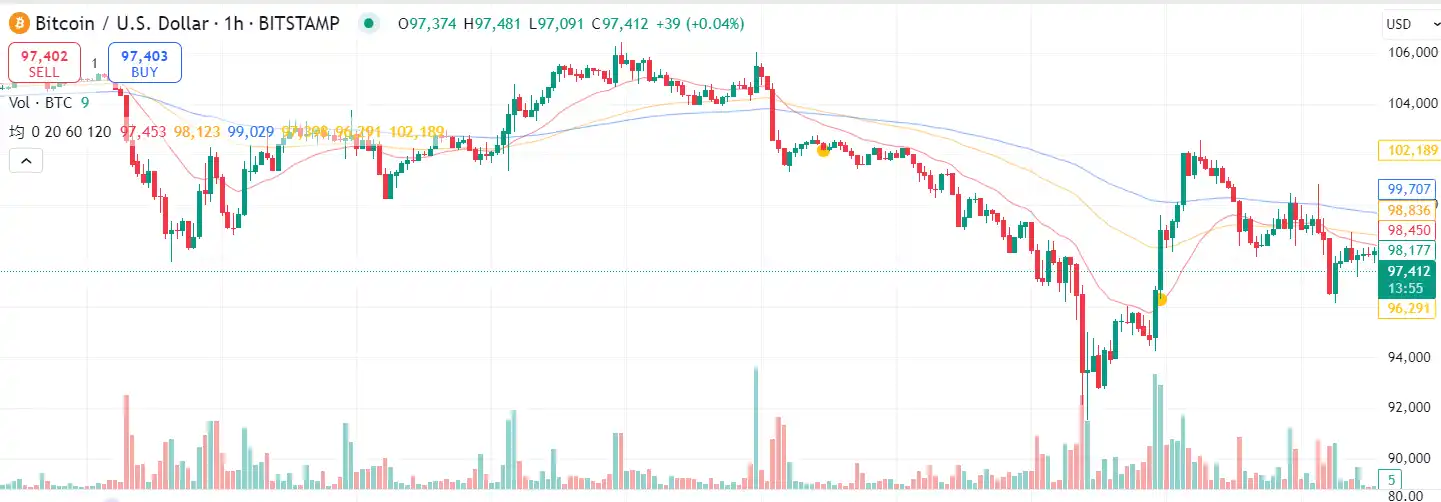
The global risk markets reacted swiftly, with cryptocurrencies hit first. Bitcoin's price plummeted rapidly from around $105,000 on the same day, breaking below the $100,000 mark, even dropping below $92,000 at one point, with a more than 7% drop within 24 hours. Ethereum dropped by about 25% at one point, to the lowest level since early September last year, and other mainstream cryptocurrencies also plunged one after another, with declines of over 10%, marking an epic crash.

Policy Tailwinds and Bewilderment Behavior run in parallel, is Trump a true Crypto Builder or a larger Scythe?

On February 3, Trump stated that he had reached an agreement with the Mexican president and decided to immediately suspend the anticipated tariffs for a month. Bitcoin rebounded to a high of $102,500 after the tariff policy delay, while Ethereum rebounded to $2,923, and other mainstream coins also rebounded to their prices before the crash.

Jeff Park, Head of Bitwise Alpha Strategies, stated that tariffs may be just a temporary tool, but in the long run, Bitcoin will not only rise but will rise faster because both parties in the trade imbalance want Bitcoin. Therefore, the ultimate result is the same: higher prices and faster speed.

It can be said that the imposition of tariffs has led to a sharp decline in the global stock market, and with other bearish news, the cryptocurrency market has also seen a decline. The tariffs are not only reshaping the international trade landscape but are also dealing a heavy blow to global financial market confidence. Given the cryptocurrency market's emerging, high-risk, high-return, and relatively undeveloped regulatory characteristics, it has become one of the most sensitive areas in this storm, once again highlighting the increasingly close relationship between the cryptocurrency market and global macroeconomic policies.

Meme Coin Drains Market Liquidity

On January 18, 2025, Donald Trump announced the launch of his personal Meme coin $TRUMP on his social media account. Upon its release, the coin saw a staggering price surge, exceeding 15,000% in just 12 hours, reaching around $30, with a peak market cap of over $800 billion. This remarkable price increase and massive market cap swiftly attracted a large influx of funds. Many investors who originally held Bitcoin, Ethereum, and other mainstream cryptocurrencies started selling off their other holdings to go all-in on $TRUMP. Apart from SOL, most other coins experienced significant sell-offs, causing a sharp downturn in other meme coins, AI Agent tokens, and more.

Furthermore, the $TRUMP issuing team holds a whopping 80% of the locked coins, granting them significant price manipulation power. As the lock-up period gradually unlocks in the future, whether through direct dumping on exchanges or staking in DeFi chains, it could potentially have a huge impact on the market. This behavior will further disrupt the market order of the cryptocurrency world, making it harder for other truly valuable cryptocurrency projects to receive funding support, leading to an imbalance in the entire crypto ecosystem.

The blood-sucking effect of Trump's coin issuance not only caused unreasonable short-term capital flows in the crypto world but also had a severe negative impact on the development and market stability of other cryptocurrency projects. It pressed pause on the once-thriving DeSci, DeFAI, and AI Agent sectors. Based on the crypto industry's fast-paced nature of hyping new projects and dropping old ones, these sectors will need a significant push to regain their momentum. This has brought more uncertainty and risk to the crypto world.

BitMEX co-founder and Chief Information Officer Arthur Hayes believes that $TRUMP's surge to nearly $1 trillion in fully diluted valuation (FDV) within 24 hours is an utterly absurd market signal. The meteoric rise of $TRUMP is akin to the 2021 bull market advertisement sign of FTX purchasing a Major League Baseball referee — it symbolizes the approaching market top.

Exit Scam Pump and Dump: WLFI's Bewildering Behavior

Arkham data reveals that on the night of February 3, World Liberty Financial conducted a large-scale cryptocurrency asset transfer. Their ETH holdings plummeted from around 66k on February 2 to 52, nearly liquidating all their ETH assets, with the majority flowing into a Coinbase Prime deposit address.

At this sensitive moment of asset transfer, Eric Trump, son of former President Trump, expressed on his social media platform that now is the best time to add to ETH. In the initial version of the tweet, there was also a line at the end saying, "You can thank me later."
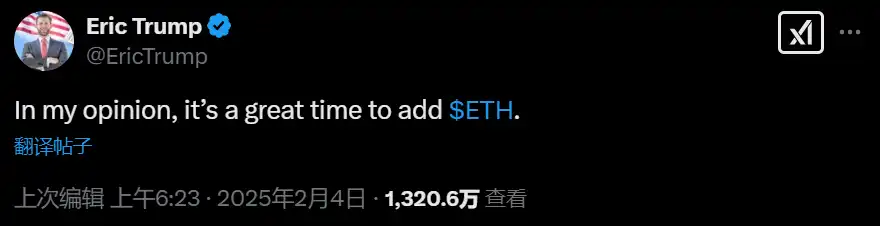
The community raised doubts about this. Some attentive investors noticed that the ETH holdings decreased from 66k to 66, missing just one unit. This seemed like an attempt to avoid detection of the asset transfer, leading to suspicions of a rug pull conspiracy. WLFI explained that these actions were aimed at maintaining a robust, secure, and efficient financial system, solely reallocating assets for regular business purposes without token sales. However, once the funds were transferred to Coinbase Prime, the actual use remained unknown, and investors could only analyze based on coin price fluctuations and WLFI's subsequent asset operations.

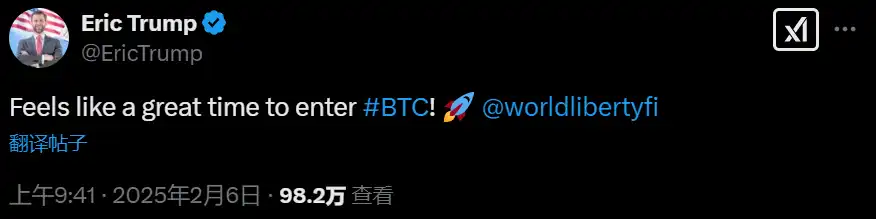
Interestingly, on the morning of February 6, Eric made another public call for BTC while mentioning the family project WLFI. The community jokingly asked, "Should we sell Bitcoin next?" Perhaps this was indeed a pre-dump signal, maybe to boost confidence suppressed by tariff increases, or just a routine promotion of the family project, as issuing calls and announcements was a common practice among these individuals.
Crypto Tsar, or Crypto Rug-Pull?

David Sacks, Chairman of the Crypto Council, is well-known as one of the PayPal founders and later gained fame by creating Yammer and selling it to Microsoft for $1.2 billion. In the crypto world, David Sacks' most significant roles are as an investor in the crypto venture capital firm Multicoin and a Solana maximalist, often referred to as the "Crypto Tsar."

Since $TRUMP is deployed on the Solana blockchain and Trump issued $TRUMP coins, David Sacks has always remained silent on these "zero-sum meme coins." Therefore, many believe that this Chairman of the Crypto Council has some involvement in them.
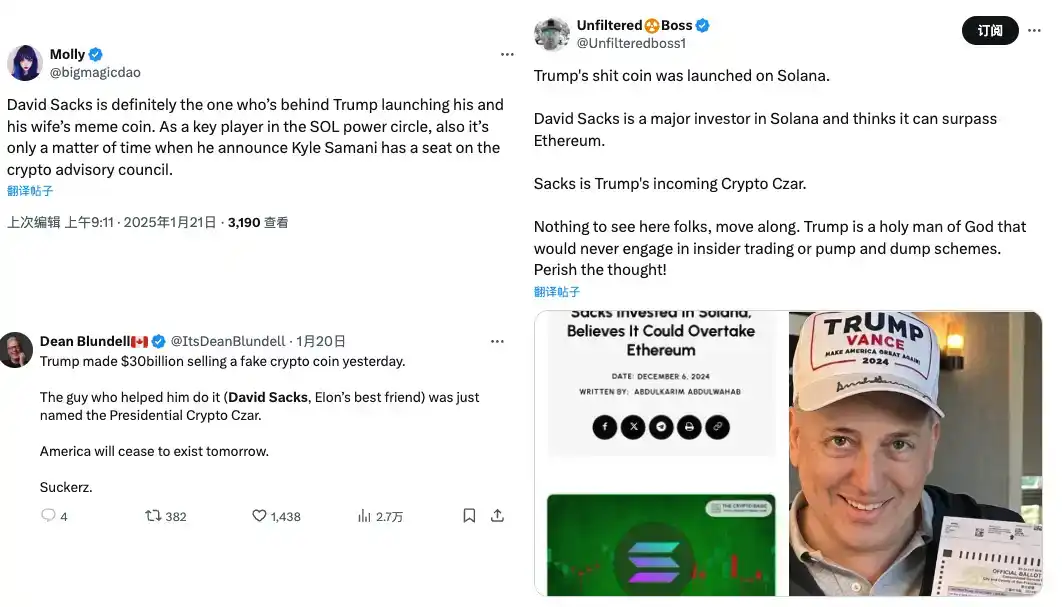
Another piece of evidence is that David Sacks has a "criminal record." In March 2024, David Sacks posted about a memecoin called $Sacks, named after himself.

Although he tweeted nine times telling people not to buy as they began purchasing, this has already confirmed his "coin issuance" history, which is exactly the same tactic as issuing $TRUMP coin. (According to community feedback, David Sacks recently deleted his posts about $Sacks.)
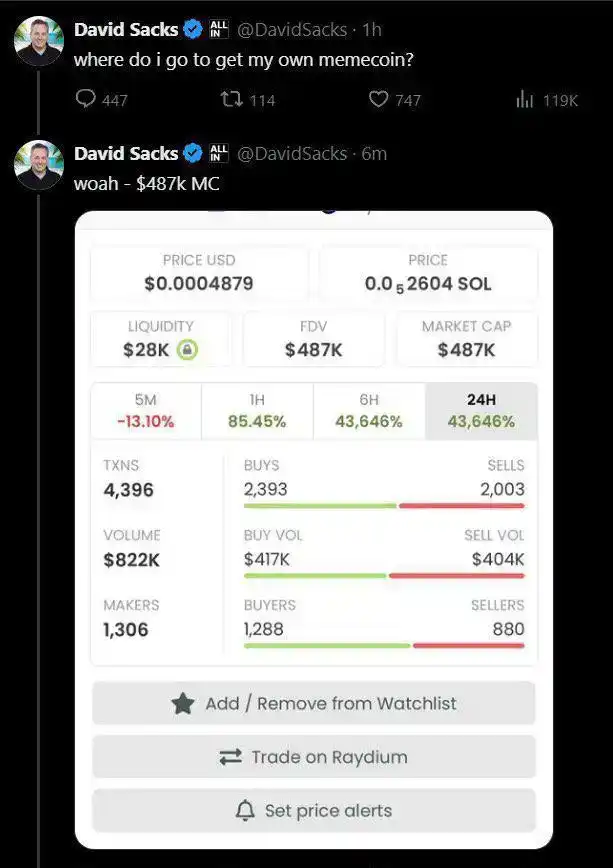
Image Source Community

This has made many people start to dislike David Sacks, feeling that his methods are too focused on quick gains and too eager to profit through this aggressive means. Even if Sacks did not directly participate, as the chairman of the Crypto Council, he should take responsibility for this incident. There are even rumors that some have proposed replacing the entire leadership of David Sacks' Crypto Council team with a new lineup.

Related Reading: "Trump's Coin Creation Makes Chinese Earn Billions, U.S. Crypto Community Divides"

On February 5, at a press conference held at 3:30 Beijing time, David Sacks reiterated his work goals, such as "establishing a clear crypto regulatory framework," "ensuring crypto innovation happens on U.S. soil," and "ushering in a golden age of digital assets," but did not disclose any new (or specific) content. When mentioning the establishment of a Bitcoin reserve, David Sacks also used the word "evaluate," which is a less definitive term (previously, when the U.S. government had to address the issue but did not want to truly resolve it, they would use the word "evaluate" to be evasive). Perhaps due to the press conference "not announcing any bullish news," market expectations were dashed, causing Bitcoin to fall below $99,000 to a low of $96,147.

Is he a true builder or a wielder of an even larger scythe?

Looking back on Trump's behavior over the years, his attitude toward cryptocurrency has undergone a significant transformation. During his last term, he publicly called Bitcoin and other cryptocurrencies a "scam," but now he has promised to make the United States the global "capital of cryptocurrency" and a "Bitcoin superpower." He has also formed a cryptocurrency group, established a family DeFi project, lifted restrictions on new token sales, and strengthened the connection between cryptocurrency companies and other traditional financial institutions.

There may be multiple reasons behind Trump's attitude change. On the one hand, the cryptocurrency market has developed rapidly in recent years, with a large investor base and significant economic influence. Courting this segment of power can help increase his political support. On the other hand, there are powerful interest groups behind the cryptocurrency industry that may influence Trump through political donations, pushing him to enact policies favorable to cryptocurrency development. Additionally, Bitcoin can be seen as a tool to hedge against the weakening of the US dollar's status. Trump's inclusion of it in the national strategic reserves is also a means to attract capital inflows and maintain the dominance of the dollar.

With the election results in, Trump's every move has gradually become a focal point in the crypto community. Especially before taking office, Trump launched his own meme coin, triggering a frenzy among countless investors inside and outside the community, creating many legendary stories of sudden wealth. It was thought to be the beginning of a bull market, but the issuance of the $MELANIA token shattered this illusion, causing the market to calm down and question the purpose of the coin's issuance. The previously booming AI Agent was drained by $TRUMP and $MELANIA, further dampened by deepseek shocks, and has been in a slump ever since. Although the meme frenzy continues, the peak market cap of many tokens keeps shrinking, the time to return to zero shortens, mainstream coins continue to fall after the celebration, prompting us to ponder whether Trump's personal involvement in crypto is truly aimed at being a builder or simply exploiting his term for the maximum benefit of his interest groups and US hegemony, leaving behind a mess in the end?

In the short term, the market will inevitably experience sharp rises and falls to digest various major developments, but long-term value growth and industry sedimentation require not only favorable policies but also a two-way game between the market and politicians. Based on his series of commitments and statements, Trump seems to have a supportive attitude toward cryptocurrency. However, the huge shift in his past remarks and positions makes it difficult to fully believe. Will he really go all out to promote cryptocurrency development and make the US a cryptocurrency haven? Trump, known for his "unexpected" nature, once in office, whether the promised favorable policies can actually be implemented, or if all this is just a facade for political gain, is filled with uncertainty.

For cryptocurrency investors, Trump's current attitude and policy direction are like a double-edged sword. If he truly fulfills his promises and creates a relaxed, friendly environment for cryptocurrency development, the crypto community is likely to usher in a new era of prosperity. However, Trump's frequent sanctions against other countries after taking office, his own and his family's controversial business practices, and the internal conflicts within his administration can also exacerbate global economic and political instability, leading to unpredictable outcomes in his cryptocurrency policy. This instability can spread investor panic, impacting the cryptocurrency market negatively.

It can be said that Trump's imposition of tariffs was just the beginning of his impact on the crypto world during his presidency. In the future, as he advances and implements policies in various areas such as the economy and foreign affairs, the crypto world will likely face even more intense volatility. In such an environment, investors need to closely monitor policy developments and make investment decisions more cautiously.

The bigger the storm, the bigger the fish. Regardless of what unknowns lie ahead, this crypto ship has already set sail, ready to face the challenges and storms.

You may also like

Token Cannot Compound, Where Is the Real Investment Opportunity?

The next chapter in the crypto industry will undoubtedly be written by Crypto-empowered Stocks.

February 6th Market Key Intelligence, How Much Did You Miss?

1. On-chain Flows: $508.2M USD inflow to Ethereum today; $390.8M USD outflow from Arbitrum 2. Biggest Gainers/Losers: $HBTC, $AIO 3. Top News: Current Bitcoin weekly RSI oversold signal comparable to June 2022

China's Central Bank and Eight Other Departments' Latest Regulatory Focus: Key Attention to RWA Tokenized Asset Risk


Foreword: Today, the People's Bank of China's website published the "Notice of the People's Bank of China, National Development and Reform Commission, Ministry of Industry and Information Technology, Ministry of Public Security, State Administration for Market Regulation, China Banking and Insurance Regulatory Commission, China Securities Regulatory Commission, State Administration of Foreign Exchange on Further Preventing and Dealing with Risks Related to Virtual Currency and Others (Yinfa [2026] No. 42)", the latest regulatory requirements from the eight departments including the central bank, which are basically consistent with the regulatory requirements of recent years. The main focus of the regulation is on speculative activities such as virtual currency trading, exchanges, ICOs, overseas platform services, and this time, regulatory oversight of RWA has been added, explicitly prohibiting RWA tokenization, stablecoins (especially those pegged to the RMB). The following is the full text:


To the people's governments of all provinces, autonomous regions, and municipalities directly under the Central Government, the Xinjiang Production and Construction Corps:


  Recently, there have been speculative activities related to virtual currency and Real-World Assets (RWA) tokenization, disrupting the economic and financial order and jeopardizing the property security of the people. In order to further prevent and address the risks related to virtual currency and Real-World Assets tokenization, effectively safeguard national security and social stability, in accordance with the "Law of the People's Republic of China on the People's Bank of China," "Law of the People's Republic of China on Commercial Banks," "Securities Law of the People's Republic of China," "Law of the People's Republic of China on Securities Investment Funds," "Law of the People's Republic of China on Futures and Derivatives," "Cybersecurity Law of the People's Republic of China," "Regulations of the People's Republic of China on the Administration of Renminbi," "Regulations on Prevention and Disposal of Illegal Fundraising," "Regulations of the People's Republic of China on Foreign Exchange Administration," "Telecommunications Regulations of the People's Republic of China," and other provisions, after reaching consensus with the Cyberspace Administration of China, the Supreme People's Court, and the Supreme People's Procuratorate, and with the approval of the State Council, the relevant matters are notified as follows:


  I. Clarify the essential attributes of virtual currency, Real-World Assets tokenization, and related business activities


  (I) Virtual currency does not possess the legal status equivalent to fiat currency. Virtual currencies such as Bitcoin, Ether, Tether, etc., have the main characteristics of being issued by non-monetary authorities, using encryption technology and distributed ledger or similar technology, existing in digital form, etc. They do not have legal tender status, should not and cannot be circulated and used as currency in the market.


  The business activities related to virtual currency are classified as illegal financial activities. The exchange of fiat currency and virtual currency within the territory, exchange of virtual currencies, acting as a central counterparty in buying and selling virtual currencies, providing information intermediary and pricing services for virtual currency transactions, token issuance financing, and trading of virtual currency-related financial products, etc., fall under illegal financial activities, such as suspected illegal issuance of token vouchers, unauthorized public issuance of securities, illegal operation of securities and futures business, illegal fundraising, etc., are strictly prohibited across the board and resolutely banned in accordance with the law. Overseas entities and individuals are not allowed to provide virtual currency-related services to domestic entities in any form.


  A stablecoin pegged to a fiat currency indirectly fulfills some functions of the fiat currency in circulation. Without the consent of relevant authorities in accordance with the law and regulations, any domestic or foreign entity or individual is not allowed to issue a RMB-pegged stablecoin overseas.


(II)Tokenization of Real-World Assets refers to the use of encryption technology and distributed ledger or similar technologies to transform ownership rights, income rights, etc., of assets into tokens (tokens) or other interests or bond certificates with token (token) characteristics, and carry out issuance and trading activities.


  Engaging in the tokenization of real-world assets domestically, as well as providing related intermediary, information technology services, etc., which are suspected of illegal issuance of token vouchers, unauthorized public offering of securities, illegal operation of securities and futures business, illegal fundraising, and other illegal financial activities, shall be prohibited; except for relevant business activities carried out with the approval of the competent authorities in accordance with the law and regulations and relying on specific financial infrastructures. Overseas entities and individuals are not allowed to illegally provide services related to the tokenization of real-world assets to domestic entities in any form.


  II. Sound Work Mechanism


  (III) Inter-agency Coordination. The People's Bank of China, together with the National Development and Reform Commission, the Ministry of Industry and Information Technology, the Ministry of Public Security, the State Administration for Market Regulation, the China Banking and Insurance Regulatory Commission, the China Securities Regulatory Commission, the State Administration of Foreign Exchange, and other departments, will improve the work mechanism, strengthen coordination with the Cyberspace Administration of China, the Supreme People's Court, and the Supreme People's Procuratorate, coordinate efforts, and overall guide regions to carry out risk prevention and disposal of virtual currency-related illegal financial activities.


  The China Securities Regulatory Commission, together with the National Development and Reform Commission, the Ministry of Industry and Information Technology, the Ministry of Public Security, the People's Bank of China, the State Administration for Market Regulation, the China Banking and Insurance Regulatory Commission, the State Administration of Foreign Exchange, and other departments, will improve the work mechanism, strengthen coordination with the Cyberspace Administration of China, the Supreme People's Court, and the Supreme People's Procuratorate, coordinate efforts, and overall guide regions to carry out risk prevention and disposal of illegal financial activities related to the tokenization of real-world assets.


  (IV) Strengthening Local Implementation. The people's governments at the provincial level are overall responsible for the prevention and disposal of risks related to virtual currencies and the tokenization of real-world assets in their respective administrative regions. The specific leading department is the local financial regulatory department, with participation from branches and dispatched institutions of the State Council's financial regulatory department, telecommunications regulators, public security, market supervision, and other departments, in coordination with cyberspace departments, courts, and procuratorates, to improve the normalization of the work mechanism, effectively connect with the relevant work mechanisms of central departments, form a cooperative and coordinated working pattern between central and local governments, effectively prevent and properly handle risks related to virtual currencies and the tokenization of real-world assets, and maintain economic and financial order and social stability.


  III. Strengthened Risk Monitoring, Prevention, and Disposal


  (5) Enhanced Risk Monitoring. The People's Bank of China, China Securities Regulatory Commission, National Development and Reform Commission, Ministry of Industry and Information Technology, Ministry of Public Security, State Administration of Foreign Exchange, Cyberspace Administration of China, and other departments continue to improve monitoring techniques and system support, enhance cross-departmental data analysis and sharing, establish sound information sharing and cross-validation mechanisms, promptly grasp the risk situation of activities related to virtual currency and real-world asset tokenization. Local governments at all levels give full play to the role of local monitoring and early warning mechanisms. Local financial regulatory authorities, together with branches and agencies of the State Council's financial regulatory authorities, as well as departments of cyberspace and public security, ensure effective connection between online monitoring, offline investigation, and fund tracking, efficiently and accurately identify activities related to virtual currency and real-world asset tokenization, promptly share risk information, improve early warning information dissemination, verification, and rapid response mechanisms.


  (6) Strengthened Oversight of Financial Institutions, Intermediaries, and Technology Service Providers. Financial institutions (including non-bank payment institutions) are prohibited from providing account opening, fund transfer, and clearing services for virtual currency-related business activities, issuing and selling financial products related to virtual currency, including virtual currency and related financial products in the scope of collateral, conducting insurance business related to virtual currency, or including virtual currency in the scope of insurance liability. Financial institutions (including non-bank payment institutions) are prohibited from providing custody, clearing, and settlement services for unauthorized real-world asset tokenization-related business and related financial products. Relevant intermediary institutions and information technology service providers are prohibited from providing intermediary, technical, or other services for unauthorized real-world asset tokenization-related businesses and related financial products.


  (7) Enhanced Management of Internet Information Content and Access. Internet enterprises are prohibited from providing online business venues, commercial displays, marketing, advertising, or paid traffic diversion services for virtual currency and real-world asset tokenization-related business activities. Upon discovering clues of illegal activities, they should promptly report to relevant departments and provide technical support and assistance for related investigations and inquiries. Based on the clues transferred by the financial regulatory authorities, the cyberspace administration, telecommunications authorities, and public security departments should promptly close and deal with websites, mobile applications (including mini-programs), and public accounts engaged in virtual currency and real-world asset tokenization-related business activities in accordance with the law.


  (8) Strengthened Entity Registration and Advertisement Management. Market supervision departments strengthen entity registration and management, and enterprise and individual business registrations must not contain terms such as "virtual currency," "virtual asset," "cryptocurrency," "crypto asset," "stablecoin," "real-world asset tokenization," or "RWA" in their names or business scopes. Market supervision departments, together with financial regulatory authorities, legally enhance the supervision of advertisements related to virtual currency and real-world asset tokenization, promptly investigating and handling relevant illegal advertisements.


  (IX) Continued Rectification of Virtual Currency Mining Activities. The National Development and Reform Commission, together with relevant departments, strictly controls virtual currency mining activities, continuously promotes the rectification of virtual currency mining activities. The people's governments of various provinces take overall responsibility for the rectification of "mining" within their respective administrative regions. In accordance with the requirements of the National Development and Reform Commission and other departments in the "Notice on the Rectification of Virtual Currency Mining Activities" (NDRC Energy-saving Building [2021] No. 1283) and the provisions of the "Guidance Catalog for Industrial Structure Adjustment (2024 Edition)," a comprehensive review, investigation, and closure of existing virtual currency mining projects are conducted, new mining projects are strictly prohibited, and mining machine production enterprises are strictly prohibited from providing mining machine sales and other services within the country.


  (X) Severe Crackdown on Related Illegal Financial Activities. Upon discovering clues to illegal financial activities related to virtual currency and the tokenization of real-world assets, local financial regulatory authorities, branches of the State Council's financial regulatory authorities, and other relevant departments promptly investigate, determine, and properly handle the issues in accordance with the law, and seriously hold the relevant entities and individuals legally responsible. Those suspected of crimes are transferred to the judicial authorities for processing according to the law.


 (XI) Severe Crackdown on Related Illegal and Criminal Activities. The Ministry of Public Security, the People's Bank of China, the State Administration for Market Regulation, the China Banking and Insurance Regulatory Commission, the China Securities Regulatory Commission, as well as judicial and procuratorial organs, in accordance with their respective responsibilities, rigorously crack down on illegal and criminal activities related to virtual currency, the tokenization of real-world assets, such as fraud, money laundering, illegal business operations, pyramid schemes, illegal fundraising, and other illegal and criminal activities carried out under the guise of virtual currency, the tokenization of real-world assets, etc.


  (XII) Strengthen Industry Self-discipline. Relevant industry associations should enhance membership management and policy advocacy, based on their own responsibilities, advocate and urge member units to resist illegal financial activities related to virtual currency and the tokenization of real-world assets. Member units that violate regulatory policies and industry self-discipline rules are to be disciplined in accordance with relevant self-regulatory management regulations. By leveraging various industry infrastructure, conduct risk monitoring related to virtual currency, the tokenization of real-world assets, and promptly transfer issue clues to relevant departments.


  IV. Strict Supervision of Domestic Entities Engaging in Overseas Business Activities


(XIII) Without the approval of relevant departments in accordance with the law and regulations, domestic entities and foreign entities controlled by them may not issue virtual currency overseas.


  (XIV) Domestic entities engaging directly or indirectly in overseas external debt-based tokenization of real-world assets, or conducting asset securitization activities abroad based on domestic ownership rights, income rights, etc. (hereinafter referred to as domestic equity), should be strictly regulated in accordance with the principles of "same business, same risk, same rules." The National Development and Reform Commission, the China Securities Regulatory Commission, the State Administration of Foreign Exchange, and other relevant departments regulate it according to their respective responsibilities. For other forms of overseas real-world asset tokenization activities based on domestic equity by domestic entities, the China Securities Regulatory Commission, together with relevant departments, supervise according to their division of responsibilities. Without the consent and filing of relevant departments, no unit or individual may engage in the above-mentioned business.


  (15) Overseas subsidiaries and branches of domestic financial institutions providing Real World Asset Tokenization-related services overseas shall do so legally and prudently. They shall have professional personnel and systems in place to effectively mitigate business risks, strictly implement customer onboarding, suitability management, anti-money laundering requirements, and incorporate them into the domestic financial institutions' compliance and risk management system. Intermediaries and information technology service providers offering Real World Asset Tokenization services abroad based on domestic equity or conducting Real World Asset Tokenization business in the form of overseas debt for domestic entities directly or indirectly venturing abroad must strictly comply with relevant laws and regulations. They should establish and improve relevant compliance and internal control systems in accordance with relevant normative requirements, strengthen business and risk control, and report the business developments to the relevant regulatory authorities for approval or filing.


  V. Strengthen Organizational Implementation


  (16) Strengthen organizational leadership and overall coordination. All departments and regions should attach great importance to the prevention of risks related to virtual currencies and Real World Asset Tokenization, strengthen organizational leadership, clarify work responsibilities, form a long-term effective working mechanism with centralized coordination, local implementation, and shared responsibilities, maintain high pressure, dynamically monitor risks, effectively prevent and mitigate risks in an orderly and efficient manner, legally protect the property security of the people, and make every effort to maintain economic and financial order and social stability.


  (17) Widely carry out publicity and education. All departments, regions, and industry associations should make full use of various media and other communication channels to disseminate information through legal and policy interpretation, analysis of typical cases, and education on investment risks, etc. They should promote the illegality and harm of virtual currencies and Real World Asset Tokenization-related businesses and their manifestations, fully alert to potential risks and hidden dangers, and enhance public awareness and identification capabilities for risk prevention.


  VI. Legal Responsibility


  (18) Engaging in illegal financial activities related to virtual currencies and Real World Asset Tokenization in violation of this notice, as well as providing services for virtual currencies and Real World Asset Tokenization-related businesses, shall be punished in accordance with relevant regulations. If it constitutes a crime, criminal liability shall be pursued according to the law. For domestic entities and individuals who knowingly or should have known that overseas entities illegally provided virtual currency or Real World Asset Tokenization-related services to domestic entities and still assisted them, relevant responsibilities shall be pursued according to the law. If it constitutes a crime, criminal liability shall be pursued according to the law.


  (19) If any unit or individual invests in virtual currencies, Real World Asset Tokens, and related financial products against public order and good customs, the relevant civil legal actions shall be invalid, and any resulting losses shall be borne by them. If there are suspicions of disrupting financial order and jeopardizing financial security, the relevant departments shall deal with them according to the law.


  This notice shall enter into force upon the date of its issuance. The People's Bank of China and ten other departments' "Notice on Further Preventing and Dealing with the Risks of Virtual Currency Trading Speculation" (Yinfa [2021] No. 237) is hereby repealed.


Former Partner's Perspective on Multicoin: Kyle's Exit, But the Game He Left Behind Just Getting Started

Kyle knew his game, so he decided to focus on playing the game he was good at and interested in.

Why Bitcoin Is Falling Now: The Real Reasons Behind BTC's Crash & WEEX's Smart Profit Playbook

Bitcoin's ongoing crash explained: Discover the 5 hidden triggers behind BTC's plunge & how WEEX's Auto Earn and Trade to Earn strategies help traders profit from crypto market volatility.

Wall Street's Hottest Trades See Exodus

This time there is no single triggering factor, but rather market anxiety about asset valuation, with many already skeptical of these valuations being too high, leading to investors choosing to retreat almost simultaneously.

Popular coins

Latest Crypto News

Read more