
Polygon Ecosystem Dilemma: The "Borrowing Chickens to Lay Eggs" Proposal Causes Concerns, AAVE and Lido Withdrew Collectively

Original title: "Polygon Ecological Crisis: AAVE and Lido collectively withdraw from the market, the trouble is caused by the "borrowing chickens to lay eggs" proposal"
Original author: Frank, PANews
As an important promoter of multi-chain interoperability, zero-knowledge proof applications, and DeFi and NFT ecosystems, Polygon once shined in the last bull market cycle. However, in the past year, many public chain projects such as Polygon have failed to achieve new breakthroughs, but have gradually been submerged in the light of new competitors such as Solana, Sui or Base. When Polygon returned to the discussion on social media again, it was not because of any major updates, but because of the withdrawal of ecological partners such as AAVE and Lido.
"Borrowing Chickens to Lay Eggs" Proposal Raises Concerns
On December 16, Aave contributor team Aave Chan released a proposal in the community to withdraw its lending services from Polygon's Proof of Stake (PoS) chain. The proposal, written by Aave Chan founder Marc Zeller, aims to gradually phase out Aave's lending protocol on Polygon to prevent possible security risks in the future. Aave is the largest decentralized application on Polygon, with deposits on the PoS chain exceeding $466 million.
Coincidentally, on the same day, the liquidity pledge agreement Lido announced that Lido on the Polygon network will be officially deactivated in the next few months. The Lido community said that the strategic refocus on Ethereum and the lack of scalability of Polygon POS were the reasons for deactivating Lido on the Polygon network.
Polygon suffered a heavy blow after losing two major ecological applications in one day. The main reason all came from the "Polygon PoS Cross-Chain Liquidity Plan" Pre-PIP improvement proposal released by the Polygon community on December 13. The main goal of the proposal is to propose the use of more than $1 billion in stablecoin reserves held on the PoS chain bridge to generate income.
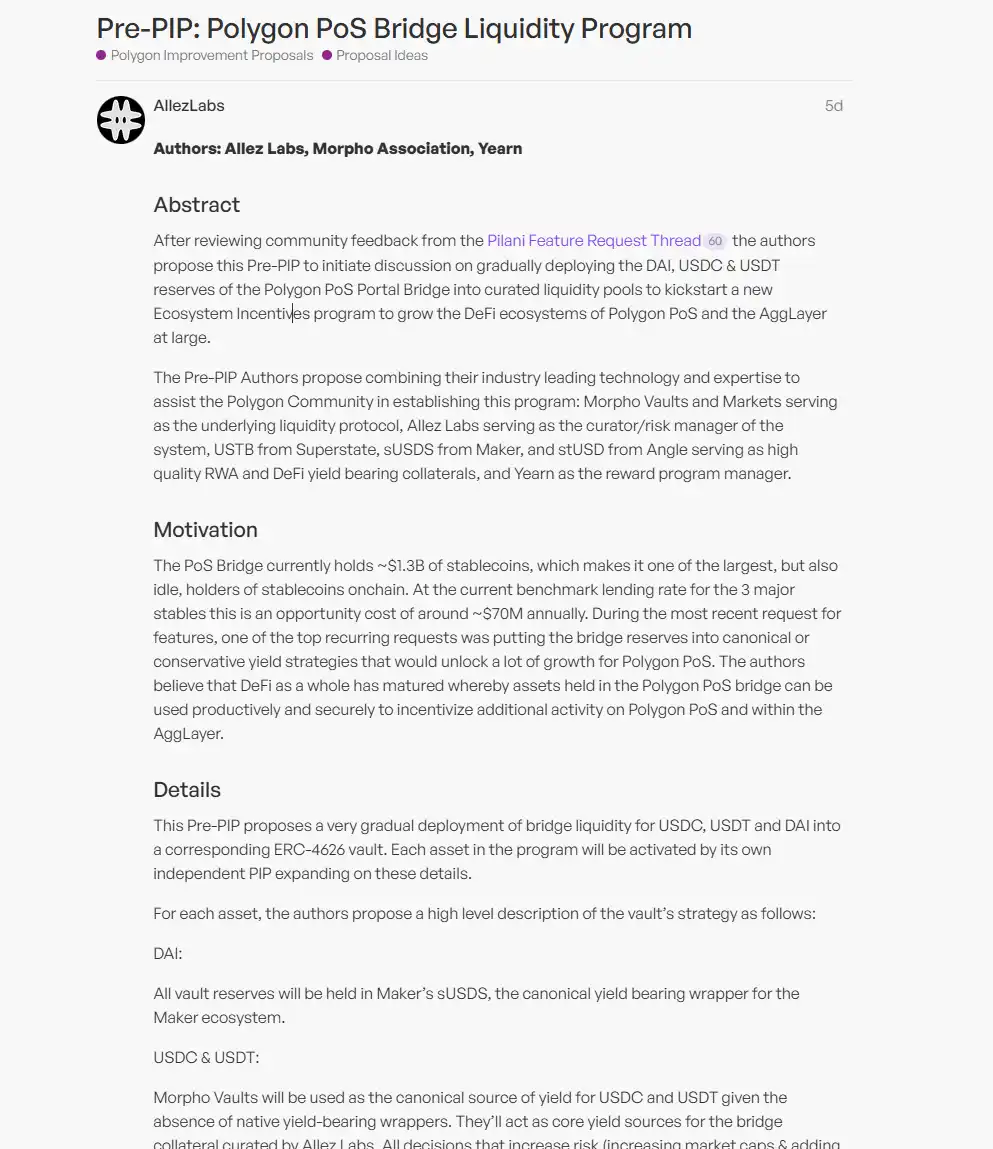
It is understood that the Polygon PoS bridge holds approximately $1.3 billion in stablecoin reserves. The community recommends deploying these idle funds into carefully selected liquidity pools to generate income and promote the development of the Polygon ecosystem. Based on the current loan interest rate, these funds may bring in approximately $70 million in income per year.
The proposal suggests that these funds be gradually invested in vaults that comply with the ERC-4626 standard. Specific strategies include:
DAI: Deposit Maker's sUSDS, the official yield token of the Maker ecosystem.
USDC and USDT: Through Morpho Vaults as the main source of income, Allez Labs is responsible for risk management. Initial markets include Superstate's USTB, Maker's sUSDS, and Angle's stUSD.
In addition, Yearn will manage the new ecosystem incentive program, using these proceeds to incentivize activities in Polygon PoS and the broader AggLayer ecosystem.
It is worth noting that the signatures of this proposal are Allez Labs, Morpho Association, and Yearn. According to Defillama data on December 17, Polygon's total TVL is 1.23 billion US dollars, of which AAVE's TVL is about 465 million US dollars, accounting for about 37.8%. Yearn Finance's TVL ranks 26th in the ecosystem, with a TVL of about 3.69 million US dollars. This may explain why AAVE proposed to withdraw from Polygon for security reasons.
Obviously, from AAVE's perspective, this proposal is to take AAVE's money and put it in other lending agreements to earn interest. As the largest application of Polygon POS cross-chain bridge funds, AAVE cannot benefit from such a proposal, but instead has to bear the risk of fund security.
However, Lido's withdrawal may have nothing to do with this proposal. After all, Lido's proposal and vote on re-evaluating Polygon were released a month ago, but it just happened to be released at this time.
A helpless move due to weak ecological development
If the AAVE withdrawal proposal is officially passed, the TVL on Polygon will drop to $765 million, which is no longer possible to achieve the $1 billion fund reserve mentioned in the Pre-PIP improvement proposal. Uniswap, which ranks second in the ecosystem, has a TVL of about $390 million. If Uniswap also follows up with a similar plan to AAVE, the TVL on Polygon will drop sharply to around $370 million. Not only will the annual interest-bearing target of $70 million not be achieved, but all aspects of the entire ecosystem will be affected, such as the price of governance tokens, active users, etc. Perhaps the loss will be far more than $70 million.
So, judging from this result, this proposal does not seem to be a wise move. Why did the Polygon community propose this plan? In the past year of development, what is the state of the Polygon ecosystem?
The most prosperous time for the Polygon ecosystem was in June 2021, when the total TVL reached 9.24 billion US dollars, which is 7.5 times that of today. As time goes by, Polygon's TVL curve has been declining all the way. Since June 2022, it has been maintained at around 1.3 billion US dollars, without much ups and downs. By 2023, it had once fallen to around 600 million US dollars. In 2024, the market rebounded, and Polygon's TVL volume was still below 1 billion US dollars in most cases. It barely recovered to more than 1 billion US dollars from October.

In terms of the number of active addresses, Polygon PoS had about 439,000 active addresses on October 29, which is almost the same as the data a year ago. Although the number of active addresses of Polygon PoS has increased significantly from March to August this year, reaching 1.65 million at one time. But for some reason, it cooled down rapidly when the market was hottest. 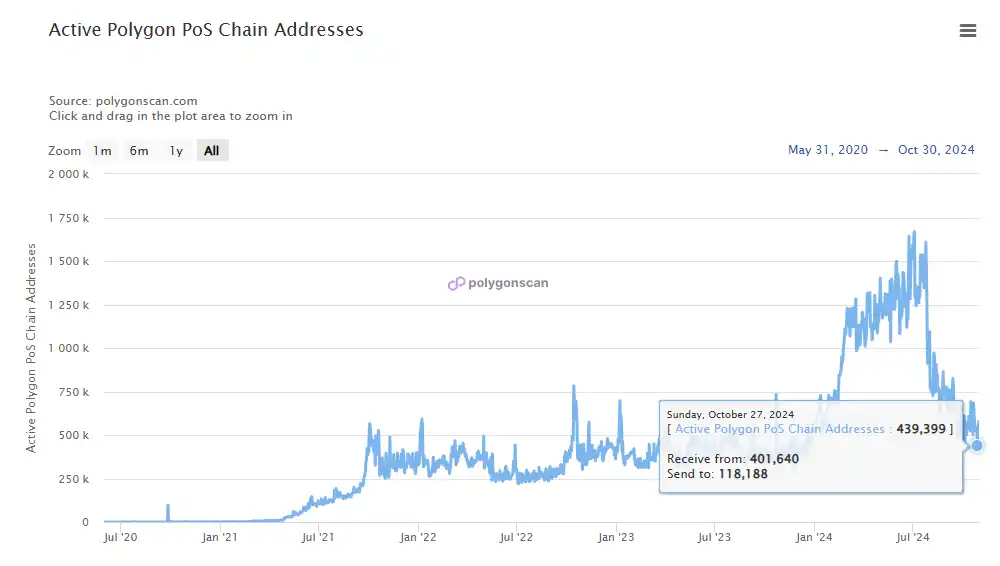
The market performance of the token was also poor. From March to November 2024, the price of POL tokens did not follow the rise of the Bitcoin and other markets, but fell all the way, from $1.3 at the beginning of the year to $0.28, a drop of more than 77%. It has only started to rebound in the past one or two months. The price has rebounded to around $0.6 recently, but it still needs to increase by about 5 times from the historical high of nearly $3.
Technological innovation + brand upgrade is not as good as "giving money"
Polygon has not given up on technology and products despite the weak development of the ecosystem. It has repeatedly released voices on technological innovation and product layout in the past year. The most eye-catching performance is naturally the development of the prediction market Polymarket in the past year. In addition, in October, Polygon released a new unified blockchain ecosystem AggLayer. According to the official introduction, Agglayer = unified chain (L1, L2, L∞), but it is obvious that the positioning of this new ecosystem does not seem to be easy to understand. In November, the official also published an article to explain AggLayer.
In addition, Polygon Plonky3, a ZK proof system toolkit within the ecosystem, has become the fastest zero-knowledge proof system. Vitalik also interacted on Twitter and said, "You won the game."
In addition to technology, this year many old public chains like to reshape their brands by changing their names and changing their coins. Polygon has already reshaped its brand, changing its name from Matic to Polygon. And for the current market environment, non-disruptive technological innovation seems to be difficult to become a narrative advantage for a project. This is indeed a cruel fact for projects such as Polygon that are still obsessed with technological innovation or hope to reshape their brands through integration.
What can really attract users and keep their attention is often reward distribution or incentive plans, such as Hyperliquid, which is in the limelight recently. Polygon wants to reform in this regard, but there are obviously not many cards available. In terms of on-chain fees, Polygon only generates tens of thousands of dollars in fees every day, and these revenues cannot arouse users' interest. So, there is the "borrowing chickens to lay eggs" proposal mentioned at the beginning.
But obviously, the owner of the "hen" does not agree with this business, and Polygon may lose more because of it. Overall, the fundamental reason for the stagnation of Polygon's ecological development is that it lacks sufficient user incentives and new narrative driving force. Faced with intensified market competition, Polygon needs to find more attractive market strategies in addition to technological innovation. This is also the common dilemma of most old chains at present.
You may also like

Morning Report | BitMine increased its holdings by 126,971 ETH last week; trader Eugene announced his exit from the crypto market

Wang Chuan: How can one not feel anxious after the neighbor Old Wang made thirty times profit by investing in storage stocks? (Seven) - A quarter-century cycle

Cryptocurrency CEXs are flocking to sell US stocks, and traditional brokerages are facing an "uninvited guest."

$75 billion in foreign capital has fled, and South Korean retail investors have absorbed it all using leverage

Japan’s Three Megabanks Plan Joint Stablecoin Issuance in Fiscal 2026
MUFG, SMBC, and Mizuho reportedly plan to jointly issue fiat-pegged stablecoins in fiscal 2026, signaling Japan’s growing push into bank-led digital payment infrastructure.

Humanity Discloses H Token Dual-Chain Attack Details, With Losses on Ethereum and BSC Exceeding $36 Million
Humanity said the H token attack across Ethereum and BSC caused more than $36 million in losses after leaked ProxyAdmin keys enabled malicious contract upgrades and token minting.
White House Discusses CLARITY Act With Law Enforcement Ahead of Senate Vote
The White House discussed the CLARITY Act with law enforcement ahead of a Senate vote, focusing on illicit finance risks and developer protections.

Bitcoin Trading Guide 2026: Strategies for Experienced Traders

What Is XAUT and PAXG? Why Tokenized Gold Is Booming in 2026

Will the SpaceX IPO Hurt Bitcoin? Here's What Traders Are Watching

Foreign selling in the South Korean stock market accelerates, with cumulative net sales reportedly reaching $75 billion this year
On June 9, The Kobeissi Letter, citing Goldman Sachs data, reported that global investors are selling South Korean stocks at an unusually rapid pace. In the latest trading session, foreign investors sold about $801 million worth of Kospi constituent stocks again; total foreign outflows last week reached about $10 billion, and the market has been in net foreign selling on nearly every trading day over the past month. According to the data cited in the report, foreign investors have sold about $75 billion worth of South Korean stocks so far this year. Meanwhile, South Korean retail and institutional investors together recorded roughly $69 billion in net buying over the same period, suggesting that the market’s main buying support has come from domestic capital rather than returning overseas funds. The information currently disclosed still mainly comes from The Kobeissi Letter’s retelling and Goldman Sachs data summaries, while public details on the statistical period and the specific definition of “selling” remain relatively limited.

Fortune Warns of Strategy’s Financing Structure Risks as Bitcoin Premium Narrows
Fortune warned that Strategy’s Bitcoin treasury model faces growing financing risks as MSTR’s net asset premium narrows and preferred stock dividend pressure increases.

Ferrari Challenge Le Mans: Carl Moon to Dominate in WEEX Livery

Sahara AI Responds to SAHARA’s Sharp Drop: No Contract or Product Security Issues Found, Internal Investigation Underway
Sahara AI responded to SAHARA’s 60% price drop, saying no token contract or product security issues have been found and an internal investigation is underway.

WEEX Deposit/Withdrawal Dynamic Island: Your Asset Status, Always in Sight
Scaling Crypto Derivatives: The Digital Asset Infrastructure Behind High-Volume Trading
In the fast-moving digital asset ecosystem, derivatives platforms face an extreme architectural test. High-leverage futures markets demand more than just standard security—they require absolute operational precision, zero-latency matching engines, and ironclad structural scalability, all while navigating intense market volatility.
As global platforms scale to meet these demands, the industry is shifting away from rigid, monolithic setups toward a more agile, "decoupled" infrastructure philosophy.
The Blueprint for High-Volume Copy TradingFor elite global exchanges like WEEX (founded in 2018), this architectural choice becomes critical when scaling high-volume retail features like social copy trading. When thousands of users automatically mirror the real-time strategies of elite traders simultaneously, it triggers sudden, monumental spikes in concurrent transactional volume.
To prevent execution latency or settlement bottlenecks during these peak volatility events, a platform's primary engine must remain entirely dedicated to risk management, copy-trade synchronization, and order matching.
The Architectural Rule: New-generation platforms must separate front-end user execution engines from heavy backend infrastructural overhead to eliminate operational friction.
By separating these layers, platforms can maintain complete sovereignty over their trading environments and user experiences while strategically aligning with institutional-grade infrastructure ecosystems. This strategic framework allows modern exchanges to leverage advanced Digital Asset Custody infrastructure such as Cobo’s behind the scenes, ensuring that backend wallet management scales elastically alongside trading spikes.
Capitalizing on Market Momentum and 400× LeverageIn a derivatives arena where platforms offer up to 400× leverage on perpetual contracts, capital efficiency and market agility are core business metrics. To capture market momentum, an exchange needs the ability to rapidly expand its asset offerings, supporting everything from legacy crypto assets to sudden, trending altcoins across a massive library of trading pairs.
Adopting a flexible, scalable Wallet-as-a-Service (WaaS) solution such as Cobo’s could completely rewrite the development timeline for high-growth exchanges. Instead of spending months of engineering capital building out custom backend wallet architectures for every new blockchain network, platforms can deploy localized infrastructure in days.
This agility allows platforms to instantly scale their listings to over a thousand trading pairs without compromising security or delaying time-to-market. It mirrors the exact operational advantages seen during high-velocity market events, similar to how advanced wallet infrastructure empowers platforms during sudden asset surges; allowing exchanges to pass that speed and liquidity directly to their global user base.
A Mature Foundation for GrowthThe synergy between trusted infrastructure ecosystems and global trading platforms represents the natural evolution of a maturing crypto market. As WEEX continues to scale its global spot and derivatives offerings for over 6 million users, adopting robust backend paradigms proves that platforms no longer have to compromise between cutting-edge trading velocity and uncompromised structural security.

Get Paid to Onboard? Try WEEX’s New Homepage with Rewards for Registration, Deposit & Trade
WEEX Custom Layout: Build Your Perfect Trading Workspace in Seconds
Morning Report | BitMine increased its holdings by 126,971 ETH last week; trader Eugene announced his exit from the crypto market
Wang Chuan: How can one not feel anxious after the neighbor Old Wang made thirty times profit by investing in storage stocks? (Seven) - A quarter-century cycle
Cryptocurrency CEXs are flocking to sell US stocks, and traditional brokerages are facing an "uninvited guest."
$75 billion in foreign capital has fled, and South Korean retail investors have absorbed it all using leverage
Japan’s Three Megabanks Plan Joint Stablecoin Issuance in Fiscal 2026
MUFG, SMBC, and Mizuho reportedly plan to jointly issue fiat-pegged stablecoins in fiscal 2026, signaling Japan’s growing push into bank-led digital payment infrastructure.
Humanity Discloses H Token Dual-Chain Attack Details, With Losses on Ethereum and BSC Exceeding $36 Million
Humanity said the H token attack across Ethereum and BSC caused more than $36 million in losses after leaked ProxyAdmin keys enabled malicious contract upgrades and token minting.

Popular coins
Latest Crypto News


