
[SCAN 2026 Final Interview] Team T34M1: A Collaboration Between Active Police Officers and Cryptocurrency Analysts

 Prefer us on Google


T34M1 team image. Source=T34M1
The world’s first cryptocurrency (digital asset) tracking competition, ‘SCAN 2026’, will be held on September 28 at 9 AM at Monaco Space in Seocho-gu, Seoul.
SCAN 2026 was established to enhance cybersecurity and investigative capabilities in the field of digital assets, hosted by the digital asset information company DAsset, with global blockchain data platform Chainalysis participating as a CTF (Capture The Flag) partner.
The final will feature the top 20 teams from the preliminary round (a total of 416 teams, 754 participants).
*The teams that advanced to the finals are as follows. (In alphabetical order)
0xfun / 1nf1n1ty / 67 / BITSkrieg / CertiScan / DeFiHackLabs / EDCCS / Funds Went to Kerning City / hello / IBarelyKnowHer / J0y_B0y / lazarus2026 / Lv1x / Project Sekai / T34M1 / Tardigrades / Tornado Cats / youtiaos / Upside Academy / Chaos of KAOS
Q. What motivated you to form this team, and what backgrounds and expertise do the team members have?
"Our team consists of 4 members: 3 active police officers and 1 civilian cryptocurrency (digital asset) analyst.
The police officer team members have experience handling digital evidence and cases related to digital assets in actual investigative settings. The civilian digital asset analyst works in the private sector, focusing on blockchain security, on-chain data analysis, anti-money laundering (AML) for digital assets, and tracking the flow of funds.
To properly analyze digital asset crimes, it is not enough to just have the technical skills to read on-chain data. It is essential to have the ability to interpret evidence from an investigative perspective and the skills to track actual fund flows. We formed this team with the belief that combining our respective experiences and expertise would enable us to solve practical problems more effectively.
We are not only focused on solving the competition problems well but also on whether the analysis results can be utilized in actual investigations and crime responses."
Q. You have advanced to the finals of SCAN 2026, which had 416 teams participating in the preliminary round. What are your thoughts on advancing to the finals and what was the most memorable moment during the preliminary round?
"We are delighted and honored to have advanced to the finals in a competition with 416 teams from around the world. Since this result comes from competing with participants from various countries in the field of digital asset analysis, it feels even more meaningful as it somewhat proves our team’s skills and approach.
The most memorable moment during the preliminary round was when we confirmed our advancement to the finals after solving all the problems. During the problem-solving process, we were so focused on our respective analyses that we hardly had time to discuss the results or consider our chances of advancing. It was only after completing all the solutions and checking the news of our advancement that we realized we had achieved it.
However, we do not consider advancing to the finals as our ultimate goal. Having confirmed our competitiveness through the preliminary round, we want to prove our skills with even better results in the finals."
Q. What was the most challenging problem or situation you faced while solving the SCAN 2026 preliminary problems? How did you approach and resolve the issues?
"No specific problem stood out as particularly difficult during the preliminary round. Since the types of problems we encountered were largely aligned with the types we regularly deal with in investigations and on-chain analysis, the process of identifying and solving the core of each problem was relatively smooth.
Rather, the most challenging aspect was predicting what problems would be presented in the competition. Digital asset analysis covers a wide range depending on the chain, protocol, and types of crimes, making it difficult to prepare for all possibilities at the same level.
Instead of focusing on predicting specific problem types, we divided roles and organized basic analysis procedures to ensure we could respond to any problem that might arise. After the problems were disclosed, we quickly proceeded with the solutions according to our respective expertise and cross-verified on-chain data and technical structures when necessary. Ultimately, I believe that having a team structure capable of responding to various situations was more important than accurately predicting the types of problems presented."
Q. What tools, technologies, or analysis methods did you use for on-chain data analysis and tracking the flow of funds during the preliminary round? If you have developed any programs or unique analysis methods, please share them as well.
"We primarily utilized blockchain explorers, public on-chain data, and address labeling information. When necessary, we directly queried transactions and event logs via Remote Procedure Call (RPC) and processed the data separately to analyze relationships between addresses and the flow of funds.
Rather than simply following the remittance paths, we examined various factors such as transaction timing, amounts, asset conversion processes, counterparties, bridge usage, and the dispersion and re-consolidation of funds. We also made it a principle to distinguish between facts confirmed on-chain and the analyst’s estimates, avoiding definitive conclusions about the nature or ownership of specific addresses based on a single clue.
During the preliminary round, our team also developed and utilized our own analysis tools and methods. Since we are still preparing for the finals, it is difficult to disclose all specific functions and analysis methods. If we achieve good results in the finals, we would like to introduce what tools we have created and how we have utilized them in solving actual problems within the scope that can be disclosed."
Q. What do you think is your team’s greatest strength or differentiated problem-solving approach compared to other finalist teams?
"Our greatest strength is the ability to combine perspectives from the field of investigation with civilian on-chain analysis technology within a single team.
Technically, tracking transactions and explaining the results as evidence in actual cases are two different capabilities. No matter how complex and sophisticated the analysis path is, if it cannot be objectively substantiated, it is difficult to utilize. Conversely, even if one has rich investigative experience, failing to accurately understand the technical structure of blockchain can lead to missing important clues.
Our team does not stop at the result of ‘addresses are connected’ but examines why we made that judgment, what other possibilities exist, and whether there is evidence at a level that can be utilized in actual investigations. I believe that valuing not only the accuracy of the analysis but also its reproducibility and explainability is what differentiates our team."
Q. What preparations are you making ahead of the finals on September 28?
"In preparation for the finals, we are conducting our own CTF within the team to practice in a manner similar to the actual competition. One team member creates problems, and the other team members solve them within a limited time.
We are not just repeating existing problems; the problem creator presents unfamiliar scenarios and on-chain data to each other. Through this, we are training our ability to quickly find key clues when encountering problems for the first time and our ability to organize analysis results within a limited time.
After the practice, we review the solving process and time taken, improving unnecessary lengthy tasks, automating parts, and refining role distribution among team members. Since it is difficult to predict the exact types of problems in the finals, we are focusing on creating a team that can flexibly respond to any situation rather than memorizing specific problems."
Q. If you win first place in the finals and receive a prize, what would you like to do with the prize money?
"At this point, I am more focused on proving our team’s skills in the finals rather than how to use the prize money.
If we achieve good results on the final stage of a competition with teams from around the world, I believe it will demonstrate that our investigative experience and on-chain analysis capabilities have international competitiveness. Right now, I am concentrating on that goal."
-- Price
This content is provided for general informational purposes only and doesn't constitute financial, investment, legal, or tax advice. Any events, rewards, online promotions, or related information mentioned herein should not be considered a recommendation, solicitation, or invitation to purchase, sell, trade, or otherwise deal in any crypto assets. Crypto assets are highly volatile and may result in loss. The availability of WEEX services, products, and related events may vary by region. You are responsible for ensuring that your participation is in accordance with applicable local laws and regulations.
You may also like
Ethereum's 'Two-Track Update': Glamsterdam Public Testnet and Hegotá Initial Validation

Exclusive Interview with Frontier Technology Investor Zheng Di: SEC's 'Innovation Exemption' Opens the Door to a Compliant Bull Market, Which Assets Are Potential Stocks?

HTX DeepThink: Opportunities Concentrate on Profitable and Fund-Supported Assets, BTC Still Has Room for Recovery After Consolidation

Why Did Sui (SUI) Crypto Price Jump 44%? Crypto OI and Leverage Explain the Rally
See why Sui (SUI) jumped 44%, how crypto OI and leverage amplified the rally, what the pullback means, and how to trade SUI on WEEX.

CFTC Chair Calls for "Mass Tokenization"! Wall Street Faces Three Barriers to Full On-Chain Adoption
Is the 1 Billion POL Burn Just a Joke?

Bitcoin Pulls Back From $87,000| WEEX TradFi Daily Brief (September 24, 2026)
Bitcoin pulled back from about $87,000 to about $84,000, with Ethereum near $2,680. S&P Global PMI on September 23 ET far exceeded forecasts. The 10-year yield broke above 5.00%, while the 5-year and 30-year touched highs last seen in 2007 and 2004. The S&P 500 and Nasdaq slipped. Energy moved with oil and crypto-treasury stocks followed bitcoin lower. Investors await earnings from COST, BB, and others.
WEEX Exclusive:Bitcoin Pulls Back From $87,000| WEEX TradFi Daily Brief (September 24, 2026)
MIT Warns AI Bubble May Require 2.7x Productivity Increase by 2030
Davie Reveals BTC Strategy Data, Volume 205.42K, Rate +0.0016%
Stablecoins hold nearly $200 billion in US debt, but money funds bought the surge

Coin Metrics revises 19 months of Bitcoin ETF wallet data

HTX Research Analyst WZ: Crypto Market Pricing Extends Beyond Crypto, Regulation and Liquidity Become Key Variables
Ye Tan: The Internet Era is Coming to an End, the AI Era has Already Begun
Chainalysis: Crypto Economic Activity Down 1.6%, Market Value Shrinks by $2.1 Trillion

$1.7 Billion Inflow to Bitcoin ETFs in Two Days
Why Do You Always Make Small Profits and Then Lose Everything? Taleb Explained It with 'Asymmetric Leverage' Twenty Years Ago

Coinbase traced $1.1 million crypto trail behind AI phishing service EvilTokens
Over 70% of South Korean Crypto Investors Oppose Crypto Tax: What Are Their Concerns?
Nomura Warns of 'Double Whammy' Risk: The Next Market Storm May Start with Interest Rate Volatility

VVV Hits All-Time High: Founder’s Perspective on Models, Privacy, and Crypto

Binance Research Team: A Bull Market Requires the Resonance of Monetary Easing and Paradigm Innovation, with RWA as a Key Driving Force

Bitpace Partners with Fireblocks for Cross-Border Payments with Stablecoins
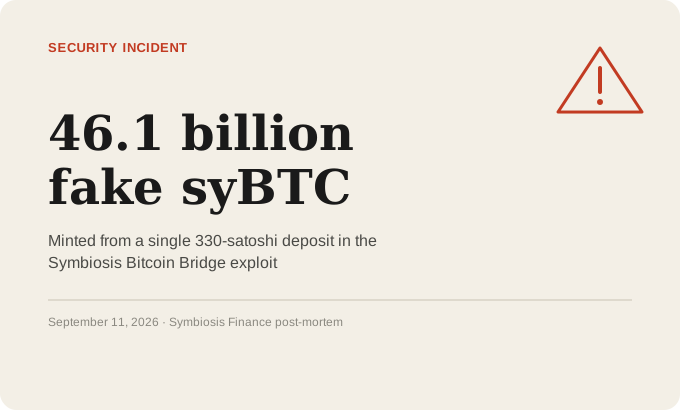
How Did a Hacker Create 46 Billion Fake Bitcoin in the Symbiosis Exploit? Decodes Bitcoin Hacker With WEEX Now
How two Symbiosis bridge bugs let a hacker mint 46.1 billion unbacked syBTC, drain Bitcoin pools and expose critical bridge risks.
[Interview] Lee Yun-ho, CEO of KIP: "We need to set the stage before the STO market opens... sharing RWA know-how with financial companies"
What is Fin.com? Understanding Cross-Border Payment Infrastructure via API

Uniswap (UNI) Price Jumps Toward $10 as CME Futures Launch Nears: What Traders Need to Know
Bernstein Research Report: Why Can Gold Still Surge to $5,700 Even with Continued Rate Hikes by the Fed?
Masayoshi Son is borrowing money again, betting billions on OpenAI
Hashed invests in $300 million digital-asset private credit fund
Ethereum's 'Two-Track Update': Glamsterdam Public Testnet and Hegotá Initial Validation
Exclusive Interview with Frontier Technology Investor Zheng Di: SEC's 'Innovation Exemption' Opens the Door to a Compliant Bull Market, Which Assets Are Potential Stocks?
HTX DeepThink: Opportunities Concentrate on Profitable and Fund-Supported Assets, BTC Still Has Room for Recovery After Consolidation
Why Did Sui (SUI) Crypto Price Jump 44%? Crypto OI and Leverage Explain the Rally
See why Sui (SUI) jumped 44%, how crypto OI and leverage amplified the rally, what the pullback means, and how to trade SUI on WEEX.
CFTC Chair Calls for "Mass Tokenization"! Wall Street Faces Three Barriers to Full On-Chain Adoption
Is the 1 Billion POL Burn Just a Joke?
Contents
Latest articles


Latest coin listings on WEEX


