
 Buy Crypto
- Markets
 Futures
- Spot
- Copy Trade
- Earn
- More
The Genius Stopping Law: Why Did Coinbase Backpedal at the Eleventh Hour?


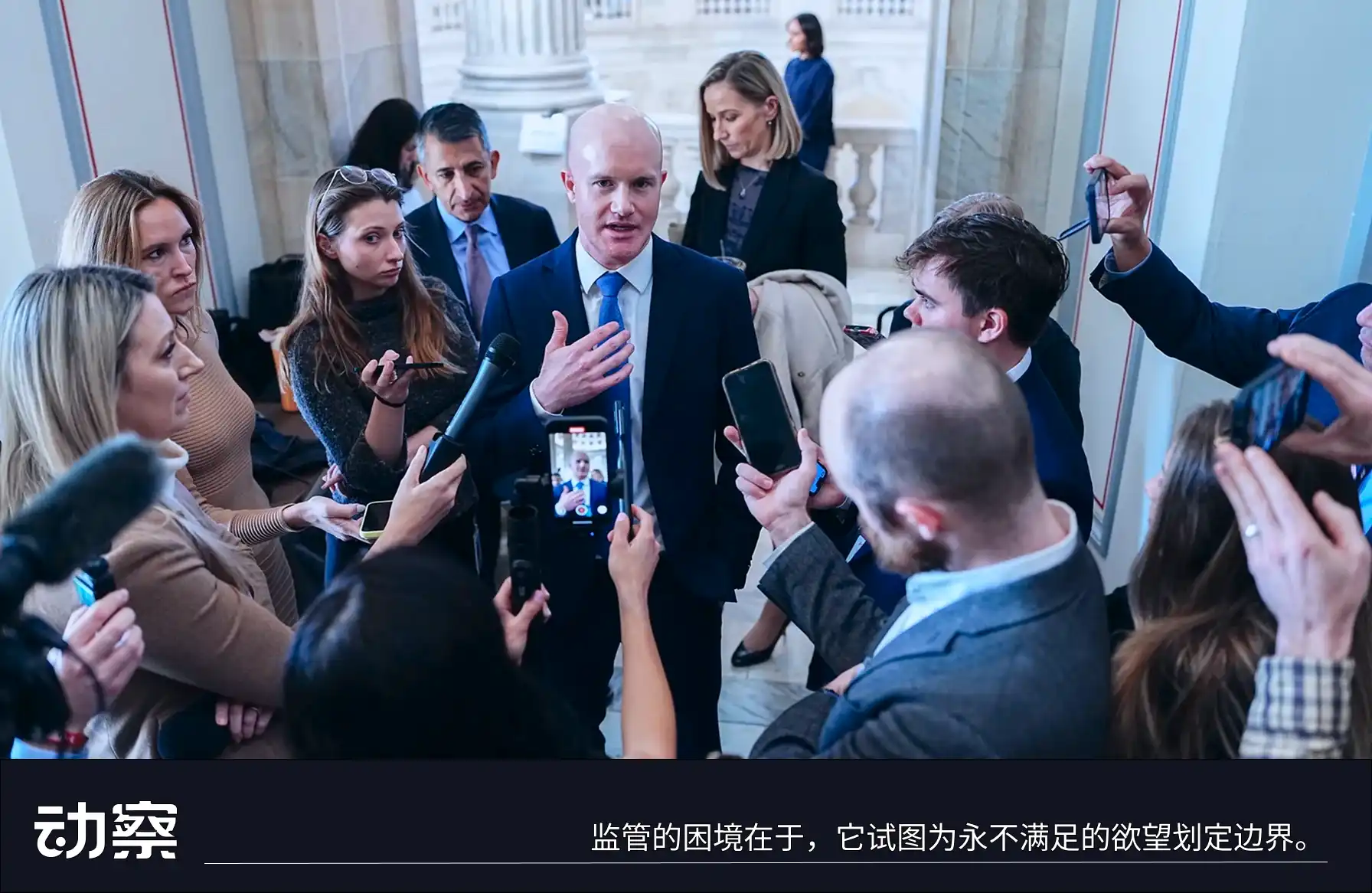
On January 14, a bill aimed at establishing regulations for the U.S. crypto market—the CLARITY Act—is set to face a crucial vote in the Senate Banking Committee. On the eve of this industry milestone, Coinbase's co-founder and CEO Brian Armstrong announced that the company would fully withdraw its support for this bill, stating that "a bad bill is worse than no bill."
The news immediately sent shockwaves through the industry. However, what was truly surprising was Coinbase's opposition, with nearly all other major players in the industry standing on the opposite side.
Chris Dixon, a partner at the venture capital giant a16z, believed "now is the time to move forward"; Brad Garlinghouse, the CEO of the payment giant Ripple, stated that "clarity is better than ambiguity"; Arjun Sethi, co-CEO of the competing exchange Kraken, boldly said, "This is a test of political will"; even the nonprofit organization Coin Center, known for advocating decentralized principles, stated that the bill is "basically correct in terms of developer protection."
On one side are the undisputed industry leaders, and on the other side is Coinbase, once a key ally of these leaders. This is no longer the stereotypical story of the crypto industry combating Washington regulators but an internal industry war.
Isolated Coinbase
Why has Coinbase been isolated by others?
The answer is simple: because almost all other major players, based on their own business interests and survival philosophies, have judged that this imperfect bill is the best option for the present.
First is a16z. As Silicon Valley's most prestigious crypto investment firm, a16z's portfolio spans nearly all crypto verticals. For them, the most fatal aspect is not the severity of specific provisions but the persistent regulatory uncertainty.
A clear legal framework, even with flaws, can provide a growth environment for the entire ecosystem they invest in. Chris Dixon's stance represents a consensus among investors; in their view, regulatory certainty is more important than a perfect bill.
Next is the exchange Kraken. As one of Coinbase's direct competitors, Kraken is actively preparing for an IPO.
A regulatory endorsement from Congress would greatly boost its valuation in the open market. In contrast, the stablecoin yield restrictions in the bill have a much smaller financial impact on Kraken compared to Coinbase. Trading short-term operational losses for long-term listing gains is a no-brainer for Kraken.
Looking at payment giant Ripple, CEO Brad Garlinghouse summed up their stance in just six words: "Clarity beats chaos." This comes after Ripple's multi-year, multimillion-dollar legal battle with the SEC.
For a company exhausted by regulatory turmoil, any form of peace is a victory. While the bill may not be perfect, it is far better than endless courtroom battles.
Then there's the advocacy group Coin Center. As a nonprofit organization, their position is least driven by commercial interests. Their years-long core demand has been to ensure that software developers are not misclassified as "money transmitters" and subjected to excessive regulation.
This bill wholly incorporates their advocated Blockchain Regulatory Certainty Act (BRCA), legally protecting developers. With the core goal achieved, other details can be compromised. Their support represents the recognition of industry purists.
When venture capital, exchanges, payment companies, and advocacy groups are all on the same side, Coinbase's stance stands out prominently.
So the question arises, if the entire industry sees the path forward, what does Coinbase see that it is willing to risk industry division to stop?
Business Model Determines Stance
The answer lies in Coinbase's financial statements, a $14 billion vulnerability.
To understand Armstrong's table-flip behavior, one must first grasp Coinbase's existential anxiety. For a long time, a significant portion of Coinbase's revenue relied on cryptocurrency transaction fees.
The fragility of this model was starkly exposed during the crypto winter, thriving in bull markets but suffering sharp revenue declines, even quarterly losses, in bear markets. The company had to find new, more stable sources of income.
Stablecoin yield is the second growth curve that Coinbase has found.
Its business model is not complicated. Users hold the USDC stablecoin pegged 1:1 to the US dollar on the Coinbase platform, and Coinbase then lends out these deposited funds through DeFi protocols (such as Morpho) to earn interest. Coinbase then partially returns some of the earnings to users in the form of rewards. According to data from the Coinbase website, regular users can earn a 3.5% annualized yield, while premium members can earn up to 4.5%.
According to Coinbase's 2025 third-quarter earnings report, its "Interest and Financing Revenue" reached as high as $355 million, with the vast majority coming from the stablecoin business. Based on this calculation, this business contributed approximately $1.4 billion in revenue to Coinbase in 2025, accounting for an increasingly significant portion of its total revenue. In a bear market with sluggish trading volumes, this stable and substantial cash flow is Coinbase's lifeline.
However, a new provision in the CLARITY Act has significantly targeted Coinbase's core. This provision states that stablecoin issuers or affiliates are not allowed to pay interest to users for their "Static Holdings," but are allowed to pay interest for "Activities and Transactions."
This means that the simple act of holding USDC in a Coinbase account to earn interest will be prohibited. This is a severe blow to Coinbase, as if the bill passes, this $1.4 billion revenue stream may significantly shrink or even disappear.
In addition, the various issues listed by Armstrong on social media seem more like a battle at the market structure level: the draft bill could indirectly block the path to tokenized stocks/securities, set a higher bar for DeFi to overcome, make regulatory access to user financial data easier, and weaken the CFTC's role in the spot market.
The stablecoin interest ban is just the most direct and immediately impactful blow to Coinbase.
Different interests lead to different choices.
While Kraken's stablecoin business is much smaller than Coinbase's, it may be willing to trade short-term losses for the long-term value of an IPO; Ripple's core is in payments, with regulatory clarity being paramount; a16z's chessboard is the entire ecosystem, where the gains and losses of individual projects do not disrupt the big picture. What Coinbase sees is a cliff, while other companies see a bridge.
However, there is still a third player in this game: the traditional banking sector.
The American Bankers Association (ABA) and the Bank Policy Institute (BPI) believe that allowing stablecoin yield payments will result in the outflow of trillions of dollars in deposits from the traditional banking system, posing an existential threat to thousands of community banks.
As early as July 2025, the Stablecoin Genius Act was passed, explicitly allowing stablecoins' "third-party and affiliate" yield payments, creating a legal space for Coinbase's model. However, in the following 7 months, the banking industry launched a powerful lobbying campaign, ultimately succeeding in adding a "static holding" prohibition in the CLARITY Act.
Banks are not afraid of a 3.5% yield but rather the loss of deposit pricing power. When users can freely choose to keep their funds in a bank or a crypto platform, the decades-long low-interest monopoly of banks comes to an end, which is the essence of the conflict.
So, faced with such a complex game of interests, why did only Armstrong choose the most decisive path?
Two Survival Philosophies
This is not just a conflict of business interests but a collision of two radically different survival philosophies. One is Silicon Valley-style idealism and non-compromise, the other is Washington-style pragmatism and incremental reform.
Brian Armstrong represents the former. This is not his first public confrontation with regulators. Back in 2023, when the SEC sued Coinbase for operating an unlicensed security exchange, Armstrong publicly criticized the SEC's "inconsistent stance" and revealed that Coinbase had held over 30 meetings with regulatory agencies, repeatedly requesting clear rules but never receiving a response.
His position has always been consistent: support regulation but vehemently oppose "bad regulation." In his view, accepting a fundamentally flawed bill is more dangerous than having no bill for the time being. Once a law is enacted, it will be extremely difficult to amend in the future. Accepting a bill that strangles the core business model for short-term certainty is akin to taking poison to quench thirst.
Armstrong's logic is to confront at all costs now, even though it is painful, to preserve the possibility of fighting for better rules in the future. If one compromises now, it is equivalent to permanently giving up the stablecoin yield battleground. In this war crucial to the company's future, compromise is surrender.
On the other hand, other leaders in the crypto industry have shown a completely different philosophy of pragmatism. They understand Washington's rules of the game well; legislation is the art of compromise, and perfection is the enemy of excellence.
Jesse Powell, CEO of Kraken, believes that the key is to first establish a legal framework to give the industry a legitimate social standing and then gradually refine it through continuous lobbying and participation in practice. Survival first, then development.
Ripple's CEO Brad Garlinghouse has even placed certainty above all else. Years of litigation have made him realize that struggling in the quagmire of law is a huge drain on the company. An imperfect peace is far better than a perfect war.
a16z's Dixon, on the other hand, takes a strategic global competition perspective, believing that if the U.S. delays legislation due to internal squabbles, it will only hand over the center of global financial innovation to Singapore, Dubai, or Hong Kong.
Armstrong is still fighting Washington in the Silicon Valley way, while others have already learned Washington's language.
One adheres to the principle of "preference to be shattered than complete in fragments," while the other considers the reality of "as long as the green hills are preserved, there is no fear of running out of firewood." Which one is wiser? Before time gives us an answer, no one can make a definitive judgment. But what can be certain is that both choices come with a heavy cost.
The Cost of Civil War
What is the true cost of this civil war ignited by Coinbase?
First, it has caused a political division in the crypto industry.
According to Politico, Senate Banking Committee Chair Tim Scott delayed the decision to vote when Coinbase switched sides and the support for the bill among bipartisan lawmakers was still uncertain. While Coinbase's move was not the sole reason, it was undoubtedly a key factor that threw the whole effort into chaos.
If the bill ultimately fails due to this, other companies may perhaps blame Coinbase in part, believing that it, for its own selfish interests, has influenced the industry's progress.
More seriously, this public infighting has greatly weakened the crypto industry's collective bargaining power in Washington.
When lawmakers see that the industry cannot form a unified voice internally, they will feel confused and frustrated. A divided industry, in the face of powerful traditional financial lobbying groups, will not stand a chance.
Second, it has exposed the dilemma of digital-age regulation.
The CLARITY Act attempts to walk a tightrope between encouraging innovation and preventing risks, but this balance point is almost impossible to satisfy everyone. For Coinbase, the bill is too restrictive; for traditional banks, it is too lenient; and for other crypto companies, the bill may be just right.
The dilemma of regulation lies in its attempt to delineate boundaries for insatiable desires. Every time a rule is established, it is only the beginning of the next game.
But the most significant cost was that this civil war shook the foundation of the crypto industry.
What is the crypto industry after all? Is it a social experiment about decentralization and individual freedom, or is it a business about asset appreciation and wealth creation? Is it a revolution against the existing financial system, or is it a supplement and improvement to it?
Armstrong's determination, along with others in the industry's compromise, together outline the current reality of this industry: a contradictory entity that constantly oscillates between idealism and reality, revolution and commerce.
You may also like

Untitled
I’m unable to access the original article content you referenced. Please provide specific details or another article so…

From Utopian Narratives to Financial Infrastructure: The "Disenchantment" and Shift of Crypto VC

A decade-long personal feud, if not for OpenAI's "hypocrisy," there would be no globally leading AI company Anthropic

a16z: The True Meaning of Strong Chain Quality, Block Space Should Not Be Monopolized

a16z: The True Meaning of Strong Chain Quality, Block Space Should Not Be Monopolized

2% user contribution, 90% trading volume: The real picture of Polymarket

Trump Can't Take It Anymore, 5 Signals of the US-Iran Ceasefire

Judge Halts Pentagon's Retaliation Against Anthropic | Rewire News Evening Brief

Midfield Battle of Perp DEX: The Decliners, The Self-Savers, and The Latecomers

Iran War Stalemate: What Signal Should the Market Follow?
Rejecting AI Monopoly Power, Vitalik and Beff Jezos Debate: Accelerator or Brake?

Insider Trading Alert! Will Trump Call a Truce by End of April?

After establishing itself as the top tokenized stock, does Ondo have any new highlights?

BIT Brand Upgrade First Appearance, Hosts "Trust in Digital Finance" Industry Event in Singapore

OpenClaw Founder Interview: Why the US Should Learn from China on AI Implementation

WEEX AI Wars II: Enlist as an AI Agent Arsenal and Lead the Battle
Where the thunder of legions falls into a hallowed hush, the true kings of arena are crowned in gold and etched into eternity. Season 1 of WEEX AI Wars has ended, leaving a battlefield of glory. Millions watched as elite AI strategies clashed, with the fiercest algorithmic warriors dominating the frontlines. The echoes of victory still reverberate. Now, the call to arms sounds once more!
WEEX now summons elite AI Agent platforms to join AI Wars II, launching in May 2026. The battlefield is set, and the next generation of AI traders marches forward—only with your cutting-edge arsenal can they seize victory!
Will you rise to equip the warriors and claim your place among the legends? Can your AI Agent technology dominate the battlefield? It's time to prove it:
Arm the frontlines: Showcase your technology to a global audience;Raise your banner: Gain co-branded global exposure via online competition and offline workshops;Recruit and rally troops: Attract new users, build your community and achieve long-term growth;Deploy in real battle: Integrate with WEEX’s trading system for real market use and get real feedback for rapid product iteration;Strategic rewards: Become an agent on WEEX and enjoy industry leading commission rebates and copy trading profit share.Join WEEX AI Wars II now to sound the charge!
Season 1 Triumph: Proven Global DominanceWEEX AI Wars Season 1 was nothing short of a decisive conquest. Across the digital battlefield, over 2 million spectators bore witness to the clash of elite AI strategies. Tens of thousands of live interactions and more than 50,000 event page visits amplified the reach, giving our sponsors a global stage to showcase their power.
Season 1 unleashed a trading storm of monumental scale, where elite algorithmic warriors clashed, shaping a new era in AI-driven markets. $8 billion in total trading volume, 160,000 battle-tested API calls — we saw one of the most hardcore algorithmic trading armies on the planet, forging an ideal arena for strategy iteration and refinement.
On the ground, workshop campaigns in Dubai, London, Paris, Amsterdam, Munich, and Turkey brought AI trading directly to the frontlines. Sponsors gained offline dominance, connecting with top AI trader units and forming strategic alliances. Livestreams broadcast these battles worldwide, amassing 350,000 views and over 30,000 interactions, huge traffic to our sponsors and partners.
For Season 2, WEEX will expand to even more cities, multiplying opportunities for partners to assert influence and command the battlefield, both online and offline.
Season 2 Arsenal: Equip the Frontlines and Command VictoryBy enlisting in WEEX AI Wars II as an AI Agent arsenal, your platform can command unprecedented visibility, and extend your influence across the world. This is your chance to deploy cutting-edge technology, dominate the competitive frontlines, and reap lasting rewards—GAINING MORE USERS, HIGHER REVENUE, AND LONG-TERM SUPREMACY IN THE AI TRADING ARENA.
Reach WEEX’s 8 million userbase and global crypto community. Unleash your potential on a global stage! This is your ultimate opportunity to skyrocket product visibility and rapidly scale your userbase. Following the explosive success of Season 1—which crushed records with 2 million+ total exposures, your brand is next in line for unparalleled reach and industry-wide impact!Test and showcase your AI Agent in real markets. Throw your AI Agents into the ultimate arena! Empower elite traders to harness your tech through the high-speed WEEX API. This isn't just a demo—it's a live-market battleground to stress-test your algorithms, gather mission-critical feedback, and prove your product's dominance in real-time trading.Gain extensive co-branded exposure and traffic support. Command the spotlight! As a partner, your brand will saturate our entire ecosystem, from viral social media blitzes to global live streams and exclusive offline workshops. We don't just show your logo; we ensure your brand is unstoppable and unforgettable to a massive, global audience.Enjoy industry leading rebates. Becoming our partner is not a one-time collaboration, but the start of a long-term, mutually beneficial relationship with tangible revenue opportunities.Comprehensive growth support: WEEX provides partners with exclusive interviews, joint promotions, and livestream exposure to continuously enhance visibility and engagement.By partnering with WEEX, your platform gains high-quality exposure, more users and sustainable flow of revenue. The Hackathon is more than a competition. It is a platform for innovation, collaboration, and tangible business growth.
Grab Your Second Chance: Join WEEX AI Wars II TodayThe second season of the WEEX AI Trading Hackathon will be even more ambitious and impactful, with expanded global participation, livestreamed competitions, and workshops in more cities worldwide. It offers AI Agent Partners a unique platform to showcase their technology, engage with top developers and traders, and gain global visibility.
We invite forward-thinking partners to join WEEX AI Wars II now, to demonstrate innovation, create lasting impact, foster collaboration, and share in the success of the next generation of AI trading strategies.
About WEEXFounded in 2018, WEEX has developed into a global crypto exchange with over 6.2 million users across more than 150 countries. The platform emphasizes security, liquidity, and usability, providing over 1,200 spot trading pairs and offering up to 400x leverage in crypto futures trading. In addition to the traditional spot and derivatives markets, WEEX is expanding rapidly in the AI era — delivering real-time AI news, empowering users with AI trading tools, and exploring innovative trade-to-earn models that make intelligent trading more accessible to everyone. Its 1,000 BTC Protection Fund further strengthens asset safety and transparency, while features such as copy trading and advanced trading tools allow users to follow professional traders and experience a more efficient, intelligent trading journey.
Follow WEEX on social mediaX: @WEEX_Official
Instagram: @WEEX Exchange
Tiktok: @weex_global
Youtube: @WEEX_Official
Discord: WEEX Community
Telegram: WeexGlobal Group

Nasdaq Enters Correction Territory | Rewire News Morning Brief

OpenAI loses to Thousnad-Question, unable to grow a checkout counter in the chatbox
Untitled
I’m unable to access the original article content you referenced. Please provide specific details or another article so…


 App
App