
- Buy Crypto
- Markets
 Futures
- Spot
- Copy Trade
- Earn
- More
The Korean youth who stays up all night trading cryptocurrency, diving headfirst into Samsung Hynix

“None of our customers' demands could be fully met this year.”
Korean chip giant SK Hynix has revealed that the company's overall DRAM and NAND inventory is now only about 4 weeks, at a historically low level. From cloud giants like Google and Microsoft, to AI companies like OpenAI, to consumer electronics manufacturers, all customers have been unable to receive an adequate supply.
A price increase is inevitable. Starting in the third quarter of 2025, SK Hynix raised the price of HBM3E by 15%-20%, with DDR5 16Gb chip prices soaring by up to 102% in a single month. Starting in November, prices for all DRAM categories increased, and NAND contract prices were simultaneously raised. In January 2026, another significant price hike occurred, ranging from 20% to 60%.
Furthermore, a stock price surge is also inevitable. Since the beginning of 2025, SK Hynix's stock price has skyrocketed by about six times, while another Korean chip giant, Samsung Electronics, has seen its stock price nearly quadruple.

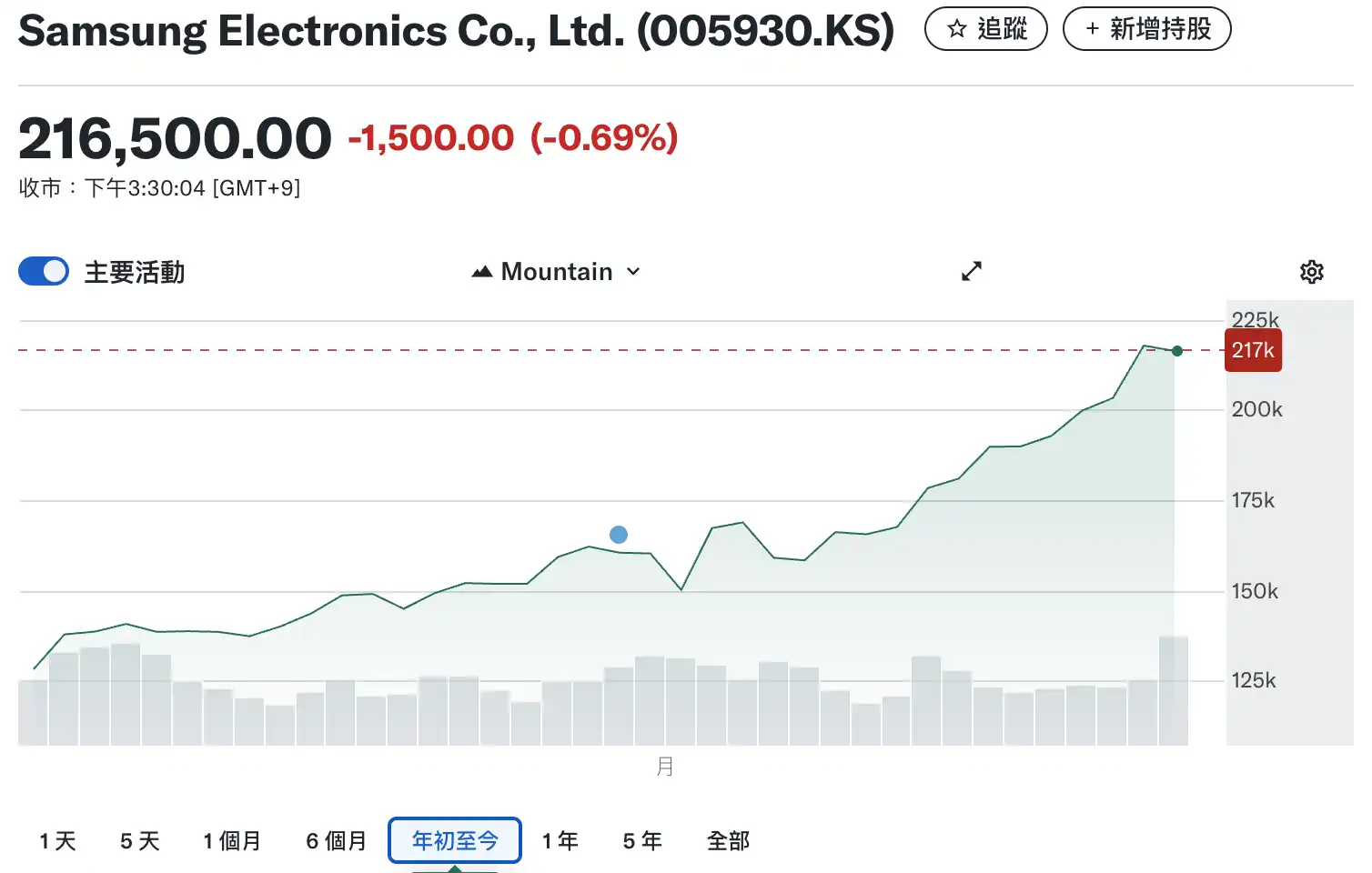
As a result, the Korean stock market KOSPI index has surpassed the 6,000-point mark for the first time, with a total market capitalization exceeding $3.76 trillion. Since the beginning of 2025, it has increased by approximately $2.23 trillion, surpassing the German and French stock markets, historically entering the global top ten and rising to ninth place. Since 2026, the index has accumulated a nearly 45% increase, making it one of the best-performing major stock markets globally.
In this tiny land of Korea, the Korean stock market, which has long been overlooked by overseas funds due to its low valuation, has now become a focus of the global capital market, also diverting the attention of those Korean young people who were once crazy about cryptocurrencies.
Redefining the Pricing of Samsung and SK Hynix
In the era of consumer electronics, the industry paradigm dominated by Apple has reigned for twenty years.
As Apple's largest contract manufacturer, Foxconn employs over 1.4 million workers in China, located at the bottom of the “Smiling Curve.” Design, brand, and sales occupy the two ends of the curve, with profits soaring upwards. Therefore, profit distribution exhibits a stable structure: the downstream (assembly/platform) enjoys the meat, while the upstream enjoys the soup. After all, there are many upstream suppliers with high substitutability; product definition is in the hands of brand factories; demand is concentrated at the terminals; and switching costs are low.
Many Chinese manufacturers take pride in being “Apple accessory manufacturers,” but from an investment perspective, the consensus is that while you can buy Apple, you shouldn't buy Foxconn.
However, when high technological concentration, slow production expansion, strong downstream dependence, and no short-term alternative paths all occur simultaneously, the upstream will transition from being an “accessory supplier” to a “system bottleneck.” The upstream will then control pricing power.
This is exactly what is happening in the current AI industry, the HBM (High Bandwidth Memory) race.
For over a decade, the semiconductor industry has defaulted to one assumption: the computational bottleneck lies within the computing chip itself. However, large-scale model training has shattered this belief. As the model parameters scale from billions to trillions, GPUs have encountered a more tangible issue: no matter how fast the computation is, there needs to be data to feed into it. HBM (High Bandwidth Memory) determines whether a GPU can run at full capacity, if cluster efficiency can be maximized, and if the cost per unit of computation can be reduced. It has become the "vascular system" of AI chips.
The more advanced GPUs become, the deeper their reliance on storage. Taking NVIDIA as an example, from A100 to H100, and then to H200 and future roadmaps, each GPU generation has seen a step-wise increase in the bound HBM capacity and bandwidth. As computational power doubles, HBM usage almost synchronously doubles. The cost of HBM is becoming a larger proportion of the overall bill of materials for the card.
Global players truly capable of large-scale production are few: Samsung Electronics, SK Hynix, and (relatively smaller in scale) Micron Technology. Apple needs Samsung, and NVIDIA needs Hynix.
When demand grows exponentially but the supply cannot be quickly ramped up, the price elasticity is infinitely amplified. In the traditional PC era, CPUs/GPUs took the bulk of the profit, with storage having strong cycles but weak pricing power. However, in the AI server era, HBM has become an irreplaceable component. When a component possesses both irreplaceability and constrained supply, it means absolute pricing power, almost guaranteeing excess profits.
Repricing Samsung and SK Hynix has become the main theme in most financial markets, including Korea. The allure of this theme even surpasses that of cryptocurrencies.
Korean Retail Investors Dive into Semiconductor Stocks
If you were to open a chat window with a young South Korean in the late nights of 2023 or 2024, Bitcoin would undoubtedly be a frequent topic of discussion. South Korea has long been one of the most retail-driven cryptocurrency markets globally, playing a pivotal role.
However, in 2026, marking the fourth year since the LUNA flash crash, Do Kwon, the last individual to have garnered significant attention in the financial industry in Korea, has been sentenced to 15 years in prison. In this year of the Fire Horse, a year of strong fire, while the AI industry is still booming, the geographically fire-affiliated South Korea seems to be excessively fiery.
Recently, when the rhythmic editor opened the Naver investment forum on Tieba, most of the discussions were about "Samsung Electronics" and "SK Hynix." Samsung and SK Hynix.
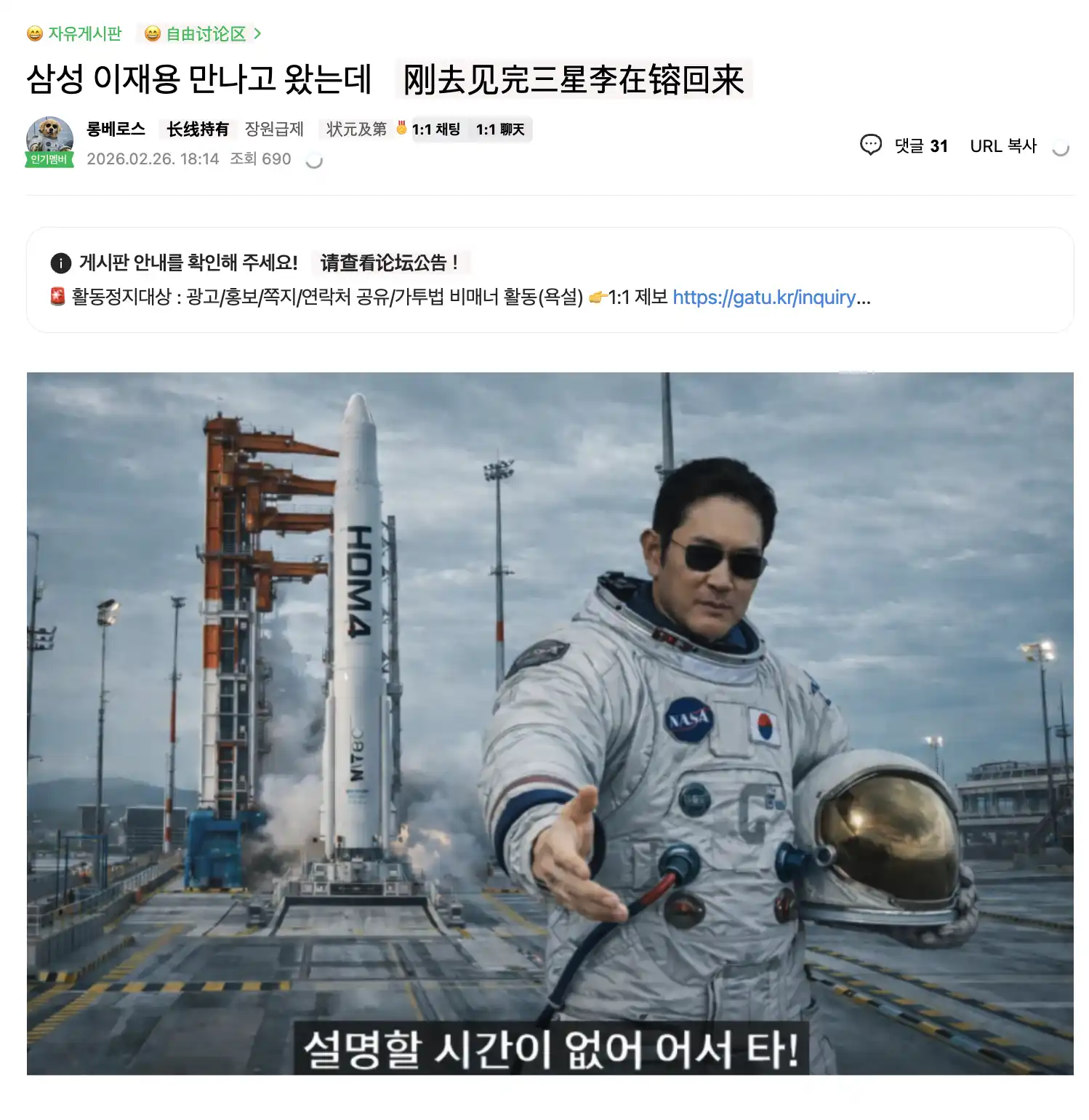
A once fervent investor in highly volatile altcoins, South Korean investors are now reallocating their funds to domestic and overseas stocks, especially those related to artificial intelligence and robotics.
According to Bloomberg's statistics, the trading volume of South Korea's local cryptocurrency exchanges in January decreased by about 65% year-on-year. In stark contrast, the trading volume of the KOSPI, the core benchmark of the South Korean stock market, surged by 221% during the same period. Securities firms' margin balances have exceeded 30 trillion Korean won (approximately $208 billion).
The speculative nature of South Korean youth has not changed, but they have shifted their focus.
This trend began to emerge as early as the end of 2025.
In 2025, Upbit's trading volume dropped by 80% compared to the same period in 2024, and the Bitcoin-Korean won trading pair was much less active than in previous years. On the other hand, the South Korean stock market was booming, with the KOSPI index soaring over 70% during the year, continuously setting new record highs. On Kakao Talk and Naver forums, retail investors who used to discuss altcoins every day are now talking about "AI semiconductor concept stocks."
This migration is also subtly resonating with the political atmosphere. The incumbent President Lee Jae-myeong made a high-profile proposal of the "KOSPI 5000" target during his election campaign. It is rumored that he repeatedly suffered losses in the stock market when he was young, and his experience of being "rugged" became the driving force behind his push for financial reform.
Furthermore, Lee Jae-myeong is well aware of one thing: whether the stock market can reach 5000 ultimately depends on whether corporate profits can improve. As the South Korean stock market is highly concentrated in the technology and semiconductor sectors, he has placed his focus on these industries.
After taking office, he quickly sent out strong signals friendly to the capital markets: establishing the "KOSPI 5000 Special Committee"; promoting revisions to commercial laws; strengthening rules for equal shareholder rights; and enhancing board accountability. On the eighth day of taking office, he made a special visit to the South Korean Exchange. There was only one goal: to keep the money of South Korean residents in the stock market for the long term.
As for how high the South Korean stock market can rise, some analysts also believe that besides the impact of the AI sector, the political sector will also hope that the upward trend will continue until the local elections in June of this year.
This atmosphere has also deeply affected the liquidity still present in the cryptocurrency circle.
On February 11, 2026, Lighter Exchange launched the world's first batch of South Korean stock perpetual contracts on the blockchain, with underlying assets including Samsung Electronics, SK Hynix, Hyundai Motor, and the KOSPI Index, with leverage up to 10 times. A few days later, Trade XYZ went live with Samsung and Hynix, also at ten times leverage.
This is also a highly symbolic image, as a trading platform that once hosted the frenzy of meme coins is now hosting South Korean stocks.
After all, in this age of AI reshaping the world, semiconductors are sexier than meme coins.
You may also like

Bloomberg: A Romanian Presidential Election Intervened by Crypto Traders

Founders Fund, Pantera, and Franklin Templeton join Sentient's "Arena" to stress test enterprise-level AI agents

Why Retail Is Shifting From Crypto to Equities: Will They Return?
Retail traders are exiting the crypto market and gravitating towards equities. Bitcoin saw a notable reduction in spot…

Canton Crypto Network vs. XRP: Understanding DTCC’s Strategic Approach to Infrastructure and Liquidity
Key Takeaways Canton Network and XRP serve distinct roles in blockchain technology: Canton for asset tokenization and atomic…

Jack Dorsey’s Block to Cut 4,000 Jobs in AI-Driven Restructuring
Key Takeaways Block’s significant job cuts aim to streamline operations for AI-driven growth. The company’s stock surged over…

Axiom Crypto Uncovered: ZachXBT Reveals $400k Insider Trading
Key Takeaways Allegations of insider trading at Axiom Crypto involve approximately $400,000 and a complex scheme where employees…

Ethereum 2029 Roadmap: ETH to Become the High-Speed Internet of Value
Key Takeaways Ethereum’s new roadmap, the “Strawmap,” aims for a settlement layer achieving 10,000 transactions per second (TPS)…
India Enhances Crypto KYC and AML Measures with Live ID and Location Checks
Key Takeaways: India classifies crypto exchanges as Virtual Digital Asset (VDA) service providers requiring enhanced Anti-Money Laundering (AML)…

Bitcoin Price Prediction: $500 Million in Short Positions Just Got Wiped Out — Is a Bull Market Beginning?
Key Takeaways: Bitcoin experienced a massive short squeeze, liquidating nearly $500 million in short positions and propelling its…

XRP Price Prediction: Ripple Invests Billions to Forge a Connection with Banks – Is $1,000 Possible?
Key Takeaways: Ripple has invested around $4 billion in establishing connections between traditional banks and crypto platforms, illustrating…

Crypto Price Prediction Today 26 February – XRP, Bitcoin, Ethereum
Key Takeaways Bitcoin has rebounded above $68,000, reigniting optimism within the crypto market and potentially signaling a shift…

Google’s Gemini AI Predicts the Price of XRP, Dogecoin, and Shiba Inu by the End of 2026
Key Takeaways Google’s Gemini AI forecasts significant price surges for XRP, Dogecoin, and Shiba Inu by the end…

Wall Street Frontrunning Retail? Institutions Flooded Ethereum Before 15% Price Rally
Key Takeaways Institutional Inflows Surge: A massive $157 million institutional inflow was recorded into Ethereum ETFs in a…

Animoca’s Yat Siu Says AI Agents Will Make 2026 the ‘Year of Utility’
Key Takeaways Animoca’s Yat Siu envisions a future where AI agents and blockchain seamlessly integrate, making 2026 a…
Chainlink Price Surges: What’s Behind Today’s LINK Rally?
Key Takeaways Chainlink’s price has experienced a notable surge, increasing over 14% to reach $9.35, its highest since…
Crypto Exchange Kraken Aims to Reignite Services in India
Key Takeaways Kraken is making strides to re-establish its footprint in the Indian cryptocurrency market. Vishesh Khurana has…

Crypto Rebound: Bitcoin Hits $68,000, Circle’s Revenue Climbs, and NEAR’s Confident Rise
Key Takeaways Bitcoin’s recent surge to $68,000 represents a strategic market rebound, driven by structural support and forced…

MetaMask Expands Mastercard Crypto Card Across the U.S.
Key Takeaways MetaMask has launched its self-custodial crypto card across all 50 U.S. states, broadening the accessibility of…
Bloomberg: A Romanian Presidential Election Intervened by Crypto Traders
Founders Fund, Pantera, and Franklin Templeton join Sentient's "Arena" to stress test enterprise-level AI agents
Why Retail Is Shifting From Crypto to Equities: Will They Return?
Retail traders are exiting the crypto market and gravitating towards equities. Bitcoin saw a notable reduction in spot…
Canton Crypto Network vs. XRP: Understanding DTCC’s Strategic Approach to Infrastructure and Liquidity
Key Takeaways Canton Network and XRP serve distinct roles in blockchain technology: Canton for asset tokenization and atomic…
Jack Dorsey’s Block to Cut 4,000 Jobs in AI-Driven Restructuring
Key Takeaways Block’s significant job cuts aim to streamline operations for AI-driven growth. The company’s stock surged over…
Axiom Crypto Uncovered: ZachXBT Reveals $400k Insider Trading
Key Takeaways Allegations of insider trading at Axiom Crypto involve approximately $400,000 and a complex scheme where employees…


 App
App