
The lending market does not require a middleman model

 Prefer us on Google


Original Article Title: CLOB Lending: Markets Don't Need Curators
Original Article Author: @0xJaehaerys, Gelora Research
Original Article Translation: EeeVee, SpecialistXBT, BlockBeats
Editor's Note: Following the exploits of Stream Finance and USDX, the DeFi community is undergoing a painful disillusionment. Protocols like Morpho and Euler introduced the "Curator" model to address liquidity fragmentation but inadvertently brought back on-chain "human" moral hazards. The author of this article points out that current lending protocols have mistakenly bundled "risk definition" with "order matching" together. Drawing inspiration from the traditional financial order book model, this article proposes a new paradigm that is curator-free and algorithmically routed.
The Evolution Logic of Lending Markets
Looking back at the history of on-chain transactions can provide us with insights into the lending market.
AMMs based on constant functions (such as Uniswap) solved a fundamental problem: how to create a market without active market makers? The answer lies in utilizing an invariant function to preset liquidity's "shape." Liquidity providers agree on a set of strategies in advance, which the protocol automatically executes.
This is effective in the trading realm because trading is relatively straightforward: the buyer and seller meet at a certain price. However, lending is much more complex. A loan encompasses multiple dimensions:
Interest Rate
Collateral Type
Loan-to-Value Ratio (LTV)
Term (Fixed vs. Variable)
Liquidation Mechanism
Lending matchmaking needs to simultaneously satisfy all the constraints of the above dimensions.
Early DeFi lending directly adopted solutions similar to AMMs. Protocols like Compound and Aave preset an interest rate curve, and lenders join a shared pool of funds. This allows the lending market to function even without active lenders.
However, this analogy has a fatal flaw. In DEX trading, the shape of the constant function curve affects execution quality (slippage, depth); whereas in lending, the shape of the interest rate curve directly determines risk. When all lenders share one pool, they also share the risk of all collateral the pool accepts. Lenders cannot express their willingness to only take on a specific risk.
In the trading realm, the order book solves this problem: it allows market makers to define their own "price curve." Each market maker quotes at their comfortable price, and the order book aggregates these quotes into a unified market, but each market maker still controls their own risk exposure.
Can lending take a similar approach? A project named Avon attempts to answer this question.
Liquidity Fracture Challenge
To empower lenders, DeFi's initial attempt was market isolation.
Protocols like Morpho Blue, Euler, among others, allow anyone to create a lending market with specific parameters: a designated collateral, borrowed asset, fixed loan-to-value (LTV) ratio, and interest rate curve. Lenders deposit into a market that aligns with their risk preference. Default in one market will never spill over to another.
This is perfect for lenders as they get the risk isolation they desire.
But for borrowers, this introduces fragmentation.
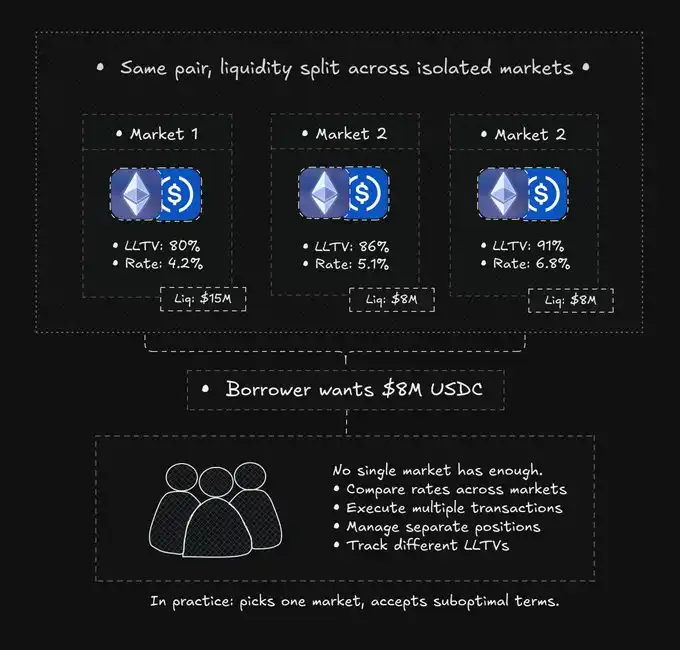
For instance, in an ETH-USDC lending scenario, there could be a dozen different markets:
Market B: 3 million liquidity, 86% LTV, 5.1% rate
Market C: 2 million liquidity, 91% LTV, 6.8% rate
… and 9 other markets with lower liquidity
A user looking to borrow 8 million USD cannot be serviced by a single market. They must manually compare rates, execute multiple transactions, manage dispersed positions, and track different liquidation thresholds. The theoretically optimal solution requires splitting the loan across four or more markets.
In practice, nobody does this. Borrowers typically choose one market. Funds sit underutilized in a fractured pool.
Market risk isolation solved the lender problem but created one for borrowers.
-- Price
Curation Vault's Limitation
The curation vault model attempts to bridge this gap.
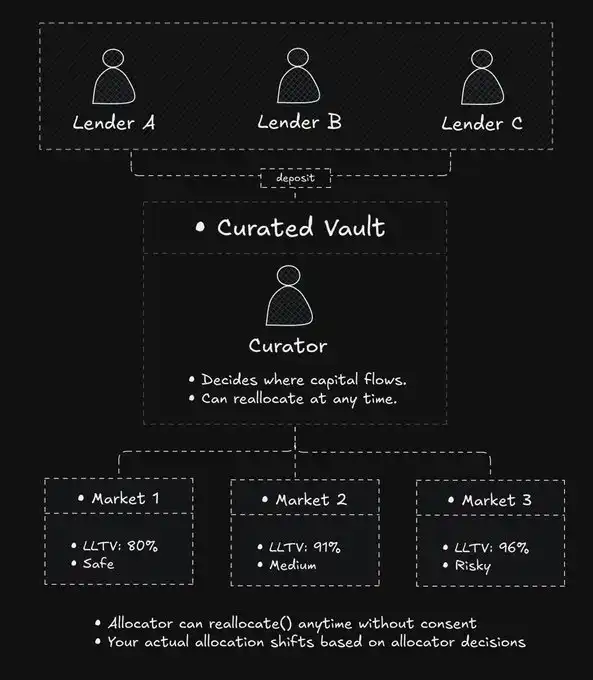
The idea is: professional curators manage capital flows. Lenders deposit into the vault, and the curator allocates funds across various underlying markets to optimize yield and manage risk. Borrowers still face fragmented markets, but at least lenders don't have to manually rebalance.
This aids lenders looking to "set and forget," but it introduces something DeFi sought to eliminate: discretionary power.
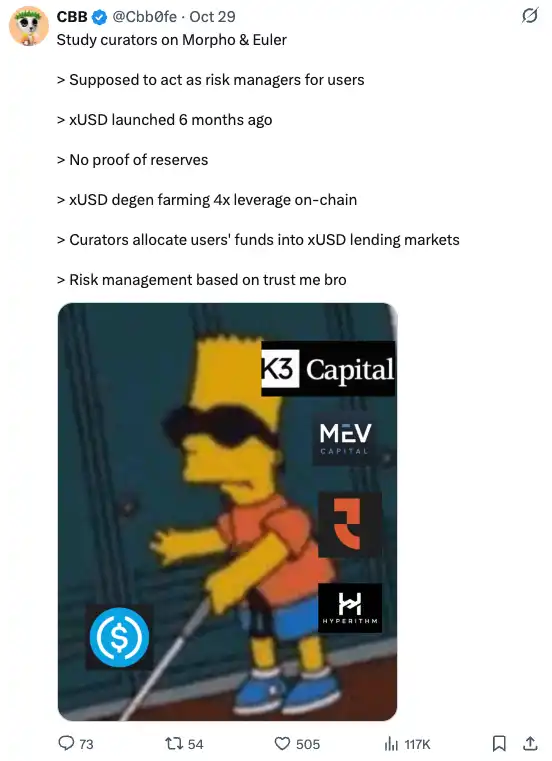
The admin decides which markets receive funding and can reallocate at any time. Lenders' risk exposure changes with the admin's decisions, which are unpredictable and uncontrollable. As a certain Twitter user put it: "The admin is PvP with the borrower, but the borrower doesn't even know they are being farmed."
This asymmetry is not only reflected in the strategy but also in the accuracy of the underlying interface. Morpho's UI sometimes shows "There is $3 million in available liquidity," but in practice, low-rate funds are scarce, with most funds in the high-rate range.
When liquidity coordination relies on human decisions, transparency is compromised.
Funds allocators adjust market liquidity on their schedule rather than based on real-time market demand. Vaults attempt to address borrower fragmentation through "rebalancing," but this incurs gas fees, relies on the admin's willingness, and often lags. Borrowers still face suboptimal rates.
Separating Risk from Matchmaking
Lending protocols conflate two fundamentally different modules.
User's definition of risk: Different lenders have varying views on collateral quality and leverage.
Protocol's matchmaking approach to lending: This is mechanical. It does not require user subjectivity, only efficient routing.
The pooled fund model binds the two, stripping lenders of control.
The isolated pool model separates risk definitions but relinquishes matchmaking; borrowers must manually seek the optimal path.
The curated vault model reintroduces matchmaking through the admin's role but introduces a trust assumption in the admin.
Can matchmaking be automated without introducing discretion (manual intervention)?
The trading arena's order book achieves this. Market makers define quotes, the order book aggregates depth, and matching is deterministic (best price first). No one decides where an order goes; the mechanism dictates everything.
CLOB lending applies the same principle to the credit market:
Lenders define risk through an isolated strategy.
Strategies post quotes to a shared order book.
Borrowers interact with unified liquidity.
Matching occurs automatically, no admin intervention required.
Risk remains with the lenders, coordination becomes mechanized. No trust in any intermediary is necessary at any step.
Dual-Layer Architecture
Avon achieves order book lending through two distinct layers.
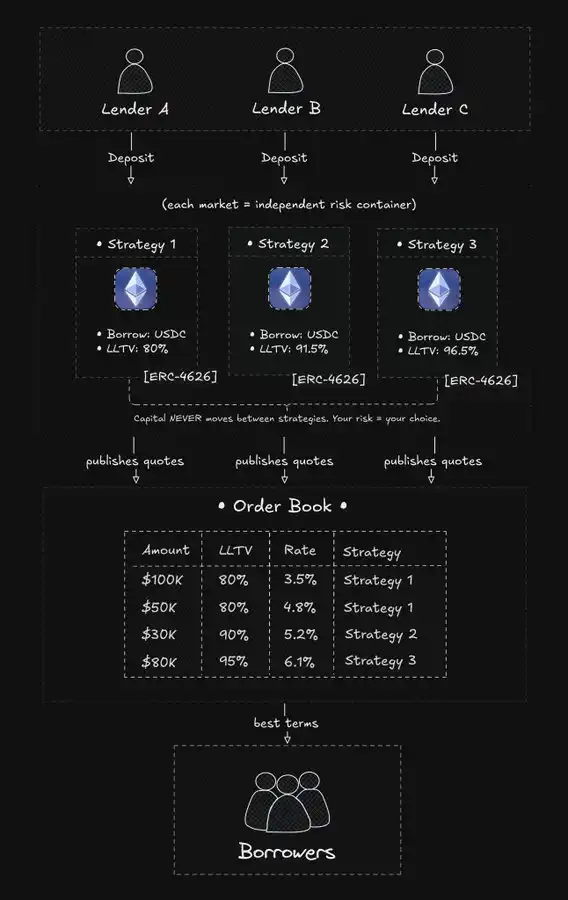
Strategy Layer
A "strategy" is an isolated lending market with fixed parameters.
The strategy creator defines the following parameters: collateral/borrowed asset, liquidation LTV, interest rate curve, oracle, liquidation mechanism.
Once deployed, the shape of the interest rate curve is immutable. Lenders know the rules exactly before depositing.
Funds never move between strategies.
If you deposit into Strategy A, your money stays in Strategy A until you withdraw. No admin, no rebalancing, no sudden changes in risk exposure.
While there are still individuals (strategy managers) setting parameters, they differ fundamentally from admins: admins are fund allocators (decide where money goes), strategy managers are true risk managers (define rules but don't move funds), akin to the Aave DAO. Decision-making power on fund allocation always resides with lenders.
How does the system adapt to market changes? Through competition, not parameter modifications. If risk-free rates spike, old strategies are force-liquidated (funds outflow), new strategies are created (funds inflow). "Discretion" shifts from "where should funds go" (admin decision) to "which strategy should I choose" (lender decision).
Matching Layer
Strategies do not directly serve borrowers but instead post quotes to a shared order book.
The order book aggregates quotes from all strategies into a unified view. Borrowers see the composite depth of all strategies accepting their collateral.
When a borrower places an order, the matching engine:
Filters quotes by compatibility (collateral type, LTV requirement).
Sorts by interest rate.
Starts executing from the cheapest.
Settles in one atomic transaction.
If one strategy can fulfill the entire order, it does; if not, the order automatically splits across multiple strategies. The borrower perceives only one transaction.
Important Note: The order book only reads the state of the strategies; it cannot modify it. It is solely responsible for coordinating access, with no authority to allocate capital.
The Gospel of RWA
DeFi has always faced a structural contradiction in institutional adoption: compliance requirements lead to segregation, but segregation suffocates liquidity.
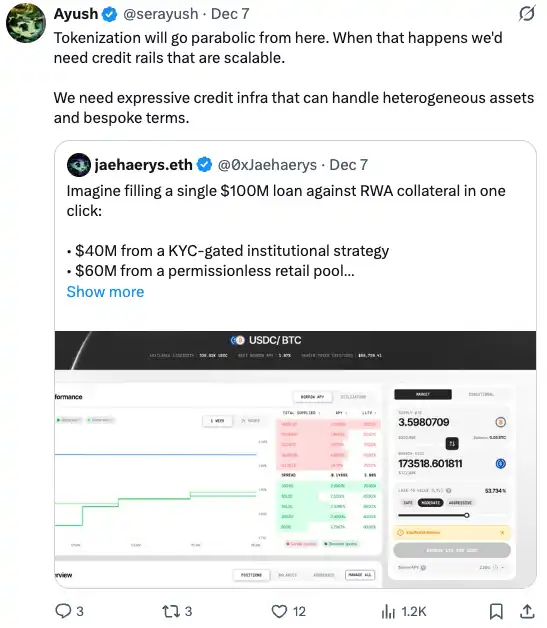
Aave Arc attempted a "walled garden" model, where compliant participants have their own pool. The result was shallow liquidity and rate spreads. Aave Horizon experimented with a "semi-open" model (RWA issuers need KYC, but lending is permissionless), which was a step forward, but institutional borrowers still couldn't access Aave's $32 billion liquidity pool. Some projects are exploring permissioned rollups. The KYC process is completed at the infrastructure layer. This approach works for some use cases but leads to fragmentation of network-level liquidity. Compliant users on Chain A can't access liquidity on Chain B.
The order book model provides a third way.
The strategy layer can implement any access control (KYC, geographical restrictions, accredited investor checks). The matching engine is only responsible for matching.
If a compliant strategy and a permissionless strategy both offer compatible terms, they can simultaneously fill the same loan.
Imagine a corporate treasury collateralizing tokenized government bonds to borrow $100 million:
$30 million from a strategy requiring institutional KYC (pension fund LP)
$20 million from a strategy requiring accredited investor verification (family office LP)
$50 million from a fully permissionless strategy (retail LP)
Funds never mix at the source, institutions remain compliant, but liquidity is unified globally. This breaks the deadlock of "compliance equals segregation."
Multi-Dimensional Matching Mechanism
The order book only matches on one dimension: price. The highest bid and lowest ask match.
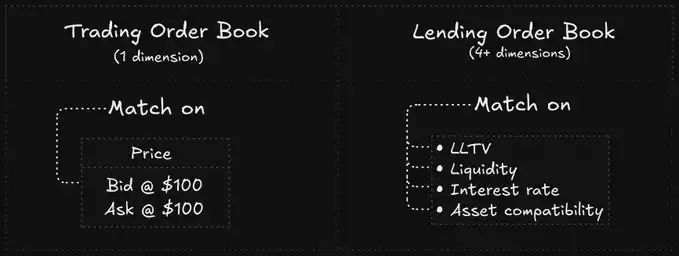
A lending order book must match on multiple dimensions simultaneously:
Interest rate: Must be lower than the borrower's acceptable upper limit.
LTV: The borrower's loan-to-value ratio must meet the strategy's requirement.
Asset compatibility: Currency matching.
Liquidity: Market liquidity must be sufficient.
Borrowers who offer more collateral (lower LTV) or accept a higher interest rate can match with more strategies. The engine finds the cheapest path within this constraint space.
For large borrowers, one thing to note is that in Aave, $1 billion in liquidity is a single pool. In order book lending, $1 billion could be spread across hundreds of strategies. A $100 million loan would rapidly deplete the entire order book, starting from the cheapest strategy and gradually filling into the pricier ones. Slippage is evident.
Pool-based systems also experience slippage, but it manifests differently: a surge in utilization will drive up the interest rate. The key difference lies in transparency. In an order book, slippage is previsibly visible. In a pool, slippage only becomes apparent after the trade is executed.
Floating Rate and Repricing
DeFi lending employs a floating interest rate. As utilization changes, the interest rate changes as well.
This poses a synchronicity challenge: if the utilization of a strategy changes but the quoted price on the order book does not update, the borrower may end up executing at the wrong price.
Solution: continuous repricing.
Upon a change in strategy state, immediately publish a new quote to the order book. This necessitates extremely high infrastructure performance:
Extremely fast block times.
Extremely low transaction costs.
Atomic state reads.
This is also why Avon chose to build on top of MegaETH. On the Ethereum mainnet, this architecture is impractical due to high gas fees.
Existing Friction:
If the market rate changes but the strategy's fixed curve does not adapt, a "Dead Zone" may occur — borrowers find the rate too high to borrow, and lenders receive no yield. In Aave, the curve adjusts automatically, whereas in CLOB mode, lenders must manually withdraw and migrate to a new strategy. This is the cost paid for control.
Multi-Strategy Position Management
When a loan is filled by multiple strategies, the borrower effectively holds a multi-strategy position.
Although it appears as a single loan on the interface, it is independent at the core:
Independent rates: Component A's rate may increase due to the rise in Strategy A's utilization, while component B remains unchanged.
Independent Health Ratios: In the event of a price drop, components with stricter LTV limits will be partially liquidated first. You won't incur immediate liquidation but will go through a series of partial liquidations like being "eaten away."
To streamline the experience, Avon offers unified position management (one-click collateral addition, automatic weighted distribution) and one-click refinancing (automatically borrow new to repay old via flash loans, always locking in the best market rate).
Conclusion
DeFi lending has gone through several stages:
Pool Protocol (Pooled): Gave borrowers depth but deprived lenders of control.
Isolated Market: Gives control to the lender but severs the borrowing experience.
Vaults: Attempts to bridge the two but introduces risks of discretionary decisions.
Central Limit Order Book (CLOB): Achieves decoupling of the above. Risk definition authority returns to the lender, with matching facilitated through an order book engine.
The design principle here is clear: When matching can be done through code, human intervention is no longer needed. The market can self-regulate.
Original Tweet: 「Original Tweet Link」
This content is provided for general informational purposes only and doesn't constitute financial, investment, legal, or tax advice. Any events, rewards, online promotions, or related information mentioned herein should not be considered a recommendation, solicitation, or invitation to purchase, sell, trade, or otherwise deal in any crypto assets. Crypto assets are highly volatile and may result in loss. The availability of WEEX services, products, and related events may vary by region. You are responsible for ensuring that your participation is in accordance with applicable local laws and regulations.
You may also like

Aave V4 Total Deposits Exceed $600 Million

Web3: Foreign Media Reports Need for Safer Liquidity Tools in Crypto Collateralized Lending

Babylon TBV Completes Security Audit, Prepares for Aave v4 Mainnet Launch

Uniswap Launches Regulated 'Permissioned Pools'

Aave V4 Launched on Avalanche Network, First Multi-Chain Hub & Spoke Architecture

Aave V4 deposits surpass 275 million

Abraxas Capital Provides Approximately $39 Million in Liquidity to Aave

Aave Labs Proposal to Integrate Maple's syrupUSDG

Abraxas Capital Deposits 8,000 ETH to Aave
Data: Aave's new Monad market surpassed $100 million in deposits within two days of its launch, and total deposits for V4 exceeded $250 million, setting a new record

Data: ParaFi Capital continues to increase its holdings of 56 million SKY, with a total position loss of 1.72 million USD

Aave V3 has been deployed on Monad

Standard Chartered claims that Aave could rise 50 times to $3,500 by 2030

Data: DeFi lending and DEX fees plummeted over 50% in a week, mainly due to leveraged liquidations
Grayscale: Aave's protocol revenue has grown over 6.6 times in the past three years, and AAVE's current valuation is relatively conservative
Data: A certain whale has cumulatively shorted 44,000 ETH, currently facing an unrealized loss of 3.08 million USD
Ethereum 1CO giant whale buys back 5,817 ETH, liquidation price $1,432

The Kelp DAO cross-chain bridge hacker has laundered nearly $220 million of stolen funds, with only $1.7 million remaining untransferred

DeFi has reached its most dangerous moment: the real vulnerabilities are not in the code
Babylon proposes to integrate native Bitcoin collateral on Aave V4 without the need for cross-chain bridges and custody
Kelp DAO announced that rsETH has fully recovered after five weeks of repairs, following a $293 million hacker attack

Morning Report | SpaceX reveals it holds approximately $1.45 billion in Bitcoin; Nvidia's Q1 financial report shows revenue of $81.6 billion; Manus plans to raise $1 billion for buyback business

Kelp DAO Attacker Transfers $175M in Ether Following Exploit
Key Takeaways: The Kelp DAO exploiter has moved $175 million worth of Ether, part of a larger $290…

DeFi Losses Top $600 Million Amid Kelp DAO Exploit and TVL Decline
Key Takeaways: Total DeFi losses have skyrocketed to approximately $1 billion recently, with $600M+ linked directly to the…

Aave TVL Plummets $15 Billion Post-KelpDAO Hack – Future Prospects for AAVE Price?
Key Takeaways: Aave saw a drastic $15.1 billion withdrawal following the KelpDAO hack, nearly a third of its…

Kelp DAO Exploit Fallout Deepens as Attacker Routes $175M in ETH via Privacy Rails
Key Takeaways: The attacker moved $175 million in stolen ETH to new wallets using privacy tools. The exploit…

Aave V4 is progressing smoothly with a phased launch, introducing a dual-layer market isolation architecture
The tokenized market will reach a trillion-dollar scale, but there are still four major obstacles

Standard Chartered Bank: It is expected that by the end of 2028, the scale of on-chain tokenized assets will reach $4 trillion, with DeFi protocols being the biggest beneficiaries
Delphi Digital: Aave's three core markets have structural issues, resulting in an annual loss of approximately 52 million dollars
Aave V4 Total Deposits Exceed $600 Million
Web3: Foreign Media Reports Need for Safer Liquidity Tools in Crypto Collateralized Lending
Babylon TBV Completes Security Audit, Prepares for Aave v4 Mainnet Launch
Uniswap Launches Regulated 'Permissioned Pools'
Aave V4 Launched on Avalanche Network, First Multi-Chain Hub & Spoke Architecture
Aave V4 deposits surpass 275 million

Contents
Latest articles


Latest coin listings on WEEX


