
The US has had a president impeached twice, and Trump's platform says it's not an "insurrection."

On January 3, local time in Venezuela, in a predawn operation, the US military simultaneously entered the country from the air and ground, took control of several key military facilities, and extradited President Nicolás Maduro to the United States.
Precision airstrikes, ground troop armed control, and the abduction of a head of state... According to a universally accepted definition of international law, this has constituted a military invasion of a sovereign nation.
Meanwhile, on the other side, in Polymarket, the world's hottest prediction market, a group of traders had already begun celebrating their own victory as a result of this attack.
They had bet before the incident that the US military would invade Venezuela, and the news of smoke and gunfire seemed to be an early celebration for them of a massive profit at high odds.
At that moment, no one would have thought that they had already become losers at the very moment they engaged in the trade.
The news reported globally has never happened on Polymarket
The market "The US invades Venezuela by January 31, 2026" had a clear definition of invasion before the attack occurred: "US military assault with the aim of establishing control."
After the attack, the probability of this market surged from 2% to 80%. This probability-to-odds trading model allowed traders who bet before the attack to enjoy a massive windfall.
Just as mainstream media around the world were reporting "US Attacks Venezuela," multiple bets against this narrative suddenly appeared on the market, asserting "The US did not invade Venezuela." This caused the probability to plummet to a minimum of 7%.
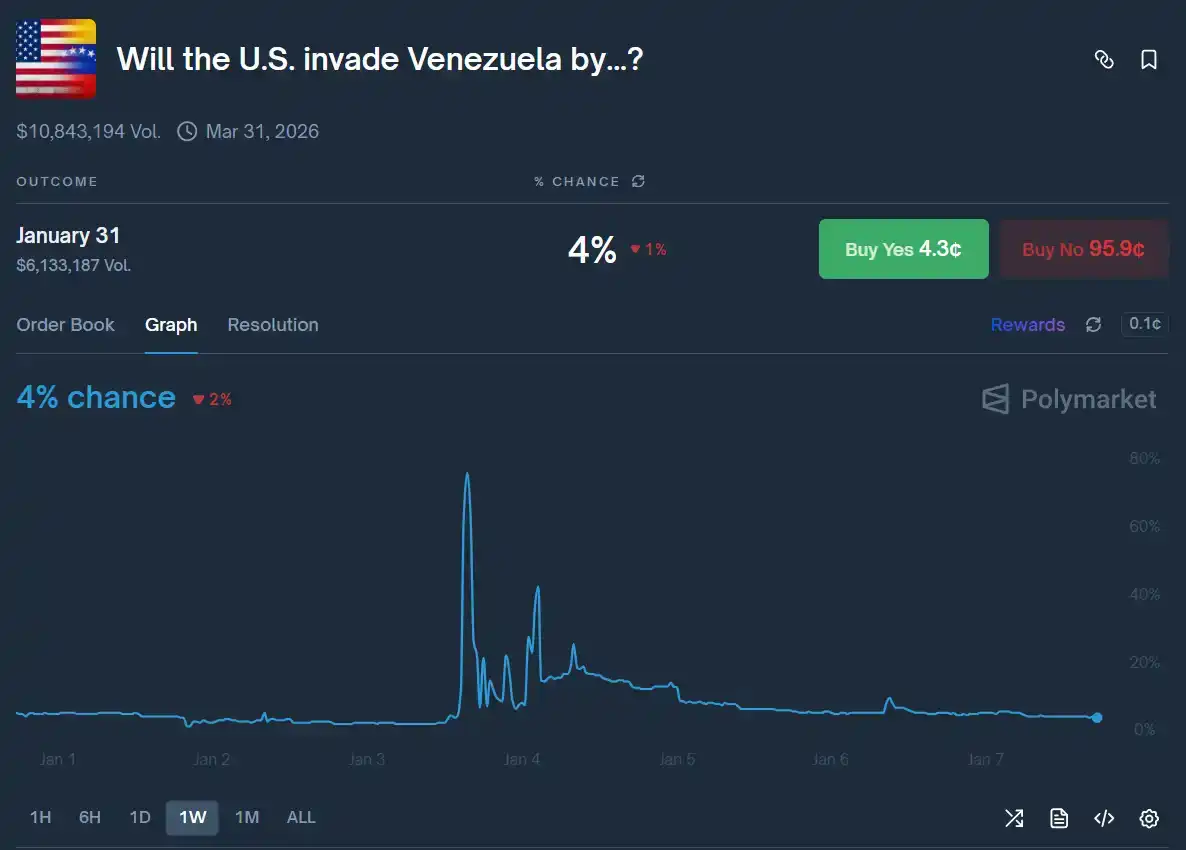
Even as Trump unabashedly declared "run Venezuela" after the attack, as of the writing of this article, the market has not yet been settled, and the probability has dropped to 4%.
This globally impactful military invasion seemed as though it never happened on Polymarket.
"Tailored" Rule Update: Denying an Invasion with Wordplay
If one were to search for evidence of the invasion that did occur on Polymarket, there is some: Hours after the attack, the platform officials released a rule clarification:
This market refers to U.S. military operations intended to establish control. President Trump’s statement that they will "run" Venezuela while referencing ongoing talks with the Venezuelan government does not alone qualify the snatch-and-extract mission to capture Maduro as an invasion.
In simple terms: US military entry and bombing do not count as invasion. Trump said invasion, occupation, operation do not count as invasion. Even arresting the president does not count as invasion.
But still, the saying goes: "Military actions aimed at establishing control are considered invasion."
Filling out a job application based on these terms has never been so rigorous. Traders who had bet on this scenario did not have to consider these currently nonexistent hidden clauses when analyzing the military situation.
Meanwhile, traders who bet during the period of a skyrocketing "no" odds (mostly whales) relied on the tailor-made rule updates to once again achieve substantial profits.
A similar plot occurred in another market "US and Venezuela to engage in military conflict by 2025." On December 26, 2025, Trump publicly stated in an interview that the US had destroyed a key facility inside Venezuela.
Several mainstream media outlets subsequently reported on the matter, with CNN pointing out that the action was "planned and executed by the Central Intelligence Agency (CIA)."
Shortly after the event, the platform issued a rule clarification stating that "actions carried out by non-military intelligence agencies do not meet the criteria."
Coincidentally, the CIA falls precisely under the category of non-military intelligence agencies.
In the absence of a formal clarification from the US government on the attribution of the operation, Polymarket, relying on the "anonymous sources" in CNN's report, precisely excluded a military strike from the settlement scope.
Why Did the Rules Change? Uncovering the Link to the Trump Family's "Prediction Market"
As losing traders gathered to protest on the forums, a more fundamental question emerged: Why did Polymarket willingly risk its reputation and openly modify the rules in front of everyone?
The clues point to those unusual names at the top of the platform.
Despite wearing the cloak of decentralization, Polymarket is a privately held company that is actually regulated by the US Commodity Futures Trading Commission (CFTC). A pivotal investment that altered its fate took place last August:
Donald Trump Jr.—the eldest son of the current US President, through his private investment firm, officially acquired a stake in Polymarket, and he himself promptly joined the company's "Advisory Board."
The timeline of events is intriguing: following Trump Jr.'s investment, Polymarket, which had long operated in a regulatory gray area, swiftly obtained CFTC operational approval, thus becoming legalized in the US.
The five top commissioners of the CFTC are all directly appointed by the President.
“This is just normal business investment.” Some comments try to downplay the connection, “The Trump administration has always supported cryptocurrency innovation.”
The next step is to verify whether Trump's inner circle is taking advantage of information asymmetry to profit from Polymarket.
From On-chain Data to the White House Inner Circle: When “Coincidences” Are Too Many to Be Coincidental
Let's turn our attention back to three hours before the Capitol breach.
In another related market “Maduro to step down by January 31, 2026,” a previously inactive wallet address suddenly injected $30,000 into the market, betting “yes” in full. As Maduro boarded the plane, this $30,000 turned into over $400,000 within hours.
The account's behavior pattern is highly suspicious: new registration, single deposit, betting on a single market within a specific timeframe, immediate withdrawal upon profit. This is nothing short of treating the prediction market as a personal ATM.
Who is this “insider”?
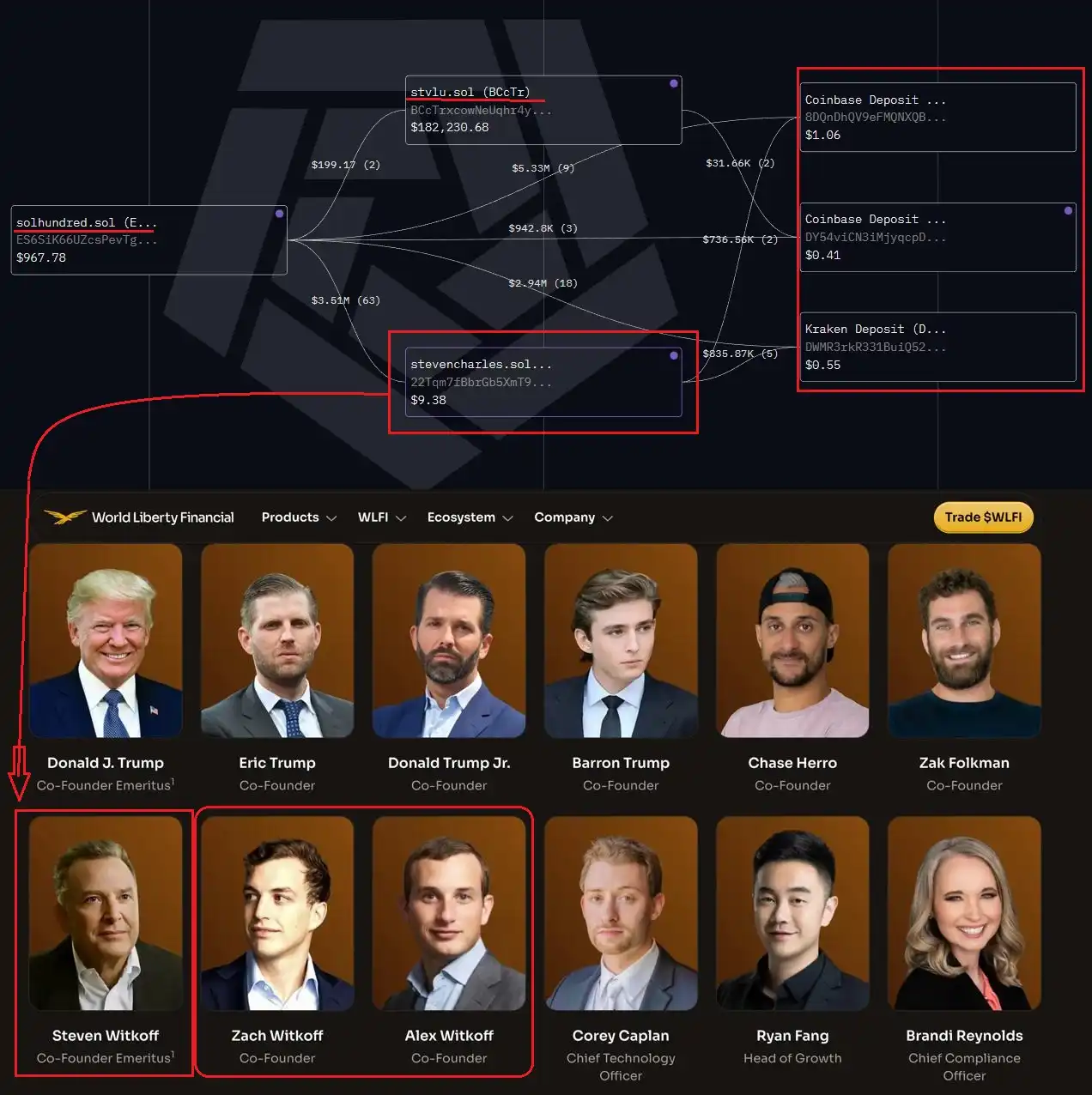
On-chain analysis blogger @Andrey_10gwei found through comparing exchange on-chain deposit and withdrawal amounts that the insider account's source of funds can be traced back to an account with the domain “stevencharles.sol.”
Steven Charles?
Upon opening WFLLC core team member website personally overseen by the younger Trump, it can be seen that the second person on the left in the second row is one of the company's co-founders, also a New York real estate developer, who provided campaign funding to Trump and has had a friendship with him for nearly 40 years.
(cr: https://x.com/Andrey_10gwei/status/2007904168791454011?s=20)
His full name? Steven Charles Witkoff. Perfect match for the on-chain domain “stevencharles.”
An account shrouded in mystery turning $30,000 into $400,000 in 3 hours, a source of funds on-chain named “stevencharles,” a business magnate closely tied to the presidential family and with direct influence over Polymarket.
The concatenation of three events with near-zero probability can no longer be explained by coincidence.
Epilogue
Marketed as a decentralized fair trading platform, Polymarket may appear to the average person as merely a financial tool to profit from by betting on outcomes.
However, perhaps in the unseen corners, it has long devolved into a puppet that can arbitrarily redefine the very concept of right and wrong, repeatedly draining people's assets through rule updates that interfere with market transactions and asymmetric information gaps.
And how long the common person can survive here may entirely depend on the desires and moral compass of the elite group.
You may also like

Galaxy Deep Dive: Is the Bitcoin Four-Year Cycle Still Valid?

Value Distribution of Stablecoins

On the day of SpaceX's IPO, the first real test of the three perpetual mechanisms

Claude enforces "facial recognition for household registration," starting in July, no ID card means no access?

After 18 years, blockchain has finally started to head towards the main channel

SpaceX IPO, Nvidia, and Bitcoin: Why Traders Are Watching More Than Just Crypto in 2026

Paul Graham: How to Make a Billion Dollars

If the AI bubble has already burst, who will truly remain?

Morning Report | Prediction market platforms like Kalshi and Polymarket jointly sue Kentucky over 14.25% trading tax; Bridgewater founder discusses decision-making in the AI era: principled thinking should run parallel to AI, human insight remains irre...
What is the connection between Huang Zheng of Pinduoduo and blockchain?

The other side of Musk's trillion-dollar fortune: 85% cannot be sold
The U.S. government prohibits foreigners from using Fable 5, Anthropic issues a rebuttal

Citibank releases "2030 Asset Tokenization Market Outlook": 6 major trends may create a $8.2 trillion market
The trillion-dollar valuation test: Are the three major super IPOs a celebration for tech stocks or a nightmare for the crypto market?
Morning Report | Digital Asset completes $355 million financing led by a16z Crypto; Meta completes operational separation from Manus

a16z Crypto Partner: Cash flow is the moat

Cryptocurrency market makers collectively seek change as it becomes increasingly difficult to make money

How TradeXYZ, xStocks, and Alpaca break down the SpaceX IPO into three different strategies
Galaxy Deep Dive: Is the Bitcoin Four-Year Cycle Still Valid?
Value Distribution of Stablecoins
On the day of SpaceX's IPO, the first real test of the three perpetual mechanisms
Claude enforces "facial recognition for household registration," starting in July, no ID card means no access?
After 18 years, blockchain has finally started to head towards the main channel
SpaceX IPO, Nvidia, and Bitcoin: Why Traders Are Watching More Than Just Crypto in 2026


