
Why Are You Always Losing Money on Polymarket? Because You're Betting on News, While The Rulebook Favors Insiders

 Prefer us on Google

Original Title: "Why Are You Always Losing Money on Polymarket? Because You're Betting on News While the Front-Runners Are Reading the Rules"
Do you know why you can't beat the frontrunners on Polymarket? Because they focus on the rules, scrutinizing them like a lawyer reviewing a contract.
In April 2026, a controversy about the Venezuelan leader on Polymarket caused a stir in the community.
There was a market on Polymarket asking, "Who will be the leader of Venezuela by the end of 2026?" Many traders' intuition was that since Maduro was in a U.S. prison and Delcy was running the cabinet in Caracas, it was clear that Delcy was the actual leader, so they bet on Delcy.
But the rules and additional explanations were very clear: "officially holds" refers to the person who has been officially appointed and sworn in. The UN-recognized Venezuelan government has not officially removed or replaced Maduro, and official government information still recognizes him as the president. The rules also specifically added: "Temporarily exercising presidential powers does not equate to a transfer of the presidency."
According to these rules, even if Maduro is still in a U.S. prison, he is still the legitimate president of Venezuela.
There are many similar examples:
· After Polymarket issued a stablecoin, there was a dispute over "What is the FDV of the Polymarket token": whether a stablecoin counts as a token, a difference of one word
· Iran Uranium: The standard for "agreement," conditional statement vs. formal signing of the agreement
Behind these examples is the same logic: on Polymarket, the rules are paramount. But when the rules are in dispute, Polymarket has a complete arbitration process to resolve it: this article will introduce how this mechanism works and where it is similar to, or fundamentally different from, traditional courts.
1. Polymarket's Arbitration Mechanism
The ambiguity in the rule text not only causes pricing differences but also turns into formal disputes during settlement.
Every day on Polymarket, there are numerous market settlements, with markets involving political statements, diplomatic positions, and military actions being particularly prone to disputes.
The dispute event is actually a common occurrence in prediction markets. Ambiguity during the trading phase creates pricing discrepancies, which turn into dispute conflicts during the settlement phase. It is the same issue manifesting differently at two different points in time.
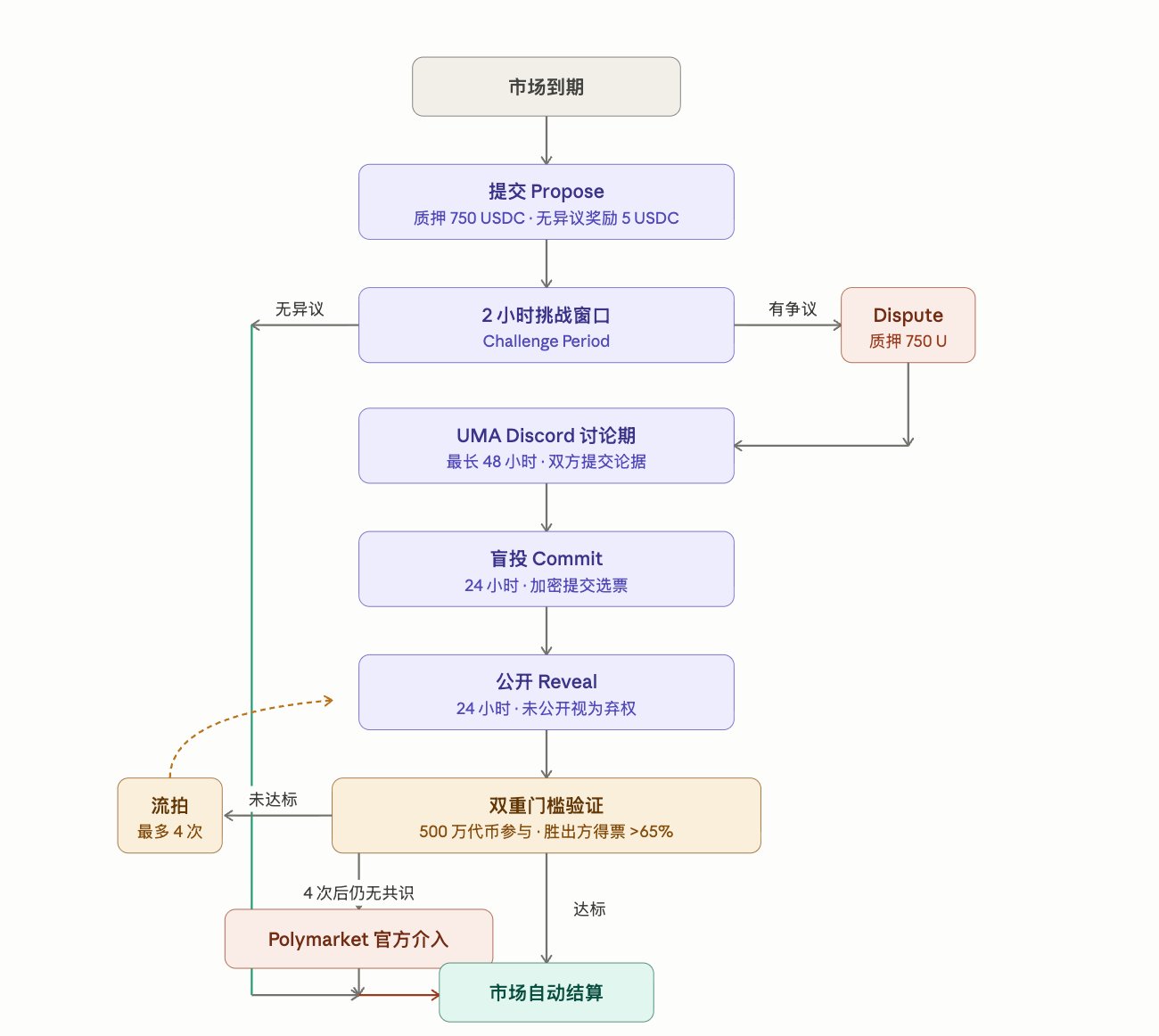
To address these disputes, Polymarket has established a comprehensive dispute resolution process. The settlement process follows two paths: normal settlement and dispute resolution.
Step 1: Submit Proposal
When a market meets the settlement conditions, anyone can submit a resolution outcome, stating whether this market should be resolved as YES or NO. When submitting a proposal, a deposit of 750 USDC is required as collateral. This deposit signifies the submitter's endorsement of their judgment. In the case of no disputes in the market, the user who submitted the proposal can receive a reward of 5 USDC.
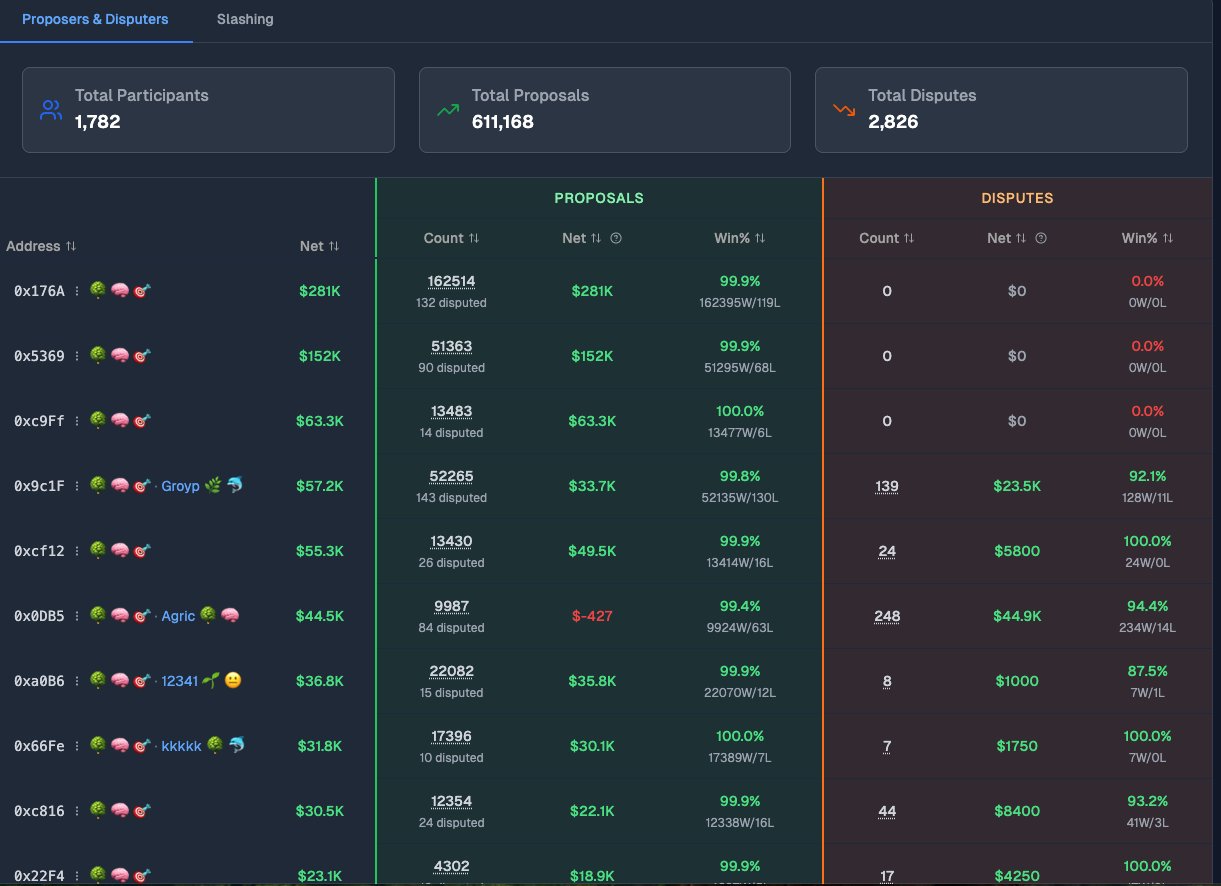
Currently, there are only 1782 users submitting proposals in the market, with the highest-earning user having accumulated $281K.
Step 2: 2-Hour Challenge Window (Dispute)
After the proposal submission, a 2-hour challenge period commences. This is the first fork in the entire process.
If no one raises an objection within 2 hours, the system defaults to the proposal being correct, and the market settles directly, concluding the process. The vast majority of markets follow this path.
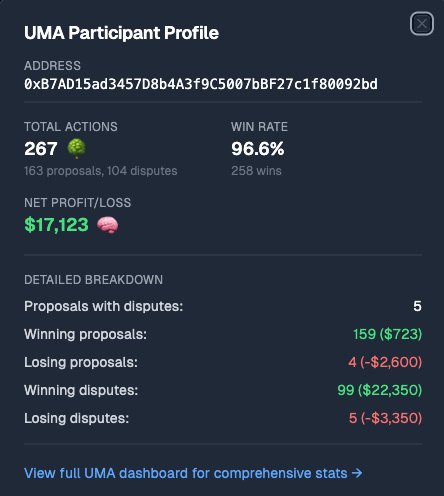
If someone believes the proposal result is incorrect, they can challenge it within this 2-hour period, also requiring a 750 USDC deposit. A successful challenge can earn a bonus of 250 USDC.
There are very few users in the market specifically dedicated to Dispute. The user who has earned the most during the Dispute phase is 0xB7A, with a profit of $17,123.
Step 3: Up to 48-Hour Discussion Period
Upon entering the dispute track, both parties enter the UMA Discord discussion phase. The purpose of this stage is for all parties to submit arguments and evidence: the interpretation of the rule text, relevant news coverage, historical precedents, official statements—any material that can support their position can be presented during this stage.
The discussion period lasts up to 48 hours and is the only stage in the entire process where arguments can be fully articulated. The quality of this stage significantly influences the direction of subsequent voting.
-- Price
Step Four: 48-Hour Voting
After the discussion, we move to the UMA token holder voting phase, which is divided into two 24-hour phases.
· The first phase is blind voting. Each voter must make an independent decision based on their own understanding of the rules, rather than following large holders.
· The second phase is public voting. Any votes not made public in this phase are considered abstentions and are directly invalidated.
After the voting ends, UMA has set two settlement thresholds that must be met simultaneously to reach a resolution:
· Participation Threshold: At least 5 million tokens must participate in the vote to ensure an adequate representation for the decision.
· Absolute Consensus Threshold: The winning side must have a vote share of over 65%, rather than a simple majority of 51%.
If these two thresholds are not met simultaneously, the vote is inconclusive, leading to the next round of voting, with a maximum of 4 re-votes. If there is still no consensus after 4 rounds, Polymarket officially reserves the right to intervene for a decision.
Step Five: Automatic Settlement
Once the voting results are confirmed, the market automatically settles, and funds are distributed according to the results. There is no appeals process, no retrials, and no recourse.
The entire dispute process, from challenge submission to final settlement, typically concludes within one week.
II. Polymarket vs. Traditional Courts: Same Logic, Different Design
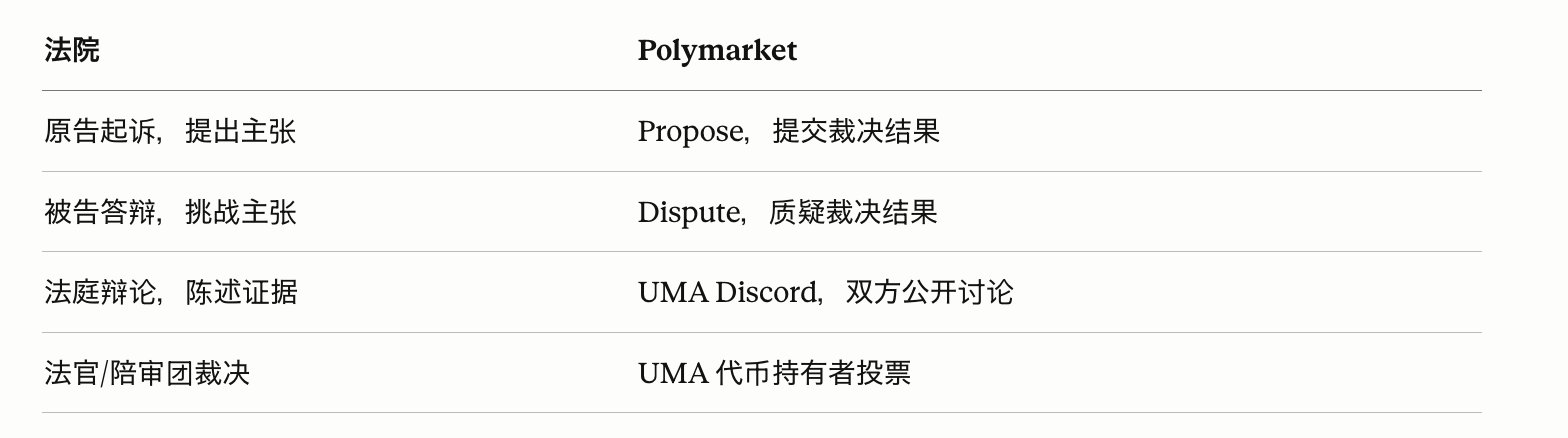
On the surface, Polymarket's arbitration process appears highly similar to traditional courts: both have a claimant, a respondent, a discussion phase, and ultimately a decision-maker providing a ruling.
However, these two systems are fundamentally different in one key aspect: Separation of Powers.
1. Segregation of Powers in Courts
In traditional courts, the plaintiff and defendant only have the right to present their cases, not to decide. Judges solely hold the power to make judgments and do not have a vested interest. Most importantly, judges must maintain independence from the cases they preside over. If there is any conflict of interest between a judge and a case, recusal is mandatory, and a different judge must oversee the case.
The judge and the interested party are never the same person.
2. Polymarket Does Not Have This Separation
UMA token holders are the judges, but they can also hold positions in the dispute market. Ruling in a certain direction directly impacts their own profits and losses. When the judge and the interested party are the same person, it is called a conflict of interest in traditional courts and would be required to recuse, but in Polymarket, this is legal and normal.
This design flaw is the root of the following two issues.
1. Why the Discussion Phase Fails
In a courtroom, the positions of the plaintiff and the defendant are fixed from the moment of filing. Lawyers do not switch sides midway through a trial or withdraw their statements because the other party seems stronger. The positions are clear, the roles are defined, and the entire argument is built on this stability.
The UMA Discord discussion faces two issues simultaneously.
· Herd Mentality: Discussions are conducted openly and under real identities. Once an influential KOL expresses an opinion, it easily sways others to follow suit. Many participants only post a single line like "P1" or "P2" without providing any reasons.
· Position Shift: Participants in the discussion also hold positions in the dispute market. As their positions change, their stances naturally follow suit. This is why there are often cases in the UMA Discord where opinions are shared and then deleted.
The root cause of these two issues is the same: there is no separation between the judge and the interested party. The court system uses a mechanism of recusal to separate these two roles, ensuring the stability of positions during the discussion. Polymarket does not have this separation.
2. Why the Ruling Result is Not Transparent
In a courtroom, after hearing the complete statements from both sides, the judge issues a ruling. The ruling document clearly states which party's arguments were accepted, what the basis was, and why the decision was made. The losing party may disagree, but at least they know where they lost and can strengthen their arguments for the next time.
These rulings form a system of precedents that can be studied. Subsequent judges, lawyers, and parties can refer to these, making the judgment standards open, learnable, and predictable.
After the UMA vote concludes, there is only one result: YES or NO. The two sides of the discussion do not know what the voters saw, believed, or why they leaned one way. The winning side does not know which argument was effective, and the losing side does not know where their argument lacked persuasiveness. Because the rationale behind the judgment is not made public, the outcome of the dispute is difficult to study and build upon.
The court's judgment forms the basis of a precedent system, with Polymarket's ruling leaving only one outcome.
III. Final Thoughts
Therefore, Polymarket has never been merely a "guess the event" market; it is more like a system that translates real-world events into legal text and then translates legal text into settlement outcomes.
Understanding the rules and conducting research are equally important. The edge often comes from a deep understanding of the rules, knowing what this system acknowledges and what the rulings will recognize.
Those who can recognize the gap between "reality" and "rules" early on are more likely to seize the opportunity to earn from the price divergences created by misunderstanding, dispute, and emotion.
Original Article Link
This content is provided for general informational purposes only and doesn't constitute financial, investment, legal, or tax advice. Any events, rewards, online promotions, or related information mentioned herein should not be considered a recommendation, solicitation, or invitation to purchase, sell, trade, or otherwise deal in any crypto assets. Crypto assets are highly volatile and may result in loss. The availability of WEEX services, products, and related events may vary by region. You are responsible for ensuring that your participation is in accordance with applicable local laws and regulations.
You may also like
After Covering 'Half of Brazil', Nu Introduces Stablecoins into Nu Global Accounts
Polymarket - Presidential Election 2027: $128M Bet, Blocked in France
How to Play Event Contracts? Comparison of 4 Popular Platforms
Polymarket: The private key rotation has been completed, and the private key is planned to be migrated to a key management service
Polymarket: The security incident reported by ZachXBT is due to the leakage of the internal operational wallet's private key, but user funds and market settlements are safe

The Polymarket private key leak incident has frozen $164,000 in funds

The Polymarket UMA CTF adapter contract was attacked on Polygon, resulting in losses exceeding $520,000

Oracle: The Second Battlefield Behind the Prediction Market War
Illustration of Polymarket's 38 Web3 business partners: Who is providing the infrastructure for "information pricing"?
Polymarket launches a bug bounty program of up to $5 million on the Cantina platform
Predicting Contrarian Buy Pressure in the Market: Who is Taking the Other Side of Your Trade?
Predictive Market Probable is about to go live, incubated by PancakeSwap in partnership with YZi Labs
Coinbase International Site to List ZEN, UMA, and GMX Perpetual Contracts
A transaction of $0.1 can cause Polymarket market makers to lose everything
Uniswap’s Token Burn and Protocol Fee Initiative Gains Overwhelming Support
Key Takeaways Uniswap’s transformative proposal, known as “UNIfication,” aims to burn UNI tokens and activate protocol fees, establishing…
LTC Airdrop 2026: How to Claim 50,000 USDT Rewards on WEEX
Hedera IDTrust joins IBM Cloud Catalog for AI agents
CoinShares report shows RWA deposits tripling to $7.4B

STJ Keeps Man in Prison for Blowing Up Supermarket in MT in Bitcoin Scam
Towards "mass tokenization": the finance of the future will trade 24/7
SoFi Makes Blockchain Invisible in $25 Billion Settlement

Raiffeisen’s crypto deal could reach 18 million customers. How many can actually trade?
Ethereum's 'Two-Track Update': Glamsterdam Public Testnet and Hegotá Initial Validation

TRON Surpasses $30T in Total Transaction Volume as it Secures its Place as Leading Chain for Stablecoins

Nick Clegg's View on AI: The Real Risk is Power, Not Robots
Privy Expands Support for TRON with Enhanced Wallet and Payment Infrastructure for Developers
Bitcoin, Ethereum, Solana: How Institutions Manage Their Cryptos

Krafton Stock Price Prediction 2026: Can the PUBG Maker Recover to 300,000 Won?
Krafton stock sits near a 52 week low at KRW 198,000, but multiple analysts still use KRW 300,000 or higher in their models, here's what would actually need to happen to close that gap.
U.S. 5-Year Treasury Auction Yield Hits Highest in 20 Years
Treasury at Highest in 18 Years: Federal Reserve Set for New Rate Hikes
After Covering 'Half of Brazil', Nu Introduces Stablecoins into Nu Global Accounts
Polymarket - Presidential Election 2027: $128M Bet, Blocked in France
How to Play Event Contracts? Comparison of 4 Popular Platforms
Polymarket: The private key rotation has been completed, and the private key is planned to be migrated to a key management service
Polymarket: The security incident reported by ZachXBT is due to the leakage of the internal operational wallet's private key, but user funds and market settlements are safe
The Polymarket private key leak incident has frozen $164,000 in funds
Contents
Latest articles


Latest coin listings on WEEX


