
With a $1 billion valuation, why couldn't Farcaster pull off a "decentralized" Twitter?

 Prefer us on Google


Original Article Title: "A 10 Billion Valuation and Five Years of Exploration, Why Did It 'Throw in the Towel'?"
Original Article Author: Bootly, via Bitpush News
After five years of establishment, raising approximately $180 million in total funding, and once reaching a valuation close to $10 billion, Farcaster has officially admitted that the path of Web3 social has not panned out.
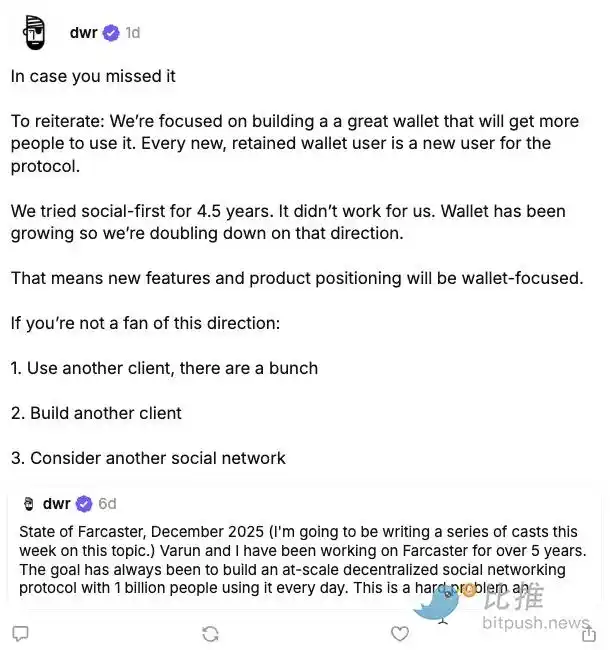
Recently, Farcaster co-founder Dan Romero posted consecutively on the platform, announcing that the team will abandon the "social-first" product strategy and instead fully focus on the wallet direction. In his statement, this was not seen as a proactive upgrade but rather a choice made after a long period of attempts, compelled by reality.
"We tried for 4.5 years to put social first, but it didn't work."
This assessment not only signifies Farcaster's transformation but also once again shines a spotlight on the structural challenges of Web3 social.
The Gap Between Ideal and Reality: Why Farcaster Couldn't Become "Decentralized Twitter"
Farcaster emerged in 2020, amidst the rising narrative of Web3. It attempted to address three core issues of Web2 social platforms:
· Platform Monopoly and Censorship
· User Data Not Owned by Oneself
· Creators Unable to Monetize Directly
Its design concept was quite idealistic:
· Protocol Layer Decentralization
· Clients Can Freely Build
· Social Relationships On-Chain and Migratable
Among the many "decentralized social" projects, Farcaster was once seen as the product closest to Product-Market Fit (PMF). Especially after the 2023 Warpcast, numerous Key Opinion Leaders (KOLs) joined Crypto Twitter, making it seem like the prototype of the next-generation social network.
However, problems soon surfaced.
According to Farcaster Monthly Active Users (MAU) data on Dune Analytics, Farcaster's user growth trajectory revealed a very clear but not optimistic pattern:
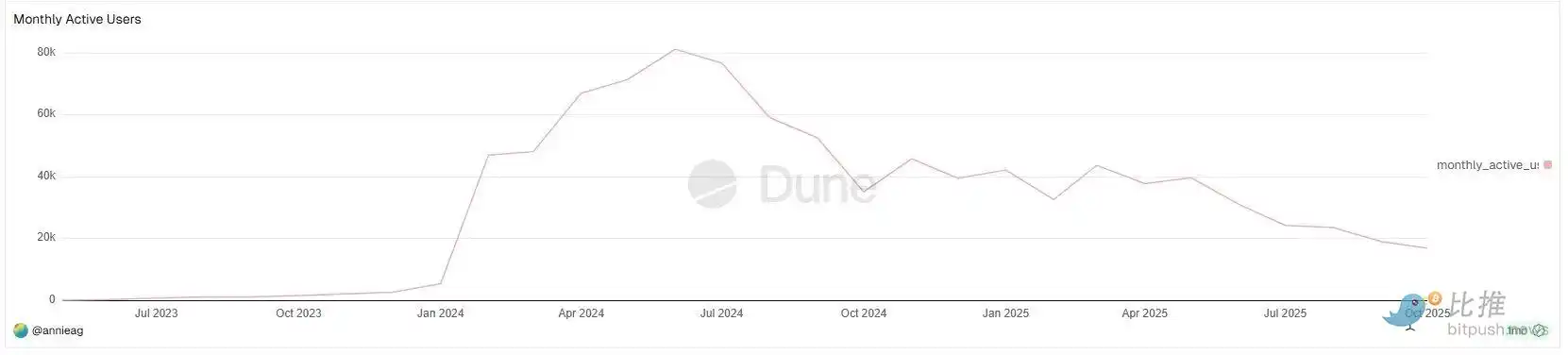
Throughout most of 2023, Farcaster's monthly active users (MAU) were almost negligible;
The true inflection point in growth occurred in early 2024, with MAU rapidly rising from low thousands to approximately 40,000–50,000 in a short period of time, peaking at nearly 80,000 MAU in mid-2024.
This was the only truly significant scaling window for Farcaster since its inception. Particularly noteworthy is that this growth did not occur during a bear market, but rather during a phase of high Base ecosystem activity and intense SocialFi narratives.
However, this window did not last long.
Starting in the latter half of 2024, MAU data showed a noticeable decline, presenting a fluctuating downward trend over the following year:
· MAU rebounded multiple times, but the peaks trended lower
· By the second half of 2025, MAU had dropped to less than 20,000
In reality, Farcaster's growth has always been unable to "break the circle," with its user base highly homogeneous:
· Crypto industry professionals
· VCs
· Builders
· Crypto-native users
For the average user:
· The registration threshold is high
· Social content is heavily "in-group"
· The user experience is not superior to X/Instagram
This has led Farcaster to consistently fail to generate true network effects.
DeFi KOL Ignas on X (@DeFiIgnas) bluntly stated that Farcaster "simply acknowledged what everyone had been feeling for a long time":
The network effect intensity of X (formerly Twitter) is almost impossible to be positively breached.
This is not an issue of crypto narratives but a structural barrier of social products. From a product perspective, the social aspect of Farcaster's issues is quite typical:
· User growth has always been locked within the crypto-native crowd
· Content is highly self-referential, making overflow difficult
· Creator Monetization and User Retention Did Not Form a Positive Feedback Loop
This is also why Ignas succinctly summarized Farcaster's new strategy in one sentence:
"It's easier to add social to a wallet than to add a wallet to a social product."
This assessment fundamentally acknowledges that "social is not Web3's primary need."
"Bubbles Are Comfortable, but Numbers Are Harsh"
If MAU data answers "How is Farcaster doing," another question is: How big is this market itself?
Crypto creator Wiimee provided a set of impactful comparative data on X.

Following an "accidental breakout from the crypto content circle," Wiimee created content for the general audience for four consecutive days. The analysis data showed that within approximately 100 hours, he gained 2.7 million impressions, more than double the total views of all his crypto content in a year.
He remarked: "Crypto Twitter is a bubble, and it's small. Speaking to the general public for four days is more impactful than speaking to insiders for four years."
This is not a direct critique of Farcaster but reveals a more underlying issue: crypto social is inherently a highly self-referential ecosystem with weak external outreach capabilities. When content, relationships, and followers are all limited to the same group of native users, even the most sophisticated protocol design struggles to break through the market's size limit.
Thus, the challenge Farcaster faces is not "the product is not good enough" but rather "there are not enough people in the space."
Wallet, Unexpectedly Achieving PMF
What truly altered Farcaster's internal judgment was not a reflection on social but an unexpected validation of the wallet.
Earlier in 2024, Farcaster introduced a built-in wallet in the app, originally intended as a supplement to the social experience. However, from the usage data, the wallet's growth rate, usage frequency, and retention performance were notably different from the social module.
Dan Romero emphasized in a public response: "Every new wallet user and retained user is a new user for the protocol."
This sentence itself has revealed the core logic of the roadmap adjustment. The wallet is not facing "expressiveness," but the real, rigid on-chain operational needs: transfer, transaction, signature, and interaction with new applications.
In October, Farcaster acquired the AI Agent-driven token issuance tool Clanker and gradually integrated it into the wallet system. This move was also seen as the team's clear commitment to the "wallet-first" path.
From a business perspective, this direction has obvious advantages:
· Higher frequency of use
· Clearer monetization path
· Closer integration with on-chain ecosystem
In contrast, social features are more like icing on the cake rather than the growth-driving engine.
Although the wallet strategy is data-driven, community controversy has followed.
Several long-time users have made it clear that they are not against the wallet itself but feel uncomfortable with the accompanying cultural shift: from "users" being redefined as "traders," from "co-builders" being labeled as the "old guard."
This exposes a practical issue: when the product direction changes, community emotions are often harder to migrate than the roadmap. Farcaster's protocol layer remains decentralized, but the decision-making power regarding product direction still lies largely with the team. This tension is amplified during the transition.
Romero later admitted communication issues but also made it clear that the team has made a choice.

This is not arrogance but a common reality check for a late-stage startup project. In this sense, Farcaster has not abandoned the social ideal but has let go of the fantasy of scaling it.
Perhaps as an observer said, "First make users stay for the tool, then there is room for social interaction."
Farcaster's choice may not be the most romantic, but it may be the closest to reality, diving deep into integrating native financial tools (wallet, transaction, issuance), which is the practical path to transforming into sustainable business value.
-- Price
This content is provided for general informational purposes only and doesn't constitute financial, investment, legal, or tax advice. Any events, rewards, online promotions, or related information mentioned herein should not be considered a recommendation, solicitation, or invitation to purchase, sell, trade, or otherwise deal in any crypto assets. Crypto assets are highly volatile and may result in loss. The availability of WEEX services, products, and related events may vary by region. You are responsible for ensuring that your participation is in accordance with applicable local laws and regulations.
You may also like

The euro stablecoin's retail VASP transaction volume increased 12 times to $777 million over 15 months

Y Combinator launches the YC Crypto Deals program, with participation from the Solana Foundation and others
The Federal Reserve is seeking feedback on the "streamlined master account" framework, proposing to allow cryptocurrency companies to access its payment system

Futures Trading Hours Explained: How Smart Traders Cut Futures Fees and Earn More Cryptocurrency in 2026

BNKR’s Recent Surge Marks New Heights in Cryptocurrency Market
Key Takeaways BNKR Token Peak: BNKR reached an all-time high of $0.0011 on July 31, 2025. Significant Market…

Beast Industries Acquires Step – Expanding Fintech Horizons
Key Takeaways Beast Industries, led by YouTube celeb MrBeast, has acquired the teen-focused fintech banking app Step, aiming…
SlowMist’s Latest Alert: A Deep Dive into LiteLLM’s Data Breach
Key Takeaways SlowMist identifies a major breach in the LiteLLM library, with approximately 300GB of sensitive data compromised.…

Steakhouse Financial Experiences Phishing Attack: A Comprehensive Overview
Key Takeaways Steakhouse Financial’s domain experienced a phishing attack, prompting user safety advisories. Depositors’ funds and smart contracts…
FTX/Alameda Wallet Transfers Over $8 Million in ZRO Tokens to Wintermute
Key Takeaways An FTX/Alameda-associated wallet moved 4.126 million ZRO tokens to market maker Wintermute, with an approximate value…

Analysis of Recent Ethereum Short Position Activity on HyperLiquid
Key Takeaways Recently, a newly created wallet deposited $4.89 million into HyperLiquid, opening a short ETH position with…

Upbit and Bithumb Designate DRIFT as a Trading Alert Item
Key Takeaways Upbit and Bithumb have labeled DRIFT as a “trading alert” asset following guidance from the Digital…
“Brother Maji” Faces Potential Liquidation with ETH Long Position
Key Takeaways “Brother Maji” currently holds a substantial 25x leveraged long position of 6,000 ETH. The position was…
Binance’s Strategic Delisting of Trading Pairs Enhances Market Health
Key Takeaways Binance has decided to remove 23 spot trading pairs, focusing on those with low liquidity and…
Renew the Spirit, Reveal the Worth: Insights on U.S. Economic Trends
Key Takeaways U.S. Treasury Secretary Scott Bessent confirms the Federal Reserve plans to eventually lower interest rates. Current…

Hackers in Brazil Use Fake Google Play Store to Steal Cryptocurrency
Key Takeaways Hackers in Brazil are exploiting fake Google Play Store pages to spread Android malware. Infected devices…

Binance to Delist Key Spot Trading Pairs: What You Need to Know
Key Takeaways Binance is set to remove several spot trading pairs on March 27, 2026, at 11:00 AM…
Dragonfly Receives $55.8 Million Worth of LIT Tokens, Locked Until December 2026
Key Takeaways Dragonfly has acquired 55.8 million LIT tokens from Lighter, according to Arkham. The tokens are valued…
Circle and Tether Freeze Iranian Exchange Wallex Wallet with $2.49M Assets on Hold
Key Takeaways Circle and Tether have frozen a significant amount of assets from an Iranian exchange called Wallex,…
Binance to Delist 10 Spot Pairs Including ARB/EUR
Key Takeaways Binance has announced the delisting of 10 spot trading pairs. The affected pairs include ARB/EUR, BANANA/FDUSD,…

SpaceX Stock Prediction: Hitting $1,200 at 2026 IPO?
Key Takeaways Elon Musk confirms SpaceX is advancing its IPO plans, with expected filing as early as weeks…

OpenClaw 3.28 Update: Potential Security Risks with Axios
Key Takeaways Recent findings suggest OpenClaw version 3.28 may contain a compromised version of the Axios library. Dependency…
Massive Whale Movement: Unstaking $84.96 Million in HYPE Tokens
Key Takeaways A crypto whale, known as TechnoRevenant, has unstaked approximately $84.96 million in HYPE tokens. The tokens…

Security Risks of Fake Ledger Nano S+ Devices Emerging Through Chinese E-Commerce
Key Takeaways Counterfeit Ledger Nano S+ devices are being sold on Chinese e-commerce platforms, posing significant risks to…

How Crypto Futures Markets Are Fueling ‘Scam Coin’ Insider Schemes
Key Takeaways: RAVE’s market cap skyrocketed to $6.7 billion before plummeting by 95% due to insider control and…

SEC’s “Innovation Exemption” Sets New Rails for Tokenized Securities
Key Takeaways: SEC Chair Paul Atkins introduces an “innovation exemption” to regulate tokenized securities. A five-category token framework…

Ripple Sets 2028 Deadline for Quantum-Ready XRPL
Key Takeaways: Ripple commits to a 2028 deadline for XRPL’s quantum-readiness, focusing on quantum-resistant cryptographic systems. Google’s research…
Breaking: Crypto Investor Tim Cook Steps Down as Apple CEO
Key Takeaways: Tim Cook will transition from CEO to Executive Chairman on September 1, 2026. John Ternus, a…
UK Fintech Stratiphy Reopens Tax-Free Crypto ETNs Through IF ISAs
Key Takeaways: Stratiphy now offers UK investors tax-free crypto ETNs via Innovative Finance (IF) ISAs. Recent policies restrict…

Stratiphy Reopens Tax-Free Crypto ETNs for UK Investors
Key Takeaways: Stratiphy reintroduces tax-free access to crypto ETNs in the UK, reversing limitations imposed by HMRC’s ISA…
Uzbekistan Launches Tax-Free Crypto Mining Zone in Karakalpakstan
Key Takeaways: Uzbekistan has initiated the “Besqala Mining Valley” in Karakalpakstan, offering a supervised zone for crypto mining…
The euro stablecoin's retail VASP transaction volume increased 12 times to $777 million over 15 months
Y Combinator launches the YC Crypto Deals program, with participation from the Solana Foundation and others
The Federal Reserve is seeking feedback on the "streamlined master account" framework, proposing to allow cryptocurrency companies to access its payment system
Futures Trading Hours Explained: How Smart Traders Cut Futures Fees and Earn More Cryptocurrency in 2026
BNKR’s Recent Surge Marks New Heights in Cryptocurrency Market
Key Takeaways BNKR Token Peak: BNKR reached an all-time high of $0.0011 on July 31, 2025. Significant Market…
Beast Industries Acquires Step – Expanding Fintech Horizons
Key Takeaways Beast Industries, led by YouTube celeb MrBeast, has acquired the teen-focused fintech banking app Step, aiming…