
ZeusNode is officially live, and the $ZEUS Guardian Staking Program has been launched.


Article Source: ZEUS
A New Era of Bitcoin Liquidity Utilization Begins: ZeusNode Goes Live, Initiates Epoch 1, and Paves the Way for 1% of $BTC on Solana.
ZeusNode Overview
ZeusNode is core infrastructure built on the Solana Virtual Machine (SVM) to support ZeusLayer, establishing its role as Solana's Layer 1.5 and enhancing Solana's liquidity through permissionless Bitcoin integration.
The primary mission of ZeusNode is to achieve seamless Bitcoin operations in Solana's high-speed environment while ensuring transaction integrity and adhering to the highest security standards for cross-chain assets.
Now, with the formal start of Epoch 1, ZeusNode has initiated Operators and Guardians to oversee network security and is preparing to soon onboard Bitcoin transactions.
Operators and Guardians
ZeusNode acts as a trustless interactor between Bitcoin and Solana, supported by cooperation between Operators and Guardians. They ensure network security for smooth Bitcoin liquidity inflow into Solana.
In the Bitcoin-to-Solana scenario, Operators collect transaction proposals and submit them to Guardians for validation and signature. Upon validation, Operators facilitate interaction requests between the blockchains, enabling secure and efficient cross-chain operations.
With Operators now activated by Zeus Network, the ZeusNode Guardian delegation has officially opened, paving the way for Bitcoin to Solana requests.
Guardian Staking: Bitcoin's Anchor on Solana
Each Guardian is responsible for validating transactions, ensuring the security of the ZeusNode network, and the integrity of ZPL assets. Guardians oversee transaction signing to ensure secure interaction between Bitcoin and Solana.
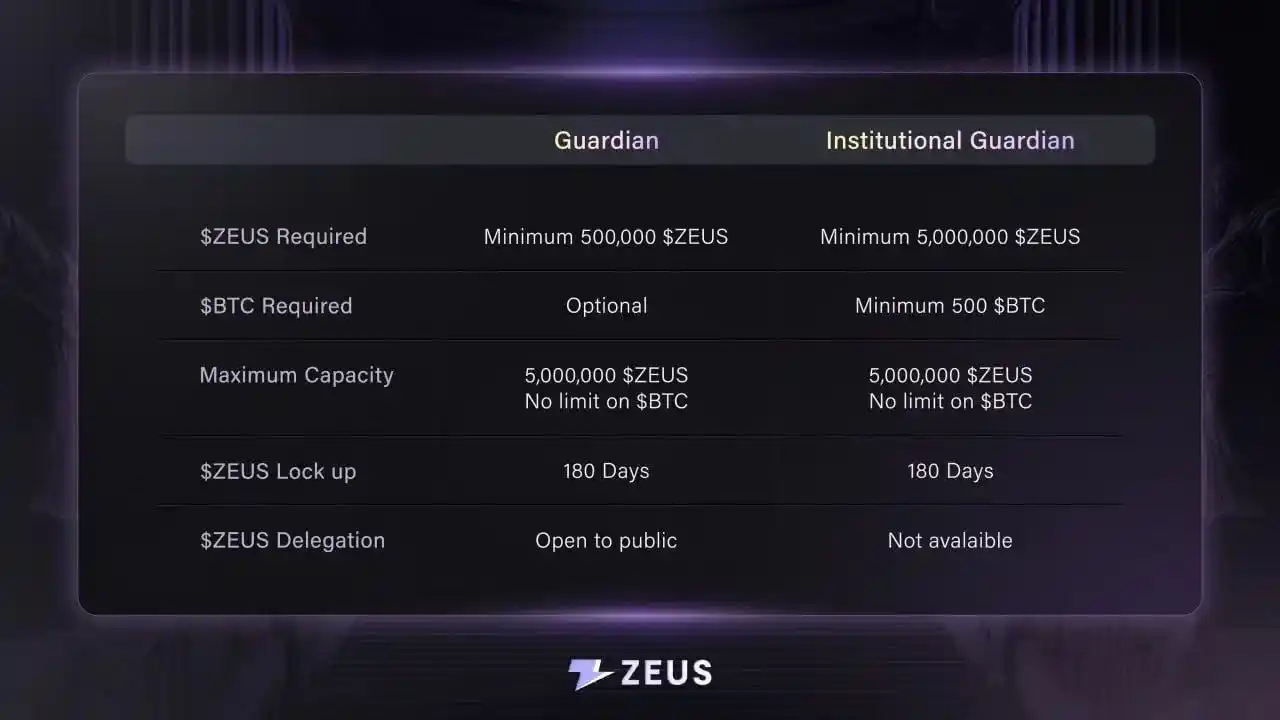
ZeusNode offers two Guardian programs for Bitcoin liquidity providers:
Guardians: Only reputable entities can become Guardians to protect the network. This type of Guardian is open to anyone willing to delegate $ZEUS and actively contribute to network security.
Institutional Guardians: Customized for large $BTC liquidity providers, allowing them to establish a private Guardian to enhance asset management on Solana. $ZEUS holders cannot delegate.
In the early stages, the ZeusNode program will admit a maximum of 10 Guardians and several Institutional Guardians to ensure network security and scalability. Please read the following to further understand each Guardian type.
Guardian
The Guardian is the cornerstone of the ZeusNode trustless mechanism, responsible for ensuring secure cross-chain interaction. Only trusted notary entities can become Guardians by depositing and locking the minimum amount of $ZEUS, activating their role in the network.
Institutional Guardian
Institutional Guardians are custom-tailored to meet the needs of large liquidity providers, enabling them to effectively manage and optimize significant $BTC volumes.
The Institutional Guardian model serves institutions capable of handling large inflows of Solana $BTC. To participate, entities must deposit a minimum of 500 $BTC, with no limit on $BTC inflow capacity to ensure flexibility and scalability.
ZeusNode Development
In order to ensure the secure and seamless liquidity flow of Bitcoin, we have collaborated with cryptographers and security experts to develop a phased capacity model to strengthen its security foundation.
Dynamic Ratio: $ZEUS-$BTC
With the launch of ZeusNode Epoch 1, the delegation process at a 20,000:1 initial $ZEUS to $BTC ratio successfully initiated the first batch of Guardians, allocating a secure capacity to manage the incoming $BTC.
Once a Guardian's delegation reaches 5,000,000 $ZEUS, this ratio will dynamically adjust, unlocking unlimited $BTC inflow capacity to ensure adaptability and responsiveness to market demand.
Network Capacity Roadmap
This journey starts with activating ZeusNode and the Guardian delegation plan, allowing users to delegate their $ZEUS and actively contribute to the network's security and growth.
As the network evolves, ZeusNode will onboard more Guardians and Institutional Guardians, progressively unlocking more $ZEUS delegation slots to enhance network security and maximize $BTC capacity, while paving the way for integrating other UTXO-based assets.
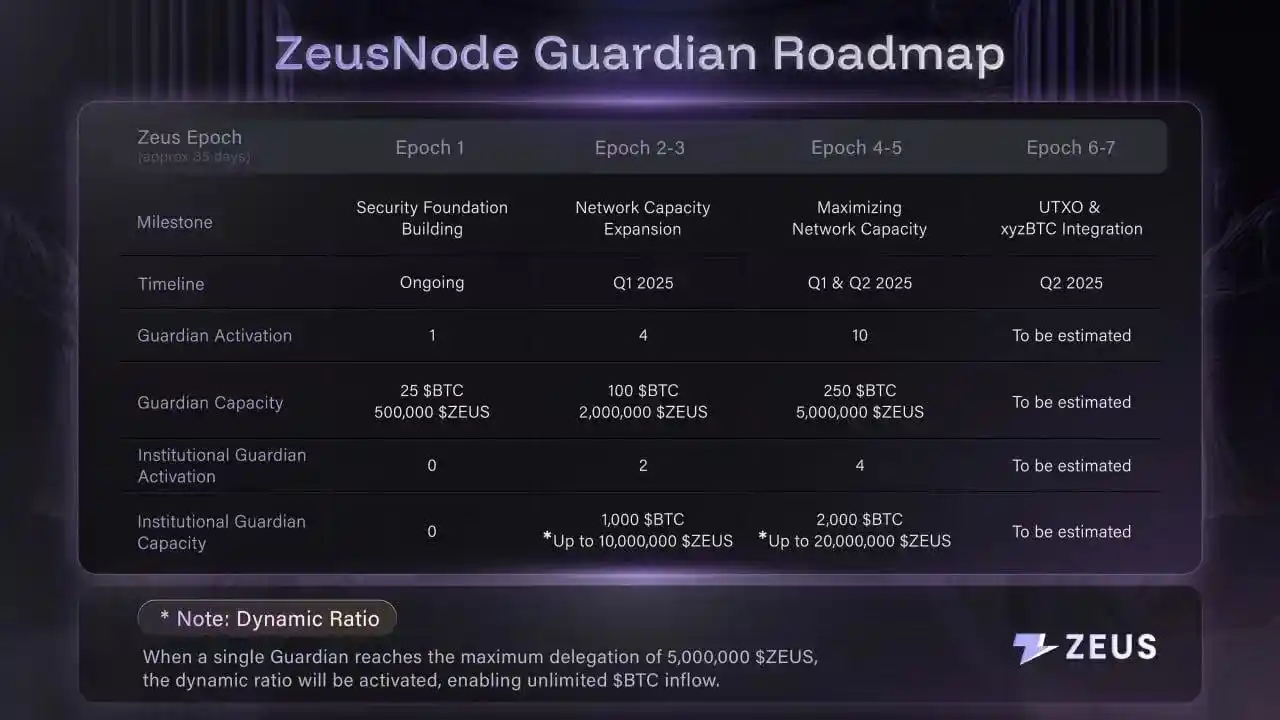
Epoch 1: Security Foundation Build
Based on the Foundation's security ratio, once the network achieves full security through 500,000 $ZEUS in delegation, there will be a $BTC inflow of 25 into Solana. The $BTC in this stage will initially be rolled out as $zBTC, supported by APOLLO, marking the flagship of ZPL assets.
Timeline: Ongoing
Guardians: 1
Institutional Guardians: 0
Network Capacity: 25 $BTC / 500,000 $ZEUS
Periods 2 and 3: Network Capacity Expansion
The activation of three additional Guardians and the introduction of Institutional Guardians will enhance the network's capacity. With support from institutional Bitcoin liquidity, this expansion is expected to bring in 1,100 $BTC. Therefore, the network's capacity will significantly increase, supporting delegations of up to 12,000,000 $ZEUS.
Timeline: Q1 2025
Guardians: 4
Institutional Guardians: 2
Network Capacity: 1,100 $BTC / up to 12,000,000 $ZEUS
Phases 4 and 5: Maximizing Network Capacity
The vision for this phase is to onboard 1% of Bitcoin liquidity to Solana, aiming to maximize the network's capacity through the full activation of 10 Guardians and multiple Institutional Guardians. By fully delegating $ZEUS to each Guardian, it achieves an infinite flow of $BTC inflow, laying the foundation for Solana's seamless scalability and liquidity expansion.
Timeline: Q1/Q2 2025
Guardians: 10
Institutional Guardians: 4
Network Capacity: 2,250 $BTC / up to 25,000,000 $ZEUS
Phases 6 and 7: UTXO and xyzBTC Integration
The focus of this phase is to enable UTXO-based assets and xyzBTC to seamlessly flow into Solana, unlocking new opportunities for asset interoperability and use cases. This step represents a transformative leap in connecting Bitcoin liquidity to Solana, granting users unparalleled flexibility and $BTC management capabilities.
Timeline: Q2 2025
Guardians: To be determined
Institutional Guardians: To be determined
Network Capacity: To be determined
Delegate $ZEUS Now
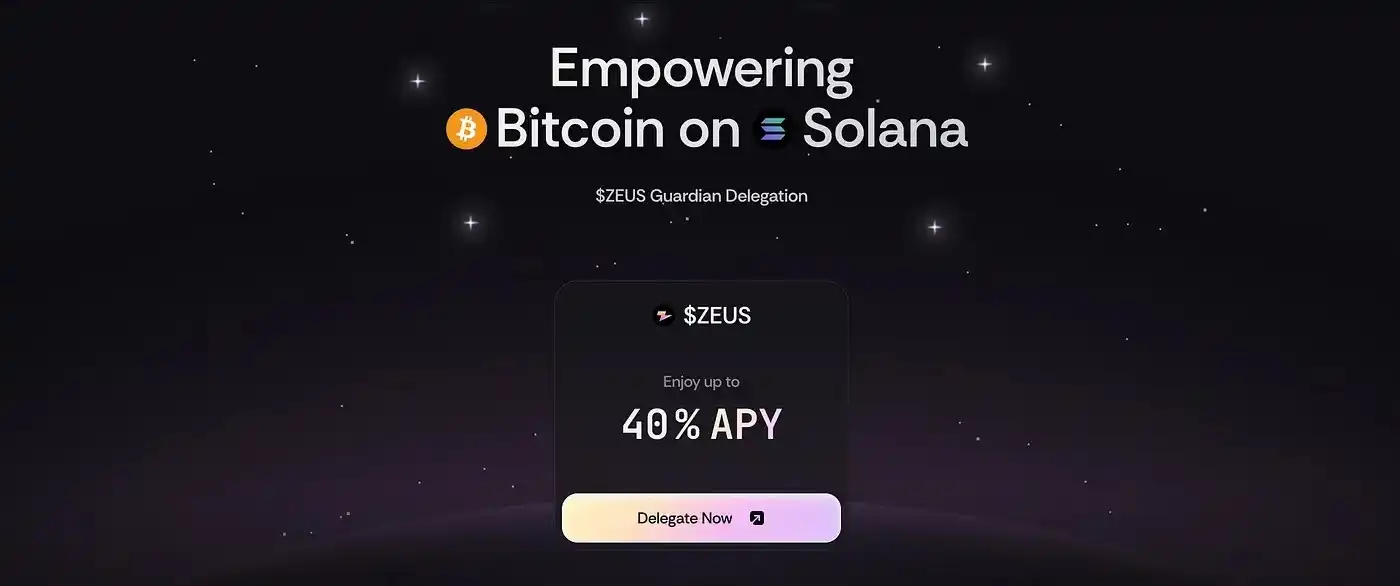
$ZEUS holders can now delegate their tokens to guardians to strengthen network security while earning rewards.
This article is contributed content and does not represent the views of BlockBeats.
You may also like

Morning Report | OpenAI has submitted an S-1 registration statement draft to the U.S. SEC; Morpho completes $175 million financing

Galaxy Deep Research Report: How Hyperliquid's HIP-4 Upgrade Changes the Landscape of Prediction Markets?

Latest research from 13 top universities including Cornell University: The current state, challenges, and misconceptions of the fusion of Crypto and AI

Deconstructing Anthropic: The Best AI Company, Possibly Also a Type of Organizational Invention

Every exchange is a "Universal Exchange."

The counterattack of traditional finance: Alliance chains are quietly reviving
Pantera Capital Partner: How Tokenization is Restructuring the Private Equity and Early Investment Ecosystem?

Mastercard Launches Agent Pay for AI, Plans to Record AI Agent Payment Authorizations on Polygon
Mastercard launched Agent Pay for AI, a new payment protocol designed to help AI agents make small payments such as pay-per-use access to data and APIs. The system plans to record human-granted AI agent permissions on Polygon, focusing on verifiable authorization, identity, and payment controls.

Curve Deploys Llamalend v2 on Optimism With 250,000 OP Incentives
Curve launched Llamalend v2 on Optimism with 250,000 OP incentives from the Optimism Foundation. The upgrade expands Llamalend beyond its earlier crvUSD-focused model, adding broader collateral support, LlamaRisk market reviews, and the ability to use Curve LP tokens as collateral.

Raydium Old Liquidity Pool Reportedly Exploited, With $1.34 Million Moved to Ethereum and Tornado Cash
An old Raydium liquidity pool was reportedly exploited for around $1.34 million in USDC, RAY, and wSOL, with the stolen funds bridged to Ethereum and deposited into Tornado Cash. The incident highlights the tail risks of legacy DeFi pools, old contracts, and cross-chain fund laundering paths.
Kalshi Executive Challenges “SBF Backed AI Unicorns” Narrative, Says Leopold Aschenbrenner Was Key Figure
Kalshi executive John Wang questioned the “SBF backed AI unicorns” narrative, saying Leopold Aschenbrenner was the key figure behind major AI investment decisions.

New York Proposes Stricter Stablecoin Issuer Rules Aligned With Federal GENIUS Act
NYDFS proposed stricter stablecoin issuer rules aligned with the GENIUS Act, covering reserves, custody, redemption timelines, audits, and capital buffers.

CryptoQuant Says Bitcoin Profitable Supply Is Near 45% Pressure Zone as On-Chain Data Points to Market Repricing
CryptoQuant said Bitcoin’s profitable supply is nearing the 45% pressure zone, signaling rising market stress, unrealized losses, and a possible on-chain repricing phase.

Bitcoin Falls Below 200-Week Moving Average as On-Chain Data Shows Over Half of Supply in Loss
Bitcoin dropped below its 200-week moving average as on-chain data showed over 50% of circulating supply is now in loss, signaling rising market stress.

CFTC Reportedly Plans New Prediction Market Rules Focused on Manipulation Risk and Public Interest Review
The CFTC is reportedly preparing new prediction market rules focused on manipulation risk, public interest review, and retail trader protections.

Meet the new WEEX trial fund—your gateway to greater profits

WEEX Labs Lands at Dutch Blockchain Week: A Disruptive Crypto × AI Conversation Sets Sail in Amsterdam
SK Hynix Reportedly Plans U.S. ADR Listing as Early as August, With SEC Approval Possible in Late June
SK Hynix may pursue a U.S. ADR listing as early as August, with SEC approval reportedly possible in late June amid strong AI chip supply chain demand.
Morning Report | OpenAI has submitted an S-1 registration statement draft to the U.S. SEC; Morpho completes $175 million financing
Galaxy Deep Research Report: How Hyperliquid's HIP-4 Upgrade Changes the Landscape of Prediction Markets?
Latest research from 13 top universities including Cornell University: The current state, challenges, and misconceptions of the fusion of Crypto and AI
Deconstructing Anthropic: The Best AI Company, Possibly Also a Type of Organizational Invention
Every exchange is a "Universal Exchange."
The counterattack of traditional finance: Alliance chains are quietly reviving


