
Dow Jones Today: Record Highs and the Signal for Crypto


The Dow Jones Industrial Average is trading around 52,800 on Tuesday, July 7, 2026, easing back roughly 0.2% after the blue-chip index closed above 53,000 for the first time a day earlier. In other words, "Dow Jones today" is a story of records first, and a mild pause second. The move matters far beyond Wall Street: with Bitcoin's correlation to US stocks near historic highs, what the Dow does now feeds directly into how crypto trades this week.
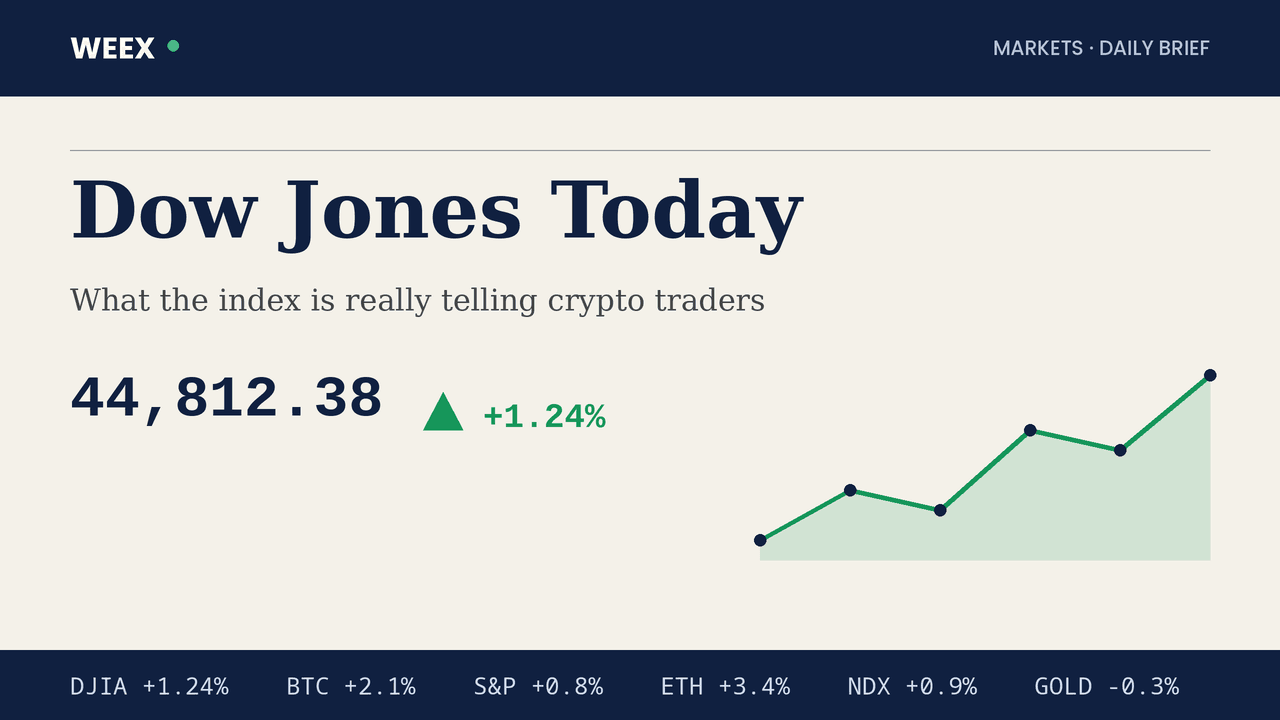
Here is the fast read. A softer-than-expected June jobs report revived bets that the Federal Reserve will cut interest rates later in 2026. That is a risk-on signal, and it pushed the Dow to fresh records into the July 4 holiday. Today's small dip looks like consolidation, not a reversal — but the setup underneath it is what traders should actually watch.
Where the Dow Jones stands today
As of midday trading on July 7, 2026, the Dow sits near 52,800, down about 114 points (roughly 0.2%) on the session. That follows a record close at 53,056 on Monday, July 6 — the first time the index has ever finished above 53,000 — and a 594-point surge (+1.14%) to 52,900 on Thursday, July 2.
| Snapshot | Level / Move |
|---|---|
| Dow today (intraday, Jul 7) | ~52,800, about -0.2% |
| Previous close (Jul 6) | 53,056 (record) |
| Prior record close (Jul 2) | 52,900 (+1.14%) |
| 52-week range | ~43,341 – 53,053 |
| Main driver | Rate-cut hopes after weak June jobs data |
Intraday numbers move constantly, so treat the level above as a marker rather than a fixed quote. The direction is the point: the Dow is near all-time highs and digesting a strong run, not breaking down.
Why the Dow hit a record this week
The catalyst was the June employment report. The US economy added just 57,000 jobs, short of forecasts, while the unemployment rate ticked down to 4.2% from 4.3%. A cooling labor market is exactly the kind of data that pulls forward expectations for Fed rate cuts, and lower rates tend to lift equity valuations — especially the steadier, dividend-paying names that dominate the Dow.
That is the mechanism behind the rally: weaker jobs, softer expected policy, higher stock prices. The more important point is that the market is now leaning heavily on a rate-cut narrative. If incoming data or the FOMC minutes due this week challenge that assumption, the same names that led the Dow higher can give ground quickly.
Why the Nasdaq is lagging the Dow
A record on the Dow has not been matched by the Nasdaq. Semiconductors have been the drag, with the group falling for multiple sessions — the VanEck Semiconductor ETF dropped about 4.5% in one stretch, Nvidia slipped, and Micron fell more than 5%. When money rotates out of high-multiple chip and AI names into more defensive blue chips, you get exactly this split: Dow up, Nasdaq soft.
This rotation matters for crypto readers because Bitcoin has behaved more like a high-beta tech stock than like digital gold. When the Nasdaq wobbles, crypto has more often followed the Nasdaq than the Dow.
What Dow records mean for Bitcoin and crypto
Here is the connection most "Dow Jones today" coverage skips. Through 2026, Bitcoin's correlation with US equities has run at record levels, with some readings of the Bitcoin–S&P 500 relationship near 0.96. In plain terms, crypto and stocks are increasingly drinking from the same well: institutional capital chasing risk. When rate-cut hopes turn Wall Street risk-on, that tailwind tends to reach Bitcoin too.
But the correlation cuts both ways, and that is the trap. The June 2026 AI-driven selloff was a reminder that when equities crack, crypto often falls harder rather than acting as a hedge. So a Dow at record highs is a supportive backdrop for crypto — but it also means a sharp equity reversal would likely pressure Bitcoin and altcoins in sympathy. The diversification story that once justified holding both is much weaker than it was a few years ago.
The practical takeaway: if you trade crypto, the Dow's record is a sentiment signal, not a guarantee. Watch whether the Nasdaq confirms the risk-on move. A market where only the Dow is rising, powered by defensive rotation, is a shakier foundation for crypto than a broad, everything-rallies tape.
How crypto traders can read the Dow alongside their positions
You do not need a stock account to use this. Equity index futures trade nearly around the clock, so they front-run the risk mood while US crypto desks sleep. A deep overnight drop in S&P 500 or Nasdaq futures after a hawkish Fed headline can hit Bitcoin within minutes. If you want the mechanics of how those contracts work and how to read them, WEEX's explainer on US stock futures covers it.
For traders who want to express a macro view directly in crypto, perpetual contracts are the usual tool. You can position long or short on BTC perpetual futures on WEEX, or browse the full futures markets for other pairs. The same discipline that applies to index futures applies here: leverage magnifies both directions, and a Dow that looks calm at the close can gap on overnight news before you can react.
What matters most right now
Strip away the headline and the situation is straightforward. The Dow is at record highs on rate-cut optimism, the Nasdaq is not confirming, and crypto is tethered more tightly to equities than at almost any point in its history. That combination rewards attention to breadth: a rally led only by defensive blue chips is a weaker crypto signal than one where tech participates. Keep watching the Dow today, but watch the Nasdaq and the rate-cut narrative even more closely.
FAQ
1. What is the Dow Jones at today?
As of intraday trading on July 7, 2026, the Dow is near 52,800, down about 0.2%, after closing at a record 53,056 on July 6. Intraday levels change throughout the session, so check a live quote for the exact figure.
2. Why is the Dow Jones up recently?
A weaker-than-expected June jobs report (57,000 new jobs) revived expectations that the Federal Reserve will cut interest rates later in 2026. Lower expected rates tend to lift stocks, pushing the Dow to record closes into early July.
3. Why is the Dow at a record but the Nasdaq is not?
Semiconductor and AI stocks have sold off, dragging the tech-heavy Nasdaq while investors rotated into steadier Dow blue chips. This split reflects a defensive tilt rather than a broad, everything-rallies move.
4. Does the Dow Jones affect Bitcoin and crypto?
Yes, increasingly. Bitcoin's correlation with US equities has run near record highs in 2026. Risk-on moves in stocks tend to support crypto, but sharp equity selloffs often pressure Bitcoin harder, so the relationship is not a reliable hedge.
5. How can crypto traders use Dow and stock futures data?
Equity index futures trade nearly 24 hours, so they signal macro risk appetite while US markets are closed. A sharp overnight move in S&P 500 or Nasdaq futures can foreshadow how Bitcoin trades at the next session, though the link loosens during crypto-specific events.
Risk Warning
Market levels, index records, and rate-cut expectations discussed here can change within a single session and were accurate only as of July 7, 2026. Equities and crypto assets are both volatile, and the strong correlation between them means a downturn can hit stocks and Bitcoin at the same time, removing the diversification many investors assume they have. Crypto assets in particular can lose part or all of their value. Leverage on perpetual futures magnifies both gains and losses and can trigger liquidation, and overnight gaps can move against a position before you can react. Liquidity, custody, counterparty, and regulatory risks all apply. Nothing here is investment advice; size positions to what you can afford to lose and use clear risk controls.
Disclaimer: This content is provided for general informational and educational purposes only and should not be considered financial, investment, legal, or tax advice. Nothing in this article constitutes an offer, recommendation, solicitation, or invitation to buy, sell, or trade any crypto asset or use any specific service. Crypto assets are highly volatile and involve a high degree of risk. You may lose some or all of the value of your investment and should not invest funds you cannot afford to lose. WEEX services may not be available in all regions and are subject to applicable laws, regulations, and user eligibility requirements. Please carefully assess risks and confirm local requirements before making any financial decisions.