
NVIDIA vs Apple: Which Stock Has Performed Better After a Split?


Stock splits don't create value on their own but they do create useful comparison points. And when you put Nvidia's 2024 split next to Apple's split history, you get two of the most instructive case studies the market has produced in recent years.
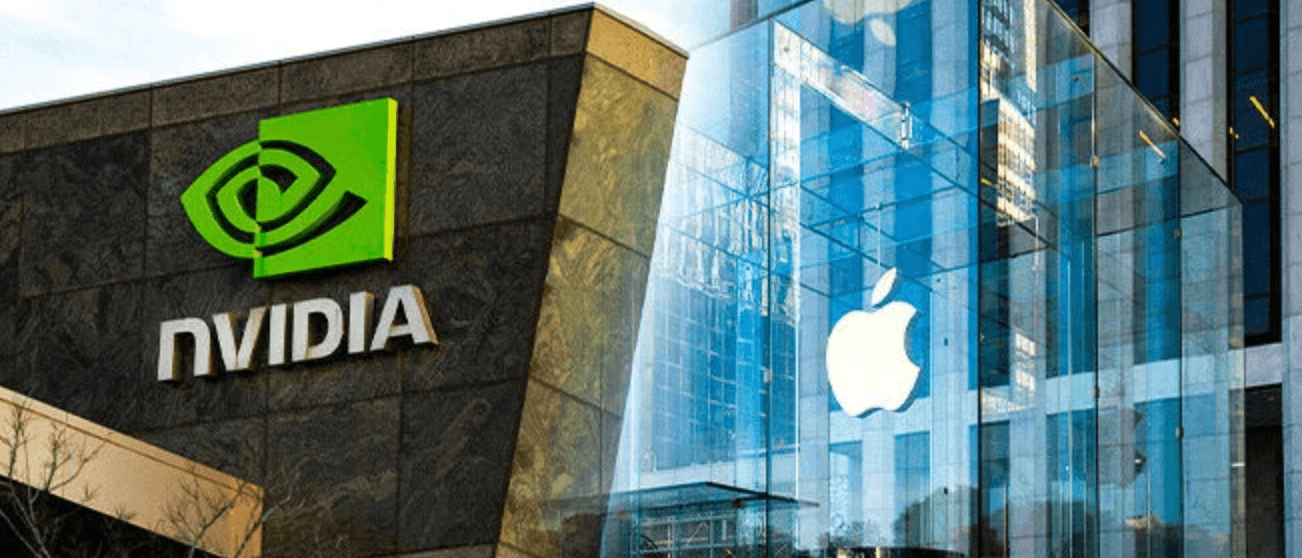
Nvidia stock price after split became one of the most searched topics in markets following the 10-for-1 split in 2024. Apple has been through multiple splits over its history, with the most recent 4-for-1 split happening in 2020. Both companies saw strong post-split performance. But the stories behind that performance are quite different and understanding the difference tells you something useful about what actually drives stock prices over time.

The Splits: What Each Company Did
Nvidia's 2024 split was a 10-for-1. A share that cost around $1,200 before the split became ten shares at roughly $120 each. The stated reason was accessibility, the share price had climbed high enough that many retail investors were effectively priced out of buying whole shares.
Apple's most recent split, in August 2020, was a 4-for-1. Before the split, Apple shares were trading around $400. After the split, the price adjusted to approximately $125 per share. Apple has actually split its stock four times in total in 1987, 2000, 2005, and 2020 which gives it a much longer split history to draw from.
In both cases, the mechanics were identical to any other split: more shares, lower price per share, same total value. The interesting part is what happened next.
Post-Split Performance: Nvidia
Nvidia's post split trajectory was dramatic by almost any measure.
In the months following the 2024 split, the stock continued climbing significantly. By 2026, shares were trading around $210 meaning investors who held through the split period had seen substantial gains from the post-split price of around $120.
The driver wasn't the split. It was AI. Data center revenue accelerated sharply. Earnings consistently beat expectations. The competitive position in AI GPU infrastructure proved more durable than many analysts had predicted. The split opened the door for more retail participants but the business performance kept them there.
What made Nvidia's post split period unusual was the speed and scale of the gains, and the fact that they were anchored in genuine fundamental improvement rather than sentiment alone.
Post-Split Performance: Apple
Apple's 2020 split also preceded a period of strong performance, though the character of the gains was different.
After the August 2020 split, Apple stock rallied significantly through the end of that year, driven by strong iPhone demand, services revenue growth, and the broader technology rally that characterized 2020's market environment. The stock went on to reach new all-time highs in the years that followed.
Apple's longer split history offers an even broader perspective. Each of its four splits occurred during periods of strong business momentum, and each was followed by continued appreciation over subsequent years though with the normal volatility and drawdowns you'd expect from any long duration holding.
The consistency across Apple's split history is one of its most instructive features. Not because splits caused the gains, but because Apple repeatedly split during periods when the underlying business was genuinely performing well. The splits were symptoms of success, not causes of it.
What Drove Each Company's Gains
This is where the comparison gets most useful.
For Nvidia, the post-split gains were driven by a single dominant theme: artificial intelligence infrastructure. The company found itself at the center of one of the largest technology infrastructure buildouts in history, with hardware that nobody had yet produced a credible alternative to. That's an unusual competitive situation, and the stock price reflected it.
For Apple, the gains have been driven by something broader and more diversified. iPhone revenue remains the largest single contributor, but services the App Store, Apple Music, iCloud, Apple Pay have grown into a substantial and high-margin business that has changed how investors value the company. The hardware upgrade cycle, the ecosystem stickiness, and the consistent capital return program through buybacks and dividends all contribute to a different kind of investment profile than Nvidia offers.
Nvidia's post-split story is about being in the right place at the right time with genuinely scarce hardware during an AI boom. Apple's story is about building an ecosystem so deeply embedded in people's daily lives that switching costs become almost insurmountable.
Both are compelling. They're compelling for entirely different reasons.
Risk Profiles: Very Different Animals
Putting these two stocks side by side also highlights how different their risk profiles are.
Nvidia is a high-growth, high multiple semiconductor company whose fortunes are closely tied to AI infrastructure spending. When that spending accelerates, Nvidia tends to outperform almost everything. When it moderates or investors worry about sustainability, the stock can sell off sharply. The volatility is real and significant.
Apple is a mature, diversified technology company with predictable cash flows, a massive buyback program, and a global consumer base that churns slowly. It doesn't tend to produce Nvidia-style gains during AI booms, but it also doesn't produce Nvidia-style drawdowns during periods of uncertainty. For many investors, it's a lower-volatility way to stay invested in technology over the long term.
Neither profile is superior. They serve different purposes in a portfolio. Nvidia offers higher upside potential with higher volatility. Apple offers more stability with more modest but still meaningful long-term returns.
What Investors Can Learn From the Comparison
Putting Nvidia and Apple side by side after their respective splits produces a few useful observations.
First, post-split gains require a business that earns them. Both companies performed well after their splits but both were already performing well before them. The split didn't produce the gains. The business performance did. This holds across both companies' histories.
Second, the nature of the growth matters as much as the fact of it. Nvidia's AI-driven growth has been more concentrated and more volatile. Apple's ecosystem-driven growth has been more diversified and more predictable. Understanding which kind of growth you're buying matters for how you manage expectations and position sizing.
Third, time horizon changes the answer significantly. Over a very long horizon, both stocks have rewarded patient investors. Over shorter periods, Nvidia can dramatically outperform or underperform depending on the AI investment cycle. Apple tends to grind more steadily in either direction.
For investors interested in stocks like Nvidia and Apple, WEEX provides access to stock trading products and is running its First Stock Trade Protected campaign.
Conclusion
Nvidia stock price after split has delivered impressive gains driven by AI infrastructure demand. Apple's post-split performance across multiple splits has delivered consistent longterm appreciation driven by ecosystem strength and capital returns.
Both companies have rewarded investors who held through their splits. But the reasons are different, the risk profiles are different, and the investment cases are different. The split in each case was a milestone along the way not the reason the stocks went where they did.
The lesson that applies to both: find businesses with genuine competitive advantages and durable growth, and the split becomes irrelevant. It's just a number on a share certificate that gets divided up differently.
FAQ
1. Which stock performed better after a split, Nvidia or Apple?
Nvidia's post-2024 split performance has been more dramatic in percentage terms, driven by AI infrastructure demand. Apple's performance across multiple splits has been more consistent over a longer period. The comparison depends heavily on the time horizon you use.
2. Why did both Nvidia and Apple stocks rise after their splits?
Both companies were performing strongly before and during their splits — the post-split gains came from continued business execution, not from the splits themselves. Strong earnings, competitive advantages, and favorable industry trends drove the appreciation in both cases.
3. Is Nvidia or Apple a better long-term investment?
They serve different purposes. Nvidia offers higher growth potential tied to AI infrastructure with higher volatility. Apple offers more stable, diversified returns with a strong capital return program. Neither is universally better — it depends on your investment goals and risk tolerance.
4. How many times has Apple split its stock?
Apple has split its stock four times: in 1987, 2000, 2005, and most recently in 2020 with a 4-for-1 split.
5. What was Nvidia's stock split ratio in 2024?
Nvidia executed a 10-for-1 stock split in 2024, reducing the share price to one-tenth of its pre-split level while increasing the number of shares tenfold.
Disclaimer
This content is provided for general informational and educational purposes only and should not be considered financial, investment, legal, or tax advice. Nothing in this article constitutes an offer, recommendation, solicitation, or invitation to buy, sell, or trade any crypto asset or use any specific service. Crypto assets are highly volatile and involve risk, including the potential loss of capital. WEEX services may not be available in all regions and are subject to applicable laws, regulations, and user eligibility requirements. Please carefully assess risks and confirm local requirements before making any financial decisions.
You may also like
Microsoft Stock and the Italy Probe: What EU Pressure Means for MSFT
Microsoft Stock sits at the center of a new regulatory test in Europe. Italy’s competition authority opened an…
Why ASML Stock Is the Best Picks and Shovels Play on AI
ASML stock sits at the choke point of the AI supply chain. It sells the lithography tools every…
ASML Stock and Korea’s $1.3 Trillion Chip Plan: What It Means for EUV Demand
South Korea just unveiled a decade-long semiconductor strategy worth roughly $1.3 trillion. That scale doesn’t just lift memory…
Is ASML Stock a Buy Before Earnings?
ASML stock has surged into its July 15 earnings date, forcing a classic decision: buy strength now or…
ASML Stock China Risk: What the Pax Silica Alliance Means for Investors
ASML Stock sits at the center of a major policy shift: the Netherlands joined the US-led Pax Silica…
What is D-Wave Quantum Tokenized Stock (Ondo)(QBTSON) Coin? A comprehensive guide on what is, how to buy, and what should you do
D-Wave Quantum Tokenized Stock (Ondo) (QBTSON) is a tokenized representation of D-Wave Quantum Inc. (QBTS) equity, structured by…
Samsung Stock Q2 Earnings Preview: Can It Beat the Record Set Just 90 Days Ago?
Samsung Stock is heading into a closely watched Q2 print on July 23, just six days before SK…
Buy or Sell America250 Crypto? Big Pump or July 4 Dump?
America250 is a Solana meme coin riding the U.S. Semiquincentennial narrative ahead of July 4, 2026. This article…
What Is SKHY Stock? SK Hynix Nasdaq ADR Explained for Investors
SKHY is the Nasdaq-listed American Depositary Receipt (ADR) for SK Hynix, giving U.S. investors a direct way to…
Is DEGEN the Next Big Crypto Winner? Buy Now or Wait?
DEGEN has surged back into the spotlight as a Farcaster-linked social token on Base. This article breaks down…
SK Hynix vs Micron: Which AI Memory Stock Is the Better Buy Before July Earnings?
SK Hynix and Micron have become the purest ways to play AI memory demand, and July earnings could…
Samsung Stock Is Cheaper Than Nvidia: The AI Valuation Gap Investors Are Finally Noticing
Samsung stock trades at a steep discount to Nvidia even though both sit at the center of the…
Samsung Stock vs SK Hynix Stock: Who Will Report Better Q2 Results?
This guide compares Samsung stock vs SK Hynix stock ahead of their Q2 reports, focusing on expected revenue,…
When to Sell Gold? Is This the End of the Crowded Trade?
Gold’s latest slide looks less like a loss of faith and more like the air coming out of…
Why Michael Burry Bought Microsoft Stock and What It Means
Michael Burry’s latest 13F shows positions in Microsoft and Palantir, and the market took notice. Microsoft stock jumped…
What is Rigetti Computing Tokenized Stock (Ondo)(RGTION) Coin: everything you need to know
This guide explains what Rigetti Computing Tokenized Stock (Ondo) (RGTION) is, how it works, where to buy it,…
Microsoft Stock Before July 28 Earnings: What to Watch
Microsoft Stock is heading into July 28 earnings with investors laser-focused on cloud momentum, AI monetization, and cash…
Microsoft Stock Is Down 35%: Value Trap or Buying Opportunity?
Microsoft stock has dropped about 35% from its peak, even as analysts maintain a roughly 50% upside target.…
Microsoft Stock and the Italy Probe: What EU Pressure Means for MSFT
Microsoft Stock sits at the center of a new regulatory test in Europe. Italy’s competition authority opened an…
Why ASML Stock Is the Best Picks and Shovels Play on AI
ASML stock sits at the choke point of the AI supply chain. It sells the lithography tools every…
ASML Stock and Korea’s $1.3 Trillion Chip Plan: What It Means for EUV Demand
South Korea just unveiled a decade-long semiconductor strategy worth roughly $1.3 trillion. That scale doesn’t just lift memory…
Is ASML Stock a Buy Before Earnings?
ASML stock has surged into its July 15 earnings date, forcing a classic decision: buy strength now or…
ASML Stock China Risk: What the Pax Silica Alliance Means for Investors
ASML Stock sits at the center of a major policy shift: the Netherlands joined the US-led Pax Silica…
What is D-Wave Quantum Tokenized Stock (Ondo)(QBTSON) Coin? A comprehensive guide on what is, how to buy, and what should you do
D-Wave Quantum Tokenized Stock (Ondo) (QBTSON) is a tokenized representation of D-Wave Quantum Inc. (QBTS) equity, structured by…


