
Polymarket Prediction Guide: How the Odds Actually Work in 2026


A Polymarket prediction is a price, not a promise. On the world's largest prediction market, every real-world question — an election, a rate cut, a World Cup final — trades as a share priced between $0.00 and $1.00, and that price is the crowd's live estimate of the odds. This guide explains how a Polymarket prediction is built, how accurate the platform really is, what changed in 2026, and how to read the numbers without getting fooled by thin markets or hype.
What a Polymarket Prediction Really Is
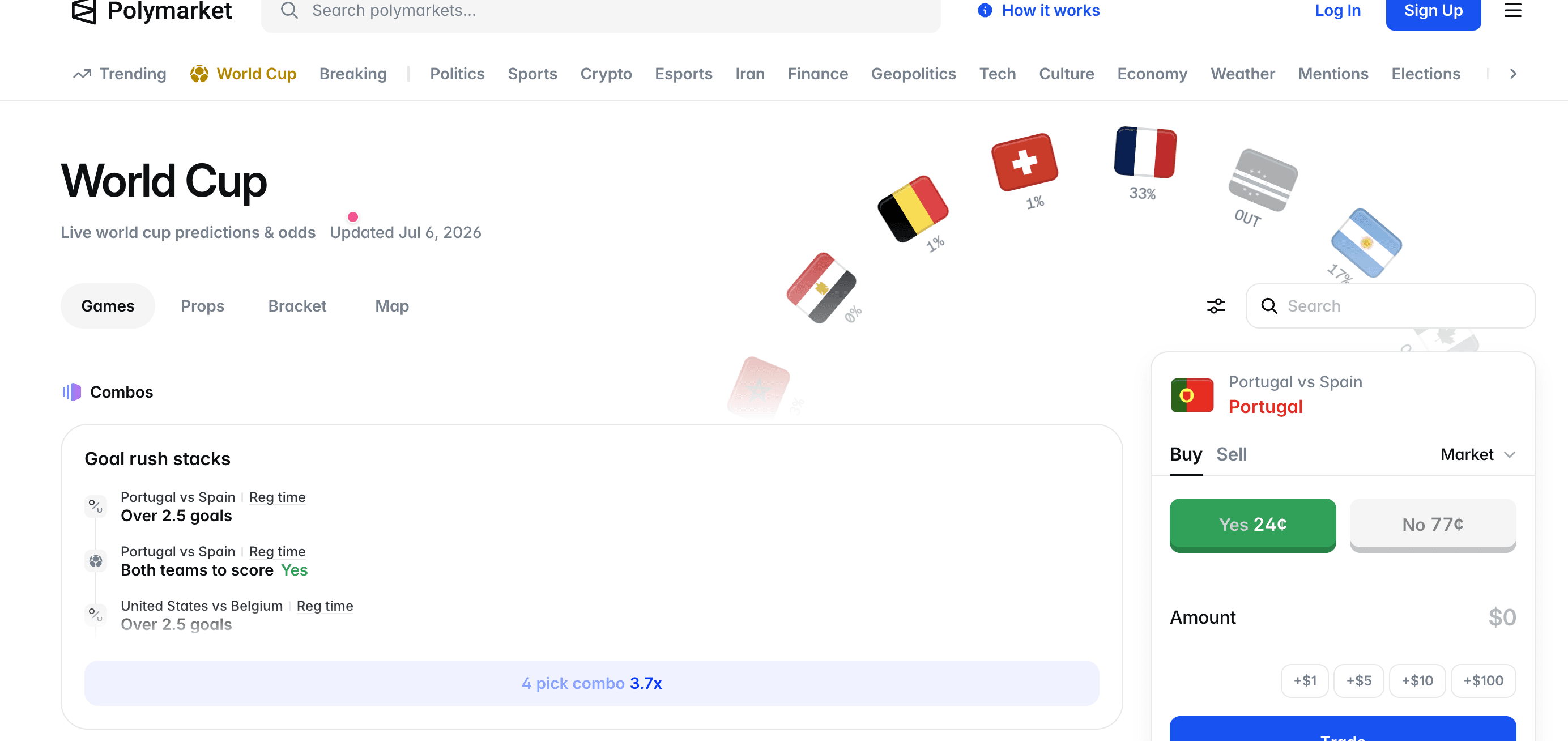
Polymarket runs as an exchange, not a bookmaker. You do not bet against the house; you trade Yes or No shares with other users, settled in USDC, the dollar-pegged stablecoin. A share that resolves in your favor pays $1, and one that resolves against you pays $0. So a "Yes" share trading at $0.62 tells you the market currently prices that outcome at roughly a 62% chance.
That single mechanic is the whole idea. A Polymarket prediction converts scattered opinions, money, and information into one number that updates in real time as people trade. As of early July 2026, the platform hosts more than 2,400 active markets spanning politics, macro data, crypto, sports, and breaking news. When you see a headline like "Polymarket gives X a 70% chance," that figure is just the last traded price on a Yes share — nothing more, nothing less.
The important nuance: the price is an implied probability, not a forecast guarantee. In a deep, liquid market it can be a genuinely useful signal. In a thin one, a single large order can jerk the odds around without any real-world news behind it.
How to Read a Polymarket Prediction Price
Before you trust any Polymarket prediction, pressure-test the number. Experienced traders look at more than the headline percentage.
| What to check | Why it matters |
|---|---|
| Resolution rules | Vague wording or an unclear settlement source can break the odds even when the event seems obvious |
| Liquidity and spread | Thin volume means the quoted price may not reflect a real crowd view, and exits get expensive |
| Time to resolution | Long-dated markets tie up capital; a headline price ignores the cost of waiting |
| Order-flow context | A sudden move with no news is often traders reacting to each other, not to reality |
The single most common mistake is treating a Polymarket prediction as certainty. A 75% market still loses one time in four — that is the entire point of a probability. Traders who forget this tend to over-size positions and get wiped out by the "obvious" outcome that did not happen.
For a step-by-step walkthrough of reading event wording, implied probability, and position sizing, WEEX's guide on how to trade prediction markets covers the mechanics in more depth.
How Accurate Is a Polymarket Prediction?
This is where the marketing and the evidence diverge, and readers deserve both sides.
Polymarket's supporters point to November 2024, when the market leaned toward a Trump win while many traditional polls showed a near-tie. The platform also promotes internal figures suggesting it is accurate the large majority of the time well before an outcome is known. Those are real data points — but they are the platform's own framing.
Independent research is more cautious. One academic analysis of the 2024 US cycle found that markets called outcomes correctly about 93% of the time on PredictIt, 78% on Kalshi, and only 67% on Polymarket, with Polymarket performing notably worse on down-ballot races than statistical models did. The better reading is that prediction markets are competitive with polls in some high-attention, high-liquidity markets, and clearly weaker in low-liquidity or long-tail ones.
| Claim | The more careful reading |
|---|---|
| "More accurate than polls" | True in some marquee races; not a general law, and one election is a single data point |
| "94%+ accurate before resolution" | A platform-reported figure; independent studies show lower, market-specific accuracy |
| "The crowd can't be wrong" | Thin markets and coordinated flow have moved odds without new information |
The practical takeaway: a Polymarket prediction is best used as one sentiment layer, not as an oracle. Cross-check it against polls, models, and your own read of the event.
What Changed for Polymarket in 2026
2026 has been the platform's most consequential year. Polymarket secured a path back into the United States after receiving a no-action letter from the Commodity Futures Trading Commission (CFTC), building on its 2025 acquisition of QCX, a licensed exchange and clearinghouse. In October 2025, Intercontinental Exchange — the parent of the NYSE — invested a reported $2 billion at a roughly $9 billion valuation, a striking vote of institutional confidence.
In April 2026, Polymarket overhauled its exchange stack with new contracts, a faster order book, an updated collateral token, and smart-contract wallet support — infrastructure aimed at scaling toward a regulated US relaunch.
Two open questions still hang over the platform. First, a widely discussed POLY token and airdrop: the company's CMO signaled in late 2025 that "there will be a token, there will be an airdrop," yet Polymarket's own help center has continued to say no token or airdrop has been officially announced, with community expectations loosely pointing to late 2026. Treat any "guaranteed airdrop" claim with skepticism until there is an official confirmation. Second, in late June 2026 the CFTC opened an investigation into Polymarket's business and marketing practices following a Wall Street Journal report alleging fabricated promotional trading videos — a reminder that headline risk and regulatory risk are live, not hypothetical.
Where WEEX Fits
WEEX does not operate a prediction market, and it is worth being clear about that. The cleaner way to use a Polymarket prediction alongside a trading account is to separate the two jobs: treat the event odds as research on one venue, and manage your crypto market exposure on a trading platform. A trader watching a crypto-regulation market, for example, might hedge broader beta by trading a correlated coin or parking funds in stablecoins while awaiting resolution.
If you are newer to the space, two WEEX explainers give useful context: why prediction markets are becoming popular in 2026, which breaks down centralized versus decentralized models, and what USDC is, since USDC is the settlement asset behind most Polymarket predictions.
Market View: What Matters Most
Strip away the noise and one point dominates: a Polymarket prediction is only as good as the market's liquidity and the clarity of its resolution rules. A deep market on a well-defined question can be a genuinely sharp signal. A thin market on a fuzzy question is closer to a rumor with a price tag. Read the rulebook before you read the odds — that habit alone separates disciplined participants from the crowd that gets trapped near event deadlines.
FAQ
1. What is a Polymarket prediction?
It is the live, crowd-set price of a Yes or No share on a real-world event. The price, between $0 and $1, reflects the market's implied probability of that outcome, settled in USDC.
2. Is a Polymarket prediction the same as a probability?
It is read as an implied probability, but it is not a guaranteed forecast. Liquidity, trader bias, and order flow can all distort the price, especially in thin markets.
3. How accurate is Polymarket?
It has been competitive with polls in some high-profile races and weaker in others. Independent studies found it less accurate than PredictIt and Kalshi in the 2024 cycle, particularly on down-ballot markets, so treat single-race successes with caution.
4. Can Polymarket predictions be manipulated?
Large or coordinated orders have moved odds in thin markets without new information, and the platform has faced scrutiny over marketing and regulatory practices. Deep, liquid markets are harder to distort than illiquid ones.
5. Is there a Polymarket (POLY) token or airdrop?
As of July 2026, no token or airdrop has been officially confirmed by Polymarket, despite public hints from company leadership. Be wary of any site promising a guaranteed POLY airdrop.
6. Do I need crypto to use Polymarket?
Yes. Trading uses USDC, so you fund a wallet with the stablecoin rather than depositing local currency directly in most cases.
7. How should beginners use a Polymarket prediction?
As one sentiment input, not an instruction. Start small, read the resolution rules, check liquidity, and cross-reference the odds with polls, models, and your own analysis.
Risk Warning
Polymarket predictions carry real, specific risks. Contracts are binary: if the event goes against your position, the share can lose most or all of its value with no chance to recover, unlike a spot asset that may rebound. Thin liquidity can trap you in a position or force costly exits through wide spreads. Because settlement is in USDC, you also inherit stablecoin risks such as depegs and custody exposure. Prediction markets face active and shifting regulation, and Polymarket itself is under a CFTC investigation as of mid-2026, so access, legality, and platform terms can change quickly by jurisdiction. Crypto assets are highly volatile, and you may lose part or all of the funds you commit. Never trade a market you do not fully understand, and never risk money you cannot afford to lose.
Disclaimer: This content is provided for general informational and educational purposes only and should not be considered financial, investment, legal, or tax advice. Nothing in this article constitutes an offer, recommendation, solicitation, or invitation to buy, sell, or trade any crypto asset or use any specific service. Crypto assets are highly volatile and involve a high degree of risk. You may lose some or all of the value of your investment and should not invest funds you cannot afford to lose. WEEX services may not be available in all regions and are subject to applicable laws, regulations, and user eligibility requirements. Please carefully assess risks and confirm local requirements before making any financial decisions.