
ACHR Stock After the Boeing Deal: What the 20% Stake Costs

 Prefer us on Google

ACHR stock closed at $6.26 on August 10, 2026, up 11.99% on the day and briefly up more than 20% intraday, after Archer Aviation announced it will buy three Boeing subsidiaries — Wisk Aero, Insitu and SkyGrid — and hand Boeing a stake of just under 20% in return. The same evening, Archer reported second-quarter results.
Two events in one session make ACHR stock harder to read than the usual quote page suggests. The deal turns a company with $1.90 million of trailing revenue into one with a pro-forma revenue base above $200 million. It also issues Boeing roughly 187 million new shares. Both things are true, and most coverage only counts one of them.
This piece works through the arithmetic: what Archer is paying, what it is getting, what the quarter actually showed, and how traders outside the US can take a position on that price move without a brokerage account.
Why ACHR stock jumped on August 10, 2026
Archer and Boeing signed definitive agreements for Archer to acquire Wisk Aero (autonomous passenger eVTOL), Insitu (uncrewed defense aircraft) and SkyGrid (airspace management software). Boeing receives Archer shares equal to 19.75% of outstanding Class A stock at close, one board seat, and two warrants to buy up to $200 million more stock later. Boeing has also agreed to invest up to $55 million in an upcoming Archer funding round and keeps cross-licensing rights to Wisk's autonomy stack.
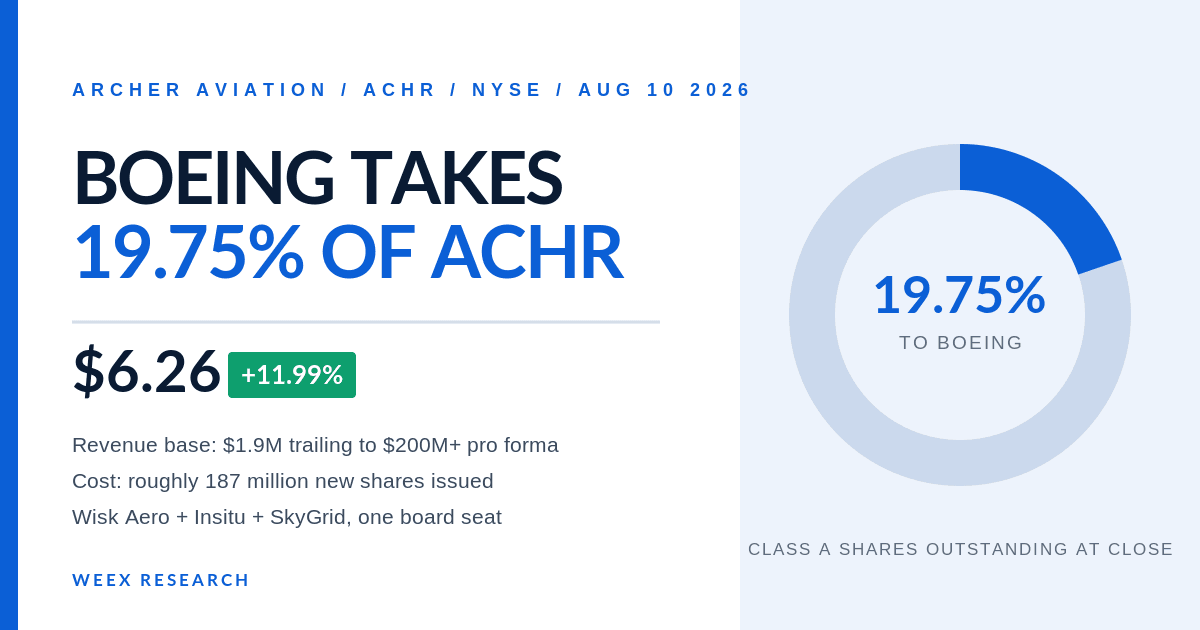
The market's reaction was about one number: Insitu is a profitable business generating more than $200 million in annual revenue across operations in 35 countries. Archer's trailing twelve-month revenue is $1.90 million.
ACHR stock key facts, as of the August 10, 2026 close
| Metric | Value |
|---|---|
| Price (NYSE close, Aug 10, 2026) | $6.26, +11.99% |
| Previous close / day's range | $5.59 / $5.94–$6.87 |
| Volume | 128.1 million shares |
| Market capitalization | $4.76 billion |
| Shares outstanding | 759.6 million |
| 52-week range | $4.30–$14.62 |
| Beta | 3.21 |
| Revenue (TTM) / net income | $1.90M / –$742.5M |
| Analyst consensus (9 analysts) | Buy, average target $10.50 |
Source: StockAnalysis / S&P Global Market Intelligence, data as of the August 10, 2026 close. After-hours the stock traded at $6.14.
Note the 52-week range. ACHR stock is still roughly 57% below its 12-month high of $14.62 even after a 12% day. A double-digit pop off a depressed base is not the same as a re-rating.
What the Boeing stake actually costs Archer shareholders
Nobody in the SERP has run this number, so here it is with the assumptions on the table.
Boeing receives shares representing 19.75% of outstanding Class A stock at close. If you solve for the new shares issued against the current 759.6 million share count, you get roughly 187 million new shares — existing holders end up owning about 80% of what they owned before. At the August 10 close of $6.26, that stock is worth around $1.17 billion, before the two warrants for up to $200 million more.
Estimated cost of the Boeing transaction to existing ACHR holders
| Item | Estimate | Basis |
|---|---|---|
| New shares issued to Boeing | ~187 million | 19.75% of post-close Class A, solved against 759.6M shares out |
| Implied value at $6.26 | ~$1.17 billion | New shares × Aug 10, 2026 close |
| Additional warrants | Up to $200 million | Two warrants, exercisable later |
| Existing holders' ownership after close | ~80% | 100% minus Boeing's 19.75% |
| Revenue acquired | >$200 million/year | Insitu alone, per the deal announcement |
| Implied price-to-sales on the acquired revenue | ~5.8× | $1.17B ÷ $200M |
These are estimates from the announced 19.75% figure and the pre-deal share count, not audited pro-forma figures. Archer's final S-4 and closing documents will govern.
The interesting part is the last row. Archer is paying roughly 5.8× sales for revenue that already exists and is profitable, using stock that the market values at roughly 2,500× its own trailing sales. Measured that way the transaction is dilutive on share count and accretive on valuation — which is exactly why the stock went up rather than down on a 20% issuance. Companies with expensive paper and no revenue are supposed to buy revenue with paper. This one did.
The counter-argument worth holding onto: none of that revenue lands on Archer's income statement until the deal closes, which is targeted for end-2026 and still needs US antitrust clearance.
Archer's Q2 2026 numbers: $5M of revenue against a $177M quarterly burn
The earnings release was overshadowed, but it matters more than the headline suggests.
| Q2 2026 (reported Aug 10, 2026) | Result |
|---|---|
| Revenue | $5.0 million, up 213% year over year, vs ~$1.96M consensus |
| GAAP loss per share | $(0.34), in line with consensus |
| Net loss | $263.2 million |
| Adjusted EBITDA | $(177.1) million, within guidance of $(170)M–$(200)M |
| Cash, equivalents and short-term investments | $1,560.6 million |
| Q3 2026 adjusted EBITDA guidance | $(170) million to $(200) million |
At the guided burn rate, that $1.56 billion balance buys roughly two years of runway before financing — which is unusually comfortable for a pre-certification eVTOL developer, and is the reason Archer could negotiate from a position of some strength rather than accept a rescue. Boeing's additional $55 million investment commitment reinforces that reading.
The revenue number deserves a caveat. $5.0 million against a $263 million quarterly net loss is not commercialization. It is early defense and program revenue. The 213% growth rate is arithmetically true and practically meaningless at this base.
Is ACHR stock a good buy at $6.26?
Nine analysts covering ACHR stock carry a consensus Buy rating with an average 12-month target of $10.50, about 68% above the August 10 close. That spread tells you the sell side thinks the stock is cheap relative to the milestone path — and that the market disagrees, since the shares are down roughly 52% over the past year.
The honest framing is that ACHR is not a valuation call, it is a binary-outcome call with a beta of 3.21. Three things resolve it, in rough order of importance:
- Does the Boeing deal close? It is subject to US competition review and targeted for end-2026. A blocked or delayed close removes the $200 million revenue base and leaves the dilution question hanging over a company that is back to $5 million of quarterly revenue.
- Does Midnight get FAA type certification? Archer closed Phase 3 of the FAA's four-phase process in April 2026 and is working through Phase 4, with TIA flight testing ahead. Certification has slipped across the entire eVTOL sector before.
- Does Insitu integrate cleanly? Insitu is a profitable defense contractor with a 35-country footprint being folded into a pre-revenue California startup. Defense integrations are where synergy assumptions usually die.
If you want a single sentence: the Boeing deal changed what ACHR stock is — from a pure certification bet to a defense-and-autonomy business with a certification option attached — but it did not change the fact that the outcome is still decided by regulators.
How to trade ACHR-style stock exposure with USDT
Here is the practical problem for a lot of readers. ACHR trades on the NYSE, in US market hours, through a brokerage account many people outside the US either cannot open or do not want to maintain. The Boeing news broke at the start of a US session and moved the stock 20% before most non-US retail traders could act on it.
WEEX TradFi exists for that gap. It is a USDT-margined perpetual futures product covering precious metals, commodities, indices and stocks, executed from an existing WEEX account with no separate brokerage setup, no fiat rails and no share custody. Per WEEX's help center, stock products support leverage up to 100×, precious metals up to 400×, and crude oil up to 50×, with fees as low as 0% during promotional periods.
Two constraints matter more than the leverage headline:
- Coverage is selective. WEEX TradFi's published stock lineup centres on large-cap US names. Availability changes, so check the live product list before assuming any specific ticker — including ACHR — is tradable.
- Trading hours follow the underlying market. These are equity-linked products, not crypto. Positions open and close during the reference market's hours, while funding fees can still accrue. A gap-and-run event like August 10 is exactly the scenario where you cannot exit at the price on your screen.
If you are newer to the mechanism behind equity exposure delivered through a crypto account, WEEX's explainer on tokenized US stocks covers the custody, rights and liquidity trade-offs, and the WEEX TradFi vs brokerage access breakdown compares the two account models directly.
What traders usually miss on a day like this
The trap on an event-driven 12% move is not direction, it is sizing. Beta 3.21 means ACHR routinely moves three times the market. Run that through 20× leverage and a normal-for-ACHR 8% adverse day is a liquidation. On the Aug 10 session the stock touched $6.87 and closed at $6.26 — a 9% round trip inside one day, on good news. Position for the round trip, not the headline.
The bottom line on ACHR stock
The Boeing transaction is the most consequential thing that has happened to ACHR stock since the SPAC. It buys real, profitable, $200 million-a-year defense revenue at a reasonable multiple using stock the market prices generously, and it costs existing shareholders roughly a fifth of the company. The $1.56 billion cash pile means Archer was not forced into it. The end-2026 close date and the FAA Phase 4 timeline mean nothing is settled yet.
For traders, that combination — high beta, binary catalysts, a stock still 57% off its 12-month high — is a trading setup, not a hold-and-forget position. If you want exposure to that setup without a US brokerage account, USDT-margined stock futures on WEEX are the route worth reviewing, starting with the live product list and fee schedule rather than the leverage number.
FAQ
1. Why did ACHR stock go up on August 10, 2026?
Archer announced definitive agreements to acquire Boeing's Wisk Aero, Insitu and SkyGrid in exchange for Boeing taking a 19.75% Class A stake, one board seat and warrants for up to $200 million more stock. Insitu alone brings more than $200 million in annual revenue. ACHR stock closed up 11.99% at $6.26.
2. How much does the Boeing deal dilute ACHR shareholders?
Boeing's 19.75% post-close stake implies roughly 187 million new shares against the current 759.6 million outstanding, leaving existing holders with about 80% of their prior ownership. Two warrants for up to $200 million of additional stock sit on top of that. Final terms are governed by Archer's closing documents.
3. What is the analyst price target for ACHR stock?
As of August 10, 2026, nine analysts carry a consensus Buy rating with an average 12-month target of $10.50, about 68% above the closing price of $6.26. Targets are estimates, not commitments, and the stock is still down roughly 52% over the past twelve months.
4. Is Archer Aviation profitable?
No. Archer reported a Q2 2026 net loss of $263.2 million on $5.0 million of revenue, with adjusted EBITDA of –$177.1 million. It ended the quarter with $1.56 billion in cash, equivalents and short-term investments.
5. Can I trade ACHR stock exposure on WEEX?
WEEX TradFi offers USDT-margined futures on selected US stocks, indices, commodities and precious metals from an existing WEEX account. The stock lineup is selective and changes over time, so check WEEX's live TradFi product list to confirm whether a specific ticker such as ACHR is available before planning a trade.
6. When does the Boeing acquisition close?
Archer and Boeing target completion by the end of 2026, subject to conditions including US competition-law clearance. Until close, none of the acquired revenue appears in Archer's reported results.
Risk Warning
ACHR is a pre-certification, loss-making company with a beta of 3.21 and a 52-week range of $4.30 to $14.62 — price swings of 10% or more in a single session are normal, and a total loss of capital is possible. Specific risks in this story include deal risk (the Boeing transaction requires US antitrust clearance and may be delayed, altered or blocked), dilution risk (roughly 187 million new shares plus warrants for up to $200 million more), certification risk (FAA type certification for Midnight is in Phase 4 and eVTOL timelines have slipped industry-wide), integration risk on Insitu, and continued financing risk against a guided quarterly adjusted EBITDA burn of $170–200 million.
If you take exposure through USDT-margined TradFi futures rather than shares, you add leverage and liquidation risk, funding-fee costs on held positions, trading-hours risk (equity-linked products follow the underlying market's session, so you may be unable to exit during a gap), and thinner liquidity outside core hours. You do not own shares, receive dividends or hold voting rights. Trade only with capital you can afford to lose, size positions for volatility rather than conviction, and confirm current product availability, leverage caps and fees on WEEX before opening a position. This article is information, not investment advice.
This content is provided for general informational purposes only and doesn't constitute financial, investment, legal, or tax advice. Any events, rewards, online promotions, or related information mentioned herein should not be considered a recommendation, solicitation, or invitation to purchase, sell, trade, or otherwise deal in any crypto assets. Crypto assets are highly volatile and may result in loss. The availability of WEEX services, products, and related events may vary by region. You are responsible for ensuring that your participation is in accordance with applicable local laws and regulations.
You may also like

Is Cronos (CRO) Still Worth Buying in 2026? Ecosystem Growth, Staking Yields and Risk Factors

Google Stock and the $200 Billion Anthropic Financing Program: What the Largest AI Deal in History Means for GOOG
Why Is Cronos (CRO) Gaining Trader Attention? Key Drivers Behind the Recent Volume Surge

Is Bitcoin Preparing for a Bullish Breakout? Key Technical Indicators and On-Chain Data
How to Avoid Liquidation During Market Crashes? Futures Risk Management Strategies

Which AI Crypto Tokens Are Surging Today? Top Decentralized AI Projects to Watch
Is Cronos (CRO) Preparing for a Major Rally? Catalysts, Risks and the 2026 Outlook
Which Major Tokens Face Massive Unlocks Tomorrow? Market Impact and Price Predictions
HIMS Stock Falls After Raising Guidance: What the GLP-1 Regulatory Uncertainty Actually Changes
What Are the New Crypto Regulation Laws? Essential Compliance Guide for Traders
ASTS Stock Price Prediction 2026-2027: Can AST SpaceMobile Recover After the Launch Bottleneck
Is ASTS Stock a Buy After Falling 48% From Its All-Time High? What the $1.3 Billion Backlog Actually Implies
PLTR Stock Is Up 37% From Its Low: What Michael Burry's "Price Does Not Matter" Warning Actually Means
Goldman Sachs Says Buy SpaceX or Palantir But Not Both: What the Forced Choice Actually Reveals
Nvda Stock Price and the $3 Billion Lancium Investment: What Betting on AI Data Center Energy Actually Means
SPY ETF vs QQQ: Which Is the Better Way to Invest in the AI Stock Recovery
What Is SPY ETF? How the World's Largest S&P 500 Fund Works and Why It Matters
RKLB Stock Price Prediction 2026-2027: Can RKLB Reach $107 After the Space Force Deals
Is RKLB Stock a Buy After the Space Force Contracts and Q2 Earnings?
MSFT Stock and the 30 Million Copilot Seats Milestone: What Growing From 20 Million Actually Changes
Cathie Wood Just Bought $36.9 Million of SPCX Stock: What ARK's SpaceX Bet Actually Signals
SPCX Stock and the $60 Billion Cursor Acquisition: What Buying an AI Coding Startup Actually Means for SPCX
RKLB Stock vs SpaceX Stock: Who Is Winning the Commercial Space Race After SPCX's IPO
Intel Stock Is Raising $15 Billion in New Shares: What the Largest Dilution in Years Actually Means
RKLB Stock Q2 2026: What Record Revenue and the $397 Million Space Force Contract Actually Mean
MU Stock and the Apple CXMT Test: What Replacing Micron With Chinese Memory Actually Means
Strategic Petroleum Reserve 2026: What's Left and What It Can Do
Tiffany Milanovich and the $5M Fake-Support Call Playbook
Microsoft Stock Is Charging Back: What the Case for Another 30% Rally Actually Requires
SPCX Stock Price Rebounds 16% From Its All Time Low: Is the Worst Finally Over for SpaceX
Is Cronos (CRO) Still Worth Buying in 2026? Ecosystem Growth, Staking Yields and Risk Factors
Google Stock and the $200 Billion Anthropic Financing Program: What the Largest AI Deal in History Means for GOOG
Why Is Cronos (CRO) Gaining Trader Attention? Key Drivers Behind the Recent Volume Surge
Is Bitcoin Preparing for a Bullish Breakout? Key Technical Indicators and On-Chain Data
How to Avoid Liquidation During Market Crashes? Futures Risk Management Strategies
Which AI Crypto Tokens Are Surging Today? Top Decentralized AI Projects to Watch
Contents
Popular coins
Latest articles


