
Tiffany Milanovich and the $5M Fake-Support Call Playbook

 Prefer us on Google


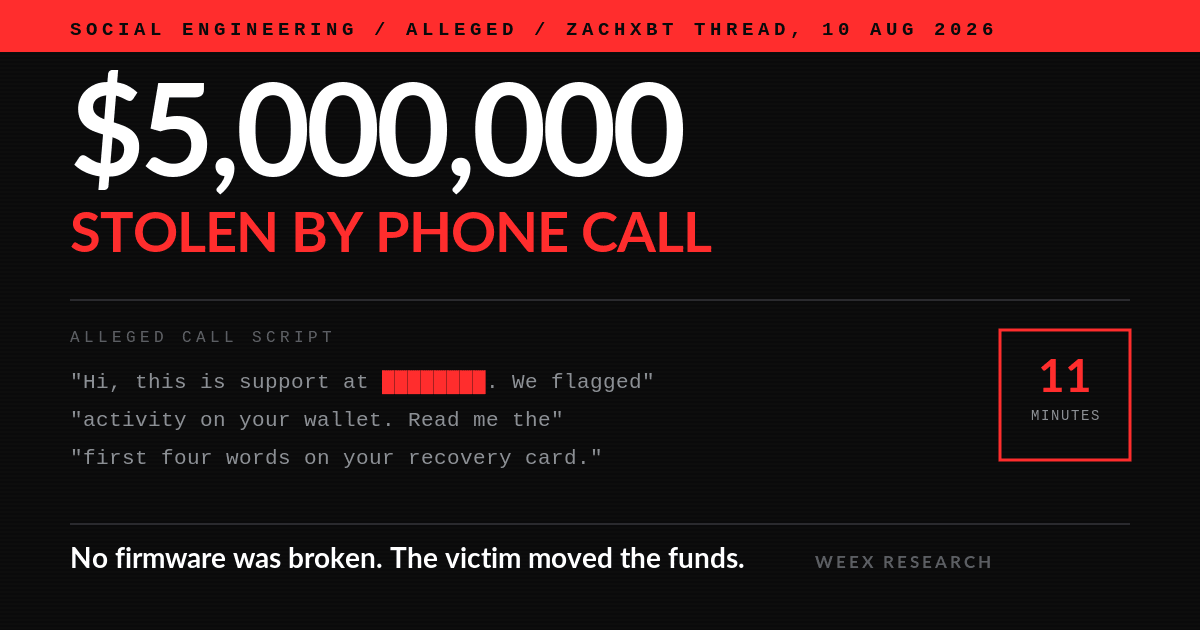
On August 10, 2026, on-chain investigator ZachXBT published a thread naming Tiffany Milanovich, a US-based individual he alleges worked as the "caller" in a series of support-impersonation thefts totalling at least $5 million. The allegations are his — as of August 11, 2026, no law enforcement agency has publicly confirmed her identity, and no charges have been announced.
The name is trending. The more useful question is the one the coverage keeps skipping: this was not a hack. Nobody broke Trezor's firmware or cracked Coinbase's servers. A person picked up a phone, sounded credible for eleven minutes, and the victim moved the funds themselves. That is a defence problem, not a cryptography problem, and it is the part worth reading.
What ZachXBT actually alleges about Tiffany Milanovich
According to the thread posted at roughly 12:03 UTC on August 10, 2026, Milanovich's role in the crew was the voice. She allegedly phoned targets while posing as support staff from a hardware wallet vendor or a centralized exchange, walked them through a "security" procedure, and induced them to hand over access to their own funds.
ZachXBT lists two anchor incidents. In June 2026, a victim allegedly lost $1.2 million in BTC and ETH from a Trezor wallet after a spoofed BitcoinIRA email sent under the alias "Patricia Massie." In October 2025, roughly $500,000 in BTC was taken from a Coinbase account. He states that a separate actor operating as "bled" and "harm" supplied the phishing-panel infrastructure behind the campaigns, and that proceeds were discussed afterwards in Telegram groups.
Two details in the thread do more work than the dollar figures. First, he says she recorded herself taunting victims on those calls — meaning the crew kept audio of its own crimes. Second, he notes that some of the "flex" videos appear to have been edited to inflate the apparent size of the hauls, which is a caution against treating scammer self-reporting as data.
Timeline of the alleged incidents
| Date | Target | Entry point | Reported loss | On-chain reference cited |
|---|---|---|---|---|
| Oct 2025 | Coinbase account | Support impersonation call | ~$500,000 in BTC | bc1qw3mej5hx7jhtdagqwt7ljls7wzkda2tym3w0d2; bc1q2r2tjdlcp3s4399g6v0xfamcw40xs5553qx7dx |
| Feb 2026 | — | Discord call comparing balances | Balance display, not a theft | 0x0b8cf7c3c66aa9478b101e203dc31b4e7200dfbc (~631,000 DAI) |
| Jun 2026 | Trezor hardware wallet | Spoofed BitcoinIRA email, alias "Patricia Massie" | ~$1.2M in BTC and ETH | bc1ql2t0mwtf6unkr8vnlg9hy7njuv7vcvn9nxvlzy; 0x491333e8ea6f4fc2a2475db01b649e1e4602ec3c |
All figures and addresses as reported by ZachXBT on August 10, 2026. The bulk of the June proceeds were still dormant at the time of his post — a detail that matters, because dormant funds are recoverable funds if a seizure ever lands.
The DAI address is the most instructive line in the table. ZachXBT reports it was funded through multiple instant-exchange transactions originating from Monero. That is the modern laundering shape: take the traceable coin, push it through a privacy chain, come back out into a stablecoin on Ethereum where it sits liquid and spendable. The Monero leg is where conventional chain analysis loses the thread, which is precisely why the case was built on chat logs and call recordings rather than on transaction graphs alone.
Why the caller is the hardest role to replace
Phishing panels are commodity infrastructure. Anyone with a few hundred dollars can rent one. Spoofed sender domains are trivial. The scarce input in this business is a person who can hold a stressed, suspicious victim on the line for ten minutes and sound like an employee.
That is the uncomfortable operational reality behind this case. FatMan, commenting on the thread, made the point bluntly: a caller who reads as a woman from a support desk clears the victim's threat model in a way a generic male voice often does not. Victims are trained by years of security advice to expect a scam to feel like a scam. A calm, apologetic, procedurally competent caller feels like the opposite.
The practical implication for anyone holding meaningful crypto: your instinct about whether a caller "sounds legitimate" carries no information. It is the single input the attacker optimizes hardest.
How the attack chain runs, step by step
Reconstructed from the incidents ZachXBT describes, the sequence is consistent:
- Data sourcing. Victims are pulled from leaked customer lists — the BitcoinIRA angle in the June case points at a targeted list, not cold calling.
- Priming email. A spoofed message from a plausible sender, under a fabricated staff name, plants the idea that something is wrong with the account.
- The call. The caller phones shortly after, referencing the email. Referencing a message the victim genuinely received is the entire trick — it converts a cold call into a warm one.
- The manufactured emergency. The account is compromised; funds must be "migrated to a secure address" or a recovery phrase must be "verified."
- The victim moves the money. No exploit. The withdrawal is signed by the rightful owner.
- Immediate dispersal. Funds hop to instant exchangers, through Monero, and back into stablecoins.
Step 5 is why hardware wallets did not help here. A Trezor faithfully signs whatever its owner approves. It has no opinion about why.
What real support never does
| Behaviour | Legitimate support | The impersonation call |
|---|---|---|
| Initiates contact | Rarely; usually responds to your ticket | Always calls you first |
| Asks for your recovery phrase | Never, under any circumstance | Frames it as "verification" |
| Asks you to move funds | Never | The core ask, dressed as a rescue |
| Creates time pressure | No | "Your funds will be drained in minutes" |
| Objects to a callback | No — encourages it | Discourages hanging up, stays on the line |
The single rule that defeats this entire class of attack: hang up and call back through a number or channel you found yourself. Every one of these operations dies at that step, which is why the caller works so hard to keep you from taking it.
The defences that would have stopped this
None of these are exotic. All of them are boring, and boring is the point.
| Layer | Control | What it stops |
|---|---|---|
| Account | Withdrawal address whitelist with a cooling-off period | The panicked transfer to an attacker address |
| Account | 2FA via authenticator app, not SMS | Credential reuse and SIM-swap follow-ons |
| Wallet | Recovery phrase never typed into anything, ever | Seed extraction over a call |
| Process | Callback rule on every inbound "support" contact | The entire pretext |
| Process | A second signer or a 24-hour delay on large moves | Sole-decision-maker failure |
Withdrawal whitelisting is the one most people skip and the one that matters most in this scenario, because it converts an instant loss into a delay the victim can wake up from. WEEX's own account security guide walks through enabling it alongside 2FA and session monitoring, and the broader account security and risk management guide covers the settings side. Exchange support desks, including WEEX's, will never ask for your password or seed phrase by phone, email, or social media.
What traders usually miss
The frequent takeaway from cases like this is "use a hardware wallet." That advice is now partly contested. On July 16, 2026, ZachXBT argued that hardware wallets are not the answer he once considered them and said he does not recommend them for storing significant funds, suggesting technically capable users consider a dedicated iPhone instead, citing the Secure Enclave and app sandboxing.
Reasonable people disagree with that, and it is a strong claim about a broad product category. But the underlying observation holds: in the June 2026 case the hardware wallet worked exactly as designed and the money left anyway. Device security and human security are different problems, and only one of them was under attack.
The second thing traders miss is the recovery window. Dormant stolen funds — like the June proceeds ZachXBT describes — are the cases where reporting fast actually changes the outcome. Exchanges can freeze; casinos can lock accounts, as Shuffle reportedly agreed to do after ZachXBT submitted evidence. The first hour after realising you have been drained is worth more than the next six months of forensics.
Has anyone been charged?
Not publicly, as of August 11, 2026. ZachXBT's thread includes a screenshot of a Connecticut search-and-seizure warrant he says predates several of the listed incidents, and he notes a connection to John Daghita, known online as "Lick," whom he previously linked to the theft of roughly $46 million in crypto that had been seized by the US government and who was arrested in March 2026. Milanovich is described as close to Daghita.
That is context, not a charging document. Everything in this article about Milanovich is an allegation by a private investigator, and the appropriate posture until a prosecutor files something is exactly that. WEEX's news desk covered the initial report on August 10, 2026.
FAQ
1. Who is Tiffany Milanovich?
A US-based individual named by on-chain investigator ZachXBT on August 10, 2026 as an alleged participant in crypto support-impersonation thefts totalling at least $5 million. She has not been charged publicly, and the allegations have not been confirmed by law enforcement.
2. How much crypto is she alleged to have helped steal?
At least $5 million across multiple incidents, per ZachXBT. The two largest cited are roughly $1.2 million in BTC and ETH from a Trezor wallet in June 2026 and about $500,000 in BTC from a Coinbase account in October 2025.
3. Was Trezor or Coinbase hacked?
No. Both incidents as described are social engineering. The victims were persuaded to authorize transfers or surrender access themselves. No vendor exploit is alleged.
4. How do I tell a fake support call from a real one?
You cannot, reliably, from the call itself. Hang up and re-initiate contact through a number or in-app channel you look up yourself. Real support has no problem with that; an impersonator will try to keep you on the line.
5. What should I do in the first hour after being drained?
Contact the exchange or custodian immediately with the transaction hashes, file with your local law enforcement, and report the addresses publicly or to a chain-analytics contact. Stolen funds that sit dormant are the ones that occasionally get frozen or recovered.
6. Can stolen crypto that went through Monero be traced?
Generally not through the privacy leg itself. Investigators typically rebuild those cases from the edges — exchange deposits, instant-swap records, chat logs, and operational mistakes — rather than from the chain alone, which is what ZachXBT appears to have done here.
Risk Warning
Crypto assets are volatile and self-custody is unforgiving; a transfer you authorize cannot be reversed, and partial or total loss of funds is possible. Social-engineering losses of the kind described here are almost never covered by any insurance or platform guarantee, because the transaction is technically legitimate — you signed it. Treat every unsolicited call, email, or message claiming to be exchange or wallet support as hostile until you have verified it through a channel you initiated. Never share a recovery phrase, private key, password, or 2FA code with anyone, including anyone identifying themselves as support staff. Details in this article reflect allegations published by ZachXBT on August 10, 2026 and reporting current as of August 11, 2026; no charges have been publicly confirmed, and the situation may change.
This content is provided for general informational purposes only and doesn't constitute financial, investment, legal, or tax advice. Any events, rewards, online promotions, or related information mentioned herein should not be considered a recommendation, solicitation, or invitation to purchase, sell, trade, or otherwise deal in any crypto assets. Crypto assets are highly volatile and may result in loss. The availability of WEEX services, products, and related events may vary by region. You are responsible for ensuring that your participation is in accordance with applicable local laws and regulations.
You may also like

Is Cronos (CRO) Still Worth Buying in 2026? Ecosystem Growth, Staking Yields and Risk Factors

Google Stock and the $200 Billion Anthropic Financing Program: What the Largest AI Deal in History Means for GOOG
Why Is Cronos (CRO) Gaining Trader Attention? Key Drivers Behind the Recent Volume Surge
Is Bitcoin Preparing for a Bullish Breakout? Key Technical Indicators and On-Chain Data

How to Avoid Liquidation During Market Crashes? Futures Risk Management Strategies

Which AI Crypto Tokens Are Surging Today? Top Decentralized AI Projects to Watch
Is Cronos (CRO) Preparing for a Major Rally? Catalysts, Risks and the 2026 Outlook
Which Major Tokens Face Massive Unlocks Tomorrow? Market Impact and Price Predictions
HIMS Stock Falls After Raising Guidance: What the GLP-1 Regulatory Uncertainty Actually Changes
What Are the New Crypto Regulation Laws? Essential Compliance Guide for Traders
ASTS Stock Price Prediction 2026-2027: Can AST SpaceMobile Recover After the Launch Bottleneck
Is ASTS Stock a Buy After Falling 48% From Its All-Time High? What the $1.3 Billion Backlog Actually Implies
PLTR Stock Is Up 37% From Its Low: What Michael Burry's "Price Does Not Matter" Warning Actually Means
Goldman Sachs Says Buy SpaceX or Palantir But Not Both: What the Forced Choice Actually Reveals
Nvda Stock Price and the $3 Billion Lancium Investment: What Betting on AI Data Center Energy Actually Means
SPY ETF vs QQQ: Which Is the Better Way to Invest in the AI Stock Recovery
What Is SPY ETF? How the World's Largest S&P 500 Fund Works and Why It Matters

RKLB Stock Price Prediction 2026-2027: Can RKLB Reach $107 After the Space Force Deals
Is RKLB Stock a Buy After the Space Force Contracts and Q2 Earnings?
MSFT Stock and the 30 Million Copilot Seats Milestone: What Growing From 20 Million Actually Changes
Cathie Wood Just Bought $36.9 Million of SPCX Stock: What ARK's SpaceX Bet Actually Signals
SPCX Stock and the $60 Billion Cursor Acquisition: What Buying an AI Coding Startup Actually Means for SPCX
RKLB Stock vs SpaceX Stock: Who Is Winning the Commercial Space Race After SPCX's IPO
Intel Stock Is Raising $15 Billion in New Shares: What the Largest Dilution in Years Actually Means
RKLB Stock Q2 2026: What Record Revenue and the $397 Million Space Force Contract Actually Mean
MU Stock and the Apple CXMT Test: What Replacing Micron With Chinese Memory Actually Means
ACHR Stock After the Boeing Deal: What the 20% Stake Costs
Strategic Petroleum Reserve 2026: What's Left and What It Can Do
Microsoft Stock Is Charging Back: What the Case for Another 30% Rally Actually Requires
SPCX Stock Price Rebounds 16% From Its All Time Low: Is the Worst Finally Over for SpaceX
Is Cronos (CRO) Still Worth Buying in 2026? Ecosystem Growth, Staking Yields and Risk Factors
Google Stock and the $200 Billion Anthropic Financing Program: What the Largest AI Deal in History Means for GOOG
Why Is Cronos (CRO) Gaining Trader Attention? Key Drivers Behind the Recent Volume Surge
Is Bitcoin Preparing for a Bullish Breakout? Key Technical Indicators and On-Chain Data
How to Avoid Liquidation During Market Crashes? Futures Risk Management Strategies
Which AI Crypto Tokens Are Surging Today? Top Decentralized AI Projects to Watch




